

Tech Mahindra and Microsoft announced on June 30, 2026, that they are collaborating on an AI-driven 5G network digital twin for medium and large telecom operators, combining Microsoft Azure, Microsoft Fabric, Azure Digital Twins, Microsoft Foundry, and Tech Mahindra’s telecom operations expertise. The pitch is not merely better simulation; it is a bid to turn the telecom network into a live, queryable, partially self-operating system. For WindowsForum readers, the story matters because the same cloud, AI, identity, data, and governance stack now being pushed into carrier networks is also becoming the substrate beneath enterprise connectivity, edge computing, private 5G, and managed Windows fleets. The telecom back end is starting to look a lot like the modern enterprise IT stack, only with higher stakes and less margin for improvisation.
For decades, telecom networks were treated as infrastructure in the old sense of the word: expensive, specialized, slow-moving, and administered by engineering cultures that prized predictability over agility. The 5G era has weakened that separation. A mobile network is now a distributed software platform, and the operators who own it are under pressure to make it behave less like a utility grid and more like a programmable cloud.
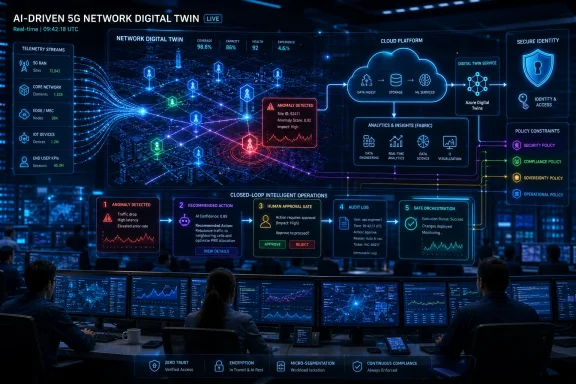
That is the space Tech Mahindra and Microsoft are trying to occupy with this new 5G network digital twin. The companies describe a virtual replica of a live network that can ingest telemetry, model behavior, simulate changes, and help operators predict outcomes before pushing decisions into production. The marketing language is dense, but the strategic point is simple: Microsoft wants Azure to be part of the control room for telecom operations.
This is not Microsoft’s first pass at telecom, nor Tech Mahindra’s first attempt to productize network modernization. Microsoft has spent years positioning Azure as a carrier-grade platform, first through edge and private 5G services, then through partnerships around network functions, operations, analytics, and AI. Tech Mahindra, meanwhile, has long sold itself as a systems integrator with enough domain knowledge to translate carrier complexity into deployable enterprise software.
The result is a familiar 2026 pattern. A specialist services firm brings domain credibility, Microsoft supplies the cloud data plane and AI platform, and the customer is promised a path from bespoke operations to repeatable automation. Whether that promise survives contact with live carrier environments is the interesting part.
That distinction matters. A static model can help planners understand where equipment sits and how assets relate to one another. A live network twin, if it works as advertised, can reason over radio conditions, transport dependencies, core behavior, customer service levels, energy consumption, capacity plans, and failure scenarios. It becomes less a map and more a laboratory.
The Tech Mahindra-Microsoft proposal is explicitly aimed at moving operators away from traditional simulation methods toward cloud-scale digital twins tied to real-time telemetry. In plain English, that means using Azure services to consolidate large volumes of network data, model relationships between network elements, and run predictive or prescriptive analysis over that state. The advertised ingredients include Azure, Microsoft Fabric, Azure Digital Twins, Microsoft Foundry, Fabric IQ, and agentic AI frameworks.
The real shift is from passive visibility to operational inference. Network operations centers already have dashboards, alarms, counters, logs, probes, and ticketing systems. They do not lack data. They lack a common layer where data can be interpreted in context quickly enough to change the outcome of an incident, a capacity crunch, or a service-level violation.
That is the problem digital twins are now being asked to solve. Not just “show me the network,” but “tell me what happens if I change this route, slice this capacity, move this workload, alter this policy, or accept this enterprise customer’s performance guarantee.”
Carrier networks are full of specialized languages. Radio engineers talk in one set of abstractions, core network teams in another, transport teams in another, and enterprise service teams in still another. Even when those teams use excellent tools, the operational picture often fragments across vendors, domains, and historical layers of deployment. A large operator is not one network; it is a sedimentary record of many networks.
That is why Microsoft Fabric is important to the announcement. Fabric is Microsoft’s attempt to consolidate analytics, data engineering, real-time intelligence, warehousing, governance, and AI-facing data workflows into a single platform family. For a network digital twin, the appeal is obvious: if the data is inconsistent, late, poorly governed, or trapped in vendor silos, the AI layer becomes theater.
Microsoft Foundry then enters the story as the place where AI applications and agents can be built, evaluated, governed, and connected to enterprise data. The term agentic AI is currently being used with the same promiscuity that once attached to “cloud-native,” but in this context it implies systems that do more than answer questions. The aspiration is software that can reason over network state, recommend actions, simulate effects, and potentially trigger orchestrated responses under guardrails.
That final phrase is doing a great deal of work. Telecom operators will not hand their production networks to freewheeling AI agents because a vendor slide says “autonomous.” The more credible near-term use case is supervised automation: detect an anomaly, correlate it with topology and service impact, propose a remediation, estimate risk, and either route the action to a human or execute within tightly bounded policies.
In other words, the first job of AI in telecom may not be replacing engineers. It may be making the network legible enough that engineers can act faster without depending on tribal knowledge and swivel-chair operations.
The industry’s fallback is the enterprise market: private 5G, edge computing, network slicing, low-latency services, industrial IoT, smart logistics, connected healthcare, and managed campus networks. The Tech Mahindra-Microsoft solution is framed squarely in that direction. It promises support for SLA-driven offerings such as network slicing and edge orchestration, with stronger service assurance and risk prediction.
That is the monetization hook. If an operator can offer a manufacturer, hospital, port, mine, stadium, or government agency a guaranteed slice of network performance, it needs more than billing language. It needs confidence that the service can be provisioned, monitored, protected, and repaired against the promised SLA. A digital twin becomes the pre-sales simulator, the assurance layer, and the operational safety net.
This is where the Microsoft angle becomes particularly relevant to Windows and enterprise IT shops. Many organizations already manage identity, devices, endpoint security, data governance, and cloud workloads through Microsoft’s ecosystem. If the private wireless or edge network starts plugging into Azure-based observability, policy, and AI workflows, the boundary between “network provider” and “enterprise platform provider” gets blurrier.
For CIOs, that could be useful. A 5G slice that integrates cleanly with cloud applications, security policies, and edge workloads is easier to justify than an isolated telecom product. For network architects, it could also be troubling. The more carrier operations depend on hyperscale platforms, the more outages, licensing models, data residency rules, and vendor roadmaps become part of the telecom risk equation.
The enterprise 5G opportunity is real, but it has been slower and messier than the industry hoped. A network digital twin does not automatically create demand. It gives operators a better chance of proving that their new services can be delivered repeatedly, profitably, and with enough transparency that enterprise buyers will trust the contract.
That reality explains why systems integrators still matter. Tech Mahindra is not selling only a software component; it is selling the labor and domain knowledge required to connect messy real-world environments to a Microsoft-backed architecture. In telecom, “integration” is not a footnote. It is often the product.
Azure is positioned here as neutral ground, at least in commercial terms. Operators can bring telemetry into a cloud-scale data platform, model entities and relationships through digital twin services, and expose that state to analytics and AI tools. The promise is that Microsoft’s cloud can become the connective tissue between network domains that were never designed to share a common brain.
That promise will be tested by data gravity and operational sovereignty. Telecom telemetry is enormous, time-sensitive, and often regulated. Operators will have to decide what data moves to public cloud, what remains at the edge, what is aggregated, what is anonymized, and what can be used to train or ground AI models. “AI-ready data platform” sounds elegant in a press release; in production, it becomes a governance and architecture problem.
The most plausible deployments will therefore be hybrid. Some modeling and analytics may happen in Azure regions. Some inference and response loops may need to sit close to the network edge. Some control actions may remain inside operator-controlled environments for latency, sovereignty, or resilience reasons. The winning architecture is unlikely to be a single monolithic digital twin in the cloud. It will be a federation of data, models, policies, and operational boundaries.
Microsoft can live with that. Azure’s enterprise strategy has never depended on every workload moving to one place. It depends on Azure becoming the management, data, identity, security, and AI layer that binds the places together.
Closed-loop automation has been a telecom goal for years. In its simplest form, a system detects a condition, decides on a response, executes the response, and measures the result. The AI-era version adds natural-language interfaces, probabilistic reasoning, model-generated recommendations, and agents that may chain tasks across multiple systems. That makes the loop more powerful and more dangerous.
A carrier network is not a document repository where a hallucinated summary causes embarrassment. It is critical infrastructure. A bad recommendation can degrade service across a region, break emergency communications assumptions, misallocate capacity, violate enterprise SLAs, or trigger cascading failures. The tolerance for “move fast and iterate” is low when the thing being iterated is connectivity.
That is why the governance layer matters as much as the model layer. Operators will need role-based controls, audit trails, change-management integration, simulation gates, human approval thresholds, rollback procedures, policy constraints, and evidence that recommendations are explainable enough for engineers to trust. The system must know not only what action is optimal, but whether it is authorized.
This is one of Microsoft’s stronger cards. The company has spent years selling regulated enterprises on identity, compliance, security, logging, and administrative control. If AI-driven telecom operations are going to be accepted by large carriers, they will need to look less like a chatbot bolted onto a NOC dashboard and more like an auditable enterprise control system.
Still, the branding can get ahead of reality. “Agentic AI” sounds like a self-driving network. The near-term value is more likely to be a co-pilot for network operations, not an autopilot. That may be less glamorous, but it is also more deployable.
Microsoft’s enterprise footprint gives it a unique route into this convergence. An organization may use Windows endpoints, Entra identity, Intune device management, Defender security tools, Azure infrastructure, Fabric analytics, Power Platform workflows, and Copilot-style assistants. If that same organization buys private 5G or edge networking services that are also managed through Azure-adjacent tooling, the stack begins to consolidate around Microsoft’s control planes.
That consolidation can reduce friction. A factory running Windows-based engineering workstations, Azure-connected edge servers, IoT sensors, and private wireless networks may benefit from shared identity, policy, monitoring, and incident workflows. A field-service organization with 5G-connected Windows devices could see better service assurance if carrier network intelligence is tied to enterprise application requirements.
It can also increase dependency. When one vendor’s ecosystem becomes the common denominator across endpoint, cloud, data, AI, security, and network operations, outages and licensing changes ripple farther. Administrators who once treated carrier connectivity as an external service may find themselves troubleshooting issues that cross device policy, cloud routing, edge compute, and telecom service assurance.
The lesson for WindowsForum’s audience is not to fear the telecom cloud. It is to recognize that network modernization is becoming part of the same management universe as endpoint and application modernization. The people who understand identity, observability, automation, and governance across Microsoft platforms will increasingly be pulled into conversations that used to belong only to carrier engineers.
That does not make the announcement empty. In enterprise technology, product direction often matters before adoption numbers appear, especially when Microsoft is aligning a partner ecosystem around a specific architecture. The presence of Azure, Fabric, Digital Twins, and Foundry in one telecom package shows where Microsoft wants carrier modernization to land: on its data and AI platforms.
But it does mean the claims should be read as a roadmap and sales thesis rather than as a proven industry turn. The hardest parts of telecom modernization are rarely the demo. They are the brownfield integrations, data quality issues, operational politics, procurement cycles, security reviews, regional constraints, and the gap between a controlled environment and a live network at national scale.
Operators will also have to decide how much intelligence they want from a services-led partner versus a network equipment vendor, an OSS/BSS vendor, an in-house platform team, or a hyperscaler directly. Tech Mahindra’s advantage is integration breadth. Microsoft’s advantage is platform reach. Neither eliminates the operator’s need to own the operational model.
That ownership question will define whether AI-driven network twins become transformative or merely another dashboard. A digital twin that produces recommendations nobody trusts will become shelfware. A twin embedded into planning, assurance, incident response, and enterprise service design could become a new operating layer.
That confidence has financial consequences. Better asset utilization can delay unnecessary infrastructure spending. Better prediction can reduce outages or limit blast radius. Better service assurance can support premium enterprise contracts. Better governance can make AI automation acceptable to risk committees that would otherwise reject it.
The question is how much confidence a digital twin can actually provide when the underlying system is constantly changing. 5G networks are not static plants. They are shaped by user movement, weather, interference, device diversity, software upgrades, application behavior, energy policies, roaming relationships, and unpredictable demand spikes. A twin that is not continuously fed, validated, and corrected will drift away from reality.
That makes the telemetry pipeline as important as the AI model. If real-time data is delayed, incomplete, or semantically inconsistent, the twin becomes an expensive approximation. If the ontology that describes the network is too generic, the reasoning layer will miss domain nuance. If the automation loop cannot act safely, the value stops at recommendation.
Tech Mahindra’s role is to persuade operators that these practical problems can be solved with domain-specific integration. Microsoft’s role is to persuade them that Azure and Fabric can handle the scale and governance. The market’s role is to test both claims under pressure.
 Microsoft Wants the Network to Become a Cloud Workload
For decades, telecom networks were treated as infrastructure in the old sense of the word: expensive, specialized, slow-moving, and administered by engineering cultures that prized predictability over agility. The 5G era has weakened that separation. A mobile network is now a distributed software platform, and the operators who own it are under pressure to make it behave less like a utility grid and more like a programmable cloud.That is the space Tech Mahindra and Microsoft are trying to occupy with this new 5G network digital twin. The companies describe a virtual replica of a live network that can ingest telemetry, model behavior, simulate changes, and help operators predict outcomes before pushing decisions into production. The marketing language is dense, but the strategic point is simple: Microsoft wants Azure to be part of the control room for telecom operations.
This is not Microsoft’s first pass at telecom, nor Tech Mahindra’s first attempt to productize network modernization. Microsoft has spent years positioning Azure as a carrier-grade platform, first through edge and private 5G services, then through partnerships around network functions, operations, analytics, and AI. Tech Mahindra, meanwhile, has long sold itself as a systems integrator with enough domain knowledge to translate carrier complexity into deployable enterprise software.
The result is a familiar 2026 pattern. A specialist services firm brings domain credibility, Microsoft supplies the cloud data plane and AI platform, and the customer is promised a path from bespoke operations to repeatable automation. Whether that promise survives contact with live carrier environments is the interesting part.
The Digital Twin Is No Longer Just a Pretty Model
The phrase digital twin has been stretched almost beyond usefulness. In manufacturing, it may mean a detailed model of a factory line. In smart buildings, it can mean a graph of rooms, sensors, assets, and occupancy. In telecom, it increasingly means something more ambitious: a software representation of a network that is dynamic enough to test decisions before the network is asked to absorb them.That distinction matters. A static model can help planners understand where equipment sits and how assets relate to one another. A live network twin, if it works as advertised, can reason over radio conditions, transport dependencies, core behavior, customer service levels, energy consumption, capacity plans, and failure scenarios. It becomes less a map and more a laboratory.
The Tech Mahindra-Microsoft proposal is explicitly aimed at moving operators away from traditional simulation methods toward cloud-scale digital twins tied to real-time telemetry. In plain English, that means using Azure services to consolidate large volumes of network data, model relationships between network elements, and run predictive or prescriptive analysis over that state. The advertised ingredients include Azure, Microsoft Fabric, Azure Digital Twins, Microsoft Foundry, Fabric IQ, and agentic AI frameworks.
The real shift is from passive visibility to operational inference. Network operations centers already have dashboards, alarms, counters, logs, probes, and ticketing systems. They do not lack data. They lack a common layer where data can be interpreted in context quickly enough to change the outcome of an incident, a capacity crunch, or a service-level violation.
That is the problem digital twins are now being asked to solve. Not just “show me the network,” but “tell me what happens if I change this route, slice this capacity, move this workload, alter this policy, or accept this enterprise customer’s performance guarantee.”
Telecom AI Is Being Sold as Automation, but It Starts as Translation
The most useful way to read this announcement is not as a sudden leap to autonomous networks. It is better understood as an attempt to translate telecom sprawl into a form modern AI systems can reason about.Carrier networks are full of specialized languages. Radio engineers talk in one set of abstractions, core network teams in another, transport teams in another, and enterprise service teams in still another. Even when those teams use excellent tools, the operational picture often fragments across vendors, domains, and historical layers of deployment. A large operator is not one network; it is a sedimentary record of many networks.
That is why Microsoft Fabric is important to the announcement. Fabric is Microsoft’s attempt to consolidate analytics, data engineering, real-time intelligence, warehousing, governance, and AI-facing data workflows into a single platform family. For a network digital twin, the appeal is obvious: if the data is inconsistent, late, poorly governed, or trapped in vendor silos, the AI layer becomes theater.
Microsoft Foundry then enters the story as the place where AI applications and agents can be built, evaluated, governed, and connected to enterprise data. The term agentic AI is currently being used with the same promiscuity that once attached to “cloud-native,” but in this context it implies systems that do more than answer questions. The aspiration is software that can reason over network state, recommend actions, simulate effects, and potentially trigger orchestrated responses under guardrails.
That final phrase is doing a great deal of work. Telecom operators will not hand their production networks to freewheeling AI agents because a vendor slide says “autonomous.” The more credible near-term use case is supervised automation: detect an anomaly, correlate it with topology and service impact, propose a remediation, estimate risk, and either route the action to a human or execute within tightly bounded policies.
In other words, the first job of AI in telecom may not be replacing engineers. It may be making the network legible enough that engineers can act faster without depending on tribal knowledge and swivel-chair operations.
The Enterprise 5G Dream Still Needs a Business Case
Every major 5G pitch eventually arrives at enterprise monetization. Operators spent heavily on spectrum, radio upgrades, core modernization, and cloud-native network functions, but consumer 5G has not produced the kind of pricing revolution vendors once implied. Faster phone data is useful, but it is not a blank check.The industry’s fallback is the enterprise market: private 5G, edge computing, network slicing, low-latency services, industrial IoT, smart logistics, connected healthcare, and managed campus networks. The Tech Mahindra-Microsoft solution is framed squarely in that direction. It promises support for SLA-driven offerings such as network slicing and edge orchestration, with stronger service assurance and risk prediction.
That is the monetization hook. If an operator can offer a manufacturer, hospital, port, mine, stadium, or government agency a guaranteed slice of network performance, it needs more than billing language. It needs confidence that the service can be provisioned, monitored, protected, and repaired against the promised SLA. A digital twin becomes the pre-sales simulator, the assurance layer, and the operational safety net.
This is where the Microsoft angle becomes particularly relevant to Windows and enterprise IT shops. Many organizations already manage identity, devices, endpoint security, data governance, and cloud workloads through Microsoft’s ecosystem. If the private wireless or edge network starts plugging into Azure-based observability, policy, and AI workflows, the boundary between “network provider” and “enterprise platform provider” gets blurrier.
For CIOs, that could be useful. A 5G slice that integrates cleanly with cloud applications, security policies, and edge workloads is easier to justify than an isolated telecom product. For network architects, it could also be troubling. The more carrier operations depend on hyperscale platforms, the more outages, licensing models, data residency rules, and vendor roadmaps become part of the telecom risk equation.
The enterprise 5G opportunity is real, but it has been slower and messier than the industry hoped. A network digital twin does not automatically create demand. It gives operators a better chance of proving that their new services can be delivered repeatedly, profitably, and with enough transparency that enterprise buyers will trust the contract.
Azure Becomes the Neutral Ground for Vendor Complexity
Telecom networks are famously multi-vendor. One operator may rely on different suppliers across radio access, packet core, transport, OSS, BSS, orchestration, customer management, security, and analytics. Even when a single vendor dominates a domain, mergers, acquisitions, regional buildouts, and regulatory constraints create exceptions everywhere.That reality explains why systems integrators still matter. Tech Mahindra is not selling only a software component; it is selling the labor and domain knowledge required to connect messy real-world environments to a Microsoft-backed architecture. In telecom, “integration” is not a footnote. It is often the product.
Azure is positioned here as neutral ground, at least in commercial terms. Operators can bring telemetry into a cloud-scale data platform, model entities and relationships through digital twin services, and expose that state to analytics and AI tools. The promise is that Microsoft’s cloud can become the connective tissue between network domains that were never designed to share a common brain.
That promise will be tested by data gravity and operational sovereignty. Telecom telemetry is enormous, time-sensitive, and often regulated. Operators will have to decide what data moves to public cloud, what remains at the edge, what is aggregated, what is anonymized, and what can be used to train or ground AI models. “AI-ready data platform” sounds elegant in a press release; in production, it becomes a governance and architecture problem.
The most plausible deployments will therefore be hybrid. Some modeling and analytics may happen in Azure regions. Some inference and response loops may need to sit close to the network edge. Some control actions may remain inside operator-controlled environments for latency, sovereignty, or resilience reasons. The winning architecture is unlikely to be a single monolithic digital twin in the cloud. It will be a federation of data, models, policies, and operational boundaries.
Microsoft can live with that. Azure’s enterprise strategy has never depended on every workload moving to one place. It depends on Azure becoming the management, data, identity, security, and AI layer that binds the places together.
The Word “Agentic” Hides a Governance Problem
The most eye-catching claim in the announcement is not the digital twin itself. It is the idea that the platform can support intelligent reasoning, autonomous decision-making, and closed-loop orchestration across network operations.Closed-loop automation has been a telecom goal for years. In its simplest form, a system detects a condition, decides on a response, executes the response, and measures the result. The AI-era version adds natural-language interfaces, probabilistic reasoning, model-generated recommendations, and agents that may chain tasks across multiple systems. That makes the loop more powerful and more dangerous.
A carrier network is not a document repository where a hallucinated summary causes embarrassment. It is critical infrastructure. A bad recommendation can degrade service across a region, break emergency communications assumptions, misallocate capacity, violate enterprise SLAs, or trigger cascading failures. The tolerance for “move fast and iterate” is low when the thing being iterated is connectivity.
That is why the governance layer matters as much as the model layer. Operators will need role-based controls, audit trails, change-management integration, simulation gates, human approval thresholds, rollback procedures, policy constraints, and evidence that recommendations are explainable enough for engineers to trust. The system must know not only what action is optimal, but whether it is authorized.
This is one of Microsoft’s stronger cards. The company has spent years selling regulated enterprises on identity, compliance, security, logging, and administrative control. If AI-driven telecom operations are going to be accepted by large carriers, they will need to look less like a chatbot bolted onto a NOC dashboard and more like an auditable enterprise control system.
Still, the branding can get ahead of reality. “Agentic AI” sounds like a self-driving network. The near-term value is more likely to be a co-pilot for network operations, not an autopilot. That may be less glamorous, but it is also more deployable.
Windows Shops Should Watch the Carrier Stack
At first glance, a 5G digital twin for telecom operators may seem distant from the daily work of Windows administrators. It is not. The same forces reshaping carrier networks are already visible in enterprise IT: telemetry everywhere, AI-assisted operations, cloud-native management, edge workloads, and the demand to connect security posture with service performance.Microsoft’s enterprise footprint gives it a unique route into this convergence. An organization may use Windows endpoints, Entra identity, Intune device management, Defender security tools, Azure infrastructure, Fabric analytics, Power Platform workflows, and Copilot-style assistants. If that same organization buys private 5G or edge networking services that are also managed through Azure-adjacent tooling, the stack begins to consolidate around Microsoft’s control planes.
That consolidation can reduce friction. A factory running Windows-based engineering workstations, Azure-connected edge servers, IoT sensors, and private wireless networks may benefit from shared identity, policy, monitoring, and incident workflows. A field-service organization with 5G-connected Windows devices could see better service assurance if carrier network intelligence is tied to enterprise application requirements.
It can also increase dependency. When one vendor’s ecosystem becomes the common denominator across endpoint, cloud, data, AI, security, and network operations, outages and licensing changes ripple farther. Administrators who once treated carrier connectivity as an external service may find themselves troubleshooting issues that cross device policy, cloud routing, edge compute, and telecom service assurance.
The lesson for WindowsForum’s audience is not to fear the telecom cloud. It is to recognize that network modernization is becoming part of the same management universe as endpoint and application modernization. The people who understand identity, observability, automation, and governance across Microsoft platforms will increasingly be pulled into conversations that used to belong only to carrier engineers.
The Announcement Is Real, but the Deployment Story Is Still Missing
The strongest caveat around the Tech Mahindra-Microsoft news is that it is an announcement of collaboration and solution positioning, not evidence of broad production deployment. The companies have described capabilities, components, and intended outcomes. They have not yet provided public customer names, measured operational gains, or detailed case studies showing the system at scale inside a major carrier network.That does not make the announcement empty. In enterprise technology, product direction often matters before adoption numbers appear, especially when Microsoft is aligning a partner ecosystem around a specific architecture. The presence of Azure, Fabric, Digital Twins, and Foundry in one telecom package shows where Microsoft wants carrier modernization to land: on its data and AI platforms.
But it does mean the claims should be read as a roadmap and sales thesis rather than as a proven industry turn. The hardest parts of telecom modernization are rarely the demo. They are the brownfield integrations, data quality issues, operational politics, procurement cycles, security reviews, regional constraints, and the gap between a controlled environment and a live network at national scale.
Operators will also have to decide how much intelligence they want from a services-led partner versus a network equipment vendor, an OSS/BSS vendor, an in-house platform team, or a hyperscaler directly. Tech Mahindra’s advantage is integration breadth. Microsoft’s advantage is platform reach. Neither eliminates the operator’s need to own the operational model.
That ownership question will define whether AI-driven network twins become transformative or merely another dashboard. A digital twin that produces recommendations nobody trusts will become shelfware. A twin embedded into planning, assurance, incident response, and enterprise service design could become a new operating layer.
The Real Product Is Confidence
Telecom vendors often sell efficiency, but what they are really selling here is confidence. Confidence that a network change will not break a high-value service. Confidence that a slice can be sold against an SLA. Confidence that an enterprise edge deployment can be modeled before trucks roll. Confidence that an incident can be understood in minutes instead of hours.That confidence has financial consequences. Better asset utilization can delay unnecessary infrastructure spending. Better prediction can reduce outages or limit blast radius. Better service assurance can support premium enterprise contracts. Better governance can make AI automation acceptable to risk committees that would otherwise reject it.
The question is how much confidence a digital twin can actually provide when the underlying system is constantly changing. 5G networks are not static plants. They are shaped by user movement, weather, interference, device diversity, software upgrades, application behavior, energy policies, roaming relationships, and unpredictable demand spikes. A twin that is not continuously fed, validated, and corrected will drift away from reality.
That makes the telemetry pipeline as important as the AI model. If real-time data is delayed, incomplete, or semantically inconsistent, the twin becomes an expensive approximation. If the ontology that describes the network is too generic, the reasoning layer will miss domain nuance. If the automation loop cannot act safely, the value stops at recommendation.
Tech Mahindra’s role is to persuade operators that these practical problems can be solved with domain-specific integration. Microsoft’s role is to persuade them that Azure and Fabric can handle the scale and governance. The market’s role is to test both claims under pressure.
The 5G Twin Turns a Press Release Into an IT Planning Signal
The concrete lesson from this announcement is not that telecom networks are suddenly self-driving. It is that Microsoft’s cloud-and-AI stack is being pushed deeper into the operational machinery of connectivity itself, and that will eventually affect how enterprises buy, manage, and troubleshoot networked services.- Tech Mahindra and Microsoft are positioning the 5G network digital twin as a live operational system, not merely a planning visualization tool.
- The solution’s strategic core is the combination of telecom telemetry, Microsoft Fabric-based data consolidation, Azure Digital Twins modeling, and Microsoft Foundry-driven AI workflows.
- The most credible near-term use case is supervised automation for planning, assurance, incident response, and SLA risk prediction rather than fully autonomous carrier operations.
- Enterprise monetization is central to the pitch because network slicing, private 5G, and edge orchestration need stronger assurance before buyers will pay premium prices.
- Windows and Microsoft-centric IT teams should watch this space because carrier services, edge computing, device management, identity, and cloud governance are moving onto overlapping control planes.
- The biggest unanswered question is not whether the technology can demo well, but whether operators can integrate it safely into brownfield networks with enough trust, auditability, and measurable business impact.
References
- Primary source: Mena FN
Published: 2026-06-30T10:16:20.226607
Loading…
menafn.com - Independent coverage: Devdiscourse
Published: Tue, 30 Jun 2026 09:54:14 GMT
Loading…
www.devdiscourse.com - Related coverage: techmahindra.com
Loading…
www.techmahindra.com - Related coverage: prnewswire.co.uk
Loading…
www.prnewswire.co.uk - Official source: marketplace.microsoft.com
Loading…
marketplace.microsoft.com - Official source: microsoft.com
TM Forum DTW Ignite 2026: From strategy to execution in the AI era of telecom | The Microsoft Cloud Blog
TM Forum DTW Ignite 2026 showcases telecom AI at scale—delivering trusted, measurable outcomes across networks, data, and operations. Learn more.www.microsoft.com