

Tech workers across Silicon Valley and the wider technology sector are reporting a growing sense of moral disorientation and fear as their companies remain largely silent about a sweeping immigration enforcement campaign that has, in recent weeks, resulted in multiple civilian deaths and nationwide protests. Employees at major firms — from Google and Microsoft to specialist vendors such as CLEAR and healthcare companies like Abbott — describe a workplace climate that signals: keep your head down, stick to the mission, don’t make trouble. That culture of strategic silence is colliding with a resurgence of worker activism and a renewed reckoning over the ethical role of technology companies that sell to or cooperate with federal enforcement agencies.
The immediate flashpoint for the renewed unrest is a sequence of high-profile enforcement actions in early 2026 that culminated in at least two widely reported fatal shootings: the killing of Renée Nicole Good by an ICE officer and the killing of Alex Pretti by Border Patrol officers. Those incidents, and the aggressive surge of federal enforcement in multiple cities, have ignited protests and demands for accountability, prompting many tech employees to ask why their own leaders have so often stayed quiet or offered only circumscribed, cautious responses.
This moment contrasts sharply with earlier waves of internal tech-sector activism — notably employee opposition to government-linked projects in 2018 and corporate responses to racial-justice protests in 2020. Then, thousands of engineers and staff openly organized and pressured leadership: Google workers protested Project Maven and other defense collaborations; Microsoft employees raised objections to ICE-related contracts; and broad swaths of the industry publicly acknowledged racial-justice concerns after George Floyd’s murder. Today, the industry’s public posture looks different: many CEOs have chosen to avoid broad public statements, sometimes preferring internal memos that emphasize de-escalation or operational continuity over forceful moral condemnation.
This pattern — private condolence combined with public reticence — is fueling frustration among employees who want more explicit corporate leadership. Workers say internal town halls, corporate channels, and forums often omit references to the crisis, and that the official company posture can feel deliberately minimalist: acknowledge the human cost in private, but avoid rocking the boat externally.
The effect on worker morale is profound. People report difficulty concentrating, fear for colleagues who may be affected directly by enforcement actions, and anxiety about raising political or ethical concerns internally for fear of retaliation or career damage.
Biometric systems aggregate highly sensitive personal data. Even firms that claim not to share data with enforcement agencies may be compelled by subpoenas, compelled cooperation, or downstream data-sharing arrangements involving integrators and government contractors.
At the same time, companies can pursue mitigations: immediate moratoria on new enforcement-related sales, independent human-rights risk assessments, and tighter contractual limitations on downstream law-enforcement use.
If companies choose quiet complicity — optimizing for access to government contracts while offering only cautious private sympathies — they risk accelerating a model of technology that prioritizes state surveillance and enforcement over individual rights. Conversely, a proactive industry posture that couples careful procurement practices, independent audits, and clear ethical red lines could set guardrails for how modern computing is applied in civic contexts.
This is also a test of corporate governance and civic responsibility: boards and executives are being asked to weigh commercial imperatives against moral hazards. Their choices will reverberate across recruitment, investor relations, government relations, and public trust.
For tech workers, the moment demands careful organizing that protects vulnerable colleagues while pressing for concrete protections and accountability. For leaders and boards, the calculus is clear: continued opacity may buy short-term government access, but it risks a long-term erosion of trust, talent, and legitimacy. The next few months will test whether the industry can reconcile its commercial ambitions with a public-interest role that genuinely prioritizes human dignity and civil liberties.
Source: The Verge ‘Shut up and focus on the mission’: Tech workers are frustrated by their companies’ silence about ICE
 Background / Overview
The immediate flashpoint for the renewed unrest is a sequence of high-profile enforcement actions in early 2026 that culminated in at least two widely reported fatal shootings: the killing of Renée Nicole Good by an ICE officer and the killing of Alex Pretti by Border Patrol officers. Those incidents, and the aggressive surge of federal enforcement in multiple cities, have ignited protests and demands for accountability, prompting many tech employees to ask why their own leaders have so often stayed quiet or offered only circumscribed, cautious responses.This moment contrasts sharply with earlier waves of internal tech-sector activism — notably employee opposition to government-linked projects in 2018 and corporate responses to racial-justice protests in 2020. Then, thousands of engineers and staff openly organized and pressured leadership: Google workers protested Project Maven and other defense collaborations; Microsoft employees raised objections to ICE-related contracts; and broad swaths of the industry publicly acknowledged racial-justice concerns after George Floyd’s murder. Today, the industry’s public posture looks different: many CEOs have chosen to avoid broad public statements, sometimes preferring internal memos that emphasize de-escalation or operational continuity over forceful moral condemnation.
What tech leaders have said — and what they haven’t
Internal memos, private calls, and public silence
A handful of high-profile executives have addressed employees privately; these internal messages typically call for calm and de-escalation rather than demanding immediate policy change from the government or terminating agency partnerships. Several CEOs reportedly spoke with the White House and circulated internal notes urging restraint while expressing sympathy for affected communities. At the same time, many of the largest tech corporations have not published formal public positions condemning the enforcement tactics or announcing contract reviews.This pattern — private condolence combined with public reticence — is fueling frustration among employees who want more explicit corporate leadership. Workers say internal town halls, corporate channels, and forums often omit references to the crisis, and that the official company posture can feel deliberately minimalist: acknowledge the human cost in private, but avoid rocking the boat externally.
Who has spoken out
There are exceptions. Some senior technical staff and executives have publicly criticized federal tactics in social posts or interviews, and a few startup and midsize leaders have issued stronger condemnations. At the same time, several major companies are publicly selling or positioning specialized AI products for government use — a reality that complicates employee expectations about corporate priorities.Inside the company: worker accounts and the culture of silence
A whisper network, not a town hall
Employees The Verge and other outlets interviewed describe a workplace where dissent is quiet, informal, and often whispered in trusted groups. Many say public channels and official communications avoid the topic entirely; when employees raise the issue, the response is often either silence or a reminder to focus on business priorities.The effect on worker morale is profound. People report difficulty concentrating, fear for colleagues who may be affected directly by enforcement actions, and anxiety about raising political or ethical concerns internally for fear of retaliation or career damage.
Vulnerability of immigration-status workers
A key dynamic is the vulnerability of employees on temporary work visas or with family ties to immigrant communities. Workers on H‑1B, OPT, and other statuses say they feel particularly constrained from speaking out — not just because of fear of employer retaliation, but because the broader policy environment can put their immigration status and family members at risk.Different sectors, same unease
These sentiments are not limited to FAANGs. Staff at companies with close operational ties to federal agencies — biometrics vendors, cloud providers that sell to government, and even medical-device firms with facilities near protest zones — describe similar concerns. The pattern is consistent: where leadership remains silent, employees create informal support networks and circulate petitions and action lists outside official channels.The organizing response: petitions, coalitions, and public pressure
Employee petitions and open letters
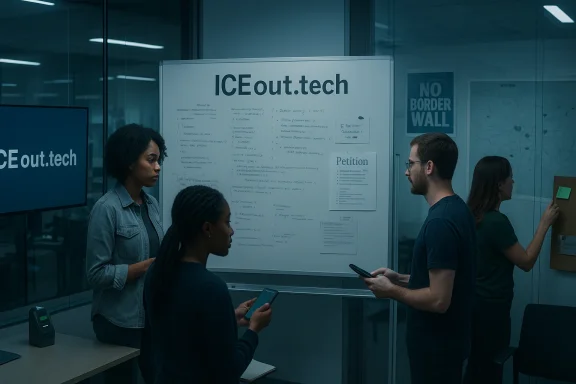
Workers are organizing again. Petitions demanding that tech CEOs publicly ask the administration to withdraw federal agents from cities and to cancel contracts with immigration-enforcement agencies have circulated widely. These campaigns — launched by collectives of employees across companies — typically ask for three things: a public corporate denouncement of violent enforcement, cancellation (or suspension) of government contracts tied to ICE and CBP, and concrete protective steps for employees and contractors who might be affected by enforcement actions.ICEout.tech and other worker-led campaigns
New coalitions formed by tech workers explicitly call on companies to use their political leverage to restrain federal enforcement. Organizers point to instances where industry leaders previously influenced White House decisions, arguing that similar pressure could be applied now. These movements aim to replicate the internal leverage workers used in earlier contract fights, but organizers face a different corporate environment — one in which company leadership often values access to government procurement and regulatory goodwill.Cross-company solidarity — and limits
While petitions and social media storms have attracted signatures from thousands of workers across many firms, organizers acknowledge limits: not all employees feel safe signing publicly, and many large companies retain deep commercial and government ties that make swift, universal policy reversals unlikely. Nonetheless, the visible pressure is shifting internal calculus at some firms and raising reputational risk that boards and executives cannot ignore.Why the silence matters: reputational and operational stakes
Reputational risk and talent retention
Technology companies trade heavily on their public image and talent brand. Employees — especially in engineering and product roles — evaluate employers based on stated values and corporate behavior. Extended silence or perceived complacency in the face of state violence can erode trust, making it harder to recruit and retain mission-driven talent. The labor market for top technologists remains tight; reputational damage can translate into measurable hiring and retention costs.Regulatory and shareholder scrutiny
Boards and institutional investors are increasingly attuned to environmental, social, and governance (ESG) risks. Contracts with enforcement agencies, biometric deployments, and AI products tailored for government use draw scrutiny from investors, civil-rights groups, and city regulators. Prolonged opacity increases the likelihood of shareholder proposals, public campaigns, and calls for independent risk assessments.Customer and partner blowback
Corporate customers — including municipalities, universities, and other large buyers — are sensitive to the optics of partnering with vendors perceived as complicit in rights violations. Consumer-facing backlash can cascade: boycotts, lost partnerships, and negative media cycles can harm revenue and market positioning.The technology side: how products intersect with enforcement
Biometric systems and access control
Companies that develop biometric identity systems — iris, fingerprint, facial recognition, gait analysis, and multimodal identity verification — operate at the intersection of convenience and risk. While deployments for airports and enterprise identity (e.g., TSA pre-check accelerators) can improve throughput, the same technologies can be repurposed or integrated into enforcement workflows that target communities.Biometric systems aggregate highly sensitive personal data. Even firms that claim not to share data with enforcement agencies may be compelled by subpoenas, compelled cooperation, or downstream data-sharing arrangements involving integrators and government contractors.
Data analytics, mapping, and predictive tools
Data-integration platforms enable enforcement agencies to aggregate public records, location signals, and internal databases into consolidated dashboards. Vendors that supply visualization, case-management, or linkage analysis tools — or that provide components to platforms used by ICE/CBP — can inadvertently power enforcement operations. Contracts and integrations with companies like Palantir illustrate how commercial data products become central to governmental enforcement capabilities.AI for government: Claude Gov, ChatGPT Gov and the like
Large language models and tailored AI products created for government customers raise novel policy questions. “Gov” variants of commercial models are often configured for stronger data access and integration with classified or sensitive workflows. While firms argue their offerings increase efficiency for legitimate administrative and national-security tasks, critics warn these systems can be adapted to support policing, deportation planning, or other coercive actions — especially if oversight and human-rights safeguards are weak.Legal and ethical considerations
Contracts, procurement, and auditability
Government procurement and contract law create real constraints and opportunities. Many companies sell to federal customers through long-term procurements, state-level schedules, or subcontracting relationships. Cancelling contracts is rarely as simple as a press release; it can have legal, financial, and contractual consequences that require board-level review and counsel.At the same time, companies can pursue mitigations: immediate moratoria on new enforcement-related sales, independent human-rights risk assessments, and tighter contractual limitations on downstream law-enforcement use.
Privacy, due process, and civil liberties
The fusion of biometrics, analytics, and AI raises due-process concerns. Systems with weak transparency — where algorithmic decisions are opaque and appeals are limited — can amplify errors and target people based on shaky inferences. For employees building these systems, the ethical risk is that technology designed for benign use cases becomes an instrument of coercion.Worker protections and free speech
Internal policies about political speech, organizing, and whistleblowing matter. Employees who raise public objections face career risks, especially those without secure immigration status. Corporate practices that implicitly discourage civic engagement risk creating a workforce that is disengaged, fearful, and less willing to surface safety concerns.Practical steps companies should take now
Below are pragmatic measures companies can take to protect workers, mitigate risk, and address legitimate ethical concerns without sacrificing necessary legal and operational responsibilities.- Publicly commit to an immediate, transparent review of any contracts with immigration enforcement agencies and to publish a timeline for that review.
- Commission independent human-rights risk assessments for products and integrations that intersect with law enforcement, and publish non‑proprietary findings.
- Institute moratoria on new sales or deployments of technologies that materially support enforcement operations until independent review is complete.
- Strengthen whistleblower protections and safe channels for employees to raise concerns, with explicit non-retaliation assurances and third‑party reporting options.
- Create cross-functional emergency response plans for employees affected by enforcement actions that include legal assistance, rapid relocation support, and mental-health resources.
- Require procurement clauses that prohibit or strictly limit downstream sharing of data with immigration or enforcement bodies unless explicitly authorized and audited.
- Expand transparency about government relationships: publish summary contract disclosures and redacted procurement terms where legally permissible.
- Offer employee briefings and Q&A sessions that are substantive and candid rather than perfunctory, and follow those with concrete action items.
Practical steps workers and organizers can take
- Document and coordinate: Use secure, end-to-end-encrypted channels for organizing; keep clear records of demands and signatures.
- Seek legal counsel: Connect with employment-law or immigration-law groups that provide pro bono or low-cost advice to employees who fear retaliation.
- Raise small, specific demands: Ask for concrete protections for migrants and contractors (legal clinics, emergency leave policies, relocation funds) rather than only broad moral statements.
- Build cross-company coalitions: Collective leverage is more effective when companies face joint reputational and market pressure.
- Pursue external allies: Local civil-rights groups, community organizations, and sympathetic city officials can amplify employee demands and provide real-world aid.
Risks and tradeoffs — what leaders and employees should keep in mind
For companies
- Abrupt contract cancellations without legal and operational plans can create downstream vulnerabilities, including service disruptions and potential breach-of-contract litigation.
- Overly defensive or purely symbolic statements may do little to placate employees while exposing firms to accusations of performative ethics.
- Continued alignment with government customers may secure short-term revenue and procurement advantages but can increase long-term reputational and regulatory risk.
For workers
- Public organizing remains risky for individuals with precarious immigration statuses or in tightly controlled employment environments.
- Pushing too fast without a clear strategy may cause backlash that strengthens management in the short term; coordinated campaigns with legal and PR strategies are more likely to shift corporate behavior.
- Demands for radical immediate change (e.g., wholesale contract cancellations) must be weighed against practical protections employees want now, like legal assistance and emergency support.
Why this moment matters for the future of technology
The current standoff is not merely a protest over tactics or a debate about public statements. It cuts to the core of what much of the technology industry now builds and whom it ultimately serves. The expansion of AI tailored for government and national-security uses, the proliferation of biometric identity systems, and the increasing embedding of data analytics into public-safety workflows mean that corporate decisions about sales, design, and oversight have direct effects on civic life.If companies choose quiet complicity — optimizing for access to government contracts while offering only cautious private sympathies — they risk accelerating a model of technology that prioritizes state surveillance and enforcement over individual rights. Conversely, a proactive industry posture that couples careful procurement practices, independent audits, and clear ethical red lines could set guardrails for how modern computing is applied in civic contexts.
This is also a test of corporate governance and civic responsibility: boards and executives are being asked to weigh commercial imperatives against moral hazards. Their choices will reverberate across recruitment, investor relations, government relations, and public trust.
A roadmap for the next 90 days
To move from rhetoric to responsibility, companies and worker coalitions should consider a focused 90‑day roadmap that balances immediacy with legal prudence:- Day 0–14: Issue a transparent acknowledgement of the crisis and commit to an independent review of enforcement-related contracts and risk. Launch company-wide, moderated Q&A sessions and share mental-health resources targeted to affected colleagues.
- Day 14–45: Commission third‑party human-rights and privacy audits of relevant products and contracts. Pause new sales to enforcement agencies until audit terms are agreed.
- Day 45–75: Publish a non‑proprietary executive summary of audit findings and a public remediation plan that includes contractual safeguards and community accountability mechanisms.
- Day 75–90: Implement concrete worker protections (legal hotlines, emergency leave, relocation assistance) and a transparent procurement policy requiring risk assessments for future government sales.
Conclusion
The current anger and fear among tech workers reflect a broader crisis of confidence: the technology sector is wrestling with whether the systems it builds will protect democratic rights or serve coercive power. Corporate silence in the face of violent enforcement is not a neutral stance; it signals priorities to employees, customers, and communities. Companies that are serious about their stated values must answer hard questions now — and do so with both transparency and tangible policy changes.For tech workers, the moment demands careful organizing that protects vulnerable colleagues while pressing for concrete protections and accountability. For leaders and boards, the calculus is clear: continued opacity may buy short-term government access, but it risks a long-term erosion of trust, talent, and legitimacy. The next few months will test whether the industry can reconcile its commercial ambitions with a public-interest role that genuinely prioritizes human dignity and civil liberties.
Source: The Verge ‘Shut up and focus on the mission’: Tech workers are frustrated by their companies’ silence about ICE
