Teens Using AI Chatbots for Schoolwork: Pew Findings Shape Policy

  • Thread Author
The arrival of generative chatbots into teenagers’ daily lives has moved from novelty to norm: a new, large-scale Pew Research Center survey finds that a clear majority of U.S. teens now use AI chatbots, and more than half report using those tools to help with schoolwork, a shift that has educators, parents and IT leaders scrambling to translate policy into practice. (pewresearch.org)

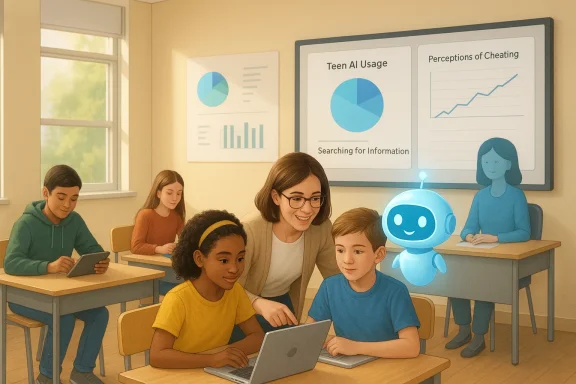
Students in a sunny classroom work on laptops, learning AI literacy with a teacher guiding.Background: the survey that changed the conversation​

Pew Research Center conducted a nationally representative survey of 1,458 U.S. teens ages 13–17 (and corresponding parent interviews) during September 25–October 9, 2025 to map how young people use the internet, social platforms and — newly — AI chatbots. The study frames the clearest publicly available snapshot yet of teens’ AI behavior: 64% of teens say they have used a chatbot, and 54% say they have used one to help with schoolwork. The survey also measured frequency, specific tasks, and teens’ views on whether AI-driven cheating is common at their school. (pewresearch.org)
Those headline numbers have been widely reported — including in major outlets summarizing the Pew findings — and they explain why the debate over AI in K–12 classrooms has escalated from anecdote to policy urgency this academic year. Reporting across news organizations echoes the same central findings while adding context about parental perceptions, educator responses, and concerns about emotional reliance on chatbots.

What the numbers actually say​

The Pew data contain several interlocking facts that matter for school leaders and IT administrators:
  • Adoption: Roughly two-thirds (64%) of teens report having used an AI chatbot at all. Usage is higher among older teens (ages 15–17) and varies by household income and race/ethnicity. (pewresearch.org)
  • Schoolwork: A majority of teens (54%) say they have used chatbots to help with schoolwork in some way — from researching topics to solving math problems and editing writing. However, intensity varies: about 10% report doing all or most of their schoolwork with the help of chatbots; others report only a little or some.
  • Frequency: About three in ten teens say they use chatbots daily, and 16% say they use them several times a day or almost constantly. (pewresearch.org)
  • Perception of cheating: A substantial share of teens (nearly 6 in 10) believe cheating with AI is at least “somewhat often” at their school — a perception that heightens pressure on schools to respond.
  • Emotional uses: Not all chatbot interactions are academic. Around 12% of teens report using chatbots to get emotional support or advice, a trend that has drawn scrutiny from mental-health professionals and parents.
These are the load-bearing statistics that policymakers and school IT teams should plan around — not hypothetical questions about adoption. The Pew survey is recent, rigorously sampled, and publicly available, which gives it more weight than earlier, smaller studies. (pewresearch.org)

How teens are actually using chatbots — practical patterns​

Pew’s breakdown of how teens use chatbots matters for classroom policy because it shows many uses are legitimate, everyday tasks rather than obvious cheating.
  • Research and information-seeking top the list: more than half of teens say they use chatbots to search for information.
  • Help with specific school tasks is common: many teens use chatbots for solving math problems, summarizing articles, editing writing, or generating ideas for projects. Editing and revision are particularly frequent.
  • Entertainment and social uses are nontrivial: roughly half of teens report using chatbots for fun or casual conversation, not just academics.
Those patterns should reframe how schools ask what is permitted rather than if chatbots are being used. For many students, a chatbot is already a research or drafting tool — the question for teachers is whether and how they want that tool integrated into learning objectives. The outside reporting is consistent: journalists who interviewed teachers and students found that many students view chatbots as a companion research and drafting assistant, while a smaller minority use them to shortcut learning.

Academic integrity and the "cheating" problem​

One of the most combustible findings is perception: a majority of teens say cheating with AI happens at their school at least somewhat often. That perceived prevalence — whether or not every case meets a teacher’s definition of cheating — changes the classroom dynamic.
Why perception matters:
  • When students believe “everyone” uses AI to get ahead, social pressure to conform increases.
  • Teachers may face growing skepticism of student work, prompting blanket restrictions that can penalize legitimate, ethical use.
  • Detection is hard: Unlike a plagiarized paragraph copied from a single web page, AI-generated text can be original, coherent, and difficult to distinguish from student writing without a robust assessment design.
Pew’s data show nuance: teens distinguish between acceptable uses (researching topics) and unacceptable ones (writing essays or solving math in ways that bypass learning). Still, the boundary lines are fuzzy for many students. Educators told reporters they are experimenting with approaches that include AI literacy lessons, assignment redesign, and in some cases, monitored AI-free assessments. Those mixed responses reflect the real-world difficulty of balancing learning goals with academic honesty.

Parents: the perception gap and the role of supervision​

The survey found a consistent perception gap: parents underestimate how often teens use chatbots. In multiple news summaries, the share of teens reporting chatbot use (64%) was higher than the share of parents who said their teen used one (about 51%). That mismatch matters because parental awareness is often a key lever for shaping student behavior outside school. (pewresearch.org)
Parents and guardians are balancing competing priorities: limiting screen time, protecting mental health, and supporting academic success. Experts quoted in coverage warn that blanket bans can backfire, pushing usage underground and making coaching about ethics and critical evaluation harder. Instead, parents are advised to ask about how their teen uses AI, set boundaries aligned with learning goals, and coordinate with teachers on classroom policies.

Emotional reliance and the mental-health dimension​

A striking ancillary finding is that a measurable minority of teens are using chatbots for emotional support. Pew reports that about 12% of teens say they have used chatbots to get emotional help or advice. That statistic has alarmed clinicians and child advocates because chatbots do not provide therapy, cannot reliably identify crises, and may amplify isolation when they replace human connection.
Journalistic follow-ups emphasize an important distinction: many teens use chatbots for casual conversation or to ask sensitive questions they might not pose to adults — sometimes because of privacy concerns or stigma. But clinicians warn that reliance on automated responses for serious emotional distress is risky. Reporters and experts call for better safety controls in chatbot platforms, clearer guidance for parents, and improved mental-health resources in schools.

Strengths of the Pew findings and what they tell educators​

The Pew study has several strengths that make it useful for school planning:
  • Representative sample and transparent methodology: Pew’s probability-based recruitment and clear methodology make the results more generalizable than convenience samples. The survey’s sample of 1,458 teens is large enough to analyze demographic differences meaningfully. (pewresearch.org)
  • Granular task-level data: The study doesn’t stop at whether teens use chatbots; it drills into what they do with them. That detail is actionable for curriculum designers.
  • Parental comparison: By surveying parents alongside teens, Pew highlights communication gaps schools can tackle through outreach and education. (pewresearch.org)
These strengths make the survey a practical planning tool for districts, principals, teachers, and IT administrators who must craft policies that reflect actual student behavior and attitudes. (pewresearch.org)

Weaknesses, caveats, and unverifiable claims​

No single study (or media recap) tells the whole story. Important caveats include:
  • Timing lag: Pew’s fieldwork occurred in late September–early October 2025. Given the rapid pace of AI product changes and school policy updates, user behaviors and platform features may have shifted since then. Treat the results as a very recent baseline, not a real-time telemetry feed. (pewresearch.org)
  • Self-report limitations: The survey measures self-reported behavior and perceptions, which can over- or under-estimate actual use. For example, social desirability bias might lead some teens to underreport misuse, or conversely, to overstate prevalence when they feel it’s normative. (pewresearch.org)
  • Platform specificity: While Pew asked about specific chatbots (ChatGPT, Gemini, Copilot, Character.ai, Claude), the competitive landscape shifts quickly and new models or school-deployed tools may not be fully captured. Claims about which exact chatbot dominates a school or classroom can be time-limited. (pewresearch.org)
Finally, some media reports — including headline summaries — compress nuance. When a headline reads “More than half of teens use chatbots for schoolwork,” it is accurate in the Pew context but simplifies variation in intensity (from “a little” to “all or most” of schoolwork). Readers and policymakers should avoid treating the 54% figure as uniform intensity across students; the distribution behind that percentage is important.

What schools and IT administrators should do now​

The Pew results demand operational responses that are technical, pedagogical, and cultural. Below are practical actions district leaders and school IT teams can begin implementing this week.

Technical and administrative measures​

  • Audit network traffic and sanctioned tools: Identify which chatbot domains and APIs are commonly accessed on school networks. Use that telemetry to inform support and policy. (Be mindful of students’ right to privacy; audits should focus on domain-level trends rather than content.)
  • Establish secure, school-sanctioned AI options: Where feasible, pilot vetted, privacy-conscious chatbot services integrated with district accounts. Centralized, logged access reduces the risk posed by unmanaged third-party accounts.
  • Update Acceptable Use Policies (AUPs): Revise AUPs to explicitly address AI use, clarifying permitted tasks, academic integrity expectations, and consequences for misuse. Make the rules bite-sized and easy for teens and parents to understand.
  • Integrate detection and design strategies: Rely less on detection tools alone. Combine plagiarism/AI-detection tools with redesigning assessments to include in-class or oral components that emphasize process and reasoning.
  • Provide teacher tools and training: Equip educators with classroom workflows for detecting misuse, designing AI-inclusive assignments, and coaching students on ethical prompting and verification.

Pedagogical steps​

  • Teach AI literacy as part of curriculum: how chatbots are trained, their failure modes (hallucinations), and how to verify outputs.
  • Redesign assessments to emphasize metacognitive processes: require drafts, annotated sources, and reflections on how a chatbot contributed.
  • Promote prompting as a skill: coaches teach students to craft precise prompts, evaluate answers, and attribute AI assistance when appropriate.

Family and community engagement​

  • Share the perception gap with parents and offer short workshops or guides on discussing AI usage at home.
  • Provide clear examples of acceptable vs unacceptable chatbot use for specific assignments.
  • Create feedback channels so parents and students can raise concerns about mental-health risks stemming from emotional reliance on chatbots.
These combined steps move schools away from knee-jerk bans and toward managed integration — acknowledging teens’ realities while protecting learning outcomes and wellbeing. Reporting on the issue underscores this balanced approach.

Policy options: from bans to curriculum redesign​

District responses so far fall into three broad buckets, each with trade-offs:
  • Hard bans: Pros — simplicity, reduces overt misuse; Cons — enforcement problems, drives usage underground, loses coaching opportunities.
  • Permissive integration: Pros — aligns with real-world tools, teaches ethical use; Cons — requires substantial teacher training and robust assessment redesign.
  • Conditional/managed access: Pros — middle ground, supports learning while limiting high-risk use; Cons — administrative overhead and potential equity concerns (who gets access to higher-quality tools).
Pew’s findings push toward conditional and curriculum-centered solutions because they reveal that many students use chatbots for legitimate study needs. But districts with limited training capacity may choose short-term bans to buy time while they build infrastructure and teacher readiness. Both pathways are defensible if accompanied by transparent communication and measurable goals. (pewresearch.org)

Risks for IT teams and technical recommendations​

From an infrastructure and security viewpoint, the chatbot era raises specific concerns:
  • Privacy and data protection: Student prompts can contain personal or sensitive information. Districts should restrict use of consumer chatbot services that collect and repurpose user data. Contracted, privacy-compliant platforms with student-data protections are preferable.
  • Content filtering and safety: Chatbots can produce inappropriate content, or be used to generate instructions for harmful behavior. Implement filtering layers and clear incident response procedures.
  • Equity and access: If high-quality AI tools are only available off-campus (or behind paywalls), lower-income students may be disadvantaged. Districts should budget for equitable access where AI is part of pedagogy.
  • Monitoring vs privacy: Network-level monitoring of domains is useful for planning, but content-level logging raises legal and ethical issues; consult legal counsel and privacy officers before deep logging.
Technical teams should collaborate with curriculum leaders to create a joint roadmap — budgeting for licensed, privacy-focused AI tools where appropriate, and building staff training and student digital-literacy modules into rollout plans.

Recommendations for teachers: practical classroom strategies​

  • Require process artifacts: outlines, annotated drafts, and explanation logs that show how the student arrived at answers.
  • Use in-class, timed, or oral assessments to complement take-home tasks.
  • Grade for reasoning as much as for the final product: use rubrics that reward critical thinking and the demonstration of understanding.
  • Teach students to attribute AI assistance and to critically evaluate AI outputs using evidence and credible sources.
  • Create clear classroom norms about permitted AI use for each assignment and revisit them regularly.
These measures make it easier to distinguish genuine learning from mechanical output while turning AI into a teachable moment rather than an existential classroom threat. Reporting indicates teachers who frame AI as a partner for revision (not a shortcut) find better student buy-in.

Legal and ethical landscape: what districts should watch​

School districts must watch three converging developments:
  • State and federal guidance: Expect guidelines and model policies from education departments and lawmakers as the issue becomes more visible.
  • Vendor contracts and FERPA/COPPA: Contracts with AI vendors must be scrutinized for student-data protections and compliance with federal privacy statutes.
  • Liability for mental-health harms: If students rely on chatbots for emotional support and harm results, districts may face reputational and legal risks if they failed to provide alternatives or guidance.
Policy drafting should include legal counsel and privacy officers to ensure district actions respect student rights and protect the institution.

Looking ahead: integration, not interdiction​

Pew’s survey marks a watershed moment: chatbots are already embedded in teen life, and the choice for schools is not whether to engage, but how to engage responsibly. The data point toward integration with guardrails — teaching students how to use chatbots critically while redesigning assessments to emphasize skills chatbots cannot replace (creative synthesis, oral defense, and process visibility). (pewresearch.org)
From a technology-management perspective, the imperative is clear: districts must pair privacy-respecting technical solutions with teacher training, student AI literacy, and transparent family communication. Those are the levers that can preserve learning outcomes while harnessing AI’s potential to help students learn more efficiently and creatively.

Conclusion​

The Pew findings — corroborated by contemporaneous reporting — should jolt schools out of denial. Chatbots are not a fringe behavior; they are a mainstream academic tool for a majority of teens. That reality creates both opportunities and risks: smarter research, faster iteration, and new forms of learning on one hand; cheating, privacy leakage, and emotional dependence on the other. For educators and IT leaders, the path forward combines policy, pedagogy, and infrastructure: update acceptable-use policies, redesign assessments to privilege process and reasoning, procure privacy-first AI tools, and teach students how to interrogate, verify, and attribute AI-generated outputs.
If schools treat the problem as a teachable moment rather than an existential threat, they can convert a disruptive technology into an engine for better learning — but that requires decisive action, clear communication with families, and technical safeguards that protect students’ data and wellbeing. The clock is ticking: the survey’s snapshot shows that the shift already happened in students’ daily lives. Now institutions must catch up. (pewresearch.org)

Source: The New York Times https://www.nytimes.com/2026/02/24/technology/schoolwork-chatbot-cheating-pew.html
 

A majority of American teens now see artificial intelligence as both a powerful study aid and a convenient shortcut — and their views are forcing schools, parents and EdTech vendors to confront an uncomfortable truth: AI is already reshaping how a generation learns, cheats, copes and plans for the future. (pewresearch.org)

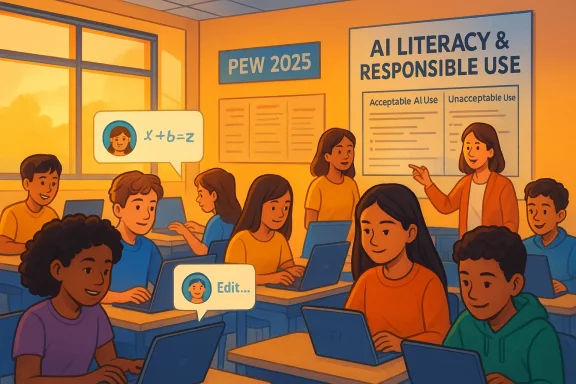
A teacher guides students as a friendly blue robot assists at a laptop.Background​

The Pew Research Center’s national survey of 1,458 U.S. teens (ages 13–17) and their parents, fielded Sept. 25–Oct. 9, 2025, provides one of the first large-scale, representative looks at how teenagers are using chatbots and generative AI in daily life and in school. The topline findings show widespread awareness and adoption: more than half of teens report using AI chatbots for schoolwork or to search for information, and a substantial minority use chatbots daily. The report also drills into differences by race, household income and age, revealing patterns that matter for equity and policy. (pewresearch.org)
This article examines what those numbers mean for classroom integrity, student learning, emotional health and school IT policy. It synthesizes Pew’s data with reporting and expert analysis, flags where evidence is still thin, and offers practical guidance for educators, IT administrators, and EdTech professionals navigating AI in K–12 and secondary education.

What the data actually says: usage, cheating perceptions and emotional support​

How teens use AI, in concrete terms​

  • 54% of teens say they have used chatbots to get help with schoolwork; 57% use them to search for information. About 47% used chatbots “for fun.” (pewresearch.org)
  • Roughly 30% of teens report daily chatbot use; about 10% say they use chatbots for all or most of their schoolwork. (pewresearch.org)
These are not marginal behaviors. For millions of students, chatbots are now a routine part of homework workflows — for research, solving math problems, drafting outlines, or generating study prompts. The tools named by teens include ChatGPT, Microsoft Copilot, Character.ai and others, showing that both consumer and enterprise-grade assistants are in play. (pewresearch.org)

Cheating: a perception that matters, even if it isn't proof​

A striking finding: 59% of teens say that students at their school use AI chatbots to cheat at least “somewhat often,” and about a third say it happens “extremely or very often.” The Pew survey did not define “cheating” or ask teens whether they personally cheated — what it captures is perception. But perceptions drive policy and practice: if most students and teachers believe cheating with AI is common, schools will change tests, assignments and proctoring accordingly. (pewresearch.org)
The line between “helpful” and “cheating” is fuzzy in students’ responses: many teens report using AI for research more than for editing or turning in AI-polished prose — yet use for editing (35% report doing this) can easily cross into academic integrity concerns depending on school rules. (pewresearch.org)

Emotional support and the parent gap​

About 12% of teens say they’ve used chatbots for emotional support or advice. Parents, by and large, disapprove of AI playing that role. This raises new mental-health and safeguarding questions: are teens turning to chatbots because they lack access to trusted adults, or because chatbots feel less judgmental? Experts warn about risks, ranging from poor mental-health outcomes to the formation of unhealthy dependence on automated companionship. (pewresearch.org)

The stakes for learning: dependence, skills erosion and equity​

Dependence vs. scaffolding​

A core debate is whether AI is a scaffold that accelerates learning or a crutch that undermines it. Some teachers and researchers argue that, used correctly, AI can personalize instruction and provide just-in-time supports for students who lack tutors. Others warn that unscaffolded or routine reliance on AI — especially for low-resource students who lack alternatives — may replace learning processes rather than support them.
Pew’s own cross-tabs show worrying patterns: teens from lower-income households report heavier reliance on chatbots for schoolwork than peers from wealthier homes. Where higher-income families might afford tutors or after-school help, lower-income students may use AI as a substitute. That changes the policy calculus: an intervention that treats AI purely as an “honesty” problem may neglect the structural gaps AI is currently filling. (pewresearch.org)

Experimental evidence (and where caution is needed)​

The Stanford education professor Guilherme Lichand — quoted in recent reporting — describes an experiment in which middle school students who had access to AI for an initial assignment and then lost it performed worse on a subsequent creativity/word-association task than peers who never had AI. The research was reported as not yet published; it suggests that sudden removal of AI scaffolds can impair confidence and self-efficacy. That finding aligns with a broader, precautionary view advanced by researchers: heavy, unsupervised use of generative AI may erode problem-solving resilience in developing learners. Because Lichand’s experiment is unpublished at the time of reporting, it should be treated as an early signal rather than definitive proof.
The Brookings Institution’s recent global report echoes the cautionary stance more broadly. After a yearlong review that included 500 interviews and over 400 studies, Brookings concluded that current trajectories risk harming core learning abilities unless stakeholders act to “prosper, prepare and protect” students — recommending pedagogically sound, tightly-scoped uses of AI paired with research, teacher training and privacy safeguards. Brookings places particular emphasis on the risk that overreliance on AI weakens students’ foundational cognitive skills and teacher-student trust.

What educators are proposing — and why policy is messy​

Practical classroom countermeasures​

Sal Khan — founder of Khan Academy and an influential voice in EdTech — advises schools to assume students will use AI to shortcut out-of-class assignments and to adapt assessments accordingly. Practical recommendations he and other educators propose include:
  • Increase in-class writing assessments and supervised demonstrations of skills.
  • Design assignments that emphasize process (drafts, revision history, reflection) rather than only polished outputs.
  • Ask students to explain their work orally or in short in-class quizzes that probe understanding of submitted assignments.
These are sensible short-term adjustments — they preserve assessment validity and make it harder to pass off AI output as student work. But they are not a full solution: heavy reliance on surveillance or proctoring can raise privacy, equity and trust issues, and in-class-only assessments disadvantage students with legitimate out-of-class learning circumstances.

The “detection arms race” and its limits​

EdTech has responded with detection tools that claim to flag AI-generated writing. But detectors are brittle: they produce false positives (particularly for English-learners and students with atypical writing styles), and generative models evolve rapidly to evade them. Detection alone is a brittle defense; many experts suggest redesigning assessments to make reliance on raw AI outputs unattractive or academically fruitless.

Equity: who gains and who loses?​

Pew’s demographic analysis is a critical part of this story. Use is not evenly distributed: in many samples, Black and Hispanic teens and those from lower-income households report higher usage rates for certain AI tasks, and the proportion of teens saying AI does “all or most” of their schoolwork is larger among lower-income teens. That pattern implies two urgent policy priorities:
  • Equity in access to high-quality supports that do not undermine learning (tutors, after-school programs, guided AI-integrated curricula).
  • Targeted professional development so teachers in under-resourced schools can design AI-aware, learning-centered assignments rather than simply policing students. (pewresearch.org)
Treating AI as merely a cheating problem risks entrenching existing resource gaps. If under-resourced students use chatbots as de facto tutors, removing or strictly banning tools without offering replacements could harm those students’ learning more than it helps overall integrity.

Emotional risks: chatbots as companions​

The Pew data showing 12% of teens turning to chatbots for emotional support is notable: that’s not anecdotal. Parents and clinicians worry about the long-term psychological effects when young people rely on systems that are designed to flatter, reassure or mimic empathy without human judgment. Brookings and mental-health commentators warn about the potential for AI companions to alter developmental patterns around feedback, resilience and interpersonal relationships. Any school policy that simply ignores or blocks chatbot conversations without addressing underlying mental-health access will be incomplete. (pewresearch.org)

Technology vendors, platforms and the wider ecosystem​

  • Major platforms and tools are already integrating assistants into mainstream experiences (for example, enterprise assistants, search-integrated “help” in browsers and productivity software). That integration both normalizes AI for students and creates control dilemmas for schools (how to block or manage these agents on managed devices). The “homework help” button controversy in mainstream browsers illustrates how quickly platform changes can produce integrity risks for schools and colleges.
  • EdTech vendors face a choice: build AI features that emphasize learning processes (feedback loops, mastery tracking, prompt transparency) or race to provide output-generation features that accelerate short-term productivity. The Brookings framework argues for co-creation with educators and students to favor the former.
  • For IT departments, the immediate actions are not purely technical: policy, professional development, procurement standards and vendor SLAs around student data privacy matter just as much as device management or network blocks.

Concrete guidance for schools, IT managers and EdTech teams​

Below are pragmatic steps that districts, principals, IT administrators and teachers can adopt now to balance learning, integrity and safety in an AI-present classroom.
  • Reframe policy from “ban-or-allow” to “design-and-assess.”
  • Prioritize assessment designs that evaluate process and understanding (portfolios, staged drafts, oral defenses, in-class synthesis prompts). (pewresearch.org)
  • Invest in teacher training and AI literacy.
  • Teachers need to know what AI can and cannot do, how to scaffold assignments, and how to coach students to use AI as a tool rather than a substitute. Brookings highlights teacher preparation as essential.
  • Make support equitable and explicit.
  • Where students rely on chatbots for tutoring, provide alternatives: school-run tutoring, after-school programs, or structured AI tools that log process and enable teacher oversight. This closes the scaffolding gap that income disparities expose. (pewresearch.org)
  • Use technology thoughtfully — not punitively.
  • Avoid over-reliance on intrusive proctoring when less invasive instructional design changes can reduce dependence on AI for cheating. Detection has limits and equity implications.
  • Address emotional-use risks with counseling access and digital-wellbeing education.
  • If a measurable share of teens seeks emotional support from chatbots, districts should expand counseling access and teach students about the limitations and risks of AI companionship. (pewresearch.org)
  • Set procurement and privacy standards.
  • Require vendors to disclose data use, enable opt-outs, and provide teacher-facing process logs (not raw outputs) that protect student privacy while helping teachers understand how tools are used.
  • Pilot, measure, iterate.
  • Launch small, evidence-informed pilots that test learning outcomes and student well-being before scaling AI tools district-wide. Brookings and other experts call for rigorous research as rollout accelerates.

Strengths, opportunities and the pragmatic case for selective adoption​

AI in education is not a binary good-or-bad question. There are clear, verifiable upside opportunities when AI is integrated with sound pedagogy:
  • Personalized practice: AI can provide targeted explanations, multiple representations of a problem and adaptive practice at scale for students who need extra help.
  • Teacher amplification: If used to automate low-value tasks (grading objective items, generating practice exercises), AI can free teachers for feedback, coaching, and differentiated instruction.
  • Accessibility gains: For students with disabilities or language barriers, tailored AI-based scaffolds (text simplification, voice synthesis, alternate formats) can improve access.
These benefits are real — but they depend on how tools are designed and deployed. Tools that produce finished answers without process visibility or pedagogical scaffolding are far more likely to harm learning outcomes than to help them.

Risks that demand policy attention​

  • Skill atrophy and overreliance: Early signals (including unpublished experiments and Brookings’ synthesis) suggest a risk that students may lose confidence and independent problem-solving ability when AI becomes a primary crutch. Treat these early signals with caution, but act proactively.
  • Equity mismatch: Left unchecked, AI use can amplify resource inequalities: students in wealthier districts will get coached integration, while lower-resourced students may be left dependent on unsupervised chatbots. (pewresearch.org)
  • Privacy and platform risk: Rapid platform changes and experimentation (including search and browser-integrated assistants) can expose school data and assessment content if not governed by strong procurement and data-use policies.
  • Mental-health dependency: The 12% of teens using chatbots for emotional support points to a nontrivial welfare issue — one that schools and policymakers must address through counseling access and digital-health curricula. (pewresearch.org)

What this means for WindowsForum readers: IT pros, administrators and EdTech builders​

WindowsForum readers range from IT administrators running school fleets to developers building learning software. The Pew and Brookings findings have practical implications:
  • For IT directors: policy beats panic. Develop clear device management and network policies that reflect pedagogical choices, not reactionary bans. Test vendor contracts for student-data protections and audit rights. Design opt-in pilots for AI tools that include teacher training and evaluation metrics. (pewresearch.org)
  • For EdTech vendors: Build features that surface process not just polished outputs — editable drafts, timestamped revision histories, reflection prompts and teacher dashboards that show student engagement without exposing private content. Co-design with districts and publish clear privacy documentation.
  • For product managers and developers: Prioritize explainability, feedback-driven prompts, and “teaching-first” modes where the assistant scaffolds rather than substitutes. Design pricing and accessibility options that avoid deepening resource divides.

Final analysis: a narrow window to steer an epochal change​

Pew’s data is not a verdict so much as a moment of clarity: a generation of teens is growing up with AI as a commonplace tool and companion, and their experiences already diverge along lines of income and support. Schools and EdTech companies face a choice about how that divergence evolves.
The Brookings report warns the risks currently outweigh the benefits in the way AI is being used today, calling for an urgent reorientation toward pedagogically sound, equity-minded and safety-first deployment. On the ground, educators like Sal Khan urge adaptation — not bans — proposing assessment and design changes that make reliance on raw AI outputs academically unrewarding. Taken together, the evidence supports a blended approach: integrate AI where it demonstrably supports learning processes, strengthen teacher capacity to design for understanding, expand mental-health and tutoring resources, and move beyond detection-and-punishment models that do not address underlying inequities.
Policymakers and school leaders must act quickly but deliberately. The Pew snapshot shows adoption is already widespread. The question isn’t whether AI will be part of schooling — it already is — but whether the next decade of AI in education will be shaped by pedagogy, equity and evidence, or by ad-hoc bans, brittle detection technology, and unequal access to human supports. The near-term decisions schools make about assessment design, teacher training, procurement and counseling will determine whether AI becomes a tool that amplifies student learning or a force that amplifies existing gaps.
The path forward is not simple, but it is actionable: train teachers, redesign assignments, pilot with research, protect student data, and provide real alternatives to those who currently lean on chatbots as their primary tutor. Do that, and the generation growing up with ChatGPT, Copilot and other assistants can gain the best of both worlds — powerful learning tools and the human development those tools should enhance. (pewresearch.org)
Conclusion: the Pew survey is an early but authoritative signal that AI has moved from novelty to norm for American teens. That shift requires equally early, evidence-driven responses from educators, technologists and policymakers — responses that center learning, equity and the long-term wellbeing of students. (pewresearch.org)

Source: Sri Lanka Guardian Teens See AI as Both Helper and Cheating Tool in Schools
 

Back
Top