

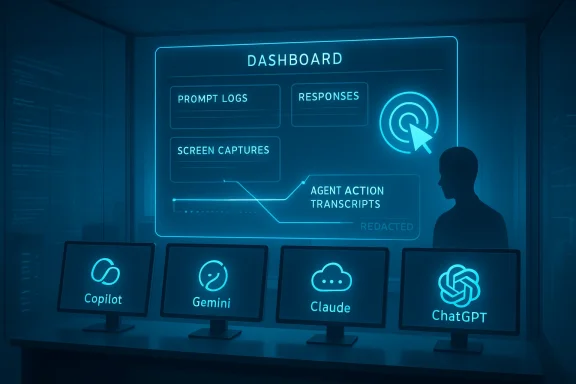
Teramind’s new AI Governance product lands at a moment when enterprises are moving from curiosity to deployment—and the company stakes a bold claim: for the first time, organizations can apply enterprise-grade behavioral oversight, continuous audit trails, and automatic enforcement to every AI tool and autonomous agent running across their workforce. The announcement positions Teramind AI Governance as a single-pane governance layer that captures prompts, responses, and agent actions across sanctioned platforms (Microsoft Copilot, Google Gemini, Claude Code, ChatGPT) and the sprawling ecosystem of unsanctioned “shadow AI” tools. If you care about prompt logging, auditability, and the operational controls necessary to scale agentic AI safely, Teramind’s pitch is worth unpacking—and interrogating.
The jump from AI assistants to agentic systems—models that plan, act, and execute multi-step workflows autonomously—has changed the risk surface for security, compliance, and insider risk teams. Industry research and consultancy surveys show a clear pattern: widespread AI experimentation, a fast-growing base of users, and a much smaller set of organizations that have built governance and operational controls to match. Enterprise studies by Deloitte and McKinsey document rapid increases in worker access to AI and growing deployments of agentic systems; at the same time, many organizations report limited governance maturity for autonomous agents.
In that context, Teramind frames the problem not as a technology gap but as a governance gap: employees will use AI whether IT approves it or not, and agents can multiply the speed and scale at which sensitive data moves across systems. The company’s new product is an explicit response to that risk calculus—offering visibility, evidence capture, behavioral detection of shadow AI, and automated policy enforcement designed to follow existing compliance frameworks.
Important compliance considerations for buyers:
Competitors and adjacent solutions span:
However, the platform is not a silver bullet. Its value depends on how the organization addresses the inevitable downstream questions: protecting the newly centralized store of prompt-and-response data; ensuring privacy and labor-law compliance; handling the scale of telemetry generated by agentic operations; and maintaining detection efficacy in the face of intentional evasion. Equally important is treating the platform as a component of broader governance—policies, role definitions, incident response runbooks, and regular audits must accompany technical controls.
For teams that must show auditors, boards, or regulators that AI is being governed—not just monitored—Teramind’s offering is compelling. For others, it’s a reminder that governance is not optional; capturing every prompt without the right protections simply creates a bigger risk repository.
Teramind’s leap into “AI governance for the agentic enterprise” is a timely and sensible product bet: enterprises need auditability, enforcement, and behavioral visibility now, not later. The vendor’s core capabilities—if implemented with strong privacy protections, smart retention policies, and integration into enterprise incident workflows—could materially reduce the accidental and intentional exposures created by ungoverned AI use. But buyers should remember that logging every interaction is only the start: protecting the logs, operationalizing the alerts, and aligning governance across legal and HR boundaries are the hard, ongoing work that determines whether a governance platform truly reduces risk—or simply collects new data that multiplies it.
Source: Business Wire https://www.businesswire.com/news/home/20260303727228/en/
 Background: why a governance layer matters now
The jump from AI assistants to agentic systems—models that plan, act, and execute multi-step workflows autonomously—has changed the risk surface for security, compliance, and insider risk teams. Industry research and consultancy surveys show a clear pattern: widespread AI experimentation, a fast-growing base of users, and a much smaller set of organizations that have built governance and operational controls to match. Enterprise studies by Deloitte and McKinsey document rapid increases in worker access to AI and growing deployments of agentic systems; at the same time, many organizations report limited governance maturity for autonomous agents.In that context, Teramind frames the problem not as a technology gap but as a governance gap: employees will use AI whether IT approves it or not, and agents can multiply the speed and scale at which sensitive data moves across systems. The company’s new product is an explicit response to that risk calculus—offering visibility, evidence capture, behavioral detection of shadow AI, and automated policy enforcement designed to follow existing compliance frameworks.
What Teramind AI Governance promises
Teramind’s product messaging highlights a set of capabilities tailored to enterprise risk, compliance, and operational needs. Key claims that should catch a CISO’s attention include:- Prompt and response capture: every prompt sent to AI systems and every response returned is logged and timestamped, creating searchable conversational records for audits and investigations.
- Visual evidence capture (screen recording + OCR): recordings of AI panels and UI elements are captured so teams can see exactly what users accepted or pasted into downstream systems.
- Console/command logging: agent-executed terminal commands and automated actions are recorded, even if no human typed a keystroke.
- Full transcripts of autonomous agent activity: agent workflows and their step-by-step actions are reconstructed into auditable transcripts.
- Behavioral detection of shadow AI: rather than rely solely on signatures, the platform claims to detect unauthorized tools by execution patterns, network behaviors, and “behavioral velocity.”
- Automatic enforcement of existing security policies: the system applies pre-existing access controls, DLP rules, and URL restrictions against AI-driven actions.
- Compliance-centric audit trails: audit outputs aimed to support SOX, HIPAA, CMMC, FedRAMP, SOC 2, ISO 27001, and the EU AI Act.
How this maps to enterprise needs today
Visibility and forensics for an agentic workforce
As agentic systems move from assistants to workers that execute sequences of actions, traditional logs (API calls, model telemetry) are necessary but not sufficient. Enterprises increasingly need evidence that links human intent to agent action—who asked for what, what output the agent produced, and what changes were made as a result. Teramind’s emphasis on unified prompt-and-response logging combined with screen capture and command transcripts directly addresses that gap.Shadow AI detection and insider risk
Large organizations report high levels of unsanctioned AI use: employees testing ChatGPT in the browser, copying proprietary text into unmanaged tools, or spinning up agentic scripts with external APIs. Behavioral detection techniques—flagging unusual execution velocity or machine actions that resemble agent workflows—can identify tools that evade signature-based controls. That capability is crucial because shadow AI is both a compliance and a data-loss vector.Compliance and regulatory readiness
Regulatory regimes are catching up. The EU AI Act and other sector-specific compliance requirements are shifting the burden of oversight onto deployers and integrators. Teramind positions its platform as a way to generate continuous audit trails and evidence packages that auditors and regulators expect—an attractive feature for regulated industries where documentation and demonstrable oversight are essential.Strengths: where Teramind appears to deliver real value
- Unified behavioral context: By integrating prompt logs, screen evidence, command transcripts, and network telemetry, the platform offers a richer, end-to-end forensic picture than siloed logs alone.
- No new infra required: If Teramind’s claim of zero-infrastructure deployment holds true in enterprise environments, adoption friction drops significantly—particularly for organizations with tight procurement or long lead times for new agents.
- Immediate auditability: Searchable trails and timestamps are powerful for incident response, insider investigation, and evidence required by regulators.
- Agent-specific detection models: Behavioral and velocity-based detection can catch emergent agents and novel integrations that signature-based defenses miss.
- Compliance-first design: Packaging audit outputs for frameworks such as SOX, HIPAA, SOC 2, and the EU AI Act speeds compliance workflows and evidence collection during audits.
Practical limitations and open questions
Beneath the headline capabilities sit operational and governance challenges that buyers must evaluate carefully.- Data sensitivity of recorded prompts and responses: Captured prompts often contain proprietary or personal data. Storing full prompt-response pairs creates a new repository of sensitive material that must be protected to the same—or higher—standards as the systems it monitors. Buyers must ask about encryption, retention policies, access controls, and whether prompt storage itself meets privacy and data minimization requirements.
- Privacy and employee surveillance concerns: Screen recording and continuous capture can trigger legal, HR, and union concerns in many jurisdictions. Organizations need careful policies that balance legitimate oversight against employee privacy rights and local labor laws.
- False positives and detection fidelity: Behavioral detection is probabilistic. Rapid automation can look like agentic activity even when legitimate (e.g., bulk scripting, CI/CD jobs). Without tuned context, alerts generate noise, increasing operational overhead and the risk of blocking valid work.
- Scale and performance: Agents can execute hundreds of commands in seconds. The telemetry volume—full transcripts, recordings, and network flows—will balloon quickly. Enterprises must evaluate ingestion capacity, storage economics, and the impact on endpoint performance.
- Evasion and adversarial tactics: Sophisticated users or malicious insiders can attempt to obfuscate agent behavior (proxying, encrypted endpoints, ephemeral containers). Behavioral models will need constant retraining and red-teaming to remain effective.
- Legal admissibility and chain of custody: Screen captures and prompt logs are useful for investigations, but organizations should validate that the platform’s evidence collection preserves tamper-evident chains of custody acceptable to legal and regulatory examiners.
- Vendor claims that are company-reported only: Several headline numbers in the announcement—Teramind’s internal research finding that “more than 80% of workers now use unapproved AI tools,” “one-third have shared proprietary data,” and “49% hide AI use from IT”—appear to derive from the vendor’s own internal research. Likewise, the claim that "AI-associated breaches now cost organizations more than $650,000 per incident" is attributed to Teramind’s Insider Risk Management Team. Those are meaningful signals, but they are company-originated and should be validated by independent audits or third-party studies before being used as baseline risk metrics across an organization.
Compliance, regulation, and the EU AI Act
Teramind positions the product as ready for today’s compliance landscape, including EU AI Act obligations. Regulatory timelines in 2025–2026 place heavy emphasis on governance, documentation, risk assessments, and incident reporting—exactly the activities Teramind says it supports.Important compliance considerations for buyers:
- Determine whether Teramind’s audit outputs meet specific evidentiary formats and retention periods required by frameworks you must satisfy (HIPAA, SOX, FedRAMP, SOC 2, ISO 27001).
- For EU AI Act needs, create mapped processes around transparency and documentation obligations. Remember that the EU AI Act’s phased enforcement imposes layered requirements: GPAI/GPAI-related disclosures, risk management documentation, and high-risk conformity assessments have different timelines and thresholds.
- Ensure that any tooling used to show compliance can produce exportable and verifiable artifacts for auditors and regulators. The ability to generate curated evidence packages (and to redact sensitive elements where required) will be a practical differentiator.
Deployment and operational checklist for security teams
If you’re evaluating Teramind AI Governance, or any equivalent oversight platform, run through this pragmatic checklist before purchase and deployment:- Define the use cases you want to solve (discovery, incident response, DLP for prompts, agent activity forensics).
- Map data flows—what will be captured (prompts, responses, screen recordings, commands), where it will be stored, and who can access it.
- Confirm encryption in transit and at rest, key management practices, and role-based access control (RBAC) for recorded artifacts.
- Inspect retention policies and data minimization options: can you redact or truncate prompts automatically? Can automatically captured data be routed to secure archives for legal holds?
- Validate integration points with SIEM, SOAR, MDM, and DLP platforms—how will Teramind’s telemetry feed into existing workflows?
- Test behavioral detection efficacy with red-team exercises; ask for realistic false-positive and false-negative rates in pilot environments.
- Review legal and HR implications for monitoring—coordinate policy updates, employee notices, and any required consents in local jurisdictions.
- Evaluate scalability and performance impacts in a representative environment with high agent activity.
- Confirm audit artifact formats and queryability for compliance reviews and legal discovery.
- Define incident response playbooks that incorporate agent mitigation and rollback steps when an agent runs unauthorized actions.
What to ask Teramind (and any vendor making similar claims)
- How are prompt-response pairs stored, who has access, and is access logged for every retrieval?
- Can the platform redact or tokenize sensitive fields in prompts automatically (PII, secrets, code snippets)?
- How does behavioral detection distinguish between legitimate automation and agentic activity? Can you tune thresholds per team or environment?
- What protections and attestations exist around data residency, encryption, and third-party risk (i.e., is telemetry sent offsite for analysis?)?
- How are agent transcripts reconstructed and correlated with system-level changes (database updates, file writes, network calls)?
- What is the performance overhead on endpoints and network when full recording is enabled at scale?
- Does the product provide tamper-evident evidence trails suitable for legal discovery and regulatory audits?
- How are false-positive rates measured and reported during pilots?
- Can the system enforce policy automatically (block/pause agent actions), or is it limited to alerts and logging?
- What is the upgrade and maintenance model for behavioral detection models that must adapt to new agent architectures?
Risk scenarios and mitigations: a practical view
- Risk: Sensitive IP is captured in prompts and stored insecurely.
- Mitigation: Insist on prompt redaction, encrypted storage, strict RBAC, and short retention windows for raw data.
- Risk: Continuous screen recording triggers privacy or labor-law violations.
- Mitigation: Record with context-aware triggers (only when AI widgets are in use), implement transparent policies, and align with HR/Legal before deployment.
- Risk: Agents evade detection through obfuscation or containerized proxies.
- Mitigation: Combine endpoint telemetry with network and cloud telemetry, perform threat-hunting exercises, and integrate agent discovery into asset inventories.
- Risk: Compliance confidence becomes a false sense of security.
- Mitigation: Regular independent audits, adversarial testing, and continuous control validation are essential to ensure detection and enforcement actually work against live threats.
Market positioning and competitive context
Teramind is not the only vendor racing to provide AI oversight, but its deep roots in workforce intelligence, DLP, and insider risk give it a domain advantage. By extending existing user-behavior analytics to AI interactions, Teramind leverages mature capabilities—screen capture, keystroke and command logging, and behavioral baselining—that are directly relevant to the agentic era.Competitors and adjacent solutions span:
- Endpoint detection and response (EDR) suites adding AI-aware telemetry,
- CASBs and SASE providers offering inline controls for cloud-based AI access,
- DLP vendors adding model-aware prevention rules,
- New specialist vendors building governance stacks focused specifically on prompts, models, and agent orchestration.
Final assessment: powerful but conditional
Teramind AI Governance reads like a practical answer to a real, pressing problem: enterprises need a way to govern agentic AI at scale without inventing an entirely new security stack. The product’s combination of prompt logging, visual evidence capture, behavioral detection, and policy enforcement matches the observable needs of security, compliance, and risk teams wrestling with shadow AI and autonomous agents.However, the platform is not a silver bullet. Its value depends on how the organization addresses the inevitable downstream questions: protecting the newly centralized store of prompt-and-response data; ensuring privacy and labor-law compliance; handling the scale of telemetry generated by agentic operations; and maintaining detection efficacy in the face of intentional evasion. Equally important is treating the platform as a component of broader governance—policies, role definitions, incident response runbooks, and regular audits must accompany technical controls.
For teams that must show auditors, boards, or regulators that AI is being governed—not just monitored—Teramind’s offering is compelling. For others, it’s a reminder that governance is not optional; capturing every prompt without the right protections simply creates a bigger risk repository.
Practical next steps for leaders considering Teramind AI Governance
- Run a scoped pilot focusing on a high-risk function (e.g., R&D or developer teams) to evaluate detection fidelity and operational overhead.
- Conduct a legal and privacy review before enabling screen capture and full prompt retention.
- Integrate outputs into existing SIEM and SOAR processes to avoid tool fragmentation.
- Establish an AI governance committee (security, legal, compliance, HR, and engineering) to define acceptable use, redaction rules, and escalation criteria.
- Commission independent testing (red-team + compliance audit) to validate that the platform’s evidence is tamper-evident and legally defensible.
Teramind’s leap into “AI governance for the agentic enterprise” is a timely and sensible product bet: enterprises need auditability, enforcement, and behavioral visibility now, not later. The vendor’s core capabilities—if implemented with strong privacy protections, smart retention policies, and integration into enterprise incident workflows—could materially reduce the accidental and intentional exposures created by ungoverned AI use. But buyers should remember that logging every interaction is only the start: protecting the logs, operationalizing the alerts, and aligning governance across legal and HR boundaries are the hard, ongoing work that determines whether a governance platform truly reduces risk—or simply collects new data that multiplies it.
Source: Business Wire https://www.businesswire.com/news/home/20260303727228/en/
