

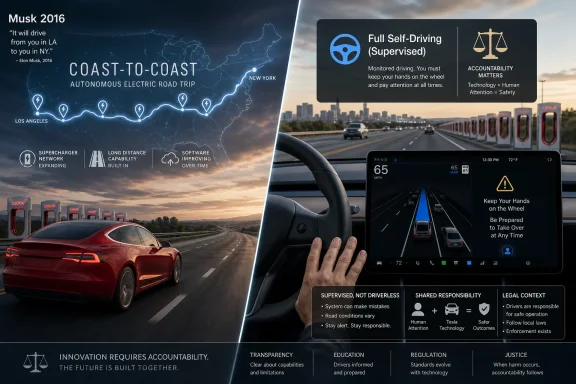
Elon Musk was predicting in January 2016 that Tesla owners would be able to summon a car across the United States within roughly two years, with the vehicle driving itself to the owner and automatically charging along the route. More than a decade later, that promise is still not a consumer product, and Tesla’s current Full Self-Driving remains a supervised driver-assistance system rather than an unsupervised autonomous chauffeur. The gap matters not because old quotes are embarrassing, but because Tesla’s autonomy story has always been a valuation story, a safety story, and a public-trust story. If the timeline was wrong by this much, the burden of proof has shifted from skeptics to Tesla.
The latest debate over Tesla Full Self-Driving often gets trapped in vocabulary. Is it Level 2, Level 2+, Level 2++, nearly Level 3, or “effectively” Level 4 in some narrow sense? The argument sounds technical, but underneath it is a much simpler question: who is responsible for the driving task when things go wrong?
Tesla’s own current language answers that question more clearly than many of its defenders do. Full Self-Driving is now commonly branded as Full Self-Driving (Supervised), and Tesla’s support language continues to say that the driver must remain attentive and ready to take over. That is the defining boundary between a driver-assistance system and autonomy.
What makes the 2016 summon prediction so potent is that it was not a vague hope about laboratory progress. Musk described a consumer-facing future in which a Tesla could be called from across the country, navigate public roads, find charging, charge itself, and arrive at the owner’s location. That is not “lane centering got better.” That is a robot vehicle completing a logistics mission without a human minder.
In hindsight, the most revealing part was not the coast-to-coast flourish. It was the charging assumption. The fantasy required not only self-driving software, but infrastructure, robotics, operational reliability, and regulatory permission all lining up on a two-year schedule. Tesla did show off its famous snake-like automated charger prototype, but the world of 2026 is not filled with Supercharger stalls that plug in unmanned cars.
But “better” is not the same as “autonomous.” A system can be impressive, even startlingly capable, and still be structurally dependent on a human safety operator. That is exactly the uncomfortable middle Tesla occupies: a car that may drive for long stretches while also requiring the person in the seat to behave as if it might fail at any moment.
That hybrid state creates a human-factors problem the industry has never solved cleanly. The more competent the automation feels, the more tempting it is for the human to mentally demote themselves from driver to passenger. Yet legally and practically, the human remains the fallback system.
This is why the “Level 2++” phrasing has gained traction among observers. It captures the reality that Tesla’s system is not ordinary adaptive cruise control, but it also resists the marketing gravity that pulls every successful demo toward “basically autonomous.” The plus signs are doing rhetorical work, but they do not change the accountability model.
That framing helped turn FSD from an option into a belief system. Buyers were not simply paying for features present on delivery day; many were buying into the idea that their vehicle would appreciate in usefulness, perhaps even generate income in a robotaxi network. The most aggressive versions of that pitch made the car sound less like a depreciating asset and more like a future revenue-producing machine.
The missed dates therefore have a different weight than ordinary product delays. If a company misses a delivery estimate for a new infotainment interface, the damage is annoyance. If it misses a decade of autonomy forecasts while selling a feature called Full Self-Driving, the damage is trust.
Musk’s defenders often argue that ambitious deadlines are part of Tesla’s culture. There is some truth to that. Tesla accelerated the EV market, forced legacy automakers to respond, and built a charging network that became a strategic asset. But autonomy is not just another aggressive manufacturing ramp. A late sedan annoys customers; a prematurely trusted driving system can put them in a ditch.
That matters because demos shape public understanding. A carefully staged route is not the same as a generally available product, but even a staged route would have suggested a certain level of system maturity. The absence of the demo became its own data point.
The automatic-charging wrinkle makes the claim even more revealing. A driverless car that cannot refuel itself is not truly independent over long distances. It may be able to move, but it cannot complete the operational loop. Autonomy is not just steering and braking; it is the whole chain of tasks required to deliver transportation without a human caretaker.
This is where Tesla’s vision has often outrun its execution. The company excels at making software progress visible to enthusiasts through updates, videos, and beta-like rollouts. It has been much less successful at converting that progress into an accountable, unsupervised mobility service available at scale.
A fleet can be constrained. It can use selected routes, defined service areas, remote assistance, local data, pre-surveyed environments, and heavy monitoring. It can be rolled out gradually and pulled back when conditions degrade. That is fundamentally different from telling a private owner that their car can drive itself from Miami to Seattle while they sleep.
This distinction is not unique to Tesla. Every serious autonomous-vehicle company has had to wrestle with the difference between a demo, a pilot, a geofenced commercial deployment, and broad consumer autonomy. The difference is that Tesla’s public narrative has often blurred those categories more aggressively than most.
If Tesla succeeds with a limited robotaxi service, it will be a significant achievement. It will not retroactively make years of consumer FSD promises accurate. Nor will miles accumulated with safety drivers or human supervision prove that the system is ready for unsupervised operation in private hands.
The industry should be judged by operational facts, not branding momentum. How many vehicles are operating without human drivers? In what conditions? Across what geography? With what disengagement profile, incident record, and regulatory oversight? Those questions are less exciting than a product event, but they are the only ones that matter.
The counterargument is equally simple: cars do not have to be limited to human senses. Radar, lidar, high-definition maps, and local infrastructure knowledge can provide redundancy and context that human drivers lack. In safety-critical systems, redundancy is not an aesthetic failure; it is often the point.
Tesla’s approach may eventually prove more scalable in some settings. A system that can learn from enormous fleet data and operate without painstaking city-by-city mapping would be a breakthrough. But the evidence required for that claim is enormous, and consumer FSD does not get to borrow the credibility of hypothetical future performance.
The weather problem is especially stubborn. Humans struggle in heavy rain, fog, glare, and snow; an automated vehicle that sees only through cameras inherits many of those limitations unless software can compensate reliably. The promise of autonomy should not be to reproduce human weakness with a better interface.
Marketing language matters because drivers form mental models from it. If a system is called “driver assistance,” users are more likely to understand their role. If it is called “Full Self-Driving,” the words push in the opposite direction, even when the fine print pulls them back.
This tension is not merely semantic. Driver monitoring, warnings, manuals, disclaimers, and in-car prompts all compete with the bigger story a company tells about its technology. When the CEO repeatedly says unsupervised autonomy is near, some users will inevitably treat supervised software as a preview of a capability it does not yet possess.
Regulators have struggled with this because the technology falls between older categories. Traditional automotive safety rules were built around vehicles controlled by humans. Software-defined driver assistance demands a more dynamic model: data reporting, incident visibility, update tracking, and clearer boundaries around what the system is allowed to claim.
What the public needs is structured data. How often do drivers intervene? What kinds of situations trigger interventions? How do rates vary by road type, weather, lighting, software version, and hardware generation? How many crashes occur while the system is engaged, recently disengaged, or plausibly influencing driver behavior?
Tesla knows more about these questions than anyone else. The vehicles are connected, the software is instrumented, and the fleet is large. But the most important safety metrics remain either unpublished, selectively framed, or difficult to compare with competitors and conventional driving.
A serious autonomy regime would require standardized reporting from every company offering advanced driver assistance or autonomous services. It would not rely on social-media clips, investor-deck aggregates, or carefully worded quarterly claims. It would give regulators and the public enough information to distinguish progress from theater.
That does not mean every raw engineering signal should be public. Companies need room to develop. But when a feature is sold to consumers and used on public roads, the balance cannot tilt entirely toward corporate secrecy. Public roads are not private beta labs.
The problem is not that a CEO was wrong once. The problem is repetition. A forecast that slips by six months can be explained by engineering difficulty. A forecast that slips by ten years becomes evidence that the forecasting method itself is broken.
Investors may decide they like the optionality anyway. Tesla’s market value has often reflected future categories more than present fundamentals, and autonomy remains one of the company’s largest narrative assets. But customers and regulators should not price Musk’s confidence the same way fans do.
The more responsible reading is that Tesla has an advanced Level 2 driver-assistance system, a large data advantage, a powerful brand, and a long record of missed autonomy deadlines. All four can be true at once. The mistake is allowing any one of them to erase the others.
Tesla’s FSD story resembles the most dangerous kind of software rollout: one where the demo is dazzling, the telemetry is proprietary, the edge cases are numerous, and the user is expected to act as both customer and last-resort QA. That model can be tolerable for a new UI pane. It is much less tolerable when the software controls a two-ton vehicle in traffic.
The analogy is not perfect, because cars are regulated differently and fail differently. But the operational mindset transfers. IT pros distrust vague readiness claims because they have seen what happens when marketing compresses risk into a version number. Autonomy deserves at least the same skepticism we apply to a rushed platform migration.
There is also a lesson in naming. Microsoft has shipped its share of confusing brands, preview channels, and features that sounded more complete than they were. But even the worst Windows naming dispute rarely asks users to bet their physical safety on the distinction between “supervised” and “unsupervised.”
It also remains possible that Tesla will find a commercially useful path through constrained autonomy before critics expect it. A geofenced robotaxi service, a more capable highway system, or tightly bounded unsupervised operation in favorable conditions would all be meaningful. The future does not have to validate the 2016 prediction to contain real progress.
But the standard must be reset. Tesla should be credited for capabilities it delivers, not for timelines it announces. The company’s autonomy claims should be treated as proposals awaiting evidence, not as inevitable milestones on a delayed but guaranteed roadmap.
That is the difference between skepticism and cynicism. Skepticism asks for proof proportional to the claim. Cynicism assumes proof will never arrive. Tesla has earned the former, even if some of its loudest critics have moved to the latter.
The practical takeaways are less glamorous than the dream, but they are more useful:
 The Old Prediction Is More Damaging Than the New One
The latest debate over Tesla Full Self-Driving often gets trapped in vocabulary. Is it Level 2, Level 2+, Level 2++, nearly Level 3, or “effectively” Level 4 in some narrow sense? The argument sounds technical, but underneath it is a much simpler question: who is responsible for the driving task when things go wrong?Tesla’s own current language answers that question more clearly than many of its defenders do. Full Self-Driving is now commonly branded as Full Self-Driving (Supervised), and Tesla’s support language continues to say that the driver must remain attentive and ready to take over. That is the defining boundary between a driver-assistance system and autonomy.
What makes the 2016 summon prediction so potent is that it was not a vague hope about laboratory progress. Musk described a consumer-facing future in which a Tesla could be called from across the country, navigate public roads, find charging, charge itself, and arrive at the owner’s location. That is not “lane centering got better.” That is a robot vehicle completing a logistics mission without a human minder.
In hindsight, the most revealing part was not the coast-to-coast flourish. It was the charging assumption. The fantasy required not only self-driving software, but infrastructure, robotics, operational reliability, and regulatory permission all lining up on a two-year schedule. Tesla did show off its famous snake-like automated charger prototype, but the world of 2026 is not filled with Supercharger stalls that plug in unmanned cars.
“Supervised” Is Doing a Lot of Work
Tesla has made real progress. Anyone who has followed FSD videos over the years can see the system has moved beyond the brittle lane-following of earlier driver-assistance packages. It can handle more streets, more turns, more traffic patterns, and more edge cases than many critics expected.But “better” is not the same as “autonomous.” A system can be impressive, even startlingly capable, and still be structurally dependent on a human safety operator. That is exactly the uncomfortable middle Tesla occupies: a car that may drive for long stretches while also requiring the person in the seat to behave as if it might fail at any moment.
That hybrid state creates a human-factors problem the industry has never solved cleanly. The more competent the automation feels, the more tempting it is for the human to mentally demote themselves from driver to passenger. Yet legally and practically, the human remains the fallback system.
This is why the “Level 2++” phrasing has gained traction among observers. It captures the reality that Tesla’s system is not ordinary adaptive cruise control, but it also resists the marketing gravity that pulls every successful demo toward “basically autonomous.” The plus signs are doing rhetorical work, but they do not change the accountability model.
Tesla’s Calendar Has Always Been Part of the Product
Tesla does not sell autonomy only as software. It sells autonomy as a timeline. Since the mid-2010s, the promise has been that cars on the road either already contain, or will soon receive, the capability needed for a far more valuable future.That framing helped turn FSD from an option into a belief system. Buyers were not simply paying for features present on delivery day; many were buying into the idea that their vehicle would appreciate in usefulness, perhaps even generate income in a robotaxi network. The most aggressive versions of that pitch made the car sound less like a depreciating asset and more like a future revenue-producing machine.
The missed dates therefore have a different weight than ordinary product delays. If a company misses a delivery estimate for a new infotainment interface, the damage is annoyance. If it misses a decade of autonomy forecasts while selling a feature called Full Self-Driving, the damage is trust.
Musk’s defenders often argue that ambitious deadlines are part of Tesla’s culture. There is some truth to that. Tesla accelerated the EV market, forced legacy automakers to respond, and built a charging network that became a strategic asset. But autonomy is not just another aggressive manufacturing ramp. A late sedan annoys customers; a prematurely trusted driving system can put them in a ditch.
The Coast-to-Coast Demo Became a Symbol of the Gap
The planned autonomous coast-to-coast drive has become one of Tesla’s most durable ghosts. It was supposed to demonstrate that the company’s vehicles could handle a complete long-distance trip with minimal or no intervention. It never arrived in the form Musk described.That matters because demos shape public understanding. A carefully staged route is not the same as a generally available product, but even a staged route would have suggested a certain level of system maturity. The absence of the demo became its own data point.
The automatic-charging wrinkle makes the claim even more revealing. A driverless car that cannot refuel itself is not truly independent over long distances. It may be able to move, but it cannot complete the operational loop. Autonomy is not just steering and braking; it is the whole chain of tasks required to deliver transportation without a human caretaker.
This is where Tesla’s vision has often outrun its execution. The company excels at making software progress visible to enthusiasts through updates, videos, and beta-like rollouts. It has been much less successful at converting that progress into an accountable, unsupervised mobility service available at scale.
Robotaxis Are Not a Loophole Around Consumer Autonomy
The emergence of Tesla robotaxi talk has muddied the conversation further. A controlled ride-hailing service in a defined city is not the same thing as giving every consumer car Level 4 capability everywhere. The operational design domain matters.A fleet can be constrained. It can use selected routes, defined service areas, remote assistance, local data, pre-surveyed environments, and heavy monitoring. It can be rolled out gradually and pulled back when conditions degrade. That is fundamentally different from telling a private owner that their car can drive itself from Miami to Seattle while they sleep.
This distinction is not unique to Tesla. Every serious autonomous-vehicle company has had to wrestle with the difference between a demo, a pilot, a geofenced commercial deployment, and broad consumer autonomy. The difference is that Tesla’s public narrative has often blurred those categories more aggressively than most.
If Tesla succeeds with a limited robotaxi service, it will be a significant achievement. It will not retroactively make years of consumer FSD promises accurate. Nor will miles accumulated with safety drivers or human supervision prove that the system is ready for unsupervised operation in private hands.
The industry should be judged by operational facts, not branding momentum. How many vehicles are operating without human drivers? In what conditions? Across what geography? With what disengagement profile, incident record, and regulatory oversight? Those questions are less exciting than a product event, but they are the only ones that matter.
Maps, Sensors, and the Philosophy Tesla Refuses to Abandon
Tesla’s autonomy strategy remains unusual because it leans so heavily on vision and neural-network generalization rather than the sensor-rich, map-heavy approach favored by many robotaxi competitors. Musk has long argued that humans drive primarily with vision, so cars should be able to do the same. It is an elegant argument, and it has obvious cost advantages if it works.The counterargument is equally simple: cars do not have to be limited to human senses. Radar, lidar, high-definition maps, and local infrastructure knowledge can provide redundancy and context that human drivers lack. In safety-critical systems, redundancy is not an aesthetic failure; it is often the point.
Tesla’s approach may eventually prove more scalable in some settings. A system that can learn from enormous fleet data and operate without painstaking city-by-city mapping would be a breakthrough. But the evidence required for that claim is enormous, and consumer FSD does not get to borrow the credibility of hypothetical future performance.
The weather problem is especially stubborn. Humans struggle in heavy rain, fog, glare, and snow; an automated vehicle that sees only through cameras inherits many of those limitations unless software can compensate reliably. The promise of autonomy should not be to reproduce human weakness with a better interface.
The Naming Problem Became a Safety Problem
“Full Self-Driving” has always been a provocative name. Tesla later adding “Supervised” improved the accuracy, but it also created one of the strangest product names in modern transportation: Full Self-Driving that is not full, not self-driving in the unsupervised sense, and explicitly requires supervision.Marketing language matters because drivers form mental models from it. If a system is called “driver assistance,” users are more likely to understand their role. If it is called “Full Self-Driving,” the words push in the opposite direction, even when the fine print pulls them back.
This tension is not merely semantic. Driver monitoring, warnings, manuals, disclaimers, and in-car prompts all compete with the bigger story a company tells about its technology. When the CEO repeatedly says unsupervised autonomy is near, some users will inevitably treat supervised software as a preview of a capability it does not yet possess.
Regulators have struggled with this because the technology falls between older categories. Traditional automotive safety rules were built around vehicles controlled by humans. Software-defined driver assistance demands a more dynamic model: data reporting, incident visibility, update tracking, and clearer boundaries around what the system is allowed to claim.
The Missing Public Dataset Is the Real Scandal
The most frustrating part of the FSD debate is that outsiders are left arguing through anecdotes. Supporters post long successful drives. Critics post failures, interventions, and near misses. Both can be true, and neither is enough.What the public needs is structured data. How often do drivers intervene? What kinds of situations trigger interventions? How do rates vary by road type, weather, lighting, software version, and hardware generation? How many crashes occur while the system is engaged, recently disengaged, or plausibly influencing driver behavior?
Tesla knows more about these questions than anyone else. The vehicles are connected, the software is instrumented, and the fleet is large. But the most important safety metrics remain either unpublished, selectively framed, or difficult to compare with competitors and conventional driving.
A serious autonomy regime would require standardized reporting from every company offering advanced driver assistance or autonomous services. It would not rely on social-media clips, investor-deck aggregates, or carefully worded quarterly claims. It would give regulators and the public enough information to distinguish progress from theater.
That does not mean every raw engineering signal should be public. Companies need room to develop. But when a feature is sold to consumers and used on public roads, the balance cannot tilt entirely toward corporate secrecy. Public roads are not private beta labs.
The Qualifiers Have Lost Their Warranty
Musk’s language has always included escape hatches: “probably,” “I think,” “fairly confident,” “quite confident,” and the occasional admission that he may be optimistic. In ordinary conversation, those qualifiers soften a prediction. In Tesla’s autonomy history, they have become part of the machinery.The problem is not that a CEO was wrong once. The problem is repetition. A forecast that slips by six months can be explained by engineering difficulty. A forecast that slips by ten years becomes evidence that the forecasting method itself is broken.
Investors may decide they like the optionality anyway. Tesla’s market value has often reflected future categories more than present fundamentals, and autonomy remains one of the company’s largest narrative assets. But customers and regulators should not price Musk’s confidence the same way fans do.
The more responsible reading is that Tesla has an advanced Level 2 driver-assistance system, a large data advantage, a powerful brand, and a long record of missed autonomy deadlines. All four can be true at once. The mistake is allowing any one of them to erase the others.
Windows People Should Recognize This Failure Mode
For WindowsForum readers, there is a familiar software lesson here. Anyone who has administered Windows fleets knows the difference between a feature being available, a feature being reliable, and a feature being safe to deploy broadly. The release notes are not the deployment plan.Tesla’s FSD story resembles the most dangerous kind of software rollout: one where the demo is dazzling, the telemetry is proprietary, the edge cases are numerous, and the user is expected to act as both customer and last-resort QA. That model can be tolerable for a new UI pane. It is much less tolerable when the software controls a two-ton vehicle in traffic.
The analogy is not perfect, because cars are regulated differently and fail differently. But the operational mindset transfers. IT pros distrust vague readiness claims because they have seen what happens when marketing compresses risk into a version number. Autonomy deserves at least the same skepticism we apply to a rushed platform migration.
There is also a lesson in naming. Microsoft has shipped its share of confusing brands, preview channels, and features that sounded more complete than they were. But even the worst Windows naming dispute rarely asks users to bet their physical safety on the distinction between “supervised” and “unsupervised.”
The Narrow Facts Tesla Can Still Build On
None of this means Tesla is doomed in autonomy. The company has vehicles on the road, customers using the software, vast amounts of driving data, and the ability to update cars quickly. Those are real advantages, and competitors ignore them at their peril.It also remains possible that Tesla will find a commercially useful path through constrained autonomy before critics expect it. A geofenced robotaxi service, a more capable highway system, or tightly bounded unsupervised operation in favorable conditions would all be meaningful. The future does not have to validate the 2016 prediction to contain real progress.
But the standard must be reset. Tesla should be credited for capabilities it delivers, not for timelines it announces. The company’s autonomy claims should be treated as proposals awaiting evidence, not as inevitable milestones on a delayed but guaranteed roadmap.
That is the difference between skepticism and cynicism. Skepticism asks for proof proportional to the claim. Cynicism assumes proof will never arrive. Tesla has earned the former, even if some of its loudest critics have moved to the latter.
The Decade-Old Summon Promise Still Defines the Debate
The 2016 cross-country summon claim is not just an old quote revived for dunking. It is a benchmark against which Tesla’s autonomy rhetoric can be measured. By that benchmark, the company is not late by a product cycle; it is late by an era.The practical takeaways are less glamorous than the dream, but they are more useful:
- Tesla Full Self-Driving (Supervised) should be treated as an advanced driver-assistance system that requires continuous human attention.
- A limited robotaxi deployment would not prove that privately owned Teslas can operate as general-purpose autonomous vehicles.
- Claims about autonomy miles are only meaningful when they separate supervised, safety-driver, remote-assisted, and truly driverless operation.
- Automatic long-distance vehicle independence requires charging, infrastructure, regulation, and operational support, not only better lane and turn handling.
- Musk’s autonomy timelines should be discounted heavily unless paired with verifiable deployment details and transparent safety data.
- Regulators should demand standardized reporting for interventions, crashes, near misses, and software-version performance across advanced driver-assistance systems.
References
- Primary source: CleanTechnica
Published: Sun, 14 Jun 2026 19:02:47 GMT
Loading…
cleantechnica.com - Related coverage: forbes.com
Loading…
www.forbes.com - Related coverage: fool.com
Loading…
www.fool.com - Related coverage: electrek.co
Loading…
electrek.co - Related coverage: roadandtrack.com
Loading…
www.roadandtrack.com - Related coverage: techspot.com
Loading…
www.techspot.com