

THE.Hosting’s new interactive VPS server configurator promises to let customers “build the perfect configuration in minutes,” offering per-core pricing, ECC memory choices, NVMe storage, and deployment across more than 50 countries — but a closer look at the product pages, press coverage, and independent user feedback shows a mix of genuine innovation, useful transparency, and practical caveats buyers must weigh before committing their infrastructure to a single vendor.
THE.Hosting is a Netherlands‑based hosting company that has increased its public profile through a series of press items and product updates throughout late 2025 and early 2026. The company published a high‑level year review and roadmap that explicitly referenced the launch of an interactive configurator as part of its 2026 product expansion. The company website lists a global footprint described as “more than 50 locations,” advertises KVM virtualization, 10 Gbps network ports, NVMe storage, and various tariff lines for VPS and dedicated servers. The homepage and product pages show the vendor’s public positioning and specific plan examples, while a January 22, 2026 press article summarizes the new configurator’s marketing claims in plain language.
Source: Weekly Voice THE.Hosting Introduces a New Server Configurator for VPS Deployment
 Background
THE.Hosting is a Netherlands‑based hosting company that has increased its public profile through a series of press items and product updates throughout late 2025 and early 2026. The company published a high‑level year review and roadmap that explicitly referenced the launch of an interactive configurator as part of its 2026 product expansion. The company website lists a global footprint described as “more than 50 locations,” advertises KVM virtualization, 10 Gbps network ports, NVMe storage, and various tariff lines for VPS and dedicated servers. The homepage and product pages show the vendor’s public positioning and specific plan examples, while a January 22, 2026 press article summarizes the new configurator’s marketing claims in plain language. What THE.Hosting says the configurator does
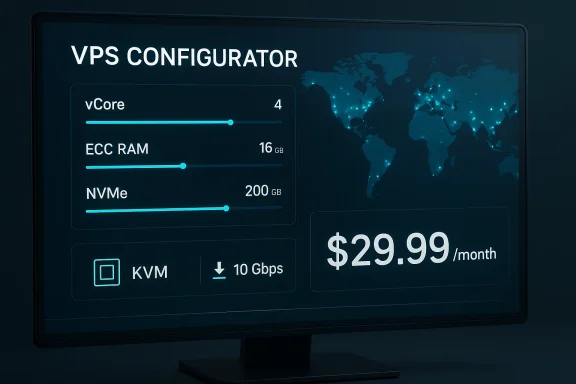
THE.Hosting’s public messaging and the Weekly Voice press item present the core value proposition succinctly: a user-facing configurator that:- Lets customers select vCore counts (advertised 1 to 64), RAM (1 GB to 128 GB ECC), and NVMe disk (15 GB to 2,000 GB) using sliders or selectors.
- Shows price updates in real time so buyers can see the final monthly cost before ordering.
- Is available across 50+ countries, allowing customers to deploy identical configurations in multiple regions.
- Offers immediate provisioning once the order is paid — the press copy claims 2–5 minutes, while the company website elsewhere lists a “just 15 minutes” timeframe for servers to go live, which is a notable inconsistency.
Verification: what the public pages actually show
We examined THE.Hosting’s site and related press items to cross‑check the major technical claims and availability statements.- The THE.Hosting site lists a detailed VPS product matrix and a VPS configurator section that enumerates countries and configuration options. The site explicitly advertises KVM virtualization, 10 Gbps ports, unlimited traffic, and a “more than 50 locations” presence. Sample tariffs and the Ferrum entry plan demonstrate baseline resource units (1 vCore, 1 GB ECC RAM, 15 GB NVMe) and show a consistent UI for selecting country and tariff.
- Dedicated server and NVMe product pages include high‑end examples reaching 32 CPU cores (64 threads) and 64–128 GB RAM in dedicated plans, along with 10 Gbps ports for many SKUs. Those dedicated server listings confirm the vendor’s capacity to present large‑scale configurations, although dedicated servers are a different product class than per‑core VPS shapes.
- The company’s PR summary (PR Newswire) reiterates the configurator launch and the 50+ countries presence as strategic priorities for 2026, adding corporate context for the feature rollout.
How the configurator is said to work (user flow)
The marketing copy describes a simple four‑step flow intended for speed and predictability:- Select a location from one of 50+ countries.
- Adjust resource sliders for vCore, RAM, and disk (NVMe).
- Choose an operating system (Linux distributions and Windows Server are listed).
- See the final price update instantly; pay online and receive server access within minutes. The press copy claims 2–5 minutes; the site itself indicates servers go live in about 15 minutes.
The strengths: where THE.Hosting’s configurator can genuinely help
- True self‑service customization. For projects that don’t fit a grid of fixed plans, a slider‑style configurator reduces friction and procurement lead time — valuable for DevOps teams, early‑stage startups, and rapid MVP cycles. This is the core product advantage THE.Hosting markets.
- Per‑core and per‑unit transparency. The vendor advertises transparent per‑core pricing and live price updates. That lowers the cognitive cost of right‑sizing (and the risk of paying for unused resources). Transparency in billing is a key buying factor for small teams.
- NVMe and ECC options. The presence of NVMe storage and ECC memory in listings is a positive signal for performance‑sensitive workloads and database engines that benefit from higher IOPS and memory reliability. The dedicated server pages show substantial NVMe and RAM sizes.
- Global footprint on paper. A 50+ country presence can be a major asset for low‑latency regional deployments and regulatory/regional data residency needs when it is implemented uniformly. THE.Hosting explicitly promotes the multi‑region capability.
- KVM virtualization and 10 Gbps ports. KVM is a well‑understood hypervisor that supports full isolation and varied guest OS choices; 10 Gbps ports are attractive for throughput‑sensitive applications. THE.Hosting lists both as standard characteristics.
The risks and red flags: what to watch for
- Customer experience variability in public reviews. Independent review sites show mixed to negative experiences for some customers — including complaints about account suspension, latency inconsistencies, and slow uploads — which indicate operational or support gaps for certain customers and locations. These grievances should not be dismissed: they reflect real incidents that prospective buyers must evaluate against their tolerance for vendor risk.
- Provisioning time discrepancy. The press coverage claims provisioning in 2–5 minutes, but THE.Hosting’s site elsewhere states “Just 15 minutes” for servers to go live. This inconsistency matters for automation and CI/CD pipelines that may assume near‑instant provisioning. Buyers should test provisioning time in their target region and SKU before scheduling production deployments.
- Region parity and geolocation accuracy. Several user complaints allege mismatch between advertised node location and observed latency or IP geolocation. Multi‑region rollouts are operationally complex; an advertised presence in a country does not guarantee the same underlying stack, peering, or IP geolocation fidelity everywhere. Validate latency and traceroute to target endpoints before cutting over production traffic.
- Support and KYC workflow concerns. Some reviewers describe abrupt suspensions and demanding KYC procedures that delayed access or refunds. For businesses that require fast, dependable recovery and predictable support escalation, a vendor’s account‑management and compliance workflow are material risk factors. Ask for a documented escalation path and SLA.
- Promotional marketing vs. consistent guarantees. Marketing assertions about “identical server configurations with the same prices and conditions across all 50+ locations” are appealing but potentially misleading; local taxes, legal compliance, and data center partner arrangements can affect final pricing or available SKUs. Treat cross‑region parity as a goal to be validated per region, not a guaranteed fact.
Technical analysis: what the specs mean in practice
KVM virtualization and guaranteed resources
KVM is an industry‑standard hypervisor providing strong isolation and broad OS support. When vendors say “guaranteed resources,” they typically mean a combination of CPU pinning or dedicated vCore allocation, memory reservation, and I/O reservations rather than purely overprovisioned bursting. Buyers should request the hypervisor policy (pinned vs. shared vCPUs), true underlying CPU model, and oversubscription ratios for each region/SKU. THE.Hosting lists KVM and shows tariff examples that imply pinned vCores on some offerings.NVMe storage, ECC RAM, and performance expectations
NVMe offers big performance advantages over SATA SSDs for random I/O and database workloads. ECC RAM reduces the risk of memory errors in critical applications. THE.Hosting’s product pages show NVMe as a core part of their VPS and dedicated offers, and listed dedicated SKUs reach meaningful RAM and disk sizes. For production workloads, buyers should benchmark raw I/O (fio) and workload‑level performance (database throughput, app P95 latencies) during a short proof‑of‑concept to detect noisy‑neighbor effects.Network: 10 Gbps port claims and real throughput
The presence of a physical 10 Gbps port on the host node is a positive sign, but cloud and VPS buyers should understand whether the per‑instance bandwidth is guaranteed or shared across the node. THE.Hosting’s pages state “10 Gbps” and note that bandwidth speed correlates with tariff level — that suggests the node has high capacity but per‑VPS bandwidth may vary by SKU. Validate per‑instance capped throughput, shaping behavior, and whether the host enforces burst ceilings.Procurement checklist: validating THE.Hosting before purchase
- Confirm the exact SKU limits and per‑region availability you intend to use. Use the configurator and try deploying a test instance in each target country.
- Measure real latency, jitter, and traceroute from your CI/CD runner or application endpoints to the new VPS. Do not rely solely on advertised location names.
- Test provisioning automation (API or web flow) and record the real “time to access” for the SKUs and regions you plan to use; expect variations from marketing copy.
- Request the vendor’s hypervisor policy: are vCores pinned or shared? Ask for oversubscription ratios and noisy neighbor mitigation.
- Validate backup and snapshot options, including retention, restore time objectives (RTOs), and whether restores are automated or manual.
- Open a support ticket to gauge real support responsiveness and escalation paths, and check for any KYC process or account verification that might affect billing or access.
Pricing transparency and SLA considerations
THE.Hosting markets real‑time pricing in the configurator and claims “no hidden fees.” That is a meaningful differentiator if the vendor truly reflects all ancillary costs (IPv6, control panel licenses, Windows Server licensing, backups, snapshots, and cross‑border tax/VAT additions) at checkout. The company pages list optional control panels and paid extras, which suggests some add‑ons are not included by default — typical for most hosts. Prospective customers should insist on a final‑price checkout screen that itemizes every recurring and one‑time fee for their exact configuration before paying. SLAs: THE.Hosting’s public pages emphasize 24/7 support but do not publish robust, enterprise‑grade SLA credits or uptime guarantees in the highlighted marketing copy. For production workloads where downtime equals revenue loss, buyers should request the vendor’s SLA PDF, service credits formula, scheduled maintenance windows, and details on how credits are applied (automatic vs. claim‑based). If compliance matters (PCI/DSS, SOC‑2), verify certifications and third‑party attestations prior to purchase.Real‑world customer feedback and what it implies
Independent reviews — including Trustpilot entries and user reports — show polarized experiences: some customers praise speed and price, while others cite account suspensions, suspected geolocation mismatches, and slow support responses. These mixed results are common for mid‑market hosts that expand rapidly across many data centers; rapid expansion often exposes operational gaps in billing, IP provisioning, peering relationships, and support staffing. Treat these reviews as red flags to investigate rather than as disqualifying condemnation: ascertain whether reported issues occurred in the specific target regions and SKUs you plan to use.When THE.Hosting’s configurator makes sense — and when it doesn't
- Best fit:
- DevOps teams building ephemeral test environments that need precise right‑sizing.
- Startups and small companies that want clear per‑unit pricing to control costs.
- Projects that require distributed regional presence for latency improvements and data locality (provided you validate actual node locality).
- Not recommended as a first choice:
- Mission‑critical production systems that require documented, heavy SLAs and formal support escalation unless the vendor can provide contractual SLA commitments.
- Applications that require guaranteed bare‑metal performance or specialized networking that only colocation or dedicated hosts can reliably provide.
Practical next steps for IT buyers
- Use the configurator and spin up a non‑production replica of your application in the target region. Measure end‑to‑end performance for 72 hours.
- Recreate a failure scenario: take a snapshot, delete an instance, and restore from snapshot to validate RTO.
- Confirm Windows licensing implications if you plan to run Windows Server images — licensing fees may be passed through as additional monthly costs and vary by region.
- If you rely on strict IP geolocation, verify trace routes and third‑party geolocation lookups to ensure advertised country presence matches reality.
Conclusion
THE.Hosting’s new server configurator is a pragmatic step toward self‑service, transparent VPS procurement — an approach that fits modern DevOps and startup workflows well. The vendor’s public pages and press materials substantiate many of the headline features: KVM virtualization, NVMe storage, a global footprint, and a slider‑style configurator that aims to expose per‑unit pricing. However, there are important operational questions to answer before treating THE.Hosting as a default choice for production infrastructure: live provisioning times differ between announcements (2–5 minutes vs. 15 minutes), independent reviews report service and support issues in some cases, and cross‑region parity — while marketed — must be validated for each target country. Prospective buyers should perform short proof‑of‑concepts, validate latency and per‑SKU throughput, and confirm SLA and billing particulars in writing. Treat the configurator as a powerful tool that can deliver value — provided you validate the specific behaviors that matter for your workload.Source: Weekly Voice THE.Hosting Introduces a New Server Configurator for VPS Deployment
