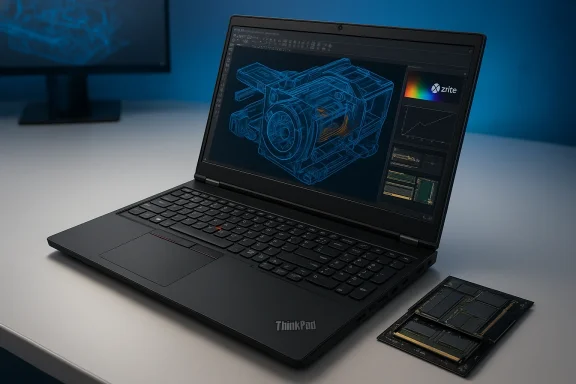
Lenovo’s ThinkPad P16 Gen 3 arrives as a deliberate, unapologetic answer to professionals who demand desktop-class performance in a portable chassis — and on first impressions it looks like the most capable ThinkPad mobile workstation Lenovo has delivered in years.
Lenovo unveiled the P16 Gen 3 at IFA 2025 as the company’s flagship 16‑inch mobile workstation, positioned to compete head‑on with the high‑end offerings from Dell and HP. The machine brings Intel’s Core Ultra HX series to the P lineup, pairs those CPUs with the latest NVIDIA Blackwell‑generation RTX Pro laptop GPUs, and significantly raises the memory and storage ceilings compared with prior generations — up to 192 GB of DDR5 and as many as three PCIe Gen5 SSDs for a theoretical 12 TB of on‑board storage.
These are not incremental changes. The P16 Gen 3 is designed for engineers, VFX artists, data scientists, and other professionals who rely on sustained multi‑threaded CPU throughput, large working sets in RAM, and high GPU compute for rendering, simulation, and machine learning workflows. Lenovo’s messaging emphasizes “mobile power for AI” alongside the usual ISV‑certified workstation credentials, and the spec sheet reflects that ambition.
What’s different is the size and weight profile. The P16 is a proper desktop replacement — you will notice it in a backpack. Lenovo’s own materials point to weights in the neighborhood of mid‑five pounds for OLED‑equipped configurations and an overall thicker profile to accommodate increased thermal hardware and multiple SSD slots. That weight buys significantly higher sustained performance and expandability compared with ultraportable creators’ machines.
Key design highlights:
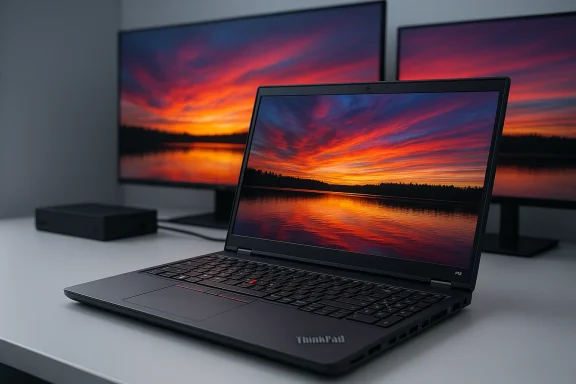
If you depend on color accuracy, the OLED configuration is the obvious choice: it offers deep blacks, a wide DCI‑P3 palette, and factory calibration on many SKUs. Lenovo also provides high‑brightness IPS alternatives for customers who prefer non‑OLED characteristics or want higher refresh rates and different power tradeoffs.
Practical takeaways:
Lenovo’s spec documents and third‑party coverage emphasize this multi‑modal compute approach: CPU cores for heavy single‑thread and multi‑thread tasks, a high‑TGP discrete GPU for rendering and CUDA workloads, and package NPUs for AI inference acceleration where appropriate. The platform aims to make the P16 usable for modern, mixed workloads without forcing buyers to choose between CPU flexibility and GPU muscle.
Why that matters:
Independent reviews and first looks report excellent real‑world throughput for GPU‑bound tasks; TechRadar’s hands‑on highlighted strong multi‑tasking and GPU performance under extended sessions, backing Lenovo’s claims that the P16 can handle sustained heavy workloads.
Important context:
Thermal behavior in practice:
This I/O mix matters for professionals who:
For creators and studios, this combination of hardware and certified software helps reduce the friction of deploying updated workstations across teams where reproducible performance and driver stability are important.
Community posts from early adopters provide practical data points: Cinebench runs on high‑end Core Ultra HX SKUs show multi‑core throughput in expected ranges for HX‑class silicon, while GPU‑bound workloads achieve levels consistent with Blackwell GPU expectations. However, community testing also highlights the usual variability across power configurations and driver maturity — so treat early numbers as directional rather than definitive.
That decision will delight studios and teams that need local performance and expandability. It will frustrate users who expected a lightweight, quiet, battery‑dominant machine with similar GPU muscle. For the target audience — engineers, data scientists, VFX and post teams, and ISV‑centric enterprise customers — the P16 Gen 3 is a powerful, thoughtfully configured option that brings modern AI‑aware hardware to the ThinkPad stable.
If you’re considering the P16 Gen 3:
Conclusion
The ThinkPad P16 Gen 3 is Lenovo’s statement that mobile workstations can be both modern and uncompromising. Built on a platform designed for mixed CPU/GPU/AI workloads, with high expandability and enterprise polish, it invites serious buyers to rethink what “mobile” means in a professional context. If your job needs the performance and scalability the P16 offers — and you accept the tradeoffs of weight, acoustics, and price — Lenovo has delivered a compelling workstation that earns a place on any shortlist of 16‑inch, pro‑grade laptops in 2025–2026.
Source: Thurrott.com p16-flat - Thurrott.com
 Background / Overview
Lenovo unveiled the P16 Gen 3 at IFA 2025 as the company’s flagship 16‑inch mobile workstation, positioned to compete head‑on with the high‑end offerings from Dell and HP. The machine brings Intel’s Core Ultra HX series to the P lineup, pairs those CPUs with the latest NVIDIA Blackwell‑generation RTX Pro laptop GPUs, and significantly raises the memory and storage ceilings compared with prior generations — up to 192 GB of DDR5 and as many as three PCIe Gen5 SSDs for a theoretical 12 TB of on‑board storage.These are not incremental changes. The P16 Gen 3 is designed for engineers, VFX artists, data scientists, and other professionals who rely on sustained multi‑threaded CPU throughput, large working sets in RAM, and high GPU compute for rendering, simulation, and machine learning workflows. Lenovo’s messaging emphasizes “mobile power for AI” alongside the usual ISV‑certified workstation credentials, and the spec sheet reflects that ambition.
Design and build: familiar ThinkPad DNA, but heavier and business‑purposeful
On the outside, the P16 Gen 3 looks and feels like a ThinkPad: conservative, black, and built for durability. The chassis retains the squared, industrial aesthetic that the P‑series customers expect, with strong hinge architecture and a traditional matte lid finish. ThinkPad staples such as the red TrackPoint, a full‑travel keyboard tuned for long sessions, and business‑grade security options remain central to the user experience.What’s different is the size and weight profile. The P16 is a proper desktop replacement — you will notice it in a backpack. Lenovo’s own materials point to weights in the neighborhood of mid‑five pounds for OLED‑equipped configurations and an overall thicker profile to accommodate increased thermal hardware and multiple SSD slots. That weight buys significantly higher sustained performance and expandability compared with ultraportable creators’ machines.
Key design highlights:
- Workstation-grade build with ISV focus and enterprise manageability.
- Full‑size keyboard with TrackPoint and ThinkPad‑style input ergonomics.
- Accessible serviceability for RAM and storage upgrades in many configurations.
- Heavier, thicker chassis to support higher‑TDP CPUs, discrete Blackwell GPUs, and triple SSD bays.
Displays: Tandem OLED, 3.2K, and color fidelity for creators
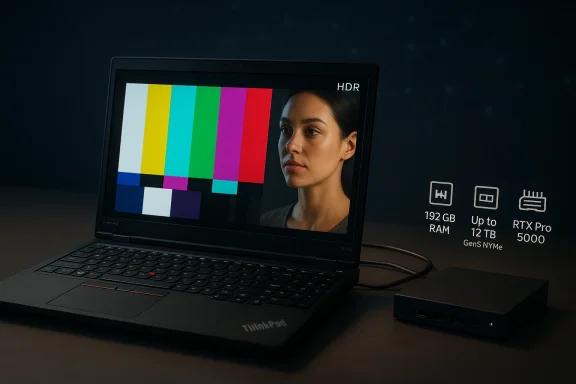
Lenovo offers a range of 16‑inch panels for the P16 Gen 3, but the most compelling option — and the one Lenovo highlights for creative professionals — is the 3.2K 16:10 Tandem OLED (3.2K, WQUXGA‑class) with high brightness, wide color gamut, and options supporting Dolby Vision and DisplayHDR. These panels aim to deliver accurate, saturated color for video and color grading work while maintaining the high contrast OLED is known for.If you depend on color accuracy, the OLED configuration is the obvious choice: it offers deep blacks, a wide DCI‑P3 palette, and factory calibration on many SKUs. Lenovo also provides high‑brightness IPS alternatives for customers who prefer non‑OLED characteristics or want higher refresh rates and different power tradeoffs.
Practical takeaways:
- Ideal for color‑critical workflows (video editing, VFX, compositing).
- OLED advantages: contrast, deep blacks, Dolby Vision HDR support.
- IPS alternatives retain good color coverage and may be preferable where burn‑in concerns exist.
Internal platform: Core Ultra HX, NPUs, and AI‑forward packaging
The P16 Gen 3 follows the industry shift to the Intel Core Ultra HX family for mobile workstations, bringing hybrid CPU architectures, high core counts, and integrated NPUs (Neural Processing Units) for on‑device AI workloads. Combined with NVIDIA’s Blackwell laptop GPUs (RTX Pro 2000 through RTX Pro 5000 options), the P16 is positioned to accelerate not only traditional GPU‑bound tasks but also newer AI‑augmented pipelines that can offload preprocessing or inference work to the CPU package NPU.Lenovo’s spec documents and third‑party coverage emphasize this multi‑modal compute approach: CPU cores for heavy single‑thread and multi‑thread tasks, a high‑TGP discrete GPU for rendering and CUDA workloads, and package NPUs for AI inference acceleration where appropriate. The platform aims to make the P16 usable for modern, mixed workloads without forcing buyers to choose between CPU flexibility and GPU muscle.
Memory and storage: absurd ceilings, practical benefits
One of the P16 Gen 3’s clearest selling points is expandability. Lenovo lists support for up to 192 GB of DDR5 system memory — a level normally reserved for desktop workstations and heavy virtualization hosts — and multiple M.2 PCIe Gen5 slots that allow up to 12 TB of local NVMe storage in certain configurations. This is a huge advantage for professionals who need to keep large datasets, 3D assets, or multi‑stream media locally without constant NAS dependency.Why that matters:
- Large RAM ceilings reduce the need to page to disk when working with expansive datasets (photogrammetry, large CAD assemblies, ML datasets).
- Multiple Gen5 SSDs can store active projects locally at blistering speeds, simplifying mobile studio workflows and reducing latency when working with large files.
GPU options and performance expectations: Blackwell arrives in force
Lenovo has equipped the P16 Gen 3 with the newest NVIDIA Blackwell‑generation RTX Pro laptop GPUs, with options ranging up to the RTX Pro 5000 (a 24 GB GDDR7 laptop GPU in Lenovo’s high‑end SKUs). These GPUs bring improved ray tracing, AI acceleration, and performance per watt compared with prior generations — features that directly benefit rendering, complex simulation, and ML training or inference on device.Independent reviews and first looks report excellent real‑world throughput for GPU‑bound tasks; TechRadar’s hands‑on highlighted strong multi‑tasking and GPU performance under extended sessions, backing Lenovo’s claims that the P16 can handle sustained heavy workloads.
Important context:
- Laptop GPU performance depends heavily on configured power limits (TGP/TDP) and cooling; observed scores can vary between retail SKUs and pre‑production press units. Some community observers have noted that Lenovo’s PSREF changed how power figures are presented between updates, so the best way to confirm peak sustained GPU performance is through independent benchmarks on the exact SKU you intend to buy.
Thermals and sustained load: the engineering tradeoffs
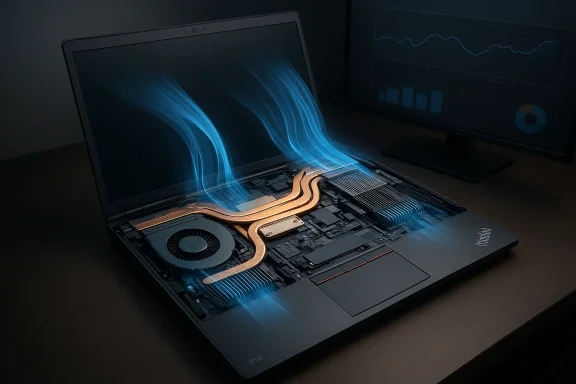
Delivering desktop‑class performance in a laptop requires thermal headroom. Lenovo’s P16 Gen 3 uses a beefed‑up cooling solution and a thicker chassis to push higher sustained CPU and GPU power than a thin‑and‑light laptop can. That enables long compilation runs, multi‑GPU rendering passes, and extended simulation jobs without immediate thermal throttling — but it also means the machine has to be treated as a portable workstation rather than an ultralight companion.Thermal behavior in practice:
- Expect audible fan profiles under heavy load; the cooling system prioritizes sustained frequency and thermal stability over whisper‑quiet operation.
- Configurations with RTX Pro 5000 and top‑end Core Ultra HX SKUs will run warmer and may need external docking or cooling when used in space‑constrained environments.
- For most professional workflows, the tradeoff favors consistent throughput — and that’s what Lenovo optimized for.
Ports, expandability, and connectivity
One criticism often aimed at premium mobile workstations is a lack of practical I/O for pro workflows; Lenovo addresses this with a robust port selection on the P16 Gen 3. Key connectivity features reported in official material and hands‑on impressions include multiple Thunderbolt ports (Thunderbolt 5 on some SKUs), USB‑A ports for legacy devices, HDMI output (often HDMI 2.1 on select SKUs), and enterprise networking options including Wi‑Fi 7 and optional 5G.This I/O mix matters for professionals who:
- Connect to high‑bandwidth NVMe RAID enclosures via Thunderbolt.
- Drive multiple 4K and even 8K external displays from the laptop.
- Need wired and cellular connectivity options for fieldwork.
Software, security, and ISV certifications
As a ThinkPad P‑series workstation, Lenovo positions the P16 Gen 3 as an ISV‑certified platform for major professional applications (Autodesk, Adobe, Dassault, Siemens, and others). Those certifications matter in enterprise procurement and for professionals whose toolchains rely on well‑tested drivers and validated performance modes. Lenovo also includes the usual enterprise security stack: TPM, optional smart card readers, Windows‑friendly management tooling, and BIOS/firmware features designed for managed fleets.For creators and studios, this combination of hardware and certified software helps reduce the friction of deploying updated workstations across teams where reproducible performance and driver stability are important.
Real‑world impressions and early benchmarks
Early hands‑on reviews and user reports paint a consistent picture: the P16 Gen 3 is fast, stable, and built for heavy work. TechRadar’s review called it “a spectacular spectacle in the mobile workstation world,” noting strong daily productivity across video, database, and multi‑stream tasks, and a comfortable typing and collaboration experience during extended sessions.Community posts from early adopters provide practical data points: Cinebench runs on high‑end Core Ultra HX SKUs show multi‑core throughput in expected ranges for HX‑class silicon, while GPU‑bound workloads achieve levels consistent with Blackwell GPU expectations. However, community testing also highlights the usual variability across power configurations and driver maturity — so treat early numbers as directional rather than definitive.
Strengths: where the P16 Gen 3 excels
- Sustained, workstation‑class performance for CPU and GPU workloads — a clear desktop replacement.
- High memory and storage ceilings that remove constraints for large projects, datasets, and local cache needs.
- Professional I/O and connectivity, including Thunderbolt 5, Wi‑Fi 7, and optional 5G for mobile professionals.
- Display options that prioritize color fidelity and HDR, with OLED available for color‑critical workflows.
- Enterprise readiness via ISV certifications and ThinkPad manageability features.
Risks, tradeoffs, and cautions
- Weight and portability: This is a heavy mobile workstation. If you need a light daily carry, consider a P1 or a creative ultrabook instead.
- Power, thermals, and acoustics: To sustain desktop‑like performance the P16 runs fans and temperatures higher than passageway ultrabooks; expect noise under load.
- SKU variability & performance variance: Performance depends on the exact CPU/GPU/TGP package and firmware/driver state. Lenovo’s documentation has evolved, and some PSREF entries have changed how power figures are presented — meaning prospective buyers should confirm the SKU’s power and cooling limits before buying.
- Price: This isn’t an inexpensive laptop. Outfitted with top CPUs, 24 GB Blackwell GPUs, and OLED panels, a P16 can quickly approach enterprise workstation pricing that demands a strong ROI analysis. Thurrott’s IFA coverage and initial press materials list starting pricing in the low‑to‑mid thousands, with high‑end configurations substantially more expensive.
Who should buy the ThinkPad P16 Gen 3?
- Professionals who need a true mobile desktop replacement: editors, VFX artists, CAD/BIM engineers, and researchers who work on large data sets.
- IT teams procuring ISV‑certified laptops for enterprise workflows where validated drivers and manageability matter.
- Buyers who prioritize sustained throughput over ultra‑thin portability and are comfortable carrying a heavier machine for the performance payoff.
Pricing and availability
Lenovo announced the P16 Gen 3 in September 2025 with shipping windows beginning in October in many regions; pricing starts in the workstation range (Thurrott cited entry family pricing and showed higher MSRP for fully configured models). Exact pricing varies by region and configuration; the cost for a fully loaded OLED/Blackwell machine can quickly reach premium workstation levels and is often higher through enterprise channels. Always check the target SKU’s final retail or channel price and request sample hardware for departmental procurement when possible.Final analysis: an uncompromising choice for professionals
Lenovo’s ThinkPad P16 Gen 3 stakes a clear claim: this is a professional machine first and a travel companion second. Where other vendors have split their attention between thin‑and‑light creators and traditional workstation markets, the P16 Gen 3 chooses the latter and leans into it with high memory ceilings, triple Gen5 storage support, Blackwell GPU options, and Intel Core Ultra HX silicon with package NPUs.That decision will delight studios and teams that need local performance and expandability. It will frustrate users who expected a lightweight, quiet, battery‑dominant machine with similar GPU muscle. For the target audience — engineers, data scientists, VFX and post teams, and ISV‑centric enterprise customers — the P16 Gen 3 is a powerful, thoughtfully configured option that brings modern AI‑aware hardware to the ThinkPad stable.
If you’re considering the P16 Gen 3:
- Start by defining the workload: heavy CPU/GPU? large RAM needs? local SSD requirements?
- Select an OLED or IPS panel based on color needs and concern for OLED artifacts.
- Verify the exact SKU’s power/TGP and cooling configuration with Lenovo or your reseller, and if possible, test the precise configuration under representative workloads.
- Factor in the total cost of ownership — especially if you need enterprise support, warranties, and managed deployment.
Conclusion
The ThinkPad P16 Gen 3 is Lenovo’s statement that mobile workstations can be both modern and uncompromising. Built on a platform designed for mixed CPU/GPU/AI workloads, with high expandability and enterprise polish, it invites serious buyers to rethink what “mobile” means in a professional context. If your job needs the performance and scalability the P16 offers — and you accept the tradeoffs of weight, acoustics, and price — Lenovo has delivered a compelling workstation that earns a place on any shortlist of 16‑inch, pro‑grade laptops in 2025–2026.
Source: Thurrott.com p16-flat - Thurrott.com