

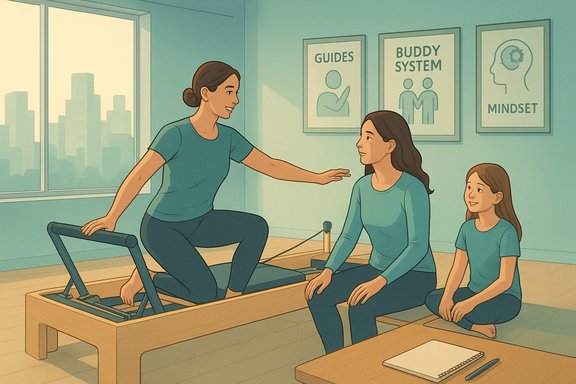
Stepping onto a reformer Pilates machine with my daughter, May Busch turned a simple fitness experiment into a concise playbook for moving beyond familiar limits — and packaged three practical lessons about guides, companions, and mindset that apply as neatly to leadership and careers as they do to a first Pilates class.
Background
May Busch’s short reflection, published in PS News, describes a beginner’s reformer Pilates session that transformed into a moment of insight about how people move — literally and figuratively — out of their comfort zones. Her three takeaways are simple: a guide makes all the difference, the buddy system works, and your mindset shapes your experience. Busch links each to workplace situations — mentoring and executive coaching, peer support and mastermind groups, and the difference between curiosity and brittle expectation. Her piece is an experiential, advice‑driven column rather than empirical research, but it maps cleanly onto established findings about workplace friendships, coaching, exercise and mindset interventions. This feature takes Busch’s personal observations as the starting point, verifies the central claims with independent evidence where possible, and offers a critical look at the strengths, practical applications, and risks of translating Pilates lessons into career strategy.Overview: What Busch observed — short and sharp
- A patient instructor who demonstrated moves step‑by‑step removed fear and accelerated learning.
- Having a trusted companion (her daughter) created commitment and made the experience enjoyable and sticky.
- Approaching the experience with curiosity — lowering expectations and avoiding comparisons — changed the emotional experience and outcomes.
A guide makes all the difference: mentorship, coaching and staged learning
What Busch saw in the studio
Busch credits her Pilates instructor, Aniko, with demystifying a complicated apparatus by demonstrating positions slowly and showing rather than only telling. This scaffolded learning relaxed her and made the class enjoyable rather than intimidating.Why guides matter in work settings
This is not only a comforting anecdote — there is robust evidence that guided, staged learning and expert feedback accelerate uptake and reduce harm. In the workplace, the same pattern shows up in mentorship programs, manager coaching, and formal onboarding: when a newcomer is matched with skilled guidance, they learn faster, make fewer costly mistakes, and feel more psychologically safe.Executive coaching, specifically, is widely used as such a staged, confidential guide. Industry surveys and academic reviews consistently report high client satisfaction and a measurable financial return on investment for organisations that implement structured coaching programs. Large cross‑sector reviews and long‑standing studies show typical ROI ranges in the multiple‑times‑investment band (very roughly 3×–7× in many conservative summaries, with selected studies reporting higher returns when retention and productivity gains are included). These figures vary by study methodology, but the recurring signal is that targeted coaching for leaders produces both behavioural change and business outcomes when well implemented.
Strengths — why staged guidance works
- Reduces cognitive load: showing steps one at a time lets learners focus on one element and build muscle memory.
- Lowers risk: an experienced teacher or coach prevents common beginner errors that could lead to injury, confusion, or reputational harm.
- Provides psychological safety: confidential coaching creates a private space to expose gaps without fear of career penalty.
Risks and limits
- Quality variability: coaching and mentoring are not regulated professions. The market contains highly credentialed practitioners and under‑trained operators. Organisations that buy coaching without vetting credentialing, alignment, or measurement risk poor outcomes or wasted investment.
- Misaligned goals: if a coach or mentor focuses on generic frameworks rather than the client’s real business context, the guidance can feel irrelevant or even counterproductive. Busch’s article correctly notes that a boss is not a one‑stop guide — but a poor external coach is also problematic.
Practical checklist for leaders
- Match the problem to the coach’s expertise (industry, stage of growth, function).
- Define measurable objectives and a 3‑6 month review cadence.
- Require confidentiality and set clear boundaries so the client can be candid about mistakes.
- Combine internal sponsors and external coaches for perspective diversity.
The buddy system works: friends at work, masterminds and accountability
Busch’s lived example
Having her daughter at the class eliminated the easy escape route: social obligation kept Busch showing up and engaging. At work she describes a “nervous room” where steering‑group peers rehearsed before meetings — a low‑stakes space to practice and calm nerves. The social support translated into a successful client meeting.Evidence: friendships and engagement at work
The buddy effect is not just warm‑and‑fuzzy: multiple large surveys and organisational studies show powerful links between workplace friendships and engagement, retention and performance. Gallup’s research famously reports that employees who say they have a “best friend” at work are far more likely to be engaged and to deliver better outcomes; other recent surveys find strong correlations between close workplace relationships and job satisfaction, productivity and even salary outcomes. These findings underline Busch’s practical point: people take bigger steps when they are accountable to a trusted companion.What works in practice
- Peer rehearsal: create designated pre‑meeting runs or “nervous rooms” where teams can role‑play high‑stakes interactions.
- Small, cross‑company peer groups: mastermind cohorts provide confidential sparring and acceleration without internal politics. Busch points to mastermind groups as a way to expand the comfort zone — a model borne out in practice.
- Friend‑friendly cultures: organisations that design for serendipitous connections (shared projects, cross‑functional rituals) score higher on engagement metrics.
Risks and caveats
- Echo chambers: buddy groups that are too homogenous can reinforce bad habits and avoid constructive challenge. Deliberately include dissenting perspectives.
- Confidentiality boundaries: buddies are not a substitute for formal feedback or HR intervention in performance or legal issues. Keep structural supports in place so buddies don’t get stuck as sole escalation paths.
Mindset shapes your experience: curiosity, comparison, and resilience
Busch’s contrast: curiosity vs pressure
Busch contrasts her Pilates curiosity with the stress she suffered when moved to lead a corporate bond origination business in London. In the latter case she reports setting high expectations, comparing herself to competitors, and experiencing burnout — until a reset and mindset shift allowed recovery. Busch’s narrative captures the main psychological difference between learning with curiosity and performing under relentless comparison.What research says about mindset
Psychological research on growth mindset — the belief that abilities can be developed — has produced mixed but instructive evidence. Foundational experimental work and large field interventions show that mindset interventions can improve persistence and outcomes in specific contexts, particularly where interventions align with supportive environments and peer norms. At the same time, meta‑analyses and replication work have cautioned against overselling simple mindset scripts as a standalone cure for complex performance problems. The evidence supports Busch’s core claim: mindset influences experience and behaviour; however, mindset interventions need to be paired with structure, feedback and supportive systems to produce consistent performance gains.Practical implications for leaders
- Encourage curiosity as an explicit norm — reward discovery, not only delivery.
- Normalize “beginner” states: create rituals that reduce the stigma of early failures (e.g., structured debriefs, psychological safety practices).
- Pair mindset reframing with operational support: training, realistic timelines and coaching to prevent the well‑meaning growth mindsets from becoming an excuse for underinvestment in skills.
Red flags
- “Toxic positivity” and victim‑blaming: urging people simply to “be curious” without addressing workload, resourcing or systemic barriers can backfire. Busch’s positive Pilates experience is helpful as an analogy, but organisational realities often require more than attitude change.
Cross‑checking Busch’s central claims against the evidence
- “A guide makes all the difference”: robust support. Coaching, mentoring, and staged instruction produce measurable benefits when aligned to context and measured. Industry studies report consistently positive outcomes for well‑run coaching engagements.
- “The buddy system works”: strong support. Gallup and multiple surveys find that close workplace relationships correlate with engagement, productivity and safety. Designing for social connection is therefore a defensible organisational strategy.
- “Mindset shapes your experience”: partial support with nuance. Growth‑mindset theory is validated in many contexts, but effects depend on implementation and environment. Mindset alone is insufficient without skills practice and social scaffolding.
Translating Pilates lessons into an organisational playbook
For leaders designing onboarding and capability programs
- Build a staged learning path. Use short, demonstrable exercises — like the Pilates instructor’s step‑by‑step demo — followed by coached practice.
- Assign external mentors for sensitive growth areas (confidentiality matters). Executive coaching is worthwhile for high‑impact transitions when matched to goals and measured for outcomes.
For team leads wanting to increase risk‑taking and innovation
- Pair novices with buddies for the first three rituals (kickoff, rehearsal, after‑action).
- Institutionalize “nervous room” rehearsal time before client or board presentations.
- Recognize and reward learning progress publicly to shift norms away from perfect performance toward iterative improvement. Busch’s nervous‑room example is a clear, low‑cost idea that reproducibly raises confidence.
For HR and people ops
- Design mastermind cohorts across regions to avoid local politics and allow candid peer feedback. Busch references mastermind groups as valuable because they are geographically and contextually varied — that structure reduces echo chambers and increases perspective breadth.
- Measure social connection as part of the engagement survey and invest in rituals that create daily micro‑moments of connection.
Strengths, risks and ethical considerations
Strengths
- Busch’s three takeaways are low‑friction and high‑signal: guidance, companionship and curiosity are cheap to test and can be rapidly scaled.
- Each recommendation is compatible with existing evidence on coaching ROI, the benefits of workplace friendships, and the efficacy of staged learning.
Risks and blind spots
- Overgeneralisation: transforming a single positive class experience into an organisational prescription risks underestimating complexity. Exercise studios are controlled, low‑stakes environments compared with corporate markets. Busch’s London business story is illustrative, not generalisable.
- Vendor and practitioner variability: executive coaching and even Pilates instruction show wide differences in training and quality. Organisations must set procurement and credential standards to avoid ineffective or harmful engagements.
- Mindset as a bandaid: encouraging curiosity without addressing structural causes of burnout (workload, role ambiguity, resourcing) can appear tone‑deaf and demotivating. Busch’s “mindset reset” worked for her after time off, but not every individual has that same opportunity or safety net.
Quick how‑to: three practical experiments to run in the next 90 days
- Starter pilot: “Guided first class” for a new skill
- Recruit an experienced coach (internal or external) and run a 6‑week staged program for a targeted cohort. Measure confidence, error rates, and one business metric.
- Buddy rehearsal ritual: “Nervous room” for high‑stakes events
- Require a 20‑minute rehearsal with a partner before every major client presentation. Track presenter confidence and meeting outcomes. Busch’s anecdote suggests a clear behavioral upside for low effort.
- Mindset + structure sprint: “Curiosity with guardrails”
- Launch a micro‑intervention that teaches growth mindset language plus a concrete skill practice and time‑boxed goals. Measure both attitude shifts and skill change to ensure the intervention delivers substance, not just optimism.
Closing analysis — why the Pilates metaphor works and when it doesn’t
May Busch’s Pilates column succeeds because it packages behavioural science into everyday, memorable moments. The reformer machine, the reassuring instructor, the supportive daughter and Busch’s own internal dialogue map easily onto leadership decisions that involve training, relationships and attitude.Those parallels are useful because they are actionable: staged guidance, peer accountability and curiosity are interventions organisations can test quickly. The empirical record shows these approaches often produce measurable benefits — from engagement lifts linked to workplace friendships to positive ROI when coaching is matched to clear objectives. Yet the metaphor is not a panacea. Real organisational change requires investment, quality control and candid measurement. A Pilates instructor’s gentle adjustments work because the instructor is trained, present and responsible for safety. The same standards must apply to leaders who deploy coaching and social interventions at scale: credentialing, alignment, and evaluation are essential.
Busch’s column is a useful nudge. Treat it as that: a short, practice‑oriented reminder that small design decisions in how we teach, how we pair people and how we talk about challenge can materially change whether someone stays stuck or starts to grow. When those nudges are paired with rigorous selection of coaches, careful measurement, and attention to workload and structural fairness, the payoff is real — whether you’re learning to use a reformer or building a market‑leading business.
Conclusion
The Pilates lesson is elegantly simple: remove friction, invite company, and adjust your expectations so you can learn. For leaders and organisations that want to expand capacity without unnecessary risk, Busch’s three takeaways provide a concise design heuristic. Implement them deliberately, verify the results, and be honest about limitations — then the jump out of a comfort zone becomes a repeatable practice rather than a one‑off gamble.
Source: psnews.com.au Life lessons from my Pilates instructor | PS News
