

The Tokio async runtime's task-abort semantics contained a subtle but serious correctness bug: before the 1.8.1 fixes, calling JoinHandle::abort could cause a task's future to be dropped on the wrong thread, which in turn could violate Rust's thread-safety assumptions for non‑Send task-local data and produce hard-to-diagnose race conditions and crashes for real-world applications using LocalSet or spawn_local.
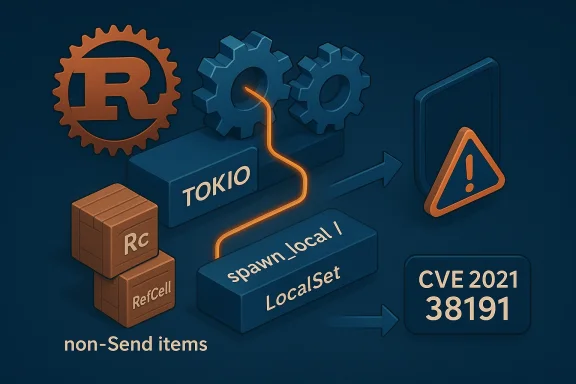
Tokio is the dominant asynchronous runtime in the Rust ecosystem, powering network servers, evented services, and embedded async code across a wide range of projects. One valuable feature Tokio provides is LocalSet (and spawn_local), which lets you run non‑Send futures on a single thread for performance and ergonomic reasons: these tasks are allowed to contain non‑Send types (for example, Rc or RefCell) because they are guaranteed to be executed and dropped on the same thread.
CVE‑2021‑38191 (also tracked as RUSTSEC‑2021‑0072 and GHSA‑2grh‑hm3w‑w7hv) describes a bug in Tokio’s task cancellation path: when a JoinHandle::abort is invoked, the runtime could drop the associated future on the calling thread rather than on the task’s owning thread, if the task wasn't actively being polled at the time of abort. For tasks that hold non‑Send state, that means dropping non‑Send data on a different thread — a direct violation of Rust’s safety model that can lead to race conditions, death-by-undefined-behavior, or application crashes.
The bug was reported with a clear reproduction and addressed in a set of backported fixes across several release series. The practical takeaway for maintainers and operators is straightforward but urgent: update your Tokio pins and rebuild artifacts that embed the runtime, and audit any use of LocalSet/spawn_local plus JoinHandle::abort patterns.
This is a concurrency/synchronization defect: the code that decided where it was safe to run the destructor did not respect the locality invariants for non‑Send tasks. Conceptually, it’s a race between the abort path and the task’s scheduler/owner thread; the resolution required ensuring that aborts become remote requests that are executed on the owning thread rather than locally dropping shared state.
The fix is concrete and well-scoped: update Tokio to a patched release, rebuild artifacts, and audit code paths that mix non‑Send task-local state with cross‑thread abort semantics. Beyond the immediate remediation, the incident highlights a broader lesson for systems developers: wherever you rely on runtime guarantees (task locality, drop semantics, scheduler behavior), build tests to encode those guarantees and keep your runtimes and toolchains current.
Takeaway checklist (one-sentence actions)
Source: MSRC Security Update Guide - Microsoft Security Response Center
 Background / Overview
Tokio is the dominant asynchronous runtime in the Rust ecosystem, powering network servers, evented services, and embedded async code across a wide range of projects. One valuable feature Tokio provides is LocalSet (and spawn_local), which lets you run non‑Send futures on a single thread for performance and ergonomic reasons: these tasks are allowed to contain non‑Send types (for example, Rc or RefCell) because they are guaranteed to be executed and dropped on the same thread.CVE‑2021‑38191 (also tracked as RUSTSEC‑2021‑0072 and GHSA‑2grh‑hm3w‑w7hv) describes a bug in Tokio’s task cancellation path: when a JoinHandle::abort is invoked, the runtime could drop the associated future on the calling thread rather than on the task’s owning thread, if the task wasn't actively being polled at the time of abort. For tasks that hold non‑Send state, that means dropping non‑Send data on a different thread — a direct violation of Rust’s safety model that can lead to race conditions, death-by-undefined-behavior, or application crashes.
The bug was reported with a clear reproduction and addressed in a set of backported fixes across several release series. The practical takeaway for maintainers and operators is straightforward but urgent: update your Tokio pins and rebuild artifacts that embed the runtime, and audit any use of LocalSet/spawn_local plus JoinHandle::abort patterns.
The bug in plain English
What went wrong
- Expected behavior: A future spawned with
spawn_localor on aLocalSetis associated with a specific thread. If the future is aborted (viaJoinHandle::abort), all accesses and the final drop of the future must happen on that same thread so non‑Send state (like Rc/RefCell) is never observed from another thread. - Actual faulty behavior: When
JoinHandle::abort()was called from another thread and the task happened to be idle (not currently running), the runtime would sometimes drop the future immediately on the caller’s thread. That causes non‑Send values to be destroyed on a thread that never owned them. - Why this matters: Many Rust projects rely on the promise that
!Sendtypes will never be moved or dropped across threads. Violating that can produce undefined behavior: panics, memory corruption, or worse — behavior that is extremely difficult to reproduce and diagnose because it may only appear under specific timing windows.
The root cause (technical summary)
The problem sits in the abort/unregister/drop path of Tokio’s task runtime. When aborting a task, the runtime must ensure exclusive ownership of the task’s state and schedule the final drop on the thread that owns the task. The buggy path allowed the abort caller to take a fast path that performed the final drop synchronously on the caller thread if the task was not currently executing — effectively bypassing the per‑thread locality guarantees for LocalSet tasks.This is a concurrency/synchronization defect: the code that decided where it was safe to run the destructor did not respect the locality invariants for non‑Send tasks. Conceptually, it’s a race between the abort path and the task’s scheduler/owner thread; the resolution required ensuring that aborts become remote requests that are executed on the owning thread rather than locally dropping shared state.
Timeline and fixes
- The bug was reported with a minimal reproduction showing a
spawn_localtask holding a non‑Send drop guard and another thread callingJoinHandle::abort. The reproduction triggers a message like “non-Send value dropped in another thread!” when the incorrect drop occurs. - The Tokio maintainers implemented a code change to ensure aborts are handled as remote aborts — i.e., the abort is routed so that the actual drop happens on the task's executing (or owning) thread rather than the aborting thread.
- Fixes were rolled into patch releases across several series (examples: 1.5.1, 1.6.3, 1.7.2, 1.8.1), making the corrected behavior available for a broad set of consumers who had adopted different minor versions of Tokio.
- The patch was recorded in the Tokio changelog and backported where needed; downstream language package trackers and advisories subsequently flagged affected versions and recommended upgrades.
Impact and threat model
Direct technical impact
- Safety violation for non‑Send types: Dropping non‑Send values on the wrong thread can produce undefined behavior. Types that implicitly rely on thread-local invariants (Rc, RefCell, or custom thread-affine resources) are at risk.
- Race conditions: The timing-dependent nature of the bug makes it a classical race: only when abort occurs at particular moments will the incorrect path be taken. This makes bugs intermittent and hard to reproduce.
- Availability and correctness problems: Exploits or accidental triggers can result in panics, crashes, or memory-safety failures that affect service availability and correctness.
Exploitability
- Attacker model: In general this is a local or logic-level hazard within the application developer’s authority — the bug is exploitable only if an application constructs a situation where a JoinHandle is aborted from a thread different from the LocalSet thread and the aborted future is not Send. It is not a remote network vulnerability in itself unless application logic exposes such cross-thread abort patterns to external triggers.
- Likelihood in typical codebases: Projects that intentionally use
spawn_localor LocalSet semantics withRc/RefCellor other !Send types are most at risk. Many high‑performance or embedded apps use this pattern, so exposure is non-trivial. - Observed exploitation: There are no broad reports of this CVE being weaponized in the wild for broad-scale attacks, but that absence is not proof of safety. Because the bug leads to undefined behavior rather than a convenient remote code execution primitive, an attacker’s benefit is mainly disruption or crash‑induction in scenarios where they can influence abort logic or scheduling.
Who should prioritize this
- Service teams that use
spawn_local,LocalSet, orspawn_local-style patterns and also callJoinHandle::abort()from other threads. - Library maintainers who ship Tokio as a dependency and who might expose APIs that mix non‑Send task-local resources with cross-thread cancellation.
- Vendors and packagers that embed Rust binaries or link statically against Tokio — updates require rebuilds, not just library version bumps.
Developer guidance — immediate steps
If you maintain Rust code that depends on Tokio, follow this prioritized checklist:- Upgrade Tokio
- Pin Tokio to a fixed release that contains the fix: upgrade to one of the patched releases (for example, 1.8.1 or later; patch releases for older branches are available — adopt whichever line your project follows).
- Run cargo update and ensure your Cargo.lock resolves to a fixed Tokio version.
- Rebuild all artifacts
- Rebuild any binaries, containers, or static artifacts that incorporate Tokio. If you ship prebuilt binaries, a simple dependency update in source control is not enough — you must rebuild and redeploy.
- Audit task-local usage and abort patterns
- Inspect code for
spawn_local,LocalSet::spawn_local, or use of!Sendtypes inside tasks. - Search for cross-thread
JoinHandle::abort()calls that could be invoked from other threads. - Prefer Send where feasible
- Convert task-local state to
Sendtypes if the design permits. ReplacingRcwithArc(and using appropriate synchronization) eliminates the class of risk. - Add tests and fuzzing
- Add unit/integration tests that exercise abort and shutdown paths, especially with
LocalSet. Use stress tests that interleave aborts from background threads. - Consider fuzzing the runtime shutdown and abort semantics to catch regressions or timing-sensitive errors.
- CI and dependency scanning
- Enforce dependency checks in CI (cargo deny, cargo-audit, or Snyk) so transitive Tokios are upgraded.
- Fail builds when the transitive dependency tree resolves to an affected Tokio version.
Operational guidance — for operators and packagers
- If you are a distro or cloud vendor:
- Ensure package metadata is updated to reflect the fixed releases and that rebuilds are propagated into images.
- For statically linked binaries, provide rebuilt artifacts — users cannot be protected by system package updates if binaries were linked earlier.
- If you run third-party images or appliances:
- Request attested rebuilt artifacts (or rebuild from source) before resuming normal operations if the software uses Tokio and LocalSet patterns.
- For large fleets:
- Use SBOMs and dependency inventory tooling to identify which images or packages include Tokio versions in the vulnerable range.
- Treat this as a rebuild-and-verify operation rather than a simple patch install in many cases.
Code-level mitigations and best practices
- Avoid mixing non‑Send task-local state and cross-thread cancellation semantics when possible. When you need both:
- Keep the cancel decision and drop handling on the owner thread by redesigning cancellation to post a shutdown notification rather than calling
JoinHandle::abort()from an arbitrary thread. - Implement a small “remote abort” channel: the aborting thread sends a message to the LocalSet owner thread to perform the drop there.
- Favor graceful cancellation:
- Make tasks cooperative: send a shutdown flag or use a oneshot/broadcast channel that instructs tasks to exit themselves, ensuring drops happen on their executing thread.
- When using
JoinHandle::abort, assume platform semantics have changed historically; lock in fixed versions and test thoroughly across runtime versions.
Why this bug was easy to miss — and why it matters
- The bug is timing-dependent and only affects futures that are not
Send. Many teams default toSendtypes because they prefer cross-thread scheduling, so the issue’s surface is concentrated in code that intentionally optimizes by avoidingArc/Mutexfor performance. - The failure mode is undefined behavior tied to destructor execution. That’s a particularly nasty class of bug: crashes appear unrelated to the triggering logic, and traces often point at user code drop implementations rather than the runtime scheduler. As a result, debugging requires understanding the runtime internals and precise scheduling windows.
- Because many Rust developers depend on Rust’s safety contract (that non‑Send things never cross threads), code review may not catch this runtime-level break in invariants: it’s a property of the runtime, not of user code. That amplifies the responsibility of runtime maintainers — and the need for consumers to stay current on runtime patches.
Testing checklist for maintainers
When you upgrade and rebuild, validate with the following tests:- Unit test: schedule a
spawn_localfuture that holds a drop‑side effect indicating the creating thread. From another thread, callJoinHandle::abortmany times in a tight loop and confirm the drop reported thread identity is the same as the creator. - Integration: run stress tests that create many LocalSet tasks and abort them concurrently from different worker threads.
- CI regression: add a scheduled nightly test that runs the abort stress test under thread sanitizer / MIRI where feasible, and at least run it in a loop under a release build for time.
- Fuzz harness: if your application parses untrusted data and aborts tasks in reaction to inputs, fuzz the abort path and the task-local state transitions.
Tradeoffs, risks, and residual concerns
- Upgrading solves the runtime bug, but it does not eliminate design-level hazards. Projects that rely heavily on non‑Send task-local state and cross-thread manipulation should re‑examine architectural choices; using
Arc/Mutexmay be safer even if more costly. - Static/dynamic linking nuance: simply bumping a system package is insufficient if an application vendor ships its own Tokio build. Full mitigation requires rebuilding the actual executable images that will run in production.
- Behavioral changes: the fix changes abort semantics (it ensures remote aborts are performed on the owning thread). In pathological user code that relied on the old incorrect behavior inadvertently, upgrades could reveal higher-level logic bugs. That’s an argument for adding integration tests when upgrading.
- Unverifiable claims: public reports did not show large-scale exploitation campaigns built around this CVE at disclosure time; however, that does not imply the bug was harmless in practice. Because the exploit surface is application‑specific, it’s possible that certain deployment patterns caused production instability that went unreported. Treat unverified exploitation absence as “unknown” rather than as justification for complacency.
Practical remediation playbook (concise)
- Inventory
- Run
cargo tree -i tokioor similar in each Rust repo to find direct and transitive Tokio usage. - Collect image/package SBOMs to find binaries with embedded Tokio.
- Patch
- Update Cargo.toml to require patched Tokio releases (e.g., >=1.8.1 for the 1.8.x branch) and run
cargo update. - Rebuild
- Rebuild containers and binaries; redeploy.
- Test
- Execute abort/stress tests and smoke tests in staging.
- Monitor
- Watch for crashes and abnormal panics in services that used LocalSet or non‑Send task-local types.
- Vendor coordination
- If you depend on third-party binaries, ask vendors for rebuilt releases or attestations that they updated Tokio and rebuilt artifacts.
Conclusion
CVE‑2021‑38191 is a textbook example of how runtime semantics — not just API surface or memory-safety bugs — can break core language guarantees if left unchecked. The mismatch between where a task is logically owned and where it is destroyed undermines Rust’s thread-affinity assumptions and can expose applications to subtle, severe failures.The fix is concrete and well-scoped: update Tokio to a patched release, rebuild artifacts, and audit code paths that mix non‑Send task-local state with cross‑thread abort semantics. Beyond the immediate remediation, the incident highlights a broader lesson for systems developers: wherever you rely on runtime guarantees (task locality, drop semantics, scheduler behavior), build tests to encode those guarantees and keep your runtimes and toolchains current.
Takeaway checklist (one-sentence actions)
- Upgrade Tokio to a patched version and rebuild.
- Audit LocalSet and spawn_local usage and prefer Send types or cooperative shutdowns.
- Add tests that exercise cross-thread abort and drop behavior.
- Use SBOMs and dependency scanning to ensure no hidden, statically-linked vulnerable artifacts remain.
Source: MSRC Security Update Guide - Microsoft Security Response Center