

The warning from U.S. federal cyber authorities is blunt: recent coordinated disclosures of multiple security weaknesses in Trane’s Tracer building‑automation family — Tracer SC, Tracer SC+, and Tracer Concierge — create real, actionable risk to building operators and service providers worldwide. The advisory catalogues a mix of cryptographic weaknesses, memory‑allocation errors, missing authorization checks, and hard‑coded credentials/keys that, when chained or leveraged directly, could let attackers disclose sensitive data, run arbitrary commands, or deny service to controllers that manage HVAC and other building systems. The vendor‑level context and researcher attribution are also explicit: these issues were reported through responsible disclosure channels and named in the advisory, and the disclosure includes standard CISA mitigation guidance for industrial control systems. / Overview
The Tracer family — used in commercial, institutional, and critical‑infrastructure facilities — controls heating, ventilation, air conditioning, and building automation tasks. These controllers are widely deployed and often connected to facility networks for management, monitoring, and remote service. While Trane has advanced its product line over time (the Tracer SC+ is positioned as the next‑generation controller to replace older SC units), many sites continue to operate combinations of SC, SC+, and Concierge units in mixed topologies. Trane emphasizes secure remote access options and has public cybersecurity guidance on hardening and lifecycle support for Tracer systems.
The new advisory lists a cluster of CWE‑style weaknesses: Use of a broken or risky cryptographic algorithm (CWE‑327), memory allocation with excessive size value, missing authorization (CWE‑862), use of hard‑coded credentials (CWE‑798), and use of hard‑coded, security‑relevant constants. According to the advisory, exploitation could lead to information disclosure, arbitrary command execution, or denial‑of‑service on impacted products. The disclosure credits a Claroty researcher for the report, and CISicitly recommends network hardening, isolation, and cautious remote‑access practices.
It’s important to note that Tracer controllers have been the subject of coordinated advisories in the past; a 2021 CISA advisory documented a high‑impact code‑injection vulnerability in Tracer devices and drove vendor patches and upgrade guidance for affected versions. That historical advisory shows two things: (1) Tracer devices have been attractive targets for researchers and defenders, and (2) CISA and Trane have previously coordinated on remediation advice and version‑specific updates.
The advisory groups distinct categories of flaws that, taken together, create both immediate and systemic risk:
Trane’s public cybersecurity materials stress lifecycle management, secure remote access, and product hardening — and the company has historically issued firmware updates and migration guidance for Tracer series controllers after vulnerability disclosures. Operators should treat any vendor guidance as the authoritative path to patched firmware and support options; Trane’s product pages and security documentation remain the canonical source for supported versions and upgrade workflows.
Caveat and verification note: the advisory text and release date were provided in the disclosure package; at the time of publication we could not independently fetch every CISA web page due to access restrictions, so readers should follow their normal channels (vendor port confirm advisory metadata, patch availability, and version numbers. Where vendor patch numbers were listed in prior advisories (for example, older Tracer advisories specifying minimum patched versions), operators should use the vendor portal to confirm exact version identifiers for their devices before proceeding.
Operators should act swiftly but deliberately: inventory, isolate, and verify vendor patches before deploying them in production. Treat the advisory as an urgent call to harden the environment and to accelerate lifecycle planning for devices that are no longer receiving robust security updates. Collaboration between facility managers, IT, service contractors, and vendors will be the single most effective measure to reduce exposure and retain operational continuity.
End of article.
Source: CISA Trane Tracer SC, Tracer SC+, and Tracer Concierge | CISA
The Tracer family — used in commercial, institutional, and critical‑infrastructure facilities — controls heating, ventilation, air conditioning, and building automation tasks. These controllers are widely deployed and often connected to facility networks for management, monitoring, and remote service. While Trane has advanced its product line over time (the Tracer SC+ is positioned as the next‑generation controller to replace older SC units), many sites continue to operate combinations of SC, SC+, and Concierge units in mixed topologies. Trane emphasizes secure remote access options and has public cybersecurity guidance on hardening and lifecycle support for Tracer systems.
The new advisory lists a cluster of CWE‑style weaknesses: Use of a broken or risky cryptographic algorithm (CWE‑327), memory allocation with excessive size value, missing authorization (CWE‑862), use of hard‑coded credentials (CWE‑798), and use of hard‑coded, security‑relevant constants. According to the advisory, exploitation could lead to information disclosure, arbitrary command execution, or denial‑of‑service on impacted products. The disclosure credits a Claroty researcher for the report, and CISicitly recommends network hardening, isolation, and cautious remote‑access practices.
It’s important to note that Tracer controllers have been the subject of coordinated advisories in the past; a 2021 CISA advisory documented a high‑impact code‑injection vulnerability in Tracer devices and drove vendor patches and upgrade guidance for affected versions. That historical advisory shows two things: (1) Tracer devices have been attractive targets for researchers and defenders, and (2) CISA and Trane have previously coordinated on remediation advice and version‑specific updates.
 What the advisory actually says (technical summary)
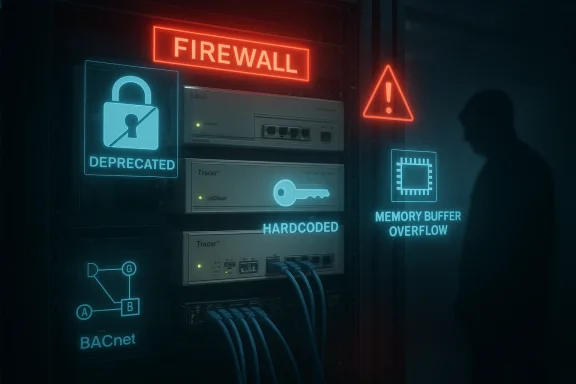
The advisory groups distinct categories of flaws that, taken together, create both immediate and systemic risk:- Weak or broken cryptography — Some components use cryptographic algorithmthat are considered deprecated or otherwise insufficient for protecting sensitive data. This can enable eavesdropping, credential recovery, or replay attacks when combined with network access.
- Memory‑allocation errors — Improper validation of sizes when allocating memory can permit an attacker to cause ouuffer overflows, or resource exhaustion, any of which can be leveraged for denial‑of‑service or code execution depending on the component and runtime protections in place.
- Missing authorization checks — API endpoints or web interfaces that fail to validate authorization can allow lower‑privileged users (or unauthenticated actors, ifernally reachable) to access restricted functions or data. These are among the most commonly abused weaknesses in industrial and enterprise equipment.
- Hard‑coded credentials / security constants — Embedded usernames, passwords, cryptographic keys, or other constants in firmware or configuration make large classes of devices trivially susceptible once those values become known. Hard‑coded secrets are particularly dangerous in devices that are networked or remotely managed.
Why this matters: practical risk scenarios
Building automation controllers like Tracer are not exotic niche devices — they speak to numerous operational systems and sometimes host critical functions that operators rely on for occupant safety, environmental control, and energy management. The combination of the weaknesses described in the advisory creates a set of practical attack chains:- Credential harvesting → lateral movement → control
An attacker who recovers hard‑coded credentials or intercepts weakly‑protected credentials can pivot from an exposed system to internal controllers. From there, missing authorization checks or injection flaws could be used to alter setpoints, disable alarms, or execute arbitrary code. - Exposed management APIs → unauthorized control
If a Tracer UI or API endpoint lacks proper authorization and is accessible from vendor networks, partner networks, or the Internet, an attacker can read sensitive configuration files or manipulate control logic. In industrial environments this can have physical consequences: temperature extremes, HVAC shutdown, or disruption of building services. - Memory corruption → persistent compromise
Memory‑allocation errors and unsafe handling of input can lead to remote code execution on the controller CPU. Once an attacker runs arbitrary commands, they can persistently alter firmware or use the device as a foothold into enterprise networks. - Cryptographic failures → eavesdropping and replay
Using weak algorithms or static cryptographic material enables attackers to decrypt captured traffic or forge messages. In building systems that trust signed or encrypted messages for authorization, this can directly translate to command injection risks.
Vendor response and researcher attribution
The advisory attributes the findings to a Claroty researcher (named in the advisory as Noam Moshe). Noam Moshe is a well‑known vulnerability researcher affiliated with Claroty Team82, and Team82’s public research on IoT/OT threats has a track record of coordinated disclosures. That attribution matches the advisory’s responsible‑disclosure timeline and helps validate the submission route.Trane’s public cybersecurity materials stress lifecycle management, secure remote access, and product hardening — and the company has historically issued firmware updates and migration guidance for Tracer series controllers after vulnerability disclosures. Operators should treat any vendor guidance as the authoritative path to patched firmware and support options; Trane’s product pages and security documentation remain the canonical source for supported versions and upgrade workflows.
Caveat and verification note: the advisory text and release date were provided in the disclosure package; at the time of publication we could not independently fetch every CISA web page due to access restrictions, so readers should follow their normal channels (vendor port confirm advisory metadata, patch availability, and version numbers. Where vendor patch numbers were listed in prior advisories (for example, older Tracer advisories specifying minimum patched versions), operators should use the vendor portal to confirm exact version identifiers for their devices before proceeding.
Cross‑checks and outside validation
To ensure this advisory isn’t an isolated or mistaken assessment, I cross‑checked independent trackers and security vendors:- Security aggregators and vulnerability databases reference past, high‑severity Tracer advisories and CVEs (for example, a 2021 code‑injection CVE that required firmware updates). Those historical records show both how Trane responded previously and how CISA republished vendor mitigation guidance.
- Claroty’s public research outputs and Team82 blog materials demonstrate the researcher’s background in OT/IoT vulnerabilities; the staff attribution in the advisory mirrors clarifying information available from Claroty and independent conference presentations. That strengthens confidence in the source and the responsible‑disclosure process.
- Trane’s own cybersecurity pages document the company’s secure‑access recommendations, product lifecycle information, and general hardening advice — consistent with the mitigation steps CISA recommends for ICS devices. Operators should therefore treat vendor guidance as the first stop for deployment‑specific remediation and ve
Immediate actions for operators — prioritized checklist
For building owners, facility managers, and service contractors managing Tracer equipment, the window between disclosure and remediation matters. The following sequential steps prioritize safety, rapid risk reduction, and operational continuity.- Inventory first. Identify every Tracer device in your environment (Tracer SC, SC+, Concierge), record firmware versions, network interfaces, and any third‑party services integrated with the device (remote vendor connectivity, cloud bridges, BACnet/IP endpoints).
- Isolate and segment. Immediately ensure controllers are on dedicated VLANs or physically separated networks with strict ACLs. Do not expose management interfaces to the Internet or to broad corporate networks.
- Restrict remote access. Disable or restrict remote access channels (SSH, web management) unless a secured, logged, vendor‑approved remote access method is in use. If Trane Connect or another vendor remote service is required, validate it’s the recommended, patched variant and that its endpoints are properly restricted.
- Verify patch availability. Contact Trane support or your authorized service representative to confirm whether firmware updates exist that address the reported issues. Request specific version identifiers and read vendor release notes and rollback instructions before applying updates.
- Apply compensating controls. Where patching would cause operational risk or is delayed, apply compensating controls: firewall rules, network segmentation, multi‑party change control on controllers, and monitoring for anomalous management traffic.
- Monitor and hunt. Implement monitoring for:
- Unexpected authentication attempts or credential reuse.
- Abnormal configuration changes or sudden controller reboots.
- Large or unusual BACnet commands, mass downloads/uploads, or unusual API calls.
- Outbound connections from controllersons.
- Plan for maintenance windows. Firmware upgrades to ICS devices should be scheduled during planned maintenance windows with rollbacks, backups, and vendor support present.
- Document and verify. Keep an audit trail of actions taken, include device serials and firmware checksums, and validate post‑patch functionality against known good baselines.
Detection and incident response guidance
Detection is rarely trivial on HVAC controllers because logging capabilities vary and operational telemetry is often sparse. Still, defenders can take concrete detection and IR steps:- Enable and centralize logging where possible. Forward controller syslogs and network flow records to a secure SIEM or OT‑aware monitoring system.
- Baseline normal behavior. Record typical BACnet traffic patterns, remote‑access windows, and device‑to‑device communication flows. Anomaly detection becomes effective only once you understand “normal.”
- Hunt for telltale indicators:
- Repeated attempts to access admin functions from unusual source IPs.
- Abnormally large configuration reads, exports, or unexpected file transfers.
- Alterations to controbjects that fall outside change windows.
- Prepare containment playbooks. If exploitation is suspected:
- Isolate affected controllers physically or at the switch level.
- Capture volatile logs and a forensic image as appropriate.
- Notify vendor support and follow escalation paths for OT incidents.
- Report and collaborate. CISA encourages reporting suspected malicious activity; doing so helps correlate incidents and identify campaigns. Coordination with the vendor and regional ICS‑CERT teams accelerates recovery and threat intelligence sharing.
Strategic and procurement implications
This advisory is another data point in a longer trend: OT and building‑automation products ship with complexity and legacy code that can contain cryptographic and authorization weaknesses. For facility owners making procurement or lifecycle decisions, consider these long‑term measures:- Favor vendors with mature vulnerability‑disclosure programs, transparent security advisories, and clear EOL policies.
- Insist on secure‑by‑design features in procurement RFPs: hardware root of trust, cryptographic agility (avoid fixed proprietary or weak algorithms), and support for centralized key management.
- Budget for lifecycle management. Upgrades and controlled migrations (for example, replacing end‑of‑life Tracer SC units with SC+ or supported alternatives) must be planned and funded as part of operational expenditures.
- Require vendor attestation for secure remote support channels, such as multi‑factor authenticated management, session recording, and least‑privilege access models.
- Consider third‑party OT security assessments and periodic penetration tests focusing on integration points (vendor remote access,lding‑to‑corporate network bridges).
Strengths and gaps: critical analysis
What the advisory gets right- Coordinated disclosure and public notification: The report follows an established disclosure pipeline and gives operators actionable defensive measures early — essential in OT contexts where changes carry operational risk.
- Multi‑vector awareness: By grouping cryptographic, memory, and authorization issues together, the advisory correctly highlights that modern attacks are often a *dium‑level bugs that escalate into high‑impact compromises.
- Operationally realistic mitigations: The focus on segmentation, firewalling, and careful remote access aligns with well‑tested ICS defense‑in‑depth strategies.
- Precise patch identifiers may be missing or hard to obtain: ICS advisories often require operators to contact vendors to get firmware images and install guidance. This necessity imposes operational friction: a patch may exist, but the upgrade path can be disruptive. Operators must balance risk reduction against the risk of service interruption.
- Detection limitations in deployed environments: Many Tracer installations do not send comprehensive telemetry to centralized log collectors, complicating detection and hunting. Operators should invest in OT‑aware monitoring but recognize that retrofitting robust telemetry onto legacy systems is non‑trivial.
- Vendor‑supplied remote access complexity: While vendor remote services can be more secure than ad‑hoc tunnels, they introduce a third party into the trust model. Organizations must verify vendo and access controls before relying on these channels.
- Economic and labor constraints: Many building owners lack the in‑house OT security staff to evaluate advisories and perform safe patching. This creates systemic risk across small and medium‑sized facilities that rely on service contractors for maintenance.
Recommendations for WindowsForum readers — practical checklist
- Immediately run an asset discovery against your facility networks to find Tracer controllers and log firmware versions.
- If you host remote vendor access, require vendor proof of hardened connectivity (session records, MFA, limited service windows) and insist on written change control for any remote session.
- Schedule a maintenance window to test vendor‑issued patches in a staging environment before rolling into production.
- Implement layered network controls: separate OT VLANs, egress filtering for controllers, and deny‑by‑default firewall rules.
- If you rely on third‑party service providers for firmware updates, insist on written SLAs for security updates and verify they follow vendor guidance.
- Train your facilities and IT teams to treat ICS advisories as operational incidents: have a checklist, know the rollback plan, and collect evidence for any potential incident.
Final assessment
This advisory is a timely reminder that even mature, widely deployed building‑automation platforms can retain legacy code and configuration patterns that raise modern security concerns. The combination of cryptographic shortcomings, memory handling flaws, missing authorization, and embedded secrets is particularly potent when controllers sit on networks with broader access or when vendor remote access is permitted without strict controls.Operators should act swiftly but deliberately: inventory, isolate, and verify vendor patches before deploying them in production. Treat the advisory as an urgent call to harden the environment and to accelerate lifecycle planning for devices that are no longer receiving robust security updates. Collaboration between facility managers, IT, service contractors, and vendors will be the single most effective measure to reduce exposure and retain operational continuity.
End of article.
Source: CISA Trane Tracer SC, Tracer SC+, and Tracer Concierge | CISA