

Trend Micro will unveil the Trend Vision One™ AI Security Package in December at AWS re:Invent — a bundled, end-to-end suite that promises proactive exposure management, model-aware analytics, and runtime guardrails designed to protect the full AI application stack from development through deployment and operations.
Organizations are rushing to deploy generative and agentic AI systems, but security tooling has lagged behind: traditional endpoint, network and cloud security products do not natively understand model behavior, prompt-level attacks, or AI-specific data risks such as prompt injection, data poisoning, model theft and output manipulation. Trend Micro’s latest package aims to address those gaps by extending the company’s existing Trend Vision One platform with AI-focused controls and analytics that operate across cloud-native, containerized, and multi‑cloud environments. Trend Micro has been steadily positioning its platform for AI-era threats throughout 2025 — integrating NVIDIA Morpheus capabilities for high-performance detection and leaning on AWS-native infrastructure to scale telemetry and model evaluation. Those technology moves set the stage for a product that is explicitly built to run at the intersection of AI model telemetry, cloud infrastructure, and traditional security telemetry.
That said, security leaders should approach vendor claims with pragmatic skepticism. The package should be evaluated as a serious platform candidate — but not as a silver bullet. Rigorous pilot testing, contractual guarantees around data handling, and adversarial validation must accompany any adoption decision. In a landscape where AI attack techniques evolve rapidly, successful defense will depend as much on governance, testing, and organizational process as on any single vendor solution.
Trend Vision One’s AI Security Package is a significant indicator of the industry’s next phase: mainstream security vendors packaging model‑aware controls, runtime guardrails, and multicloud visibility into unified offerings that map to the AI development lifecycle. For enterprises, the obvious benefit is concentrated functionality and a single pane of glass for AI risk — but reaping that benefit requires disciplined pilots, contractual safeguards, and rigorous adversarial testing to convert vendor promises into operational security resilience.
Source: Techzine Global Trend Micro launches AI Security Package
 Background
Organizations are rushing to deploy generative and agentic AI systems, but security tooling has lagged behind: traditional endpoint, network and cloud security products do not natively understand model behavior, prompt-level attacks, or AI-specific data risks such as prompt injection, data poisoning, model theft and output manipulation. Trend Micro’s latest package aims to address those gaps by extending the company’s existing Trend Vision One platform with AI-focused controls and analytics that operate across cloud-native, containerized, and multi‑cloud environments. Trend Micro has been steadily positioning its platform for AI-era threats throughout 2025 — integrating NVIDIA Morpheus capabilities for high-performance detection and leaning on AWS-native infrastructure to scale telemetry and model evaluation. Those technology moves set the stage for a product that is explicitly built to run at the intersection of AI model telemetry, cloud infrastructure, and traditional security telemetry. What’s included in the Trend Vision One AI Security Package
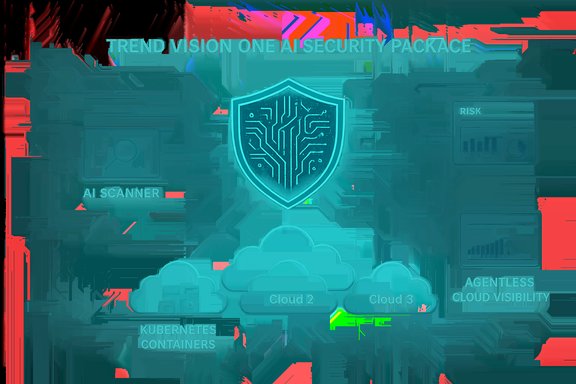
The package (as announced by Trend Micro and summarized by industry press) is not a single monolithic product but a coordinated bundle of new and extended capabilities inside the Trend Vision One portfolio. Key components are described below with the vendor’s positioning and observable technical direction.AI Application Security and AI Scanner
- Continuous model scanning to detect vulnerabilities in models and training pipelines.
- Intelligent AI guardrails that apply runtime and pre-deployment protections to reduce exposure to prompt injection, data leakage, and malicious input patterns.
- A closed-loop workflow that claims to detect model risks and automatically apply protective measures across development and runtime stages.
AI Security Blueprint and Risk Insights
- A governance layer to create auditable AI policies, unified risk dashboards, and compliance-ready reporting for proprietary models and training datasets.
- Designed to help security and compliance teams visualize AI risk posture and make prioritized, auditable remediation decisions.
Cloud Risk Management with Project View
- Breaks down “development security silos” by mapping AI pipelines and supply chains across multi-cloud projects.
- Agentless vulnerability discovery for AWS, Azure, and Google Cloud Platform that markets zero-impact deployment and frequent (24-hour) asset visibility refresh.
Container & Code Security (Shift-left)
- Shift-left scanning for container images and code repositories with automated vulnerability analysis earlier in the SDLC.
- File Integrity Monitoring (FIM) enhancements for critical system files with Kubernetes and eBPF support to increase runtime detection fidelity.
File Security with NetApp Storage Support
- Real-time malware and ransomware scanning for cloud storage integrated with a design that claims files do not leave the customer environment (local scanning, metadata to Trend Micro only).
- A Kubernetes-native architecture for automatic scaling tied to Trend Vision One visibility.
Agentic SIEM
- Correlation of new cloud app logs with existing threat intelligence, IOC sweeping, and automated playbooks to accelerate incident response.
- Rapid ingestion of new cloud application logs within hours to maintain up-to-date detection across dynamic cloud services.
Zero Trust Secure Access for Generative AI
- Extends Zero Trust policy principles to generative AI tools, enforcing granular policies to limit how employees interact with models and preventing sensitive-data exposure and shadow IT.
Technical pillars and how the package works
Trend Micro’s public messaging highlights several technical pillars underpinning the package: model-aware scanning, runtime guardrails, multicloud agentless visibility, and accelerated detection powered by NVIDIA frameworks and AWS infrastructure.- AI Scanner & Guardrails: The scanner continuously analyzes model artifacts, datasets and runtime prompts aiming to flag exploitable paths (e.g., prompt injection vectors or insecure connectors). Guardrails are described as automated protective layers that can alter or block risky operations in-flight. That concept mirrors the industry trend of inserting synchronous decision points into agent execution flows (submit plan → evaluate → allow/block/modify).
- High-throughput detection: Trend explicitly calls out NVIDIA Morpheus and RAPIDS acceleration as part of the detection stack to allow real‑time anomaly detection on large telemetry volumes — a practical necessity when processing model I/O, logs and cloud telemetry at scale. Trend’s public documentation and prior announcements confirm this integration strategy.
- Agentless multi-cloud scanning: For many customers, agentless discovery is attractive because it avoids installing sensors inside production clouds and systems. Trend’s package claims agentless discovery across AWS, Azure and GCP with rapid 24‑hour refresh cycles for visibility — a trade-off between deployment simplicity and the depth of telemetry normally available to agent-based sensors.
- Kubernetes + eBPF runtime protection: File Integrity Monitoring with eBPF support and Kubernetes-native detection gives the package runtime hooks inside modern cloud-native environments that can observe file changes, process activity and network behavior with low overhead. These techniques are increasingly common in cloud runtime security.
Partnerships and ecosystem strategy
Trend Micro is explicitly tying this package to major ecosystem partners. The company cites AWS as a primary infrastructure host for Trend Vision One capabilities, while NVIDIA frameworks (Morpheus, RAPIDS) are mentioned for high-throughput AI detection workloads. Trend also has co-engineered offerings with Dell and validated designs with NVIDIA to support enterprise and sovereign deployments that require on-prem or air‑gapped options. These partner choices reflect a practical engineering decision: complex AI detection models need accelerated compute and scalable cloud services for telemetry ingestion and inference. The integration strategy gives Trend flexibility — running workloads on public cloud, dedicated private clouds, or pre-validated OEM appliances for regulated environments.Why this matters: benefits for security teams
- Holistic AI risk management: By covering build-time and runtime stages, Trend positions AI risk management as a lifecycle issue rather than an afterthought. The unified risk view and auditable blueprints are aimed at compliance-driven organizations worried about IP theft, model leakage, and regulatory scrutiny.
- Faster detection at scale: Offloading heavy detection workloads to NVIDIA-accelerated pipelines and AWS infrastructure reduces latency for anomaly detection in busy AI environments, which can be critical to stop automated exfiltration or malicious model manipulation.
- Shift-left and automation: Integrating vulnerability scanning earlier in CI/CD and automating policy enforcement reduces manual toil and helps development teams ship safer models and containers. This is especially useful where DevOps and data‑science teams lack established security controls.
- Multicloud flexibility: Agentless discovery and cloud-native connectors across AWS, Azure and GCP address the reality of heterogeneous AI pipelines and third‑party model suppliers in modern enterprises.
Critical analysis — strengths and potential blind spots
The package is ambitious and aligns with known gaps in AI risk management. That said, there are technical and programmatic caveats security professionals should weigh.Strengths
- Comprehensive scope: Covering the entire AI application stack — from training data to runtime — is the correct architectural approach for model protection. Packaging discovery, governance, scanning, runtime guardrails, and file storage scanning gives organizations fewer integration gaps if adoption is correct.
- Scalable telemetry processing: Integration with NVIDIA Morpheus and AWS cloud services is a meaningful advantage for customers who need real-time analysis of very large telemetry streams without unacceptable latency.
- Practical multicloud orientation: The emphasis on agentless scanning and cloud-agnostic connectors recognizes enterprise heterogeneity and the need to secure pipelines that cross cloud providers.
Limitations and risks
- Vendor marketing vs. independent verification: Several product statements (for example “first solution package delivering proactive, centralized exposure management” or “files never leave the environment”) are marketing claims that should be independently validated in pilot deployments and third‑party testing. Organizations must treat such statements as vendor positioning until a neutral evaluation confirms them.
- Visibility trade-offs with agentless scanning: Agentless discovery reduces deployment friction but may not provide the same depth of telemetry (kernel events, low-level process context, ephemeral container activity) as well‑instrumented agent-based sensors. For high-risk environments, a hybrid approach is often necessary.
- Protecting models is hard: Guardrails and scanners can reduce common risks but cannot guarantee resilience against determined adversaries. Attack techniques such as model inversion, advanced data poisoning, or carefully crafted adversarial inputs remain topics of active research and require layered defenses, ongoing model validation, and adversarial robustness testing. Any vendor claim of “automatic protection” should be validated with red-team exercises.
- Data residency and privacy considerations: Local scanning of files and metadata claims (metadata sent to vendor) reduce the risk of exfiltration, but customers must validate where metadata is stored, how it is processed, retention policies, and whether the telemetry could indirectly expose sensitive content. Auditable contracts and data processing agreements are essential.
- Complexity & operational cost: Integrating model-level telemetry, agentic SIEM pipelines, and sandboxed model instrumentation across multiple clouds and Kubernetes clusters increases operational complexity. Security teams must consider the human and tooling costs required to tune detection models, manage false positives, and maintain specialized infrastructure.
Unverifiable and cautionary claims
Several strong vendor claims in the announcement should be treated as marketing until independently validated:- “First” or “industry’s most comprehensive” monikers are competitive positioning and depend on definitions; other vendors are building overlapping functionality.
- Absolute privacy claims such as “files never leave the environment” require contractual guarantees, independent audits, and technical proofs (for example zero-knowledge proofs or in‑tenant scanning architectures) to be fully accepted.
- Claims about the immediate effectiveness of guardrails against all prompt-injection vectors or sophisticated poisoning attacks are aspirational — guardrails mitigate many scenarios but do not eliminate attacker creativity.
Practical guidance for security teams evaluating the package
- Start with a targeted pilot:
- Deploy the AI Scanner and Project View against a representative AI pipeline (training data, model registry, inference endpoints).
- Measure detection latency, false positive rate, and operational overhead.
- Verify data handling and compliance:
- Request data processing addenda and independent audit reports showing where metadata and telemetry are stored, how long they are retained, and what controls exist for access and deletion.
- Run adversarial tests:
- Conduct red-team exercises focused on prompt injection, model inversion, and poisoning to validate the claimed guardrails and response playbooks.
- Validate performance in production:
- For latency-sensitive inference, measure whether inline guardrails introduce unacceptable delays and assess fallback options.
- Integrate with existing telemetry:
- Ensure Trend Vision One’s Agentic SIEM and playbooks can integrate with existing SIEMs, ticketing systems, and SecOps runbooks.
- Contractual and support considerations:
- Clarify SLAs for detection model updates, threat intel feeds, and support windows for new cloud log ingestion.
Threat scenarios and mitigations to test with any AI security vendor
- Prompt injection: Test the scanner/guardrails with both naive and sophisticated injection attempts; verify that the system can detect and either block or sanitize prompts before model execution.
- Data poisoning: Introduce poisoned training examples in controlled conditions and verify pipeline alerts and traceability to model artifacts.
- Model theft / exfiltration: Simulate extraction attempts (e.g., membership inference attacks, repeated black-box probing) and test whether the system logs and throttles suspicious patterns.
- Supply-chain compromise: Validate Project View’s ability to map dependencies (third-party models, open-source libraries) and generate alerts when upstream vulnerabilities appear.
- Runtime connector abuse: For agentic AI workflows with external connectors, test whether guardrails can intercept unsafe tool invocations and apply allow/block verdicts synchronously.
Availability, pricing and where it will be shown
Trend Micro’s announcement states the Trend Vision One AI Security Package will be introduced at AWS re:Invent in December, and the company’s press materials issued November 24, 2025 describe the package and related AI innovations. Exact SKUs, pricing models, and EULA details will typically be finalized during or after vendor briefings at the event; procurement teams should expect a mix of subscription and pay-as-you-go options depending on deployment architecture (cloud, sovereign private cloud, or OEM-infused appliances).Final verdict — where this fits in a modern security stack
Trend Micro’s AI Security Package is a logical evolution for large vendors that already provide endpoint, network, cloud, and storage protection. It fills a market need by explicitly addressing model lifecycle risks and embedding AI-aware controls into existing security operations and cloud-native workflows. The strengths are real: comprehensive scope, multicloud orientation, and an engineering strategy that leverages accelerated compute and cloud scale.That said, security leaders should approach vendor claims with pragmatic skepticism. The package should be evaluated as a serious platform candidate — but not as a silver bullet. Rigorous pilot testing, contractual guarantees around data handling, and adversarial validation must accompany any adoption decision. In a landscape where AI attack techniques evolve rapidly, successful defense will depend as much on governance, testing, and organizational process as on any single vendor solution.
Quick checklist for procurement teams
- Confirm where telemetry and metadata are stored and request proof of in‑tenant/local-only scanning architecture if that is a requirement.
- Insist on a measurable pilot with performance and false-positive metrics.
- Require integration tests with existing SIEM, SOAR, and identity platforms.
- Validate guardrails with adversarial red-team tests and document remediation playbooks.
- Ensure contractual clarity around model updates, privacy, and data residency.
Trend Vision One’s AI Security Package is a significant indicator of the industry’s next phase: mainstream security vendors packaging model‑aware controls, runtime guardrails, and multicloud visibility into unified offerings that map to the AI development lifecycle. For enterprises, the obvious benefit is concentrated functionality and a single pane of glass for AI risk — but reaping that benefit requires disciplined pilots, contractual safeguards, and rigorous adversarial testing to convert vendor promises into operational security resilience.
Source: Techzine Global Trend Micro launches AI Security Package
