
President Donald Trump on June 18, 2026, accused Taiwan and other countries of having “stolen” America’s semiconductor factories, using a Truth Social post to blame prior U.S. presidents for losing manufacturing leadership in an industry invented and commercialized in the United States. The claim is politically useful because it turns a decades-long restructuring of global technology supply chains into a crime scene with foreign suspects. But the semiconductor story is less theft than strategy, less betrayal than policy drift, and far more complicated than any tariff slogan can carry. For Windows users, IT buyers, developers, and datacenter operators, that distinction matters because the next phase of chip nationalism will show up not as rhetoric, but as hardware prices, supply risk, procurement rules, and platform roadmaps.
Trump’s post leaned on one of the most durable memories in consumer computing: “Intel Inside.” For a generation of PC buyers, that sticker meant American engineering at the heart of the machine, from beige desktops running Windows 95 to the corporate fleets that standardized modern office computing. It is a powerful symbol because it is simple, legible, and emotionally true even when the industrial history around it is not.
The United States did invent much of the semiconductor age. Bell Labs, Fairchild, Intel, Texas Instruments, IBM, Motorola, AMD, and a vast ecosystem of universities, defense contracts, and venture-backed startups created the foundation of modern computing. The PC era, the x86 era, and the early web all reinforced the idea that America was not merely designing the future but manufacturing it.
What Trump compresses into “stolen factories,” however, was a long migration of capital, labor, process discipline, and business models. American firms did not wake up one morning to discover that their fabs had been spirited away across the Pacific. They increasingly chose to design chips, outsource manufacturing, chase higher margins, and let specialized foundries take on the terrifying cost and operational risk of making silicon at scale.
That distinction is not pedantry. If Taiwan “stole” the industry, then punishment and tariffs become the intuitive cure. If the United States voluntarily allowed its manufacturing base to thin out while shareholders rewarded asset-light models, then rebuilding it requires industrial policy, workforce development, patient capital, and years of execution.
TSMC, founded in 1987 by Morris Chang, made that model work at scale. Chang was not an outsider looting American know-how from afar; he was a deeply American-trained semiconductor executive who had spent decades at Texas Instruments before building Taiwan’s flagship chip manufacturer. The company’s genius was not that it copied Intel. It was that it served everyone Intel did not want to serve.
That shift unlocked much of the computing world WindowsForum readers now take for granted. Nvidia’s GPUs, Apple’s custom silicon, AMD’s modern Ryzen and EPYC resurgence, Qualcomm’s mobile chips, and countless networking, storage, and embedded processors all depend on the ability to design aggressively while relying on an external manufacturer. The PC industry’s current diversity of CPUs, GPUs, accelerators, controllers, and AI silicon is inseparable from the foundry revolution.
Intel’s historic model was different. It designed and manufactured its own processors, a structure that gave it enormous advantages when its process technology led the world. But when its manufacturing cadence stumbled, the same integration became a constraint. The problem was not that Taiwan took Intel’s fabs. The problem was that TSMC became better at serving the industry Intel chose not to serve, while Intel struggled to maintain its old magic.
But Intel’s problems were not primarily caused by Taiwan. They were caused by missed process transitions, delayed nodes, execution failures, management churn, and the brutal arrival of competitors that used TSMC’s manufacturing engine to attack Intel’s strongest markets. AMD’s comeback was not a Taiwanese theft operation; it was an American chip designer using a Taiwanese foundry to compete with another American chip designer.
That is the irony buried inside Trump’s complaint. The same outsourcing model he frames as national loss also helped preserve U.S. leadership in critical parts of the chip stack. Nvidia, AMD, Broadcom, Qualcomm, Apple, and many other U.S.-linked firms gained from access to TSMC’s fabs. If the only acceptable semiconductor success is vertically integrated domestic manufacturing, then much of the modern American tech sector becomes hard to explain.
Intel’s attempted revival under the foundry banner is an acknowledgment that the old order broke. The company is trying to become not only a maker of Intel chips but a manufacturer for other companies’ chips. That is the TSMC model, translated back into an American industrial strategy. The political challenge is that this takes years, while the rhetoric demands an instant villain.
A cutting-edge fab is not a textile mill that can be restarted after a trade dispute. It requires extreme ultraviolet lithography equipment, chemical supply chains, ultrapure water systems, advanced packaging, specialized engineers, cleanroom technicians, yield-management teams, and years of qualification by customers who cannot afford silent defects. Moving production is not like changing a shipping label. It is closer to transplanting a nervous system.
Tariffs can make imported chips more expensive. They can pressure companies to announce U.S. investments. They can alter boardroom calculations when deciding where the next fab goes. But they cannot create a trained workforce overnight, cannot conjure ASML machines out of thin air, and cannot make customers risk mission-critical silicon on an immature process simply because a tariff schedule says they should.
That is why the more durable U.S. response has been subsidy-driven industrial policy, including CHIPS Act incentives and large private commitments from Intel, TSMC, Samsung, Micron, and others. Those investments are not evidence that tariffs alone solved the problem. They are evidence that governments have accepted what Taiwan understood decades ago: semiconductor manufacturing is now strategic infrastructure.
By allocating tens of billions of dollars toward semiconductor manufacturing, research, and workforce development, Washington admitted that chipmaking could no longer be treated as just another efficiency-maximizing supply chain. It was now national security policy, economic policy, and technology policy in the same package. That represented a bipartisan conceptual victory even if the implementation remains uneven and contested.
Trump’s current framing does something different. It takes the industrial-policy consensus and wraps it in grievance. Instead of saying America needs more domestic fabs because concentration risk is dangerous, he says Taiwan stole what America built. Instead of making a patient case for resilience, he turns supply-chain geography into a morality play.
That may be politically potent, but it risks confusing the remedy. If the goal is resilience, the United States should want more manufacturing at home, more allied capacity, more advanced packaging options, more substrate capacity, more memory production, and better redundancy across democratic partners. If the goal is revenge, policy can drift toward theatrical punishment that raises costs without solving the bottleneck.
Trump’s language weakens the diplomatic subtlety around that shield. If Taiwan is described not as a partner but as a thief, then its strategic value becomes transactional. That matters because Taiwan’s chip industry is not merely a commercial supplier. It sits at the center of the most dangerous geopolitical flashpoint in the world.
For U.S. policymakers, the nightmare scenario is not that Taiwan keeps making advanced chips. The nightmare is that too much of the world’s advanced logic capacity remains concentrated in a place Beijing claims and has not renounced taking by force. Reducing that concentration is rational. Treating Taiwan as an adversary while relying on it for AI accelerators, server CPUs, smartphones, networking gear, and defense electronics is not.
There is also a practical contradiction in demanding that TSMC build in America while insulting the ecosystem that made TSMC valuable. The United States needs Taiwanese expertise, Taiwanese capital, Taiwanese suppliers, and Taiwanese operational discipline if Arizona is to become more than a political backdrop. You do not easily reshore a supply chain by alienating the people who know how to run it.
Windows itself is becoming more sensitive to this. Microsoft’s push into Copilot+ PCs, neural processing units, on-device AI, and Arm-based Windows systems depends on a broader and more specialized silicon base than the old Wintel world required. The operating system is no longer simply waiting for faster x86 CPUs. It is adapting to a hardware landscape defined by accelerators, heterogeneous compute, and custom silicon.
That means semiconductor nationalism could shape the Windows ecosystem in ways that are easy to underestimate. If tariffs raise component costs, budget PCs get squeezed first. If domestic fabs ramp slowly, premium hardware may absorb the earliest supply. If export controls fragment AI accelerator markets, developers may face inconsistent hardware targets across regions. If procurement rules favor U.S.-built chips, enterprise fleets may begin to diverge from consumer availability.
Sysadmins should not read Trump’s post as mere political theater. It is part of a broader shift in which chip origin, firmware provenance, supply-chain security, and geopolitical exposure become procurement variables. The spec sheet will still matter, but so will the passport of the silicon.
This is why Trump’s Intel nostalgia only partly fits the moment. The 1990s PC era was about CPUs in consumer and business machines. The 2020s AI era is about datacenter-scale systems, accelerator clusters, memory bandwidth, power delivery, interconnects, and packaging capacity. The value chain is wider, more expensive, and more globally entangled than the “Intel Inside” sticker ever suggested.
TSMC’s importance is not just that it manufactures chips. It manufactures trust at nanometer scale. Customers line up because the company can execute advanced nodes, protect customer designs, deliver yield, and coordinate with packaging and equipment partners. Replacing that trust requires more than money. It requires repeated success under the most demanding industrial conditions on earth.
Intel can still matter enormously in that world. A successful Intel Foundry would give the United States a domestic advanced manufacturing champion with geopolitical significance. But success will depend less on presidential praise than on process technology, customer confidence, packaging capability, and whether major chip designers believe Intel can deliver on time.
But saying the problem is real is not the same as accepting the explanation. U.S. firms, investors, and policymakers often preferred the returns of design, software, branding, and platform control over the lower-margin, capital-intensive grind of manufacturing. Wall Street rewarded companies that avoided heavy assets. Consumers rewarded cheaper devices. Politicians enjoyed the benefits of globalization until the bill arrived.
Taiwan made different choices. Its government cultivated semiconductor manufacturing as a national project, its firms focused relentlessly on execution, and its engineering workforce accumulated hard-won process knowledge over decades. That was not theft. It was industrial seriousness.
The United States now wants to rediscover that seriousness without accepting the costs that made it possible. Domestic fabs require subsidies, immigration policy that attracts specialized talent, regional infrastructure, technical education, and tolerance for delays. They also require customers willing to pay for resilience. If Americans want chips made in America, someone will pay more somewhere in the chain.
That simplicity is dangerous for IT decision-makers because it encourages policy volatility. A government that sees supply chains as stolen property may swing from subsidies to tariffs to equity stakes to export controls with little regard for how long fabs take to build. The semiconductor industry is already cyclical and capital hungry. Political whiplash makes it harder, not easier, to plan.
The better story is less satisfying but more useful. The United States retained enormous strength in chip design, EDA tools, cloud platforms, software ecosystems, and system architecture. Taiwan built unmatched foundry capacity. South Korea built memory and logic strength. The Netherlands became indispensable in lithography. Japan remains critical in materials and equipment. Modern computing is a coalition achievement, not a trophy sitting in one country’s cabinet.
That does not mean America should accept dependency. It means the path to reduced dependency runs through alliances as much as autarky. A resilient semiconductor strategy should make it harder for any single earthquake, blockade, export ban, or political crisis to break the computing world.
But the reasonable version requires acknowledging that allies are part of the answer. TSMC in Arizona is not a humiliation; it is a bridge. Samsung in Texas, Intel in Ohio and Arizona, Micron in New York and Idaho, and packaging investments across the ecosystem are pieces of a broader capacity map. The goal should be to build a network that can survive shocks, not to pretend every valuable chip must be born inside U.S. borders from end to end.
The hardest part will be sustaining attention after the ribbon cuttings. Fab announcements are politically glamorous. Yield ramps are not. Workforce pipelines are slow. Tool delays are boring. Environmental permitting, water use, local housing pressure, and utility demand rarely fit into campaign slogans. Yet those are the details that determine whether “made in America” becomes a durable capability or a recurring press conference.
The U.S. also has to decide what success means. Total self-sufficiency is unrealistic in the near term and may be undesirable if it fractures allied supply chains. Meaningful resilience is more plausible: enough domestic leading-edge capacity for critical needs, enough allied redundancy for scale, and enough policy stability that companies can invest without guessing which country will be the next target of a presidential post.
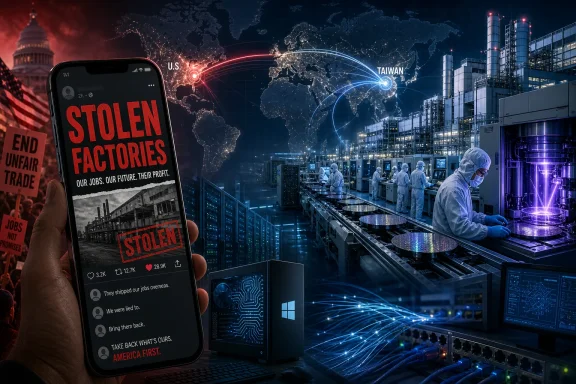 Trump Turns a Supply Chain Into a Campaign Villain
Trump’s post leaned on one of the most durable memories in consumer computing: “Intel Inside.” For a generation of PC buyers, that sticker meant American engineering at the heart of the machine, from beige desktops running Windows 95 to the corporate fleets that standardized modern office computing. It is a powerful symbol because it is simple, legible, and emotionally true even when the industrial history around it is not.The United States did invent much of the semiconductor age. Bell Labs, Fairchild, Intel, Texas Instruments, IBM, Motorola, AMD, and a vast ecosystem of universities, defense contracts, and venture-backed startups created the foundation of modern computing. The PC era, the x86 era, and the early web all reinforced the idea that America was not merely designing the future but manufacturing it.
What Trump compresses into “stolen factories,” however, was a long migration of capital, labor, process discipline, and business models. American firms did not wake up one morning to discover that their fabs had been spirited away across the Pacific. They increasingly chose to design chips, outsource manufacturing, chase higher margins, and let specialized foundries take on the terrifying cost and operational risk of making silicon at scale.
That distinction is not pedantry. If Taiwan “stole” the industry, then punishment and tariffs become the intuitive cure. If the United States voluntarily allowed its manufacturing base to thin out while shareholders rewarded asset-light models, then rebuilding it requires industrial policy, workforce development, patient capital, and years of execution.
The Foundry Model Was an Invention, Not a Heist
Taiwan’s rise began not with a raid on American factories but with a better answer to a problem the semiconductor industry was already creating for itself. As chip design became more complex and fabrication plants became more expensive, not every company could afford to do both. The pure-play foundry model separated design from manufacturing and made it possible for fabless firms to build world-class silicon without owning world-class factories.TSMC, founded in 1987 by Morris Chang, made that model work at scale. Chang was not an outsider looting American know-how from afar; he was a deeply American-trained semiconductor executive who had spent decades at Texas Instruments before building Taiwan’s flagship chip manufacturer. The company’s genius was not that it copied Intel. It was that it served everyone Intel did not want to serve.
That shift unlocked much of the computing world WindowsForum readers now take for granted. Nvidia’s GPUs, Apple’s custom silicon, AMD’s modern Ryzen and EPYC resurgence, Qualcomm’s mobile chips, and countless networking, storage, and embedded processors all depend on the ability to design aggressively while relying on an external manufacturer. The PC industry’s current diversity of CPUs, GPUs, accelerators, controllers, and AI silicon is inseparable from the foundry revolution.
Intel’s historic model was different. It designed and manufactured its own processors, a structure that gave it enormous advantages when its process technology led the world. But when its manufacturing cadence stumbled, the same integration became a constraint. The problem was not that Taiwan took Intel’s fabs. The problem was that TSMC became better at serving the industry Intel chose not to serve, while Intel struggled to maintain its old magic.
Intel’s Lost Decade Cannot Be Outsourced to Taipei
Trump’s invocation of “Intel Inside” is shrewd because Intel’s decline is the cleanest emotional hook in the argument. Intel once defined PC performance, server economics, and manufacturing leadership. Its roadmap shaped OEM design cycles, enterprise refresh plans, and even Microsoft’s assumptions about what Windows machines would look like.But Intel’s problems were not primarily caused by Taiwan. They were caused by missed process transitions, delayed nodes, execution failures, management churn, and the brutal arrival of competitors that used TSMC’s manufacturing engine to attack Intel’s strongest markets. AMD’s comeback was not a Taiwanese theft operation; it was an American chip designer using a Taiwanese foundry to compete with another American chip designer.
That is the irony buried inside Trump’s complaint. The same outsourcing model he frames as national loss also helped preserve U.S. leadership in critical parts of the chip stack. Nvidia, AMD, Broadcom, Qualcomm, Apple, and many other U.S.-linked firms gained from access to TSMC’s fabs. If the only acceptable semiconductor success is vertically integrated domestic manufacturing, then much of the modern American tech sector becomes hard to explain.
Intel’s attempted revival under the foundry banner is an acknowledgment that the old order broke. The company is trying to become not only a maker of Intel chips but a manufacturer for other companies’ chips. That is the TSMC model, translated back into an American industrial strategy. The political challenge is that this takes years, while the rhetoric demands an instant villain.
Tariffs Are a Lever, Not a Lithography Machine
Trump’s post argued that previous presidents “forgot” to protect American industries with tariffs. That line fits neatly into his broader trade worldview, where tariffs are not just bargaining tools but proof of seriousness. In semiconductors, though, tariffs can force decisions only at the margins unless they are paired with the capacity to absorb the work they are trying to redirect.A cutting-edge fab is not a textile mill that can be restarted after a trade dispute. It requires extreme ultraviolet lithography equipment, chemical supply chains, ultrapure water systems, advanced packaging, specialized engineers, cleanroom technicians, yield-management teams, and years of qualification by customers who cannot afford silent defects. Moving production is not like changing a shipping label. It is closer to transplanting a nervous system.
Tariffs can make imported chips more expensive. They can pressure companies to announce U.S. investments. They can alter boardroom calculations when deciding where the next fab goes. But they cannot create a trained workforce overnight, cannot conjure ASML machines out of thin air, and cannot make customers risk mission-critical silicon on an immature process simply because a tariff schedule says they should.
That is why the more durable U.S. response has been subsidy-driven industrial policy, including CHIPS Act incentives and large private commitments from Intel, TSMC, Samsung, Micron, and others. Those investments are not evidence that tariffs alone solved the problem. They are evidence that governments have accepted what Taiwan understood decades ago: semiconductor manufacturing is now strategic infrastructure.
The CHIPS Act Changed the Argument Before Trump Reclaimed It
The Biden-era CHIPS and Science Act marked a major shift in Washington’s thinking. For decades, U.S. policymakers largely trusted market forces to optimize global production. The pandemic chip shortage, China’s military pressure on Taiwan, and the AI boom all exposed the weakness of that faith.By allocating tens of billions of dollars toward semiconductor manufacturing, research, and workforce development, Washington admitted that chipmaking could no longer be treated as just another efficiency-maximizing supply chain. It was now national security policy, economic policy, and technology policy in the same package. That represented a bipartisan conceptual victory even if the implementation remains uneven and contested.
Trump’s current framing does something different. It takes the industrial-policy consensus and wraps it in grievance. Instead of saying America needs more domestic fabs because concentration risk is dangerous, he says Taiwan stole what America built. Instead of making a patient case for resilience, he turns supply-chain geography into a morality play.
That may be politically potent, but it risks confusing the remedy. If the goal is resilience, the United States should want more manufacturing at home, more allied capacity, more advanced packaging options, more substrate capacity, more memory production, and better redundancy across democratic partners. If the goal is revenge, policy can drift toward theatrical punishment that raises costs without solving the bottleneck.
Taiwan’s Silicon Shield Is Also a Silicon Trap
Taiwan’s semiconductor dominance has long been described as a silicon shield: the idea that the world’s dependence on TSMC makes Taiwan too important to disrupt. The island’s fabs are deeply embedded in the economic security of the United States, Europe, Japan, South Korea, and China itself. That interdependence has made Taiwan both indispensable and vulnerable.Trump’s language weakens the diplomatic subtlety around that shield. If Taiwan is described not as a partner but as a thief, then its strategic value becomes transactional. That matters because Taiwan’s chip industry is not merely a commercial supplier. It sits at the center of the most dangerous geopolitical flashpoint in the world.
For U.S. policymakers, the nightmare scenario is not that Taiwan keeps making advanced chips. The nightmare is that too much of the world’s advanced logic capacity remains concentrated in a place Beijing claims and has not renounced taking by force. Reducing that concentration is rational. Treating Taiwan as an adversary while relying on it for AI accelerators, server CPUs, smartphones, networking gear, and defense electronics is not.
There is also a practical contradiction in demanding that TSMC build in America while insulting the ecosystem that made TSMC valuable. The United States needs Taiwanese expertise, Taiwanese capital, Taiwanese suppliers, and Taiwanese operational discipline if Arizona is to become more than a political backdrop. You do not easily reshore a supply chain by alienating the people who know how to run it.
Windows Hardware Lives Downstream From This Fight
For Windows enthusiasts, semiconductor geopolitics can feel abstract until it shows up in the product stack. Every laptop refresh, workstation GPU, server platform, SSD controller, Wi-Fi module, and AI PC neural processor is the visible end of a supply chain that begins with wafer starts and packaging slots. When political pressure changes where chips are made, the effects eventually reach OEM pricing and availability.Windows itself is becoming more sensitive to this. Microsoft’s push into Copilot+ PCs, neural processing units, on-device AI, and Arm-based Windows systems depends on a broader and more specialized silicon base than the old Wintel world required. The operating system is no longer simply waiting for faster x86 CPUs. It is adapting to a hardware landscape defined by accelerators, heterogeneous compute, and custom silicon.
That means semiconductor nationalism could shape the Windows ecosystem in ways that are easy to underestimate. If tariffs raise component costs, budget PCs get squeezed first. If domestic fabs ramp slowly, premium hardware may absorb the earliest supply. If export controls fragment AI accelerator markets, developers may face inconsistent hardware targets across regions. If procurement rules favor U.S.-built chips, enterprise fleets may begin to diverge from consumer availability.
Sysadmins should not read Trump’s post as mere political theater. It is part of a broader shift in which chip origin, firmware provenance, supply-chain security, and geopolitical exposure become procurement variables. The spec sheet will still matter, but so will the passport of the silicon.
The AI Boom Makes the Old PC Fight Look Small
The semiconductor debate is sharper in 2026 because AI has transformed advanced chips from important components into strategic fuel. GPUs, AI accelerators, high-bandwidth memory, advanced packaging, and leading-edge logic now sit behind cloud economics, defense planning, software roadmaps, and national competitiveness. The country that controls compute controls more than an industry; it controls the pace of deployment.This is why Trump’s Intel nostalgia only partly fits the moment. The 1990s PC era was about CPUs in consumer and business machines. The 2020s AI era is about datacenter-scale systems, accelerator clusters, memory bandwidth, power delivery, interconnects, and packaging capacity. The value chain is wider, more expensive, and more globally entangled than the “Intel Inside” sticker ever suggested.
TSMC’s importance is not just that it manufactures chips. It manufactures trust at nanometer scale. Customers line up because the company can execute advanced nodes, protect customer designs, deliver yield, and coordinate with packaging and equipment partners. Replacing that trust requires more than money. It requires repeated success under the most demanding industrial conditions on earth.
Intel can still matter enormously in that world. A successful Intel Foundry would give the United States a domestic advanced manufacturing champion with geopolitical significance. But success will depend less on presidential praise than on process technology, customer confidence, packaging capability, and whether major chip designers believe Intel can deliver on time.
America Did Not Lose Manufacturing by Accident
The uncomfortable part of this story is that Trump is not wrong to identify a real loss. The United States once held a much larger share of global semiconductor manufacturing capacity. Over time, more production moved to Taiwan, South Korea, Japan, China, and elsewhere. The hollowing out of advanced manufacturing created vulnerabilities that the pandemic and great-power competition made impossible to ignore.But saying the problem is real is not the same as accepting the explanation. U.S. firms, investors, and policymakers often preferred the returns of design, software, branding, and platform control over the lower-margin, capital-intensive grind of manufacturing. Wall Street rewarded companies that avoided heavy assets. Consumers rewarded cheaper devices. Politicians enjoyed the benefits of globalization until the bill arrived.
Taiwan made different choices. Its government cultivated semiconductor manufacturing as a national project, its firms focused relentlessly on execution, and its engineering workforce accumulated hard-won process knowledge over decades. That was not theft. It was industrial seriousness.
The United States now wants to rediscover that seriousness without accepting the costs that made it possible. Domestic fabs require subsidies, immigration policy that attracts specialized talent, regional infrastructure, technical education, and tolerance for delays. They also require customers willing to pay for resilience. If Americans want chips made in America, someone will pay more somewhere in the chain.
The Dangerous Comfort of a Simple Story
The theft narrative is attractive because it absolves nearly everyone except foreign competitors and prior presidents. It does not ask why American corporations outsourced so much production. It does not ask why Intel missed key transitions. It does not ask why U.S. industrial policy went dormant while Asian governments treated chipmaking as strategic. It does not ask why investors punished capital intensity until the national security state rediscovered it.That simplicity is dangerous for IT decision-makers because it encourages policy volatility. A government that sees supply chains as stolen property may swing from subsidies to tariffs to equity stakes to export controls with little regard for how long fabs take to build. The semiconductor industry is already cyclical and capital hungry. Political whiplash makes it harder, not easier, to plan.
The better story is less satisfying but more useful. The United States retained enormous strength in chip design, EDA tools, cloud platforms, software ecosystems, and system architecture. Taiwan built unmatched foundry capacity. South Korea built memory and logic strength. The Netherlands became indispensable in lithography. Japan remains critical in materials and equipment. Modern computing is a coalition achievement, not a trophy sitting in one country’s cabinet.
That does not mean America should accept dependency. It means the path to reduced dependency runs through alliances as much as autarky. A resilient semiconductor strategy should make it harder for any single earthquake, blockade, export ban, or political crisis to break the computing world.
The New Industrial Policy Will Be Messy, Expensive, and Necessary
There is a reasonable version of Trump’s argument hiding beneath the accusation. The United States should manufacture more advanced chips domestically. It should not depend overwhelmingly on one island for the most important inputs into AI, defense, cloud computing, and consumer electronics. It should treat semiconductor capacity as infrastructure.But the reasonable version requires acknowledging that allies are part of the answer. TSMC in Arizona is not a humiliation; it is a bridge. Samsung in Texas, Intel in Ohio and Arizona, Micron in New York and Idaho, and packaging investments across the ecosystem are pieces of a broader capacity map. The goal should be to build a network that can survive shocks, not to pretend every valuable chip must be born inside U.S. borders from end to end.
The hardest part will be sustaining attention after the ribbon cuttings. Fab announcements are politically glamorous. Yield ramps are not. Workforce pipelines are slow. Tool delays are boring. Environmental permitting, water use, local housing pressure, and utility demand rarely fit into campaign slogans. Yet those are the details that determine whether “made in America” becomes a durable capability or a recurring press conference.
The U.S. also has to decide what success means. Total self-sufficiency is unrealistic in the near term and may be undesirable if it fractures allied supply chains. Meaningful resilience is more plausible: enough domestic leading-edge capacity for critical needs, enough allied redundancy for scale, and enough policy stability that companies can invest without guessing which country will be the next target of a presidential post.
Washington’s Chip War Comes for the Procurement Spreadsheet
The practical lesson for WindowsForum readers is that chip politics is no longer background noise. It is becoming part of the IT planning environment. Hardware refresh cycles, cloud contracts, AI deployments, and vendor risk assessments will increasingly reflect where chips are made and how governments treat that geography.- Trump’s June 18 post should be read as part of a continuing pressure campaign on semiconductor supply chains, not as an isolated social-media outburst.
- Taiwan did not steal U.S. fabs; it built a foundry model that U.S. chip designers came to rely on because it worked better than the alternatives.
- Intel’s revival matters for American resilience, but it will be judged by execution, customer wins, and manufacturing performance rather than political symbolism.
- Tariffs may shift incentives, but they cannot by themselves create leading-edge fabs, skilled workforces, or trusted production capacity.
- Windows PCs, servers, AI accelerators, and enterprise procurement will all feel the consequences if chip nationalism raises costs or fragments supply.
- The most durable U.S. strategy is likely to combine domestic manufacturing with trusted allied capacity rather than trying to unwind the global semiconductor ecosystem overnight.
References
- Primary source: Washington Examiner
Published: Thu, 18 Jun 2026 07:16:00 GMT
Loading…
www.washingtonexaminer.com - Independent coverage: Times Now
Published: 2026-06-18T06:50:09.559109
Loading…
www.timesnownews.com - Related coverage: tomshardware.com
Loading…
www.tomshardware.com - Related coverage: inquirer.com
Loading…
www.inquirer.com - Related coverage: fr.benzinga.com
Loading…
fr.benzinga.com - Related coverage: time.com
Loading…
time.com
- Related coverage: actualidad.rt.com
Loading…
actualidad.rt.com - Related coverage: scmp.com
Loading…
www.scmp.com - Related coverage: en.sedaily.com
Loading…
en.sedaily.com - Related coverage: digitimes.com
Loading…
www.digitimes.com - Related coverage: washingtonpost.com
Loading…
www.washingtonpost.com - Related coverage: britannica.com
Loading…
www.britannica.com