

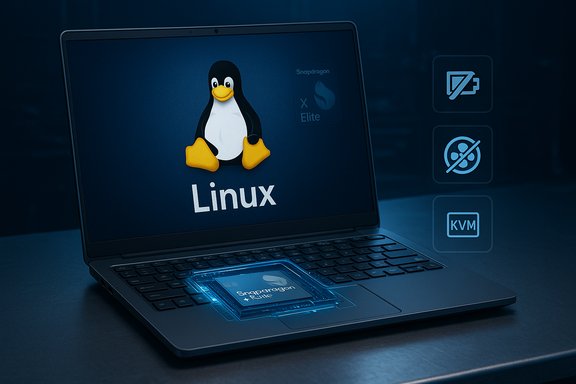
TUXEDO Computers’ decision to pause its Snapdragon X Elite (X1E) Linux laptop project is a stark reminder that raw silicon and community enthusiasm alone don’t guarantee a polished, fully supported Linux system — the underlying platform and vendor tooling matter just as much. The company explicitly says the X1E proved “less suitable for Linux than expected,” citing shortfalls in battery life under Linux, missing BIOS-update workflows, absent fan control interfaces, no practical KVM virtualization, unreliable USB4 throughput, and spotty application support for hardware video decoding.
TUXEDO has built a reputation as a vendor that ships desktops and laptops pre-configured and tested for Linux, often catering to power users and professionals who want hardware that “just works” on distributions like Ubuntu, openSUSE, and Fedora. The company’s ARM experiment began when Qualcomm introduced the Snapdragon X Elite family as a high-performance ARM alternative for Windows laptops; TUXEDO set out to deliver the first ARM-based Linux notebook in its lineup using the Snapdragon X Elite (X1E). After roughly 18 months of development, TUXEDO concluded the project and publicly posted a measured explanation of the technical barriers they encountered. Qualcomm’s broader strategy around the Snapdragon X family included explicit promises to upstream kernel support and collaborate with projects such as Linaro to bootstrap Linux on X Elite hardware. That grassroots work did make measurable progress in the kernel and firmware stacks over 2024–2025, and major OEMs shipped Windows PCs based on the X Elite (for example, Microsoft’s Surface Laptop 7 and Dell’s XPS 13 configurations that use the Snapdragon X Elite). Still, upstreaming a SoC’s basic kernel drivers is only one part of building a stable, feature-complete laptop experience for Linux users.
For the Linux community, the episode is a reminder that progress depends on partnerships: upstream work from Qualcomm and collaborators matters, but downstream integrators need more than kernel trees. Linux adoption on PC-class ARM silicon is advancing, and the pieces are coming together, but the final mile — polished firmware distribution, UEFI workflows, and user-space acceleration — remains a work in progress. Keep watching the X2E generation and the upstream kernel cycles; meaningful consumer-grade Linux ARM laptops will arrive when vendors embrace the full supply chain requirements, not just the headline benchmarks.
The TUXEDO pause is not a signal to abandon ARM on Linux; it’s a clear, public request that vendors and community partners step up on the parts of the stack that make a laptop a dependable, supported product — and that’s a request every Linux user should welcome.
Source: Windows Central https://www.windowscentral.com/hard...-to-be-less-suitable-for-linux-than-expected/
 Background
TUXEDO has built a reputation as a vendor that ships desktops and laptops pre-configured and tested for Linux, often catering to power users and professionals who want hardware that “just works” on distributions like Ubuntu, openSUSE, and Fedora. The company’s ARM experiment began when Qualcomm introduced the Snapdragon X Elite family as a high-performance ARM alternative for Windows laptops; TUXEDO set out to deliver the first ARM-based Linux notebook in its lineup using the Snapdragon X Elite (X1E). After roughly 18 months of development, TUXEDO concluded the project and publicly posted a measured explanation of the technical barriers they encountered. Qualcomm’s broader strategy around the Snapdragon X family included explicit promises to upstream kernel support and collaborate with projects such as Linaro to bootstrap Linux on X Elite hardware. That grassroots work did make measurable progress in the kernel and firmware stacks over 2024–2025, and major OEMs shipped Windows PCs based on the X Elite (for example, Microsoft’s Surface Laptop 7 and Dell’s XPS 13 configurations that use the Snapdragon X Elite). Still, upstreaming a SoC’s basic kernel drivers is only one part of building a stable, feature-complete laptop experience for Linux users. What TUXEDO said — the technical shortfalls
TUXEDO’s public post enumerated the pain points that ultimately ended the project. Each item is worth unpacking because it reveals where silicon, system firmware, driver stacks, and user-space integrations must all align for a Linux laptop to be viable.Battery life and power management
- The company reports that the “long battery runtimes—usually one of the strong arguments for ARM devices—were not achieved under Linux.” Despite the X1E’s hardware efficiency on paper, TUXEDO could not reach the battery expectations that make ARM attractive.
BIOS/UEFI updates from Linux
- TUXEDO noted a missing “viable approach for BIOS updates under Linux.” Modern Windows OEMs supply firmware-update tooling and signed payloads integrated into Windows Update or vendor utilities. Linux users expect equivalent mechanisms: firmware packaged for fwupd/ LVFS, vendor-provided tools, or a UEFI capsule flow that works predictably on native Linux installers. When vendor workflows are absent or rely on proprietary Windows-only tooling, Linux systems are left with fragile, manual, or unsupported update processes. TUXEDO found no satisfactory solution for its design.
Fan control and thermal management
- Fan control interfaces — crucial for balancing thermals and noise — weren’t available through standard Linux interfaces on the platform TUXEDO attempted to bring up. Without proper ACPI/firmware hooks or standardized sysfs knobs, fan behavior is difficult to tune under Linux. TUXEDO classified this deficiency as a showstopper for an OEM-quality device.
Virtualization and KVM
- The post states that “Virtualization with KVM is not foreseeable on our model.” Community threads and distribution bug reports echo this: on some Snapdragon X Elite machines, vendor hypervisors (notably Qualcomm’s Gunyah) or register-level restrictions block access to EL2/hypervisor mode or otherwise complicate KVM integration, limiting host virtualization functionality and guest compatibility. That makes the platform unattractive for developers and hobbyists who rely on KVM-based workflows.
USB4 performance, hardware video decoding, and application support
- TUXEDO also reported trouble getting “the high USB4 transfer rates” they expected and that, while hardware video decoding is technically feasible, “most applications lack the necessary support” in the Linux ecosystem. In short: the stack from PCIe/DP/USB controller to userspace media frameworks needs both kernel work and application-level hooks (e.g., VA-API, FFmpeg patches) to expose acceleration consistently. The absence of mature, integrated userspace support reduces the real-world benefits of hardware decoders.
Why these problems are not merely “driver bugs”
It’s tempting to treat these as fixable engineering tasks — and many of them are — but there are structural reasons the work is harder than a simple driver port.1) Multiple layers must coordinate
A modern laptop requires coordination among:- SoC firmware and secure-world components
- UEFI firmware and vendor extension mechanisms
- Kernel drivers and mainline acceptance
- Distribution packaging (linux-firmware, fwupd)
- Userspace middleware (pulseaudio/pipewire, libcamera, VA-API)
- OEM tools for firmware updates and diagnostics
2) Proprietary hypervisors and mode restrictions
Qualcomm’s adoption of Gunyah (a lightweight hypervisor) and related secure-world components can change how EL2 and virtualization features are exposed to the OS. When vendors insert an additional hypervisor layer or firmware controls into the boot path, KVM host requirements and kernel expectations must be adapted — sometimes with upstream pushback — making virtualization an uphill task. Community reports show this was a live issue on some X Elite platforms.3) Upstreaming is necessary but not sufficient
Qualcomm and partners did upstream large portions of X Elite support to the Linux kernel during 2024–2025, and that work enabled early experimentation and reference images. But upstream kernel inclusion typically focuses on core bus drivers, CPU bring-up, and early hardware enablement; power tuning, thermal heuristics, firmware distribution, and polished user-space integration remain time-consuming. Distributions and OEMs must do additional packaging and QA before a commerce-ready laptop exists.Cross-referencing the evidence
TUXEDO’s post is authoritative for the company’s project status and lists the problems they encountered. Independent reporting from Phoronix, Liliputing, Windows Central, and other outlets corroborates the core claims: the project was placed on hold and the reasons cited align across publications. Community threads and distribution bug reports show the same problems appearing in real-world deployments: KVM issues, suspend and power drain, and user-space decoding gaps. Taken together, these sources form a consistent picture: significant engineering gaps remain between an upstream kernel baseline and a turnkey Linux laptop experience on the X1E. Where clarity is weaker — for example, around how much Qualcomm’s internal choices vs. OEM policy account for the missing features — statements are speculative. There are community reports that Qualcomm preferred working through Linaro and focusing on upstream kernel merges rather than hands-on OEM support for each integrator; that may have slowed vendor-specific engineering that TUXEDO needed. That claim is plausible but not proven, so it should be treated cautiously.What this means for Linux on ARM laptops
The TUXEDO pause is not a death knell for Linux on Qualcomm’s PC-class chips, but it is a sobering reality check. Here are several implications — technical, commercial, and community-facing.Immediate implications
- Linux users who wanted an OEM-backed Snapdragon X Elite laptop will have to wait. TUXEDO explicitly said continuing would mean shipping a product over two years old relative to the X1E’s launch, which didn’t make business or technical sense.
- Developers and enthusiasts will still be able to experiment on existing X Elite hardware (Surface, Dell), but expect gaps: KVM, some power states, and end-to-end firmware workflows may remain rough. Community patches and distribution-specific images can improve this, but bundles made by one vendor don’t equal a robust, supported platform for all users.
Longer-term ecosystem effects
- The arrival of Snapdragon X2 Elite (X2E) offers an opportunity. Qualcomm unveiled the X2 Elite family with major CPU, GPU, and NPU improvements and a roadmap that targets broader PC wins; TUXEDO said it will evaluate the X2E to see whether their existing groundwork is reusable and whether the platform is easier to support on Linux. If the X2E ships with improved firmware and clearer update/management paths, other Linux OEM efforts may revive.
- For the Linux community, the episode reinforces the need for vendor commitment beyond kernel patches. Hardware vendors must deliver firmware blobs, signed update channels compatible with fwupd/LVFS, clear DTB/UEFI behavior, and a plan for exposing thermal and power controls to userspace. Without those pieces, even a robust kernel driver won’t deliver the experience that paying customers expect.
Technical anatomy: what needs to happen for a successful Linux ARM laptop
Below is a practical checklist of what integrators and vendors must solve — a distilled, actionable view of TUXEDO’s pain points that doubles as a roadmap for future OEM efforts.- Kernel support and upstreaming
- Mainline kernel must include stable drivers for CPU, GPU, display, USB, PCIe, and Wi‑Fi.
- Early merges are helpful, but downstream vendors need ongoing maintenance and feature completion (CPUfreq, suspend/resume, PM).
- Evidence: Qualcomm and Linaro upstreamed initial patches; kernel cycles continued incremental work (Linux 6.8–6.11 onward).
- Firmware packaging and distribution
- Provide redistributable firmware in linux-firmware and accessible packages for distributions.
- Support fwupd/LVFS UEFI capsule updates or supply vendor tools that run cleanly under Linux. TUXEDO explicitly flagged the absence of a safe BIOS-update approach.
- Secure boot/UEFI and device tree handling
- Standardize how multiple devicetree blobs are selected at boot (UEFI+DTB interplay), or ship single, correct DTB per SKU.
- Qualcomm and communities identified this as a known boot path issue.
- Power management and thermal controls
- Expose fan control and thermal zones via ACPI/sysfs.
- Tune suspend/resume and idle states for real-world workloads; test battery life extensively under Linux workloads, not just Windows benchmarks.
- Virtualization and EL2 access
- If vendor hypervisors are used, provide a developer pathway or documented method for enabling KVM; otherwise accept that host virtualization will be constrained.
- Community threads show KVM on X Elite hardware can be blocked by hypervisor choices or missing EL2 access.
- Userspace acceleration and media support
- Ensure VA-API/FFmpeg, VDPAU, and browser pipelines can use the hardware decoders reliably.
- Provide reference patches for common multimedia stacks and work with maintainers to land them. TUXEDO noted hardware decoding existed but apps lacked support.
How distributions, developers, and buyers should react
- Distributions: continue upstream collaboration with Qualcomm and Linaro; prioritize packaging authoritative firmware and giving clear guidance for consumer X Elite systems. Ubuntu’s “concept” work and community images illustrate how distributions can accelerate user-ready experiences.
- Developers and OEM integrators: treat platform enablement as a multi-phase program, not a single kernel sprint. Budget for firmware work, test automation, and user-space integration. Consider early community releases to get broad feedback but be transparent about limitations.
- Buyers and enthusiasts: if you need a Linux laptop that “just works” today, prefer systems with mature Linux support or vendor-stated support for your target distribution. If you’re willing to experiment, the X Elite ecosystem is live enough to test, but expect to run bleeding-edge kernels and perform manual workarounds for KVM, power tuning, or firmware extraction in some workflows.
The path forward: X2 Elite and the windows-to-Linux bridge
Qualcomm announced the Snapdragon X2 Elite lineup with substantial architectural improvements — new Oryon cores, higher clock ceilings, more NPU horsepower, and claims of better performance and efficiency. OEMs are slated to ship X2E systems in 2026. TUXEDO explicitly pointed to X2E as a possible revisit point: if the successor delivers improved Linux friendliness and the company can reuse significant work from the X1E effort, they may resume development. That’s a pragmatic stance: retailers and small OEMs need predictable vendor support and a chance to amortize engineering investments across multiple generations. Still, history suggests that silicon announcements alone don’t make a Linux laptop. The critical variables are whether Qualcomm and OEMs will:- Provide redistributable firmware and a clear update path for Linux
- Coordinate transparent hypervisor and virtualization policies that don’t block EL2/KVM
- Commit to userspace acceleration support for multimedia and power-efficient drivers
Final analysis: a pragmatic verdict
TUXEDO made the right call for its business and its customers. Building a commercial, Linux-first laptop from a new SoC requires not just upstream kernel patches but a predictable, vendor-backed firmware and update ecosystem, documented interfaces for power/thermal management, and an assurance that critical features like virtualization and USB4 will reach production-grade reliability. TUXEDO invested roughly a year and a half, coordinated with Linaro, and ultimately judged that delivering a compromised device — or one effectively made obsolete by the X2E timeline — would be unfair to customers.For the Linux community, the episode is a reminder that progress depends on partnerships: upstream work from Qualcomm and collaborators matters, but downstream integrators need more than kernel trees. Linux adoption on PC-class ARM silicon is advancing, and the pieces are coming together, but the final mile — polished firmware distribution, UEFI workflows, and user-space acceleration — remains a work in progress. Keep watching the X2E generation and the upstream kernel cycles; meaningful consumer-grade Linux ARM laptops will arrive when vendors embrace the full supply chain requirements, not just the headline benchmarks.
The TUXEDO pause is not a signal to abandon ARM on Linux; it’s a clear, public request that vendors and community partners step up on the parts of the stack that make a laptop a dependable, supported product — and that’s a request every Linux user should welcome.
Source: Windows Central https://www.windowscentral.com/hard...-to-be-less-suitable-for-linux-than-expected/
