

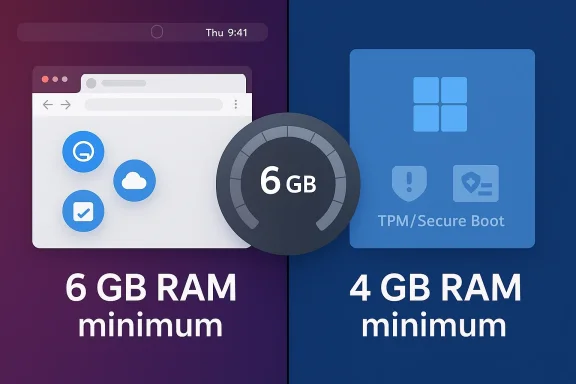
Canonical has raised Ubuntu 26.04 LTS’s minimum RAM requirement to 6 GB, and that means the next long-term-release cycle will officially ask for more memory than Windows 11’s published 4 GB floor. The headline is striking, but the real story is more nuanced: this is less about Linux suddenly becoming bloated and more about the desktop stack finally admitting how memory-hungry modern usage has become. As the file search results show, the new baseline is being framed as a realistic reflection of GNOME, browsers, snaps, flatpaks, and today’s multitasking habits rather than a return to the lightweight ideals that made Ubuntu famous on older PCs
For years, Ubuntu held a special place in the Windows-to-Linux migration story. It was the distribution people recommended when a machine felt too slow for Windows, when the storage was too cramped, or when the PC was still physically fine but no longer pleasant to use. That reputation was built on a mix of usability, broad hardware support, and a desktop experience that was polished enough to feel approachable without demanding a high-end machine.
Windows 11 changed the comparison by tightening its platform requirements in ways that go beyond RAM alone. Canonical’s new 6 GB floor puts Ubuntu in an awkward spot on the spec sheet, but Windows 11 still carries stricter rules around TPM 2.0, Secure Boot, and supported processors. The result is a strange inversion: Ubuntu may now want more memory than Microsoft’s client OS, while still remaining easier to install on many older PCs that Windows 11 simply rejects outright
That tension matters because people do not evaluate operating systems in a vacuum. They compare the whole burden: firmware compatibility, driver support, storage requirements, update policy, and whether the thing will feel usable after installation. Ubuntu’s RAM increase is therefore not just a technical change; it is a psychological one. It touches a long-standing Linux identity that equates “open” with “lightweight,” even though that identity has been under pressure for years as desktops have become more polished and more complex
Modern desktop computing has simply changed. A decade ago, a Linux desktop could get away with being spare and minimalist. Today, users expect a browser-heavy workflow, screen sharing, cloud sync, sandboxed app delivery, polished notifications, and better security defaults. Those conveniences cost memory, and the broader ecosystem has normalized 8 GB or 16 GB as the practical floor for a comfortable experience, regardless of what the official minimum says on paper
The current debate is therefore not really “Has Linux become worse than Windows?” It is “Has Ubuntu finally stopped pretending that 4 GB is enough for the default desktop experience?” The file search material points strongly toward the latter interpretation. Canonical appears to be making a support-policy decision as much as an engineering one: set a more honest minimum, reduce frustration, and align the default install with how real users actually compute in 2026
That distinction is also why the change may actually be good product management. A distro that officially supports a memory floor too low for decent real-world usage ends up attracting complaints from people who expected better. Raising the floor can reduce that mismatch. It is not glamorous, but it is often what mature software products do when they stop optimizing for nostalgia and start optimizing for supportability.
This is the kind of change that creates headlines not because it breaks computers, but because it breaks expectations. Linux users often care as much about identity as performance. The perception that Ubuntu is the gentle, efficient option has been part of its appeal for years, so a paper-spec reversal naturally triggers strong reactions even if daily use tells a subtler story.
That distinction matters because hardware compatibility often matters more than raw memory. A laptop with 4 GB might technically satisfy Windows 11’s RAM floor, but if the chipset, firmware, or CPU is unsupported, the OS is still a nonstarter. Ubuntu can remain the more practical option simply because it is less fussy about the platform around the RAM.
This is why the debate should not be reduced to “Windows is lighter now.” A system can be more restrictive in platform compatibility while still advertising a lower RAM floor. Conversely, a system can ask for more memory while still delivering a more pleasant experience on supported hardware. The two ideas are not the same.
This is especially important because many Linux users now run the same workloads as Windows users: Zoom or Teams in a tab, Gmail, cloud docs, dashboards, IDEs, and local sync clients. The old test of “Can it boot on 2 GB?” is not a serious benchmark for 2026. The more relevant question is whether the desktop stays responsive while all the modern stuff is open.
That does not mean Linux loses its value proposition. It means the recommendation becomes more fragmented. Users now need to think about desktop environment, distro family, and intended workload rather than assuming one famous distribution is the universal answer.
That makes the change less like a dead end and more like a sorting mechanism. Canonical may be implicitly telling users: if you want the mainstream Ubuntu desktop, bring modern hardware. If you want a leaner experience, choose a variant that matches your machine.
There is also a governance angle. Enterprises like clear support boundaries. A distro that sets a higher but more realistic floor may actually make planning easier, especially when paired with standardized hardware refresh cycles.
That matters because many consumers evaluate distros when they are trying to breathe life into an aging machine. They are not reading technical change logs. They are looking for the simplest answer to “Will this feel fast?” A higher minimum creates doubt, even if the real-world answer depends on the desktop environment and workload.
That is how Linux competition often works. The ecosystem is not one product but a portfolio of tradeoffs. When one distribution moves toward mainstream comfort, another can grab the thrift-and-performance niche. Canonical may be accepting that tradeoff in exchange for a better overall desktop baseline.
This is also a branding reset. Ubuntu can remain the best-known desktop Linux, but it no longer owns the “lightest” or “best for old PCs” narrative by default. That space is now open to distros that specialize more aggressively.
That is why the comparison is useful as a headline but incomplete as an assessment. A system can have a lower minimum and still feel heavier in practice. A system can have a higher minimum and still be a better user experience on the same hardware.
The most accurate conclusion, then, is not that Windows 11 is “lighter,” but that Ubuntu’s default desktop is no longer obviously lighter on paper. That is a perception problem, not necessarily a practical disaster.
What matters most now is how Canonical communicates the change. If the company presents the new floor as an honest baseline for a polished desktop, the message is defensible. If it allows the story to harden into “Linux is now bloated too,” then the brand may pay a bigger price than the engineering team intended.
Source: Fathom Journal Fathom - For a deeper understanding of Israel, the region, and global antisemitism
 Background
For years, Ubuntu held a special place in the Windows-to-Linux migration story. It was the distribution people recommended when a machine felt too slow for Windows, when the storage was too cramped, or when the PC was still physically fine but no longer pleasant to use. That reputation was built on a mix of usability, broad hardware support, and a desktop experience that was polished enough to feel approachable without demanding a high-end machine.Windows 11 changed the comparison by tightening its platform requirements in ways that go beyond RAM alone. Canonical’s new 6 GB floor puts Ubuntu in an awkward spot on the spec sheet, but Windows 11 still carries stricter rules around TPM 2.0, Secure Boot, and supported processors. The result is a strange inversion: Ubuntu may now want more memory than Microsoft’s client OS, while still remaining easier to install on many older PCs that Windows 11 simply rejects outright
That tension matters because people do not evaluate operating systems in a vacuum. They compare the whole burden: firmware compatibility, driver support, storage requirements, update policy, and whether the thing will feel usable after installation. Ubuntu’s RAM increase is therefore not just a technical change; it is a psychological one. It touches a long-standing Linux identity that equates “open” with “lightweight,” even though that identity has been under pressure for years as desktops have become more polished and more complex
Modern desktop computing has simply changed. A decade ago, a Linux desktop could get away with being spare and minimalist. Today, users expect a browser-heavy workflow, screen sharing, cloud sync, sandboxed app delivery, polished notifications, and better security defaults. Those conveniences cost memory, and the broader ecosystem has normalized 8 GB or 16 GB as the practical floor for a comfortable experience, regardless of what the official minimum says on paper
The current debate is therefore not really “Has Linux become worse than Windows?” It is “Has Ubuntu finally stopped pretending that 4 GB is enough for the default desktop experience?” The file search material points strongly toward the latter interpretation. Canonical appears to be making a support-policy decision as much as an engineering one: set a more honest minimum, reduce frustration, and align the default install with how real users actually compute in 2026
What Changed in Ubuntu 26.04 LTS
The core change is simple: Ubuntu 26.04 LTS now lists 6 GB of RAM as its minimum, alongside a dual-core 2 GHz processor and 25 GB of free storage. That alone is enough to make headlines because it reverses a familiar talking point in the desktop world. For a long time, Linux’s selling point was that it could do more with less. The new requirement suggests Canonical is increasingly focused on what the system needs to feel acceptable rather than what it needs to merely bootA baseline, not a recommendation
One important nuance is that a minimum requirement is not the same as a recommended configuration. Users often read the spec sheet as if it were a quality promise, but in practice it is usually a legal and support boundary. The file results repeatedly emphasize that Ubuntu’s new number is closer to a “comfortable baseline” than a hard promise of luxury, and that distinction matters when judging the release fairlyThat distinction is also why the change may actually be good product management. A distro that officially supports a memory floor too low for decent real-world usage ends up attracting complaints from people who expected better. Raising the floor can reduce that mismatch. It is not glamorous, but it is often what mature software products do when they stop optimizing for nostalgia and start optimizing for supportability.
- 6 GB is a minimum floor, not a luxury spec.
- The change likely reflects modern app behavior more than a single desktop feature.
- Canonical appears to be reducing support friction on borderline systems.
- The new floor weakens Ubuntu’s older “rescue distro” image.
- The spec sheet now better matches how people actually use desktops today
Why the number matters symbolically
The symbolism is bigger than the arithmetic. Ubuntu has long been the distro that casual switchers, hobbyists, and even IT staff recommended when a laptop felt tired. Once the default desktop asks for more RAM than Windows 11’s published minimum, the old narrative gets harder to sustain. That does not mean Ubuntu is heavier in every practical sense, but it does mean the simple marketing story has changedThis is the kind of change that creates headlines not because it breaks computers, but because it breaks expectations. Linux users often care as much about identity as performance. The perception that Ubuntu is the gentle, efficient option has been part of its appeal for years, so a paper-spec reversal naturally triggers strong reactions even if daily use tells a subtler story.
Ubuntu vs. Windows 11 on Paper
On the narrow metric of RAM minimums, Ubuntu 26.04 LTS now appears more demanding than Windows 11. That is the comparison driving most of the chatter, and it is easy to see why. People remember Linux as the lightweight escape hatch, so seeing the Linux desktop ask for more memory than Microsoft’s flagship client OS feels counterintuitive, even provocativeWhy the comparison is incomplete
Windows 11’s 4 GB figure is only one part of a far more restrictive support picture. Microsoft also requires TPM 2.0, Secure Boot-capable firmware, and supported processors. Ubuntu’s requirements are simpler and usually less exclusionary, which means the distro may still be far more installable on older machines even if its RAM number is higher on paperThat distinction matters because hardware compatibility often matters more than raw memory. A laptop with 4 GB might technically satisfy Windows 11’s RAM floor, but if the chipset, firmware, or CPU is unsupported, the OS is still a nonstarter. Ubuntu can remain the more practical option simply because it is less fussy about the platform around the RAM.
Spec sheets versus lived experience
There is also a real-world irony here: Windows 11 systems almost never ship with 4 GB in normal consumer life. The practical floor in the market has moved upward, and most users are already on 8 GB or 16 GB machines. That makes Microsoft’s published 4 GB number feel more like a formal minimum than a realistic comfort threshold. Ubuntu’s 6 GB minimum may actually be closer to reality than Windows’ official number, even if the headline comparison suggests otherwiseThis is why the debate should not be reduced to “Windows is lighter now.” A system can be more restrictive in platform compatibility while still advertising a lower RAM floor. Conversely, a system can ask for more memory while still delivering a more pleasant experience on supported hardware. The two ideas are not the same.
- Windows 11 has stricter platform gates.
- Ubuntu has a higher RAM floor but a simpler install path.
- Official minimums are often not the same as realistic usage.
- Many modern Windows PCs exceed 4 GB by default anyway.
- The headline is strong, but the real tradeoff is broader than RAM alone
The marketing problem
The problem for Canonical is not technical embarrassment so much as narrative erosion. Ubuntu’s brand has benefited from being the sane, efficient alternative to Windows on older hardware. Once that image weakens, the distro has to compete more on polish, ecosystem, and support than on thrift alone. That is not fatal, but it is a real shift in positioning.Why Linux Desktops Keep Getting Heavier
Ubuntu is not alone in drifting upward. The entire desktop world has become more resource-intensive. Users want sleek interfaces, richer notifications, seamless Bluetooth, better display scaling, modern sandboxing, and cloud-first workflows. Those features improve usability, but they also raise baseline memory use in ways that were hard to imagine when Linux was mainly judged against ultra-lightweight setupsThe browser is the real memory hog
The modern browser is the biggest reason the old lightweight narrative is eroding. For many users, the browser is effectively the operating system, and everything else is secondary. Tabs, video calls, web apps, streaming, collaboration tools, and browser extensions all consume far more memory than the desktop shell itself. That means a distro can be efficient in isolation and still feel heavy in daily use if the browser is the center of lifeThis is especially important because many Linux users now run the same workloads as Windows users: Zoom or Teams in a tab, Gmail, cloud docs, dashboards, IDEs, and local sync clients. The old test of “Can it boot on 2 GB?” is not a serious benchmark for 2026. The more relevant question is whether the desktop stays responsive while all the modern stuff is open.
Security and convenience have a cost
Another factor is the gradual expansion of background services. Sandboxed app formats, desktop portals, online account integration, and more sophisticated file and notification systems all add overhead. On balance, these features are often worth it. But the tradeoff is real: user-friendly Linux looks less and less like the lean rescue tool of years past, and more like a fully featured mainstream desktop platform- Better security and isolation tend to increase overhead.
- Rich desktop effects and scaling features consume RAM.
- Cloud integration and online accounts add background processes.
- Polished defaults often trade frugality for usability.
- The “lightweight Linux” story is harder to maintain in a modern app ecosystem
GNOME and the default desktop experience
Ubuntu’s default desktop choice matters here. A mainstream, polished desktop like GNOME is designed for general users, not memory purists. That makes sense from a product perspective, because Ubuntu is trying to be approachable. But it also means the default experience is not optimized to win a spec-sheet contest against the thinnest possible Windows configuration.What It Means for Older PCs
The biggest practical effect of Ubuntu’s RAM increase will be felt on older machines. These are the laptops and desktops that Linux historically rescued from obsolescence. For many of them, Ubuntu will still run, but the standard desktop may no longer be the obvious first recommendation if the hardware has less than 6 GB availableThe end of the one-size-fits-all recommendation
For years, “install Ubuntu” was the default response when someone asked what to do with a tired Windows machine. That advice still works in many cases, but it is now more conditional. A 4 GB laptop that might once have been an easy Ubuntu candidate could now feel cramped, especially with a modern browser and background services running at the same time.That does not mean Linux loses its value proposition. It means the recommendation becomes more fragmented. Users now need to think about desktop environment, distro family, and intended workload rather than assuming one famous distribution is the universal answer.
Lighter flavors regain relevance
This is where Ubuntu’s own ecosystem becomes important. The standard desktop is not the only way into the Ubuntu family. Lighter flavors and different desktop environments still matter, and they may become more attractive now that the flagship edition has moved up-market in its baseline expectations. The file search results note that lighter spins can preserve the Ubuntu ecosystem without carrying the same GNOME-centric footprintThat makes the change less like a dead end and more like a sorting mechanism. Canonical may be implicitly telling users: if you want the mainstream Ubuntu desktop, bring modern hardware. If you want a leaner experience, choose a variant that matches your machine.
Practical decision-making on limited hardware
For users with older machines, the decision now depends on what they plan to do. If the laptop is mostly for web browsing, email, and light office work, a lighter distro or flavor may offer a better experience than standard Ubuntu. If the machine has been upgraded to 8 GB or more, the 6 GB minimum is less of an issue, and Ubuntu’s polish becomes more relevant than its appetite.- 4 GB systems are now more marginal for the default Ubuntu desktop.
- Lighter flavors become more strategically important.
- Old PCs are still viable, but the best distro choice is more specific.
- Ubuntu remains useful, but less automatically so.
- The “rescue recommendation” role is no longer as universal as it once was
Enterprise and Consumer Impact
The effect of this change is not evenly distributed. In enterprise environments, 6 GB is not especially alarming; on the consumer side, though, spec-sheet perception matters much more. That makes Ubuntu’s move easier to absorb in IT departments than in the enthusiast and casual-switcher communities that helped build its reputation.Enterprises care about consistency
Corporate fleets generally standardize hardware, and many office machines already ship with well above 6 GB of RAM. For IT teams, the key questions are predictability, supportability, and maintenance. A more honest baseline can actually help because it reduces the chance of deploying a desktop image onto borderline hardware and then spending time debugging performance complaints that were inevitable from the startThere is also a governance angle. Enterprises like clear support boundaries. A distro that sets a higher but more realistic floor may actually make planning easier, especially when paired with standardized hardware refresh cycles.
Consumers react to the headline
Consumers are different. They react to framing, not just engineering logic. If a headline says Linux needs more RAM than Windows for the first time, that becomes a story about Linux getting heavier, even if the actual install experience is still better on older PCs than Windows 11. Perception can be unfair, but it is also durable.That matters because many consumers evaluate distros when they are trying to breathe life into an aging machine. They are not reading technical change logs. They are looking for the simplest answer to “Will this feel fast?” A higher minimum creates doubt, even if the real-world answer depends on the desktop environment and workload.
The switcher problem
This shift could also affect Windows switchers. The people most likely to try Linux are often the ones looking for relief from bloat, telemetry, or hardware gates. Ubuntu’s new requirement does not stop them from switching, but it does complicate the emotional pitch. If a newcomer sees Linux as no longer obviously lighter, the message has to shift from “fast and small” to “open, flexible, and easier to own.”- Enterprises are likely to view the change as manageable.
- Consumers may read it as a loss of lightweight credibility.
- New switchers could be swayed by spec-sheet optics.
- IT admins may welcome the clearer support boundary.
- The headline matters more in public perception than in corporate deployment decisions
A subtle but important advantage
Even with the RAM increase, Ubuntu retains one meaningful advantage: it avoids much of Windows 11’s platform gatekeeping. That is not a small thing. A machine that cannot satisfy Microsoft’s CPU or TPM requirements may still be perfectly suitable for Ubuntu, especially if the user is willing to choose a lighter flavor or different desktop environment.The Competition Window Opens
Any time a mainstream distro raises its baseline, alternatives get a marketing opportunity. That is already happening in the Linux world. Users who care about older hardware, faster responsiveness, or a different desktop philosophy now have a cleaner argument for trying something else.Fedora, Zorin OS, Nobara, and others
The file results point to Fedora, Zorin OS, Nobara, and Ubuntu flavors as beneficiaries of the discussion. Fedora can market freshness and polish. Zorin OS can court switchers and older PCs. Nobara can lean into gaming-centric tuning. None of these distributions need Ubuntu to fail; they just need Ubuntu to look less obviously like the default answer for every use caseThat is how Linux competition often works. The ecosystem is not one product but a portfolio of tradeoffs. When one distribution moves toward mainstream comfort, another can grab the thrift-and-performance niche. Canonical may be accepting that tradeoff in exchange for a better overall desktop baseline.
Why this could benefit the Linux ecosystem
Ironically, the change may help Linux as a whole by pushing users to think more carefully about fit. That is healthier than assuming every distro should do everything. A more mature market lets users choose between comfort, freshness, minimalism, gaming tweaks, and enterprise predictability.This is also a branding reset. Ubuntu can remain the best-known desktop Linux, but it no longer owns the “lightest” or “best for old PCs” narrative by default. That space is now open to distros that specialize more aggressively.
- Competitors gain a clearer comparison advantage.
- Ubuntu flavors become more strategically important.
- The Linux market looks more like a menu of tradeoffs.
- Resource-conscious users have more reason to compare distros.
- Canonical’s move may spur healthier product differentiation
Is Windows 11 Actually Lighter?
This is where the rhetoric can get sloppy. It is tempting to say Windows 11 is now lighter than Ubuntu because its published RAM minimum is lower. That would be an oversimplification. The official numbers do not capture telemetry, background behavior, update burden, OEM bloat, or the many ways Windows machines are configured in the real world.Minimums are not ideals
Microsoft’s 4 GB floor is a minimum, not a recommendation. Running Windows 11 on that amount is rarely a pleasant experience, and the market has largely moved beyond it anyway. Ubuntu’s 6 GB floor may simply be a more honest representation of what users need for a responsive modern desktop session.That is why the comparison is useful as a headline but incomplete as an assessment. A system can have a lower minimum and still feel heavier in practice. A system can have a higher minimum and still be a better user experience on the same hardware.
Support boundaries matter
Microsoft’s platform rules also matter. Windows 11’s official support requirements are stricter in ways that can stop an upgrade before RAM ever becomes relevant. Ubuntu’s broader compatibility makes it more forgiving on old or repurposed devices. In a real deployment decision, that often matters more than the one-line memory figure.The most accurate conclusion, then, is not that Windows 11 is “lighter,” but that Ubuntu’s default desktop is no longer obviously lighter on paper. That is a perception problem, not necessarily a practical disaster.
- Windows 11’s 4 GB is a formal minimum.
- Ubuntu’s 6 GB may be a more realistic desktop baseline.
- Platform support rules matter as much as memory.
- The headline is true in a narrow sense but incomplete in context.
- Real-world responsiveness and compatibility are the real evaluation criteria
Strengths and Opportunities
Ubuntu’s updated requirements are not just a cost; they are also an opportunity to align the product with how desktop computing actually works in 2026. The change can reduce friction, improve expectations, and make the default experience feel more credible to people who were never truly satisfied by the old “4 GB is enough” messaging. It also gives Canonical a chance to sharpen its product ladder: mainstream desktop for modern hardware, lighter flavors for modest systems, and clearer guidance for each audience.- More realistic memory expectations for modern apps and browsers.
- Lower support friction from borderline systems that feel sluggish in practice.
- Stronger distinction between the main Ubuntu desktop and lighter flavors.
- Better alignment with enterprise hardware norms.
- Cleaner product positioning for Canonical.
- Potential to improve first-time user satisfaction.
- Less mismatch between marketing and real-world usage
Risks and Concerns
The obvious risk is reputational. Ubuntu may lose part of the goodwill it earned as the easy answer for aging PCs, and that loss could outlast the technical change itself. There is also a real danger of oversimplified headlines doing damage: if people remember only “Linux needs more RAM than Windows,” they may miss the bigger picture of platform compatibility and actual performance. Finally, the change could accelerate fragmentation in the minds of newcomers who just want one simple recommendation.- Loss of the lightweight Linux brand halo.
- Confusion among newcomers trying to revive old hardware.
- Spec-sheet comparisons that favor Windows on a narrow metric.
- Risk that minimum requirement is mistaken for a recommended spec.
- Greater reliance on flavors and alternative distros to fill the low-RAM niche.
- Potential frustration among long-time Ubuntu users.
- More noise from headlines than from actual day-to-day impact
Looking Ahead
The next few Ubuntu releases will determine whether this is a one-time correction or the beginning of a broader upward climb. If Canonical holds the line at 6 GB, the controversy may fade into the background as users adapt. If the requirements keep rising, Ubuntu will increasingly be judged as a mainstream desktop platform rather than a resource-efficient refuge, and that would be a real shift in identity.What matters most now is how Canonical communicates the change. If the company presents the new floor as an honest baseline for a polished desktop, the message is defensible. If it allows the story to harden into “Linux is now bloated too,” then the brand may pay a bigger price than the engineering team intended.
- Watch whether Canonical keeps 6 GB as the stable baseline or raises it again.
- Watch how Ubuntu flavors are positioned for lower-RAM hardware.
- Watch whether the change affects newcomer recommendations.
- Watch whether competitors use the moment to market themselves as leaner alternatives.
- Watch whether enterprise messaging emphasizes predictability over nostalgia.
Source: Fathom Journal Fathom - For a deeper understanding of Israel, the region, and global antisemitism
