

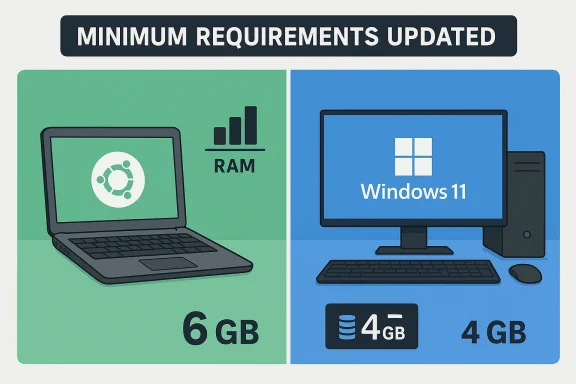
Ubuntu’s long-standing image as the “lightweight” rescue option for aging PCs just took a notable hit. Canonical has raised the minimum RAM requirement for Ubuntu 26.04 LTS to 6 GB, putting it above Windows 11’s official 4 GB floor and prompting a fresh round of debate about whether mainstream Linux has quietly become a heavier platform than the operating system it so often replaces. The change does not make Ubuntu unusable on modest hardware, but it does mark an important psychological shift for users who have treated Ubuntu as the default answer for older machines.
For years, Ubuntu occupied a special place in the PC ecosystem. It was the distribution people recommended when a Windows laptop felt slow, the hard drive was cramped, or the machine was technically still working but practically abandoned by modern software. That reputation did not come from magic so much as from positioning: Ubuntu balanced broad hardware support, a familiar desktop environment, and a level of polish that made Linux feel approachable to ordinary users.
The story also depended on comparison. Windows 11’s official requirements have long been seen as relatively strict, especially because Microsoft tied support to TPM 2.0, newer processor generations, and a minimum of 4 GB of RAM. Ubuntu, by contrast, was widely perceived as the friendlier escape hatch for older hardware because it avoided some of those gatekeeping requirements and historically ran comfortably in less memory.
What makes the current discussion interesting is not simply that Ubuntu raised its memory floor. It is that the new minimum lands at a point where the old narrative flips on paper. Ubuntu 26.04 LTS now asks for 6 GB of RAM, a dual-core 2 GHz processor, and 25 GB of storage, while Windows 11 still officially lists 4 GB of RAM and much steeper platform requirements elsewhere.
This does not mean Ubuntu has become “heavier than Windows” in every practical sense. System requirements are only one slice of real-world behavior, and they are often conservative, marketing-driven, or incomplete. But they are still an important signal, especially for consumers shopping for a distro recommendation or IT administrators deciding what to deploy on low-end machines. Paper requirements matter, even when actual experience tells a more nuanced story.
Historically, Ubuntu’s minimum memory requirements have been ratcheting upward in step with desktop expectations. The 4 GB baseline arrived years ago, and the move to 6 GB reflects a broader trend across operating systems: newer desktops, richer visual effects, background services, sandboxing, and modern application stacks all consume more memory than they did a decade ago. The question is not whether that trend exists, but whether Ubuntu crossing Windows 11’s published RAM floor changes the way users interpret “lightweight Linux.”
There is also a strong product-design argument here. A minimum requirement is not the same as a recommended requirement, and the gap between “will boot” and “will feel good” has widened across every mainstream OS. Ubuntu may be trying to avoid the support burden created by users installing a modern desktop on systems that technically meet older specs but struggle in daily use. A low minimum that produces a miserable experience helps nobody.
That distinction matters because many users do not evaluate an OS in isolation. They evaluate the full upgrade burden: firmware compatibility, storage capacity, driver support, installation difficulty, and future update risk. In that broader sense, Ubuntu remains easier to deploy on some machines that Windows 11 simply will not accept, even if Ubuntu now wants more memory.
At the same time, Linux users tend to judge distributions harshly when they drift upward, because the whole value proposition often centers on efficiency. That is why this change resonates beyond the raw spec sheet. It is not only about memory; it is about trust in the identity of the platform. If Ubuntu is no longer the thriftier option in the headline comparison, some of its brand magic fades.
This is especially true for Ubuntu because the default desktop experience is built to appeal to broad audiences, not just technically inclined users. Broad appeal often means more background services, more graphical niceties, and more conservative defaults. The result is a distro that is easier for the average person to use, but less likely to impress on a machine with very limited RAM. Convenience and frugality are increasingly in tension.
In enterprise environments, this trend is even clearer. Employees run video conferencing, collaboration suites, browser-based dashboards, local security tools, and containerized development environments. A desktop OS that “only” wants 6 GB of RAM may be perfectly reasonable in that context, even if hobbyists remember Linux as something that could breathe on 2 GB or less.
That does not mean Linux loses its place on older PCs. It means the recommendation becomes more fragmented. Instead of one famous distro serving as the universal answer, users may need to choose among lighter alternatives or Ubuntu flavors that place a lower burden on memory and GPU resources. The one-size-fits-all Linux rescue story is getting harder to sustain.
This is particularly important for newcomers who want to repurpose older laptops. They may not care about TPM, Secure Boot, or kernel tuning. They care about whether the installation will feel snappy and whether it will fit on the hardware they already own. A spec-sheet disadvantage, even a narrow one, can influence that choice. Marketing narratives often survive longer than technical nuance.
The important point is that Ubuntu’s brand still carries weight, but it no longer owns the “best for old PCs” narrative by default. That opens the door for communities that have spent years improving resource usage, installer friendliness, and tailored desktop experiences. The Linux desktop market is not one product; it is a portfolio of tradeoffs.
There is also the issue of support boundaries. Microsoft makes clear that devices outside the official requirements are not a supported configuration, and even Microsoft’s own guidance directs users back toward Windows 10 or other alternatives if a device fails Windows 11 requirements. Ubuntu is less restrictive at the platform level, so many users will still find it easier to install even if it wants more RAM.
This split says something bigger about the Linux community. Users want progress, but they also want Linux to preserve its reputation for efficiency. That tension is hard to resolve because both expectations are legitimate. When a distro matures, it can either chase modern usability or cling to old austerity; doing both perfectly is increasingly impossible.
What matters most is whether Canonical can preserve the two things users still expect from Ubuntu: dependable installation on a wide range of hardware and a polished desktop that feels modern rather than minimal. Those goals are not incompatible, but they are harder to balance than they used to be. The future of Linux desktops may belong to clearly defined experiences, not universal defaults.
Source: PCWorld Ubuntu's latest version now needs more RAM than Windows 11
 Background
For years, Ubuntu occupied a special place in the PC ecosystem. It was the distribution people recommended when a Windows laptop felt slow, the hard drive was cramped, or the machine was technically still working but practically abandoned by modern software. That reputation did not come from magic so much as from positioning: Ubuntu balanced broad hardware support, a familiar desktop environment, and a level of polish that made Linux feel approachable to ordinary users.The story also depended on comparison. Windows 11’s official requirements have long been seen as relatively strict, especially because Microsoft tied support to TPM 2.0, newer processor generations, and a minimum of 4 GB of RAM. Ubuntu, by contrast, was widely perceived as the friendlier escape hatch for older hardware because it avoided some of those gatekeeping requirements and historically ran comfortably in less memory.
What makes the current discussion interesting is not simply that Ubuntu raised its memory floor. It is that the new minimum lands at a point where the old narrative flips on paper. Ubuntu 26.04 LTS now asks for 6 GB of RAM, a dual-core 2 GHz processor, and 25 GB of storage, while Windows 11 still officially lists 4 GB of RAM and much steeper platform requirements elsewhere.
This does not mean Ubuntu has become “heavier than Windows” in every practical sense. System requirements are only one slice of real-world behavior, and they are often conservative, marketing-driven, or incomplete. But they are still an important signal, especially for consumers shopping for a distro recommendation or IT administrators deciding what to deploy on low-end machines. Paper requirements matter, even when actual experience tells a more nuanced story.
Historically, Ubuntu’s minimum memory requirements have been ratcheting upward in step with desktop expectations. The 4 GB baseline arrived years ago, and the move to 6 GB reflects a broader trend across operating systems: newer desktops, richer visual effects, background services, sandboxing, and modern application stacks all consume more memory than they did a decade ago. The question is not whether that trend exists, but whether Ubuntu crossing Windows 11’s published RAM floor changes the way users interpret “lightweight Linux.”
What Changed in Ubuntu 26.04 LTS
The headline change is straightforward: Canonical has updated Ubuntu 26.04 LTS’s minimum RAM requirement to 6 GB, with a dual-core 2 GHz CPU and 25 GB of free storage also listed. That is a meaningful jump from the earlier 4 GB-era expectations and is the core reason the comparison with Windows 11 is getting so much attention.The “honesty bump” interpretation
One reasonable reading is that this is less a dramatic technical escalation and more an acknowledgement of how people actually use desktop Linux in 2026. GNOME has become more feature-rich, browsers are vastly more memory-hungry than they were even five years ago, and many Ubuntu users run flatpaks, snaps, containers, and modern development tools that all pile pressure onto RAM. In that sense, 6 GB may be Canonical being honest about what a usable desktop looks like now.There is also a strong product-design argument here. A minimum requirement is not the same as a recommended requirement, and the gap between “will boot” and “will feel good” has widened across every mainstream OS. Ubuntu may be trying to avoid the support burden created by users installing a modern desktop on systems that technically meet older specs but struggle in daily use. A low minimum that produces a miserable experience helps nobody.
- Ubuntu 26.04 LTS is now positioned as a more modern desktop baseline.
- The RAM jump aligns with current desktop software behavior.
- The change likely reduces support friction for Canonical.
- The downside is a weaker story for resurrecting very old PCs.
Ubuntu vs. Windows 11 on Paper
The comparison that caught everyone’s attention is the simplest one: Ubuntu 26.04 LTS asks for 6 GB of RAM, while Windows 11 says 4 GB. On that metric alone, Ubuntu now looks more demanding, which is a strange reversal for anyone who remembers Linux as the lean choice for modest hardware.Why the comparison is not the whole story
Windows 11’s official requirements are famously more complicated than a single RAM number. Microsoft also requires TPM 2.0, Secure Boot-capable firmware, and a compatible processor list, all of which exclude many otherwise functional PCs. Ubuntu’s simpler requirements make it more accessible to a wider range of older or repurposed devices, even if the RAM floor is higher on paper.That distinction matters because many users do not evaluate an OS in isolation. They evaluate the full upgrade burden: firmware compatibility, storage capacity, driver support, installation difficulty, and future update risk. In that broader sense, Ubuntu remains easier to deploy on some machines that Windows 11 simply will not accept, even if Ubuntu now wants more memory.
The real-world memory debate
The RAM spec is also a little deceptive because modern Windows 11 systems almost never ship with just 4 GB in practice. Microsoft’s own support posture and the broader PC market have normalized 8 GB or 16 GB as the practical floor, which makes the official 4 GB number feel more like a legal minimum than a realistic recommendation. Ubuntu’s 6 GB minimum may actually better reflect what users need for a pleasant day-to-day experience.At the same time, Linux users tend to judge distributions harshly when they drift upward, because the whole value proposition often centers on efficiency. That is why this change resonates beyond the raw spec sheet. It is not only about memory; it is about trust in the identity of the platform. If Ubuntu is no longer the thriftier option in the headline comparison, some of its brand magic fades.
- Windows 11 still has stricter platform prerequisites.
- Ubuntu has a higher raw memory minimum now.
- Actual everyday usage matters more than official baselines.
- The perception gap may be more important than the technical gap.
Why Linux Desktops Keep Getting Heavier
There is a broader industry trend behind this news, and it is not unique to Ubuntu. Desktop environments have grown more capable, more visual, and more integrated with cloud services. That evolution benefits usability, but it also increases idle memory use and raises the floor for a smooth experience.Modern desktop expectations
A decade ago, a “good enough” desktop could get by with a modest window manager, a lightweight file manager, and a browser. Today, even mainstream distros are expected to offer fractional scaling, Wayland support, polished notifications, screen sharing, dark mode, sandboxed app delivery, and tighter integration with online accounts and peripherals. Those features are useful, but they are not free.This is especially true for Ubuntu because the default desktop experience is built to appeal to broad audiences, not just technically inclined users. Broad appeal often means more background services, more graphical niceties, and more conservative defaults. The result is a distro that is easier for the average person to use, but less likely to impress on a machine with very limited RAM. Convenience and frugality are increasingly in tension.
The browser effect
It is also impossible to ignore the modern browser. For many users, the browser is the operating system, and browser tabs are the real source of memory pressure. Even if Linux itself remains efficient, the applications people live in every day dominate actual resource consumption. That makes a 6 GB minimum less shocking than it would have been in the era of lighter web apps.In enterprise environments, this trend is even clearer. Employees run video conferencing, collaboration suites, browser-based dashboards, local security tools, and containerized development environments. A desktop OS that “only” wants 6 GB of RAM may be perfectly reasonable in that context, even if hobbyists remember Linux as something that could breathe on 2 GB or less.
- Modern desktops are more feature-rich than before.
- Browser-heavy workflows inflate memory demands.
- Security and sandboxing features consume overhead.
- Enterprise usage patterns justify higher baselines.
What It Means for Older PCs
The biggest practical consequence lands on older machines that have been kept alive through Linux installs. For those systems, Ubuntu’s new floor may be enough to push users toward leaner options or different desktop environments rather than the default Ubuntu experience.The end of Ubuntu as the default rescue recommendation?
That may be the real headline here. For years, “install Ubuntu” was the reflexive answer to a sluggish Windows laptop. Now, users with 4 GB systems or below may find Ubuntu less attractive, at least in its standard desktop form, because the distro no longer clearly wins the hardware-efficiency argument.That does not mean Linux loses its place on older PCs. It means the recommendation becomes more fragmented. Instead of one famous distro serving as the universal answer, users may need to choose among lighter alternatives or Ubuntu flavors that place a lower burden on memory and GPU resources. The one-size-fits-all Linux rescue story is getting harder to sustain.
Practical choices for limited hardware
Users with a weak laptop or aging desktop will now have to think more carefully about the desktop environment as much as the distribution brand. A plain Ubuntu install with GNOME may be overkill for some machines, while lighter spins or different distros can deliver better responsiveness with less RAM pressure. The move away from a universal default is inconvenient, but it may also be healthier for user satisfaction.- Very old PCs may no longer be ideal for default Ubuntu.
- Lightweight desktop environments regain relevance.
- Distro selection now matters more than brand recognition.
- The best choice will depend on the exact hardware.
Enterprise and Consumer Impact
The impact of this change will be different in corporate IT than it is at home. Enterprises already standardize hardware, and many corporate fleets ship with more than enough RAM, so a 6 GB minimum is not a real barrier. For them, the larger question is supportability and consistency, not whether a desktop can start.Consumer perceptions matter more
Consumers, however, are highly sensitive to framing. If Ubuntu is seen as “heavier than Windows” in a headline, some potential switchers may assume Linux has become as bloated as the platform they were trying to escape. That perception could be unfair, but perceptions drive adoption just as much as technical merit does.This is particularly important for newcomers who want to repurpose older laptops. They may not care about TPM, Secure Boot, or kernel tuning. They care about whether the installation will feel snappy and whether it will fit on the hardware they already own. A spec-sheet disadvantage, even a narrow one, can influence that choice. Marketing narratives often survive longer than technical nuance.
Workstation and developer use cases
For developers and power users, the story is different again. Many Ubuntu deployments already involve containers, local virtualization, IDEs, and browser-based tooling, all of which benefit from more RAM. In that segment, the higher minimum is less a warning sign and more a confirmation of what users have been doing anyway.- Enterprises mostly already exceed the new baseline.
- Consumers are more likely to react emotionally to spec comparisons.
- Developers may welcome the more realistic floor.
- IT teams still value Ubuntu’s simpler platform requirements.
The Competition: Fedora, Zorin OS, Nobara, and Friends
The immediate winner in the conversation may be competition. When a mainstream distro raises requirements, lighter or more opinionated alternatives get a chance to look smarter, especially to users who care about performance on aging hardware.Why alternatives matter now
Fedora often appeals to users who want a more cutting-edge Linux stack, while Zorin OS has long targeted Windows switchers with a friendlier interface and polished onboarding. Nobara, meanwhile, has cultivated a reputation for gaming-friendly tweaks and desktop convenience. None of these are direct Ubuntu clones, but each can attract users who now look at Ubuntu’s new floor and ask whether another distro suits them better.The important point is that Ubuntu’s brand still carries weight, but it no longer owns the “best for old PCs” narrative by default. That opens the door for communities that have spent years improving resource usage, installer friendliness, and tailored desktop experiences. The Linux desktop market is not one product; it is a portfolio of tradeoffs.
The role of lighter flavors
Ubuntu itself also has a built-in answer: its family of lighter flavors. Users who want the Ubuntu ecosystem without GNOME’s heavier footprint can still look at options with different desktop environments. That distinction becomes more important now, because the headline requirement applies to the standard desktop experience, not to every possible Ubuntu-based setup.- Fedora may appeal to users wanting freshness and polish.
- Zorin OS targets switchers and older PCs.
- Nobara attracts gaming-oriented users.
- Ubuntu flavors still matter for resource-conscious installs.
Is Windows 11 Really “Lighter”?
The obvious rhetorical trap is to declare Windows 11 lighter than Ubuntu now, but that would be too simplistic. Official requirements tell only part of the story, and in practice Windows 11 can still feel heavier on modest machines because of background services, update behavior, telemetry, and OEM software baggage.Minimum requirement versus lived experience
Microsoft’s 4 GB figure is a minimum, not a recommendation. Users who try to run Windows 11 on that floor typically encounter sluggishness, swapping, and a poor multitasking experience. By contrast, Ubuntu’s 6 GB minimum may actually be closer to the amount needed for a comfortable desktop session with modern apps. Minimums are not the same as ideals.There is also the issue of support boundaries. Microsoft makes clear that devices outside the official requirements are not a supported configuration, and even Microsoft’s own guidance directs users back toward Windows 10 or other alternatives if a device fails Windows 11 requirements. Ubuntu is less restrictive at the platform level, so many users will still find it easier to install even if it wants more RAM.
The perception problem
Still, perception matters, and the perception now is awkward for Ubuntu. Linux has long benefited from the idea that it is the sane, slim, efficient choice. If the most popular Linux desktop distro can no longer claim a lower memory requirement than Windows 11, it complicates the story even if the real-world experience remains favorable in many cases.- Windows 11’s minimum is smaller on paper.
- Ubuntu’s platform requirements remain simpler.
- Real-world performance can diverge from the spec sheet.
- The headline comparison is powerful even if incomplete.
Community Reaction and What It Reveals
The online reaction has been unsurprising: some users see the change as proof that Ubuntu is drifting away from its roots, while others view it as an overdue admission that modern desktops are simply heavier now. Both views contain some truth.A split between nostalgia and pragmatism
The nostalgic argument is easy to understand. Many Linux users remember a time when Ubuntu felt like the easy way to give old hardware a second life, and a higher RAM floor feels like a betrayal of that identity. The pragmatic argument is equally strong: nobody benefits from pretending that today’s browsers, desktop effects, and app ecosystems are as light as they once were.This split says something bigger about the Linux community. Users want progress, but they also want Linux to preserve its reputation for efficiency. That tension is hard to resolve because both expectations are legitimate. When a distro matures, it can either chase modern usability or cling to old austerity; doing both perfectly is increasingly impossible.
Support expectations are changing too
There is also an implicit support message here. Canonical likely does not want users filing complaints after trying to run a modern desktop on underpowered machines and then treating poor performance as a bug. Raising the minimum requirement can reduce that mismatch, even if it annoys long-time fans of ultra-light installations.- Nostalgia amplifies negative reactions.
- Pragmatism supports the update.
- Modern desktops are harder to keep lean.
- Support clarity may improve after the requirement bump.
Strengths and Opportunities
This change is not all downside. In fact, Ubuntu’s updated requirements may strengthen the platform by setting more honest expectations, reducing support confusion, and aligning the default desktop with how people actually compute today. The challenge is to preserve Ubuntu’s identity while acknowledging that the desktop world has moved on.- More realistic baseline for modern desktop workloads.
- Better user experience on supported hardware.
- Fewer support complaints from borderline systems.
- Clearer product positioning for Canonical.
- Stronger justification for Ubuntu flavors and lighter spins.
- Opportunity to modernize without pretending the old model still fits.
- Potential to attract enterprise buyers who value predictability over nostalgia.
Risks and Concerns
The obvious risk is reputational. Ubuntu may lose some of the goodwill that comes from being the easy recommendation for aging PCs, and that perception could linger even if the real-world impact is modest. The other risk is fragmentation, where users become unsure which Ubuntu flavor or alternate distro best matches their hardware.- Brand dilution as the “lightweight Linux” story weakens.
- Confusion for newcomers trying to revive old machines.
- Greater pressure on flavors to fill the low-RAM niche.
- Spec-sheet optics that favor Windows on a narrow metric.
- Possible frustration among long-time Ubuntu users.
- Risk of oversimplified headlines obscuring the real tradeoffs.
- More decision fatigue for users who just want a simple install.
Looking Ahead
The next few Ubuntu releases will matter because they will show whether 6 GB is a one-time correction or the start of a new trajectory. If Canonical keeps nudging requirements upward, Ubuntu will increasingly resemble a mainstream desktop OS in both ambition and footprint. If the line stabilizes here, the current controversy may fade into a footnote.What matters most is whether Canonical can preserve the two things users still expect from Ubuntu: dependable installation on a wide range of hardware and a polished desktop that feels modern rather than minimal. Those goals are not incompatible, but they are harder to balance than they used to be. The future of Linux desktops may belong to clearly defined experiences, not universal defaults.
- Watch whether Canonical updates the recommended specs separately from the minimum.
- Watch how Ubuntu flavors are positioned in response.
- Watch whether lighter distros gain adoption among older-PC users.
- Watch if enterprise messaging emphasizes support and stability over thrift.
- Watch whether future releases keep the 6 GB baseline or raise it again.
Source: PCWorld Ubuntu's latest version now needs more RAM than Windows 11
