

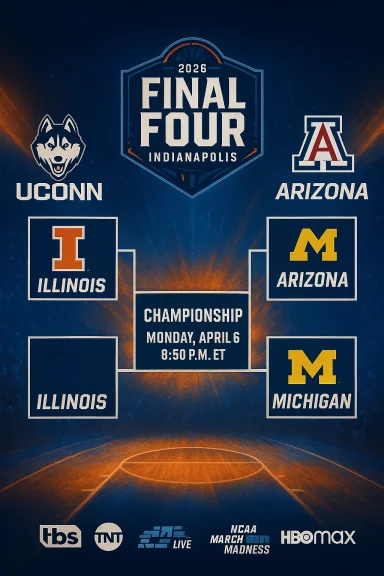
The 2026 Men’s NCAA Tournament is down to its final three games, and the sport’s biggest weekend arrives with a bracket that feels both familiar and new. UConn, Illinois, Arizona, and Michigan have reached Indianapolis, and the Final Four matchups are set for Saturday, April 4, 2026, at Lucas Oil Stadium before the national championship game on Monday, April 6. For fans, the good news is simple: the games are widely available across TBS, TNT, and truTV, with streaming through NCAA March Madness Live and HBO Max.
This year’s Final Four has the rare blend of blue-blood gravity and fresh urgency. UConn is chasing another deep run after arriving in Indianapolis for the third time in four seasons, while Illinois is trying to convert a long-awaited return to the national semifinals into something bigger. On the other side of the bracket, Arizona and Michigan bring a heavyweight feel, with both programs built around physicality, size, and the kind of postseason identity that tends to travel well in late March and early April.
The broadcast setup matters because the men’s tournament is now a distribution ecosystem as much as a live sports event. TBS will carry the Final Four and title game, while TNT and truTV simulcast coverage, and the games will also be available on NCAA March Madness Live and HBO Max. That combination reflects the modern reality of college basketball viewing: fans are no longer limited to cable alone, but the event still depends on a coherent national television brand to feel like a shared cultural moment.
There is also a broader significance to this specific Final Four weekend. Indianapolis has become a familiar host city for big NCAA events, and Lucas Oil Stadium gives the tournament the scale of an NFL venue without sacrificing the intimacy that the Final Four demands. The setting reinforces how the NCAA continues to market the closing weekend as both an elite sporting spectacle and a destination event for fans who plan their springs around it.
The tip times themselves tell part of the story. The first semifinal, UConn vs. Illinois, tips at 6:09 p.m. ET, while Arizona vs. Michigan follows at 8:49 p.m. ET. Those are not just television-friendly windows; they are the kind of staggered national slots that allow the second game to build into a prime-time crescendo, which is exactly what the NCAA and its media partners want on the sport’s biggest weekend.
The streaming picture is more flexible than it used to be, but it still rewards planning. March Madness Live remains the cleanest all-in-one option for viewers with TV authentication, while HBO Max extends the reach of the TNT Sports package for subscribers who would rather stream on a connected TV or mobile device. The result is a hybrid model: one that keeps the event on linear television while acknowledging that many fans will never touch a cable box.
There is a practical lesson here for college sports fans: not every stream is equal. A viewer who wants the most stable game feed on Saturday evening may still favor the broadcast app or the primary TV channel, while a viewer who wants to jump between games, studio shows, and highlights will likely prefer the digital bundle. That flexibility is now part of the Final Four experience, not a bonus feature.
That matters because UConn’s recent identity has been built on more than recruiting rankings. The program has combined structure, spacing, and defensive intensity in a way that repeatedly survives March pressure, and the current run suggests the coaching staff has maintained that standard even as the roster changes. Freshman guard Braylon Mullins has been central to that storyline, giving the Huskies a new face while the program keeps its old habits intact.
The Huskies also benefit from institutional memory. Programs that reach the Final Four often talk about experience, but UConn has something deeper: a culture that treats the tournament’s biggest stage as normal operating territory. That can be dangerous for opponents because it removes the mystique from the moment and turns the game into a performance problem rather than an emotional one.
The rematch angle only sharpens the drama. Illinois and UConn have already seen each other in postseason and nonconference settings, which means both staffs have at least some prior reference points for the matchup. That can make the game feel more tactical than emotional, though at this stage the emotional pressure never disappears; it simply hides behind scouting reports and half-court sets.
The broader significance is that Illinois can now sell itself differently to recruits, donors, and fans. Programs often talk about “returning” when they mean “rebasing,” and that distinction matters: a Final Four appearance changes the expectations around what is normal, what is possible, and what should be demanded next. The next step is not just winning on Saturday; it is proving the run can be repeated.
Arizona’s run is especially notable because it marks the program’s first Final Four in a quarter century. That kind of gap creates a powerful narrative arc: the pressure is real, but so is the novelty. For Michigan, the return to the Final Four for the first time since 2018 restores a familiar postseason identity that had gone quiet for a few seasons.
This kind of matchup also compresses the margin for error. Perimeter streaks can decide a game in one half, but frontcourt control tends to decide a game in forty minutes. That makes Arizona and Michigan a fascinating contrast to the more narrative-heavy first semifinal, because the tactical battle may be more important than the emotional one.
The studio schedule on Saturday reinforces that point. The Final Four Show and subsequent pregame windows create a long runway into tip-off, which helps turn the entire day into an event rather than a two-game window. For networks, that matters because shoulder programming creates continuity; for fans, it means the games feel like the center of the sports calendar, not just a pair of isolated broadcasts.
What is especially interesting is how the broadcast package now bridges television and streaming without fully abandoning either. That hybrid approach mirrors the broader state of sports media in 2026: legacy channels still matter, but they increasingly function as the spine of a wider digital product. The NCAA has effectively turned the Final Four into a showcase for convergence.
This Final Four also reinforces the importance of size and physicality in a tournament that remains unforgiving to teams that rely on only one scoring path. The most dangerous teams in March are usually the ones that can win ugly, and the semifinal pairings suggest that all four contenders have at least some version of that trait. That makes the weekend less about style points and more about who can absorb pressure without losing structural integrity.
For rivals, the message is uncomfortable but clear: brand alone is not enough. A famous logo helps, but the programs that survive April tend to be the ones that build rosters for April in the first place. That means the NCAA Tournament continues to reward teams with depth, role clarity, and the ability to create good shots against elite defenses.
The second thing to watch is whether this weekend further confirms the NCAA’s current media model. If the audience responds to the combination of linear TV, simulcast coverage, and streaming access, it strengthens the case that March Madness can remain a mass-market event even as habits change. If viewership fractures, the event may still be powerful, but the path to keeping it that way will become more complicated.
Source: USA Today Final Four schedule: How to watch Men's NCAA Tournament semifinals, championship
 Overview
This year’s Final Four has the rare blend of blue-blood gravity and fresh urgency. UConn is chasing another deep run after arriving in Indianapolis for the third time in four seasons, while Illinois is trying to convert a long-awaited return to the national semifinals into something bigger. On the other side of the bracket, Arizona and Michigan bring a heavyweight feel, with both programs built around physicality, size, and the kind of postseason identity that tends to travel well in late March and early April.The broadcast setup matters because the men’s tournament is now a distribution ecosystem as much as a live sports event. TBS will carry the Final Four and title game, while TNT and truTV simulcast coverage, and the games will also be available on NCAA March Madness Live and HBO Max. That combination reflects the modern reality of college basketball viewing: fans are no longer limited to cable alone, but the event still depends on a coherent national television brand to feel like a shared cultural moment.
There is also a broader significance to this specific Final Four weekend. Indianapolis has become a familiar host city for big NCAA events, and Lucas Oil Stadium gives the tournament the scale of an NFL venue without sacrificing the intimacy that the Final Four demands. The setting reinforces how the NCAA continues to market the closing weekend as both an elite sporting spectacle and a destination event for fans who plan their springs around it.
The tip times themselves tell part of the story. The first semifinal, UConn vs. Illinois, tips at 6:09 p.m. ET, while Arizona vs. Michigan follows at 8:49 p.m. ET. Those are not just television-friendly windows; they are the kind of staggered national slots that allow the second game to build into a prime-time crescendo, which is exactly what the NCAA and its media partners want on the sport’s biggest weekend.
How to Watch
For viewers, this Final Four is as accessible as March Madness has ever been. The games will air across TBS, TNT, and truTV, and the same coverage will stream on NCAA March Madness Live and HBO Max. Fans who still prefer traditional cable can treat TBS as the anchor channel, while cord-cutters can lean on authenticated app access or streaming subscriptions.Broadcast and streaming options
CBS Sports and TNT Sports’ joint production gives the semifinals and title game a familiar on-air identity. Ian Eagle, Bill Raftery, and Grant Hill are calling the action, with Tracy Wolfson on the sideline and Gene Steratore serving as rules analyst. That continuity matters because Final Four audiences often include casual fans, and recognizable voices help turn a one-night tournament event into a national appointment.The streaming picture is more flexible than it used to be, but it still rewards planning. March Madness Live remains the cleanest all-in-one option for viewers with TV authentication, while HBO Max extends the reach of the TNT Sports package for subscribers who would rather stream on a connected TV or mobile device. The result is a hybrid model: one that keeps the event on linear television while acknowledging that many fans will never touch a cable box.
There is a practical lesson here for college sports fans: not every stream is equal. A viewer who wants the most stable game feed on Saturday evening may still favor the broadcast app or the primary TV channel, while a viewer who wants to jump between games, studio shows, and highlights will likely prefer the digital bundle. That flexibility is now part of the Final Four experience, not a bonus feature.
What matters for viewers
The NCAA’s scheduling format also creates an easier watch experience for households and sports bars. There are only two games on Saturday, and both are on the same national feed family, which reduces the confusion that can arise earlier in the tournament when multiple networks split the slate. The championship game then lands on Monday night, where it can stand alone without competition from another live game.- Saturday, April 4: UConn vs. Illinois at 6:09 p.m. ET
- Saturday, April 4: Arizona vs. Michigan at 8:49 p.m. ET
- Monday, April 6: National championship at 8:50 p.m. ET
- Channels: TBS, TNT, and truTV
- Streaming: NCAA March Madness Live and HBO Max
UConn’s Return to the Spotlight
UConn has become the defining tournament machine of the modern era, and this run only strengthens that reputation. The Huskies are in their third Final Four in four seasons, a level of consistency that is hard to achieve in the transfer portal era, where roster churn and one-year development arcs can undo even the deepest programs. Their presence again signals that the old powers still matter, but only when they adapt fast enough to the new environment.That matters because UConn’s recent identity has been built on more than recruiting rankings. The program has combined structure, spacing, and defensive intensity in a way that repeatedly survives March pressure, and the current run suggests the coaching staff has maintained that standard even as the roster changes. Freshman guard Braylon Mullins has been central to that storyline, giving the Huskies a new face while the program keeps its old habits intact.
Why the Huskies keep showing up
UConn’s advantage is not that it looks identical every year. It is that the program seems able to identify the same competitive ingredients in different personnel groups, then build around them. That kind of continuity is rare in a landscape where many contenders lose their edge the moment the roster turns over.The Huskies also benefit from institutional memory. Programs that reach the Final Four often talk about experience, but UConn has something deeper: a culture that treats the tournament’s biggest stage as normal operating territory. That can be dangerous for opponents because it removes the mystique from the moment and turns the game into a performance problem rather than an emotional one.
- Third Final Four in four seasons
- Freshman production is still driving the ceiling
- Program identity survives roster turnover
- Experience at this stage is part of the edge
- Consistency remains the Huskies’ most important weapon
Illinois’ Long-Awaited Breakthrough
Illinois enters the Final Four with a very different storyline: not a dynasty defending its turf, but a long-overdue return to the stage. This is the Illini’s first Final Four since 2005, and that gap alone tells you how much pressure and meaning the matchup carries. A program can have a strong modern reputation without regularly reaching this point, but the Final Four is where perception hardens into legacy.The rematch angle only sharpens the drama. Illinois and UConn have already seen each other in postseason and nonconference settings, which means both staffs have at least some prior reference points for the matchup. That can make the game feel more tactical than emotional, though at this stage the emotional pressure never disappears; it simply hides behind scouting reports and half-court sets.
The significance of the 2005 gap
A 21-year absence from the Final Four is not just a trivia note. It speaks to how difficult it is to remain nationally relevant through coaching changes, recruiting cycles, and the endless churn of tournament luck. For Illinois, this is a chance to turn a long memory into a present-tense brand refresh.The broader significance is that Illinois can now sell itself differently to recruits, donors, and fans. Programs often talk about “returning” when they mean “rebasing,” and that distinction matters: a Final Four appearance changes the expectations around what is normal, what is possible, and what should be demanded next. The next step is not just winning on Saturday; it is proving the run can be repeated.
- First Final Four since 2005
- Rematch dynamics add strategic familiarity
- Legacy-building opportunity for the program
- A chance to reset expectations nationally
- Saturday is about more than just one game
Arizona and Michigan as Heavyweight Counterweights
If the first semifinal is about a modern power and an overdue return, the second is about pure brand weight. Arizona and Michigan are both among the sport’s most recognizable names, and each brings a version of tournament survival that looks different but equally credible. The Wildcats and Wolverines reached this stage by imposing themselves in the paint and controlling physical space, which is often the most reliable currency in late-round NCAA basketball.Arizona’s run is especially notable because it marks the program’s first Final Four in a quarter century. That kind of gap creates a powerful narrative arc: the pressure is real, but so is the novelty. For Michigan, the return to the Final Four for the first time since 2018 restores a familiar postseason identity that had gone quiet for a few seasons.
Why the paint battle matters
In tournament basketball, the paint is often the simplest way to identify which team can survive nerves. If a team can score around the rim, protect the rim, and rebound without panic, it usually has multiple ways to win when shots stop falling. That is why Arizona vs. Michigan feels like the day’s most potentially bruising matchup.This kind of matchup also compresses the margin for error. Perimeter streaks can decide a game in one half, but frontcourt control tends to decide a game in forty minutes. That makes Arizona and Michigan a fascinating contrast to the more narrative-heavy first semifinal, because the tactical battle may be more important than the emotional one.
- Arizona returns to the Final Four after a 25-year wait
- Michigan is back for the first time since 2018
- Both teams are built for physical postseason basketball
- Paint production may decide the game more than perimeter shot-making
- This is the bracket’s most heavyweight semifinal
The Broadcast Product and Why It Still Works
March Madness remains one of the few sports properties that can still generate a truly shared national viewing moment. The Final Four package works because it blends traditional television with layered studio coverage, recognizable talent, and a relatively simple game-night structure. Even in a fragmented media market, the tournament retains a linear-TV authority that most events would envy.The studio schedule on Saturday reinforces that point. The Final Four Show and subsequent pregame windows create a long runway into tip-off, which helps turn the entire day into an event rather than a two-game window. For networks, that matters because shoulder programming creates continuity; for fans, it means the games feel like the center of the sports calendar, not just a pair of isolated broadcasts.
The role of announcers and studio coverage
There is a reason the same names keep returning to the big stages. Ian Eagle and Bill Raftery bring game-night rhythm, while Grant Hill gives the telecast championship credibility and modern insight. Tracy Wolfson adds the courtside perspective, which matters at the Final Four because so much of the event’s atmosphere lives in the building, not just on the scoreboard.What is especially interesting is how the broadcast package now bridges television and streaming without fully abandoning either. That hybrid approach mirrors the broader state of sports media in 2026: legacy channels still matter, but they increasingly function as the spine of a wider digital product. The NCAA has effectively turned the Final Four into a showcase for convergence.
- Traditional television remains the event’s core identity
- Streaming expands access without replacing the TV model
- Studio coverage helps create a full-day sports occasion
- Familiar broadcasters reduce friction for casual viewers
- The broadcast is part of the spectacle, not just a delivery mechanism
What This Means for the Sport
The field itself reflects the current shape of college basketball. There is room for blue bloods, but there is also room for programs that have rebuilt through coaching, development, and roster management. UConn and Michigan show the value of institutional stability, while Illinois and Arizona show that long waits can end when a program finds the right mix at the right time.This Final Four also reinforces the importance of size and physicality in a tournament that remains unforgiving to teams that rely on only one scoring path. The most dangerous teams in March are usually the ones that can win ugly, and the semifinal pairings suggest that all four contenders have at least some version of that trait. That makes the weekend less about style points and more about who can absorb pressure without losing structural integrity.
Competitive implications beyond 2026
The larger competitive lesson is that college basketball success is still cyclical, but the cycle is now faster and more transactional. In the portal era, a program can surge quickly, but it can also lose momentum just as quickly if it cannot retain, replace, and integrate talent. UConn’s repeat presence is therefore a case study in modern adaptation, not just legacy maintenance.For rivals, the message is uncomfortable but clear: brand alone is not enough. A famous logo helps, but the programs that survive April tend to be the ones that build rosters for April in the first place. That means the NCAA Tournament continues to reward teams with depth, role clarity, and the ability to create good shots against elite defenses.
- Roster adaptability is now a championship skill
- Physical depth remains a postseason separator
- Legacy programs still matter, but only if they keep evolving
- The portal era rewards teams that can retool quickly
- Tournament success is increasingly about construction, not branding
Strengths and Opportunities
This Final Four is unusually strong from a storytelling perspective because it combines a dominant modern program, a long-awaited return, and two heavyweight brands with meaningful postseason history. It is also a gift to broadcasters, who get a clean, two-game Saturday and a standalone title game on Monday night. For the NCAA, the weekend represents the best version of what March Madness can still be in a fragmented media era.- Clear marquee matchups
- Strong national recognition for all four teams
- High-access broadcast and streaming package
- Compelling mix of history and fresh storylines
- Potential for a high-rating championship game
- Indianapolis provides a reliable Final Four stage
- The semifinal spacing creates a strong television rhythm
Risks and Concerns
The biggest risk is that a potentially physical, defense-heavy bracket could produce stretches of lower-scoring basketball that frustrate casual viewers. Another concern is that broad access can still be confusing if fans are not sure which platform they need, especially with TV, simulcast, and streaming options all in play. And while the Final Four has strong storylines, the tournament’s wider value depends on the games delivering competitive tension rather than name recognition alone.- Confusing channel and streaming choices for casual fans
- Possible pace-heavy, low-possession semifinal games
- Overreliance on brand names instead of on-court drama
- An injury or foul-trouble swing could flatten a matchup
- Streaming authentication remains a hurdle for some viewers
- The championship game may feel anticlimactic if Saturday is lopsided
- Too much pregame hype can raise expectations beyond what any game can guarantee
Looking Ahead
The next 72 hours will determine whether this Final Four becomes a classic or simply a strong edition of the event. The most important thing to watch is not only who advances, but how each team handles the pressure points that define elite tournament basketball: rebounding, shot creation, foul management, and late-game composure. Those elements usually decide the champion long before the final buzzer.The second thing to watch is whether this weekend further confirms the NCAA’s current media model. If the audience responds to the combination of linear TV, simulcast coverage, and streaming access, it strengthens the case that March Madness can remain a mass-market event even as habits change. If viewership fractures, the event may still be powerful, but the path to keeping it that way will become more complicated.
- Who wins the paint battles
- Which team gets the cleaner guard play
- How well each program handles foul trouble
- Whether the second semifinal feels bigger than the first
- How easily fans move between TV and streaming
Source: USA Today Final Four schedule: How to watch Men's NCAA Tournament semifinals, championship
