

Udemy’s latest move to bundle Microsoft certification vouchers into its learning marketplace is more than a convenience upgrade. It is a deliberate push to own more of the certification funnel, from first lesson to final exam, and it arrives as demand for Microsoft skills continues to surge across Azure, Copilot, Power BI, and security-adjacent roles. The company says learners can now buy more than 50 Microsoft exam vouchers directly through Udemy, extending a certification prep ecosystem that has already generated more than 10 million enrollments over the past 12 months ignificance of the announcement is easiest to see in the context of how certification has evolved. A few years ago, online learning platforms mostly sold courses and practice questions, while exam delivery and scheduling lived somewhere else entirely. That separation created friction, especially for learners who had to move from a study platform to a testing provider, then back again to track readiness, availability, and payment.
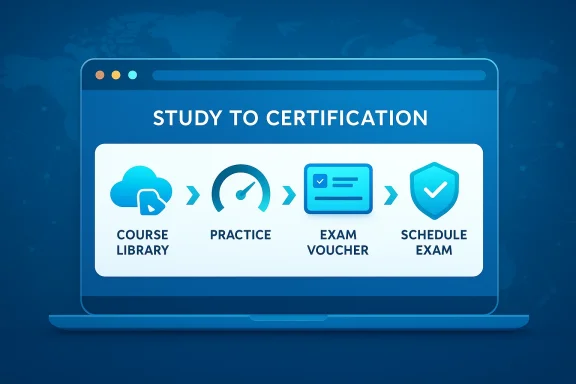
Udemy’s new Microsoft voucher offering narrows that gap. According to the company’s press release, the marketplace now lets learners move from learning to exam purchase in one place, with direct access to Microsoft certification vouchers and the company’s long-standing course library. That matters because certification is increasingly marketed not as a one-time credential, but as a full journey with study, practice, scheduling, and validation all connected in a single workflow .
This is also part ation strategy for Udemy. The company has been steadily expanding its badging and certification-prep features, and a June 2024 announcement showed that it was already treating certification journeys as a core product category rather than a side offering. That earlier move framed certification prep as a way to help learners identify supported credentials and connect them to courses more efficiently, and it emphasized the role of official prep paths in an increasingly crowded learning market .
Microsoft, for its part, has been leanic from the other direction. Microsoft Learn makes clear that vouchers are redeemed through Pearson VUE as part of the standard scheduling flow, and Microsoft continues to offer voucher-based programs, sweepstakes, and exam discounts through official channels. In other words, the certification ecosystem is already designed around a formal test-delivery partner; Udemy’s move is to make the front end of that journey much more visible and commercially integrated.
The result is a cleaner customer experience, but also a strategic one. Udemy is trying to become not just a place to study, but a place where learners decide to commit. That is a more durable position in the education marketplace because it ties platform engagement to outcomes, not just consumption.
Microsoft certifications have retained their value because they map closely to the technologies most enterprises actually use. Azure remains foundational to cloud operations, Microsoft 365 remains central to productivity and identity, and Copilot has quickly become a major point of interest for both individuals and employers. Udemy’s own announcement highlights that Microsoft Copilot was the platform’s top surging business skill in 2025, while Power BI and Azure-related skills remained heavily consumed acrosThat matters because the market no longer rewards generic familiarity as strongly as it once did. Employers want proof that someone can operate in a Microsoft-heavy environment, whether that means cloud administration, data analysis, productivity automation, or AI-enabled workflows. Certifications provide a shorthand for that proof, even if they do not replace hands-on experience.
The practical appeal for learners is obvious. Someone can begin with a foundational Azure exam, branch into data or security, and later add AI or productivity credentials as their role evolves. That creates a ladder rather than a dead end.
For consumers, the appeal is more personal and immediate. A certification can support a promotion, open a new job category, or validate a career pivot. It can also create momentum; once learners invest in the exam, they are more likely to finish the journey.
That is a classic marketplace strategy. The more complete the journey, the less likely the customer is to leave before converting. Udemy’s certification prep business has already shown strong traction, and the company says its certification preparation offering generated more than 10 million enrollments in the last 12 months . T a meaningful base of motivated learners who may be ready to take the next step.
By bringing vouchers directly into the same environment as the prep content, Udemy is betting that convenience converts. That is especially true for working professionals who are studying in short bursts and may not want to jump through multiple websites.
A simplified journey also reduces abandonment. Every extra click, tab, and policy page creates an opportunity for a learner to delay the decision.
That kind of conversion is valuable because it extends customer lifetime value. It also gives Udemy another way to compete against platforms that can offer courses but not the full certification transaction. In a crowded learning market, completeness becomes a differentiator.
At the same time, Microsoft has continued to reinforce the appeal of its certifications through targeted campaigns and role-specific challenges. The Microsoft Credentials AI Challenge, for example, offered 50% discount vouchers for new AI-related certifications tied to applied skills and current business use cases. That suggests Microsoft sees vouchers not merely as promotional tools, but as a way to drive participation in key skill areas.
That matters because it keeps the process trustworthy. Learners are not being asked to accept a novel or proprietary exam flow. They are being asked to begin it earlier and more naturally.
The release says the vouchers span Microsoft’s clAI, cybersecurity, and productivity technologies. That breadth implies Udemy is trying to support a wide range of learner roles, from IT generalists to analysts, administrators, and emerging AI practitioners .
A broader catalog also helps reduce the risk of over-concentration. If learners only want one or two exams, the platform becomes vulnerable to shifts in demand. If the offer covers multiple role families, it can serve more audiences and support more use cases.
For Udemy, that means the Microsoft expansion is as much about architecture as it is about revenue. The company is building a modular credentialing layer that can support future partnerships beyond Microsoft. AWS already appears to have been an important precedent in this strategy.
Copilot is compelling because it sits at the intersection of consumer use and enterprise use. It is visible enough to generate buzz, but concrete enough to affect workflows in email, document creation, collaboration, and knowledge work. That gives it a much larger adoption surface than more abstract AI concepts.
That means certification and prep content around Copilot can serve a much wider audience. It also means learners may see a clearer return on effort because the skills transfer directly into their daily routines.
That is where Microsoft’s certification ecosystem remains strong. It can connect technical capability with operational discipline, which is exactly what enterprise buyers value.
For Microsoft, the benefit is distribution. Every additional channel that makes certification easier can enlarge the funnel, especially for learners who are already motivated but not yet committed. That can translate into more exam volume, more upskilling, and a wider talent pool familiar with Microsoft products.
A likely industry response is more bundling, not less. Once one major platform makes certification friction visible and solvable, others tend to follow.
That means the competitive battle is happening in the layer between intention and exam day. Whoever makes that layer simplest, clearest, and most motivational may win more of the learner’s time and money.
This is especially helpful for learners who are already using Udemy as their primary study platform. Instead of treating the voucher as a separate administrative task, they can now treat it as part of the learning plan itself. That sounds small, but in practice it can be the difference between delay and completion.
It also gives learners a clearer mental model of progress. Study is no longer an open-ended consumption habit; it becomes part of a defined outcome.
That is a subtle but important psychological effect. Commitment becomes visible.
Another thing to watch is how learners respond. If voucher bundling increases completion rates, it will validate the idea that reducing friction materially improves certification outcomes. If not, the feature may be seen as useful but not transformative.
Microsoft’s own certification strategy will also matter. The company has been aggressively tying credentials to practical skills, especially in AI and cloud, which means the value of voucher distribution will depend on whether learners continue to see those exams as career-relevant.
Udemy’s Microsoft certification expansion is therefore best understood as a structural move. It does not merely make exam vouchers easier to buy; it strengthens the company’s claim to be a full-stack skills platform in an economy where verifiable credentials matter more every year. If the execution is smooth, learners get convenience, Microsoft gets more certification momentum, and Udemy gets closer to owning the most valuable part of the training lifecycle: the moment when knowledge turns into proof.
Source: www.01net.it https://www.01net.it/udemy-expands-end-to-end-certification-journey-with-microsoft-certifications/
Udemy’s new Microsoft voucher offering narrows that gap. According to the company’s press release, the marketplace now lets learners move from learning to exam purchase in one place, with direct access to Microsoft certification vouchers and the company’s long-standing course library. That matters because certification is increasingly marketed not as a one-time credential, but as a full journey with study, practice, scheduling, and validation all connected in a single workflow .
This is also part ation strategy for Udemy. The company has been steadily expanding its badging and certification-prep features, and a June 2024 announcement showed that it was already treating certification journeys as a core product category rather than a side offering. That earlier move framed certification prep as a way to help learners identify supported credentials and connect them to courses more efficiently, and it emphasized the role of official prep paths in an increasingly crowded learning market .
Microsoft, for its part, has been leanic from the other direction. Microsoft Learn makes clear that vouchers are redeemed through Pearson VUE as part of the standard scheduling flow, and Microsoft continues to offer voucher-based programs, sweepstakes, and exam discounts through official channels. In other words, the certification ecosystem is already designed around a formal test-delivery partner; Udemy’s move is to make the front end of that journey much more visible and commercially integrated.
The result is a cleaner customer experience, but also a strategic one. Udemy is trying to become not just a place to study, but a place where learners decide to commit. That is a more durable position in the education marketplace because it ties platform engagement to outcomes, not just consumption.
 Why Microsoft Certifications Matter Right Now
Microsoft certifications have retained their value because they map closely to the technologies most enterprises actually use. Azure remains foundational to cloud operations, Microsoft 365 remains central to productivity and identity, and Copilot has quickly become a major point of interest for both individuals and employers. Udemy’s own announcement highlights that Microsoft Copilot was the platform’s top surging business skill in 2025, while Power BI and Azure-related skills remained heavily consumed acrosThat matters because the market no longer rewards generic familiarity as strongly as it once did. Employers want proof that someone can operate in a Microsoft-heavy environment, whether that means cloud administration, data analysis, productivity automation, or AI-enabled workflows. Certifications provide a shorthand for that proof, even if they do not replace hands-on experience.The Azure, Copilot, and Power BI triangle
The strongest part of Microsoft’s credential ecosystem is that it now spans multiple layers of the enterprise stack. Azure certifications support cloud and infrastructure work, Power BI speaks to analytics and reporting, and Copilot signals emerging AI literacy in day-to-day business workflows. These are not isolated products; they are increasingly linked in the way companies deploy, govern, and measure digital work.The practical appeal for learners is obvious. Someone can begin with a foundational Azure exam, branch into data or security, and later add AI or productivity credentials as their role evolves. That creates a ladder rather than a dead end.
- Azure supports infrastructure and cloud operations
- Power BI supports analytics and reporting roles
- Copilot supports AI fluency and productivity modernization
- Microsoft 365 credentials support workplace administration
- Security credentials support identity and governance responsibilities
Enterprise relevance versus consumer value
For enterprises, Microsoft certifications matter because they help standardize hiring, onboarding, and internal upskilling. A manager can look at a credential and infer a baseline of platform knowledge without starting from zero. That is especially useful in Microsoft-centric shops where cloud, collaboration, identity, and analytics all intersect.For consumers, the appeal is more personal and immediate. A certification can support a promotion, open a new job category, or validate a career pivot. It can also create momentum; once learners invest in the exam, they are more likely to finish the journey.
Why Udemy’s Marketplace Strategy Is Clever
Udemy has always had a large learning audience, but audiences do not automatically convert into credential buyers. What this launch does is reduce the number of steps between intent and purchase. Instead of studying on one platform and then hunting for a voucher elsewhere, learners can stay inside a single ecosystem longer.That is a classic marketplace strategy. The more complete the journey, the less likely the customer is to leave before converting. Udemy’s certification prep business has already shown strong traction, and the company says its certification preparation offering generated more than 10 million enrollments in the last 12 months . T a meaningful base of motivated learners who may be ready to take the next step.
Friction reduction as a product feature
Friction is often invisible until a platform removes it. The main obstacles in certification journeys are rarely the exam itself; they are the logistics around it. Learners have to compare voucher sources, interpret redemption rules, check exam provider pages, and ensure they are buying the right exam for the right region and time window.By bringing vouchers directly into the same environment as the prep content, Udemy is betting that convenience converts. That is especially true for working professionals who are studying in short bursts and may not want to jump through multiple websites.
A simplified journey also reduces abandonment. Every extra click, tab, and policy page creates an opportunity for a learner to delay the decision.
Platform stickiness and revenue logic
There is also a business case here that goes beyond learner convenience. Certification vouchers are a natural upsell from course enrollment because they sit close to the moment of commitment. Once a learner has studied, practiced, and tracked progress, the voucher feels like the final investment that turns effort into recognition.That kind of conversion is valuable because it extends customer lifetime value. It also gives Udemy another way to compete against platforms that can offer courses but not the full certification transaction. In a crowded learning market, completeness becomes a differentiator.
Microsoft’s Own Certification Ecosystem Supports the Move
Udemy is not inventing a new certification market so much as plugging into one that already exists. Microsoft’s certification and voucher systems already rely on formal pathways through Pearson VUE, and Microsoft Learn documents how candidates schedule exams and redeem discounts through the standard process. That makes partner distribution a logical extension rather than a disruption.At the same time, Microsoft has continued to reinforce the appeal of its certifications through targeted campaigns and role-specific challenges. The Microsoft Credentials AI Challenge, for example, offered 50% discount vouchers for new AI-related certifications tied to applied skills and current business use cases. That suggests Microsoft sees vouchers not merely as promotional tools, but as a way to drive participation in key skill areas.
Pearson VUE remains the gatekeeper
The voucher purchase experience still ends with Pearson VUE, which is important. It means Udemy is not replacing the exam delivery system; it is helping people reach it more efficiently. Microsoft’s own support materials say voucher redemption is handled during the exam registration process through Pearson VUE, and Microsoft’s official voucher guidance continues to frame the provider as the normal route for scheduling and payment.That matters because it keeps the process trustworthy. Learners are not being asked to accept a novel or proprietary exam flow. They are being asked to begin it earlier and more naturally.
A familiar playbook in a new category
The broader industry pattern is recognizable. Training platforms increasingly want to own more of the lifecycle: discovery, preparation, validation, and renewal. Once that happens, the platform stops being merely instructional and starts becoming infrastructural.- Courses attract attention
- Practice content builds confidence
- Vouchers convert intent into commitment
- Scheduling completes the transaction
- Outcomes reinforce future platform loyalty
What the 50+ Voucher Expansion Signals
The number itself is important. More than 50 Microsoft exam vouchers means Udemy is not treating this as a limited pilot tied to one or two popular credentials. It is signaling a broader commitment to Microsoft’s certification portfolio, which is exactly what enterprise learners need if they want to move beyond a single foundational badge.The release says the vouchers span Microsoft’s clAI, cybersecurity, and productivity technologies. That breadth implies Udemy is trying to support a wide range of learner roles, from IT generalists to analysts, administrators, and emerging AI practitioners .
Breadth matters more than novelty
A narrow voucher offering can generate headlines. A broad one can generate repeat behavior. That is the difference between a marketing stunt and a durable product line.A broader catalog also helps reduce the risk of over-concentration. If learners only want one or two exams, the platform becomes vulnerable to shifts in demand. If the offer covers multiple role families, it can serve more audiences and support more use cases.
Certification prep is becoming a systems business
The real story is not the voucher inventory alone. It is the fact that certification prep is becoming an integrated system of content, practice, purchase, and validation. That system works best when it has enough depth to serve both beginners and advanced learners.For Udemy, that means the Microsoft expansion is as much about architecture as it is about revenue. The company is building a modular credentialing layer that can support future partnerships beyond Microsoft. AWS already appears to have been an important precedent in this strategy.
Why Copilot Changes the Story
If Azure defined the last wave of Microsoft career development, Copilot may define the next one. Udemy’s press release specifically notes that Microsoft Copilot was its number one surging business skill in 2025, with course consumption rising 3,400% year over year . That is an eye-catching figure, but more importantly, it reflects the speed at which AI-assisted productivity has entered the mainstream.Copilot is compelling because it sits at the intersection of consumer use and enterprise use. It is visible enough to generate buzz, but concrete enough to affect workflows in email, document creation, collaboration, and knowledge work. That gives it a much larger adoption surface than more abstract AI concepts.
AI training is now tied to everyday work
This is one of the most important shifts in the Microsoft ecosystem. AI is no longer just a specialist topic for developers or data teams. It is becoming part of the ordinary productivity stack used by business users, managers, and operational teams.That means certification and prep content around Copilot can serve a much wider audience. It also means learners may see a clearer return on effort because the skills transfer directly into their daily routines.
- Copilot supports general productivity
- Copilot supports workflow automation
- Copilot supports enterprise adoption of AI tools
- Copilot supports user-level AI literacy
- Copilot strengthens Microsoft’s AI narrative
Enterprise adoption still needs governance
The more Microsoft pushes AI into workplace software, the more it needs credentials and training that explain how to use those tools safely. That creates a natural role for certification prep platforms. Learners do not just need feature awareness; they need a framework for policy, access, data handling, and acceptable use.That is where Microsoft’s certification ecosystem remains strong. It can connect technical capability with operational discipline, which is exactly what enterprise buyers value.
Competitive Implications for Udemy, Microsoft, and Rivals
For Udemy, this launch increases its competitive differentiation against course-only platforms and even against marketplaces that sell preparation content without the credentialing transaction. If a learner can study, practice, buy a voucher, and continue tracking progress in one place, that is a powerful convenience proposition.For Microsoft, the benefit is distribution. Every additional channel that makes certification easier can enlarge the funnel, especially for learners who are already motivated but not yet committed. That can translate into more exam volume, more upskilling, and a wider talent pool familiar with Microsoft products.
Rivals will likely respond in one of three ways
Competitors now have to decide whether to match, specialize, or partner. Some may try to build their own voucher bundling programs. Others will focus on premium practice content or enterprise training relationships. A third group may double down on niche certifications where Microsoft is less dominant.A likely industry response is more bundling, not less. Once one major platform makes certification friction visible and solvable, others tend to follow.
- Some competitors will bundle vouchers directly
- Some will focus on premium lab experiences
- Some will target enterprise procurement rather than consumers
- Some will specialize in niche or vendor-agnostic credentials
- Some will emphasize coaching and human support over automation
Microsoft still controls the credential; platforms control the journey
The most interesting part of this market is that no learning platform truly owns the certification itself. Microsoft owns the credential, Pearson VUE owns the exam delivery process, and platforms like Udemy increasingly own the learner journey around it.That means the competitive battle is happening in the layer between intention and exam day. Whoever makes that layer simplest, clearest, and most motivational may win more of the learner’s time and money.
What It Means for Learners
For learners, the practical upside is obvious: fewer steps, more clarity, and a better chance of staying on track. Certification candidates are often juggling work, family, and study time, so anything that simplifies voucher purchase and exam planning can lower the dropout rate.This is especially helpful for learners who are already using Udemy as their primary study platform. Instead of treating the voucher as a separate administrative task, they can now treat it as part of the learning plan itself. That sounds small, but in practice it can be the difference between delay and completion.
Career changers may benefit the most
People moving into cloud, data, or AI-adjacent roles often need structure more than they need raw content. They need to know what to study first, when to test, and how to sequence their progress. A bundled certification journey helps provide that structure.It also gives learners a clearer mental model of progress. Study is no longer an open-ended consumption habit; it becomes part of a defined outcome.
Better alignment with employer expectations
Employers increasingly expect candidates to demonstrate not just enthusiasm, but evidence. A Microsoft certification can serve as one of the cleanest signals of job-ready knowledge in enterprise environments. When that certification is purchased and tracked in the same ecosystem as the learning content, the learner has less excuse to stall.That is a subtle but important psychological effect. Commitment becomes visible.
Strengths and Opportunities
Udemy’s Microsoft voucher expansion has several strong points, and they extend well beyond convenience. The move strengthens the platform’s place in the certification economy and gives learners a more unified path from study to validation.- Direct voucher purchase reduces friction in the certification journey
- More than 50 Microsoft vouchers create meaningful breadth
- Existing Microsoft course inventory gives the offer immediate relevance
- The model fits enterprise learners and career changers alike
- Copilot, Azure, and Power BI coverage reflects real market demand
- The bundle deepens Udemy’s role as a complete skills platform
- The strategy can likely extend to other credential families later
- A single ecosystem improves retention and conversion potential
Risks and Concerns
The strategy is promising, but it is not without risks. Any move that makes certification easier also raises expectations around clarity, trust, and support. Learners will expect the voucher experience to be accurate, region-aware, and tightly aligned with Microsoft’s official rules.- Learners may still get confused about exam eligibility and redemption rules
- Voucher availability could vary by region or product type
- Certification prep can be oversold if learners mistake study for readiness
- The platform may face support burden if voucher redemption is unclear
- Pricing pressure could emerge if competitors bundle similar offers
- Microsoft policy changes could affect voucher terms or exam availability
- Overemphasis on purchase convenience may distract from hands-on learning
What to Watch Next
The most important question is whether this becomes a one-off announcement or a repeatable model across multiple vendors and credential families. Udemy has already shown interest in certification as a strategic category, and the Microsoft launch suggests that it sees real commercial value in owning more of the path to credential completion .Another thing to watch is how learners respond. If voucher bundling increases completion rates, it will validate the idea that reducing friction materially improves certification outcomes. If not, the feature may be seen as useful but not transformative.
Microsoft’s own certification strategy will also matter. The company has been aggressively tying credentials to practical skills, especially in AI and cloud, which means the value of voucher distribution will depend on whether learners continue to see those exams as career-relevant.
- Expansion to additional vendor certifications
- Changes in Microsoft certification demand, especially around AI
- Learner conversion from study to exam purchase
- Regional availability and voucher terms
- Enterprise adoption of bundled certification pathways
Udemy’s Microsoft certification expansion is therefore best understood as a structural move. It does not merely make exam vouchers easier to buy; it strengthens the company’s claim to be a full-stack skills platform in an economy where verifiable credentials matter more every year. If the execution is smooth, learners get convenience, Microsoft gets more certification momentum, and Udemy gets closer to owning the most valuable part of the training lifecycle: the moment when knowledge turns into proof.
Source: www.01net.it https://www.01net.it/udemy-expands-end-to-end-certification-journey-with-microsoft-certifications/
Last edited:
