

UiPath sits at an inflection point: a company that once helped define the robotic process automation (RPA) category is now wrestling with a transformed AI landscape, shifting investor expectations, and renewed strategic choices about growth versus profitability. The core facts are clear — UiPath reported $1.43 billion in revenue for fiscal 2025, it has regained founder Daniel Dines as CEO after a brief leadership shuffle, and the company still commands a dominant position in RPA — but the deeper question for investors and IT leaders is whether UiPath can convert that position into the kind of enterprise‑AI breakout many expected when it IPO’d.
Background / Overview
UiPath emerged from Romania and rose to prominence by making it radically easier for enterprises to automate repetitive, rules‑based tasks across legacy systems. The company priced its IPO at $56 per share on April 21, 2021, a public debut that underscored investor excitement for automation plays. Since then, UiPath has expanded from RPA "bots" into a broader automation platform that now incorporates AI components and orchestration features intended for agentic automation. Over the past few years the market around automation has changed dramatically. Generative AI models, embedded copilots in productivity suites, and hyperscalers building automation primitives have shifted how enterprises think about automating work. Those shifts have both opened opportunities (new AI capabilities + higher total addressable market) and created risks (bundled alternatives from cloud giants and point‑solutions that undercut pricing). Analysts and outlets have debated whether UiPath’s platform breadth and governance features are enough to protect its position against bundling and commoditization.What UiPath Does — The product anatomy
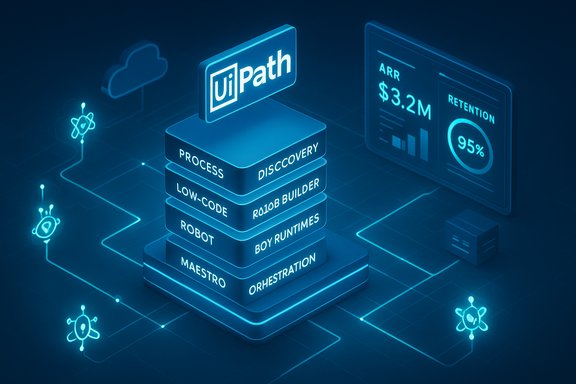
UiPath’s platform is best understood as a layered enterprise automation stack that addresses the discovery, creation, execution, orchestration, and governance of automation:- Process discovery and task mining to find automation candidates.
- Low‑code/no‑code builders and developer tools for creating automations and agents.
- Robot runtimes for attended and unattended automation.
- Orchestration layers (Maestro/Orchestrator) to schedule and govern agentic workflows.
- Document understanding, test automation, and observability for regulated environments.
- Enterprise‑grade governance, audit trails, and security controls for compliance‑sensitive buyers.
The numbers: growth, profitability and valuation
Fiscal performance and growth trajectory
UiPath’s fiscal 2025 results show a company that is still growing but at a far slower clip than in its early public years. For the full fiscal year ended January 31, 2025, UiPath reported revenue of $1.43 billion — up about 9% year‑over‑year. That follows a multi‑year rise from $608 million in fiscal 2021, equating to roughly a 24% CAGR from 2021 to 2025. The company showed improving cash generation metrics and positive non‑GAAP free cash flow in FY2025 while narrowing GAAP losses in recent quarters.Valuation snapshot
Public valuations for UiPath have compressed since its IPO. As of late 2025, third‑party market pages and commentators placed UiPath’s enterprise value in the mid‑$5 billion range and argued the company was trading at roughly “16x this year’s adjusted EBITDA” — a valuation that looks comparatively modest against the frothy AI software cohort but must be read against slower near‑term revenue growth and execution risks. Those valuation datapoints appear in industry commentary and public market screens; enterprise‑value and multiple metrics vary slightly across data providers but cluster in the same ballpark.Market dynamics: RPA market size and the generative AI wave
Two competing narratives shape UiPath’s strategic outlook:- The RPA market has room to grow as more enterprises automate routine processes — a view supported by large market research houses that forecast rapid expansion of RPA and adjacent automation categories.
- At the same time, generative AI and embedded copilots are enabling new forms of automation that threaten to reframe how customers buy automation: embedded automation in office suites, cloud services, and platform copilots could reduce the need for a standalone RPA license in some use cases.
Strengths — why UiPath still matters
- Category leadership and scale. Gartner and other market trackers continue to show UiPath as the market leader in RPA with a single‑vendor share materially ahead of rivals. That scale buys distribution, partner ecosystems, and customer references that are hard for new entrants to replicate overnight.
- Platform breadth and governance. Enterprises rarely buy automation for a single simple task; they buy it when they can discover processes, build and test automations, manage lifecycle, and enforce governance across hundreds or thousands of bots. UiPath’s end‑to‑end tooling remains a pro‑level advantage in regulated verticals.
- Developer and partner ecosystem. UiPath has invested in developer tooling, training programs, and a marketplace that accelerates deployment — a network effect that raises friction for some migrations.
- Operational discipline and cash generation. Management’s recent focus on profitability and free cash flow reduced the need for capital raises and bought runway for strategic choices (including partnerships and targeted acquisitions). UiPath delivered positive non‑GAAP operating income and strong free cash flow in FY2025, signaling that the company is executing on cost discipline.
- Strategic integrations and partnerships. Far from being displaced by large AI vendors, UiPath has moved to integrate with them — examples include public partnerships and connectors to major AI model providers to make agentic automation practical for enterprise users. Those integrations can be defense and offense at once: they let UiPath deliver model‑driven automation while preserving orchestration, governance, and enterprise controls.
Risks and counterarguments — why skeptics worry
- Bundling by hyperscalers and productivity suites. Microsoft’s Power Automate + Copilot initiatives and similar moves give large vendors a path to embed automation into tools enterprises already use. Features such as “Record with Copilot” and Copilot‑enhanced flow descriptions lower the barrier for non‑technical users to create automations inside Microsoft’s ecosystem — a form of distribution advantage UiPath must defend against. When distribution is embedded, standalone vendors can be disintermediated.
- Category redefinition through generative AI. LLMs and task agents can automate or augment many knowledge‑worker tasks previously targeted by RPA. Where processes are centered on natural‑language interaction or unstructured reasoning, generative AI products (or model‑driven platforms) can appear as a simpler substitute to purpose‑built RPA bots.
- Slowing top‑line growth. Revenue deceleration in recent years — fiscal 2025 growth of ~9% versus prior double‑digit years — is a real concern for growth‑oriented investors. If growth remains single‑digit while peers accelerate, market multiples compress further. UiPath’s shift toward prioritizing profitability means it may sacrifice top‑line acceleration for margin improvement. That trade‑off can make UiPath a safer but less dramatic long‑term growth story.
- Leadership churn and execution risk. The brief handover to Rob Enslin and the re‑appointment of Daniel Dines in mid‑2024 drew attention. Management stability matters when a company needs to execute a product pivot and close strategic partnerships; investor patience is finite. The company has since stabilized leadership, but the episode remains a governance data point to monitor.
- Potential commoditization and price pressure. As basic automation capabilities become standard features in SaaS and cloud platforms, pricing power for standalone automation licenses may erode — particularly in mid‑market and less regulated customers.
Plausible scenarios: what the future could look like
Upside scenarios (what would make UiPath a multi‑bagger)
- Successful transition to intelligent/agentic automation: UiPath evolves its platform to make AI‑native agents productive and manageable at scale, delivering demonstrable ROI for vertical workflows (e.g., finance, supply chain, healthcare). This would expand wallet share per customer and raise retention.
- Embedded distribution partnerships accelerate adoption: If UiPath’s connectors and strategic alliances with hyperscalers, OpenAI, and others deepen, UiPath could be the de facto enterprise orchestration layer even as models come from many vendors.
- Margin expansion plus steady ARR growth: Sustained profitability and cash generation could re‑rate UiPath’s multiple if investors see durable economics and secular ARR growth.
Downside scenarios (what could derail value creation)
- Bundling accelerates: Microsoft, Google, or a large SaaS vendor embeds “good enough” automation broadly, leading customers to avoid separate RPA purchases.
- Commoditization with price deflation: Automation becomes a utility, squeezing license pricing and making UiPath a services/ops play rather than a software premium.
- Execution failure on AI integration: If AI features introduce complexity, compliance issues, or poor outcomes, UiPath could lose trust — and clients — at a sensitive moment.
Strategy and what to watch next
For enterprise IT leaders and investors, the decisive evidence will be found in a few measurable signals:- Expansion of agentic ARR and the mix shift toward AI‑driven workflows (are deals growing in size and ARR per customer?, and evidence that AI features increase deal economics.
- Dollar‑based net retention and customers with large ARR buckets — sustained or rising retention suggests stickiness.
- Announcements and adoption of partnerships with model providers and hyperscalers; practical integrations that reduce friction matter more than marketing blurbs.
- Consistency of management commentary and execution on product roadmaps, especially around Agent Builder, Maestro orchestration, and agent validation/testing capabilities.
- Pricing power and margin expansion — whether UiPath can grow adjusted EBITDA while maintaining or re‑accelerating revenue growth.
Investment lens: buy, hold or monitor?
UiPath’s public market valuation has compressed from its IPO highs, creating a range of possible investment profiles:- For growth‑first investors seeking the next AI compounder, UiPath may be unappealing today: revenue growth has matured and competition from platforms is real.
- For value‑oriented or event‑driven investors, UiPath could be an attractive asymmetric bet: a dominant RPA platform with strong governance and cash generation could be a takeover target or a consolidation winner if it executes on agentic automation.
- For enterprise IT teams, UiPath remains a pragmatic playbook for scale automation, particularly where governance, compliance, and integration across legacy systems matter.
Critical analysis: strengths, gaps and the realistic path forward
UiPath’s core strengths — platform breadth, enterprise governance, developer ecosystem, and vertical footholds — are not theoretical advantages. They are practical assets that matter in procurement decisions for large organizations. UiPath’s move to integrate generative models and provide connectors to model providers is the right strategic posture: rather than fight the AI wave, the company is attempting to harness it inside a governance‑first orchestration plane. That is a defensible strategy and one that can maintain — or even extend — UiPath’s enterprise relevance. Where UiPath must prove itself is in three concrete areas:- Execution speed on product differentiation. Integrations and new AI features are necessary but not sufficient; they must materially improve time‑to‑value for customers and be easily auditable, testable, and safe in enterprise contexts.
- Distribution and go‑to‑market. Large platform vendors win on frictionless distribution. UiPath needs partnerships and embedded surfaces (connectors, marketplace integrations) that let customers choose UiPath as the orchestration and governance layer without making procurement harder.
- Clear margin economics and customer economics. Investors will reward evidence that AI features increase deal sizes, retention, and gross margins rather than merely shifting revenue composition.
Final verdict
UiPath is not a dead vendor nor is it a guaranteed multi‑bagger. Its strengths are real and meaningful for enterprise customers navigating the messy terrain of legacy systems, compliance, and scale automation. At the same time, the competitive environment is fluid: generative AI, embedded copilots, and hyperscaler bundling change the rules of competition. For investors and IT leaders, the prudent stance is to treat UiPath as a live strategic bet — one that offers takeoff potential if management can demonstrate faster, measurable adoption of agentic automation and improved deal economics, but also one that carries real downside if embedded automation becomes the easy default for a large swath of customers. The coming 12–24 months — product proofs, ARR composition, retention metrics, and partnership execution — will decide whether UiPath remains a dominant automation platform or settles into a narrower, lower‑growth niche.UiPath’s story remains one of execution, timing, and strategic clarity: a company with the technical plumbing enterprises need, but one that must now prove it can translate that plumbing into AI‑native outcomes customers will pay for and regulators will trust.
Source: AOL.com Could This Quiet AI Company Become the Next Big Winner?
