
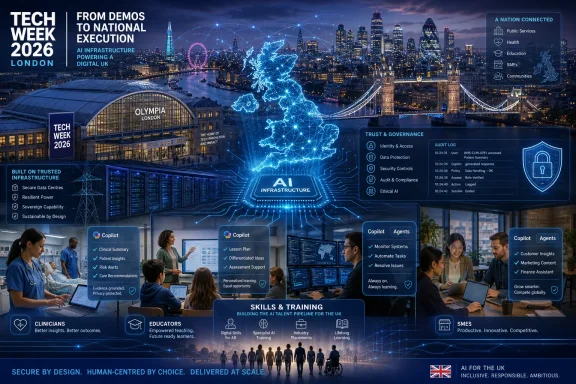
 Britain’s AI Pitch Has Moved From Wonder to Execution
There was a time, not very long ago, when every AI keynote sounded like a magic show. A chatbot wrote a sonnet, a model summarized a report, a developer generated code, and the audience was invited to imagine the rest. London Tech Week 2026 had less of that early-stage astonishment and more of the second act: if AI is real, who gets the gains, who controls the infrastructure, and who is trained quickly enough to use it?
That is why Darren Hardman’s message landed in a different register. The Microsoft UK and Ireland chief did not merely describe AI as a productivity tool. He framed it as a test of national design: the sort of economy and public sector Britain intends to build around ubiquitous machine intelligence.
The phrase “the UK can lead in the AI era” is doing a lot of work. It is a claim about skills, but also about cloud capacity, datacentres, chips, regulation, business culture and public trust. It is a claim Microsoft is happy to amplify, because its own products sit close to the centre of that transition.
But it is also a claim the UK government has chosen to make its own. Prime Minister Sir Keir Starmer opened the event by presenting AI as a national opportunity that must reach beyond London and the usual technology corridors. His example of Warrington, where a former Unilever soap factory has been turned into an AI datacentre, was not accidental. It was an attempt to tie the most abstract technology of the decade to the oldest political promise in Britain: that new industries can restore purpose to places left behind by old ones.
Starmer Wants Sovereign AI, But Sovereignty Is Expensive
The government’s headline commitment — hundreds of millions of pounds for specialist AI chips as part of a broader sovereign compute push — shows how quickly the AI debate has become a hardware debate. For years, politicians could speak about “digital” as though the internet floated above the physical world. Generative AI has made that fiction impossible to sustain.
Models require chips. Chips require capital, energy, supply chains, security planning and procurement competence. A country that cannot access enough compute will struggle to build frontier systems, support domestic start-ups or give researchers the tools they need to compete. In that sense, Starmer’s chip commitment is not merely an industrial policy announcement; it is an admission that AI leadership cannot be rented entirely from somebody else’s cloud.
The UK has a strong story to tell in research, universities, life sciences, fintech and software talent. It has a weaker story in owning the full stack of compute infrastructure at scale. That gap matters because the AI economy is consolidating around those with access to chips, energy contracts, datacentre capacity and distribution.
The sovereign compute language is therefore both necessary and revealing. Britain wants the benefits of global platforms without becoming wholly dependent on them. It wants homegrown AI companies, but those companies will need access to hardware that is scarce, expensive and globally contested. It wants public services to use AI, but public-sector AI adoption will need procurement discipline and data governance that are rarely produced by speeches alone.
Microsoft’s role in this picture is complicated in the way all serious technology politics is complicated. The company is an investor, supplier, platform owner and strategic partner. It is helping build the future the UK wants, but it is also positioning itself to own the tools through which that future is delivered.
Microsoft’s Real Argument Is That AI Must Become Boring
Hardman’s most interesting point was not that AI can write, summarize or code. It was that AI is beginning to dissolve the boundaries that used to keep useful capabilities locked inside specialist roles. A scientist can prototype an app without being a professional developer. A teacher can generate learning materials without a production team. An employee closest to a workflow problem can build a small tool to fix it.
That is a much more radical argument than “AI saves time.” It suggests that organizations may need to rethink where expertise lives. In the old model, capability was concentrated: developers built software, analysts handled data, designers produced materials, managers coordinated workflows. In the emerging model, AI pushes some of those capabilities outward, letting more workers attempt tasks that once required a separate function.
Hardman’s formulation — that AI does not replace expertise but diffuses it — is the optimistic version of this shift. The less comfortable version is that many organizations will use diffusion as a justification for flattening roles, cutting support functions or asking workers to absorb more responsibility without more pay. Both can be true at once.
For WindowsForum readers, the relevant point is practical. The AI story is not confined to a few glamour products or research labs. It is being embedded into Microsoft 365, GitHub, Dynamics, Teams, security tooling and the broader enterprise stack. In other words, AI is being placed exactly where administrators already manage identity, permissions, compliance, endpoints and user behavior.
That makes the next phase less spectacular and more consequential. The technology becomes important precisely when it stops feeling novel. Once Copilot, agents and AI-generated workflows are ordinary parts of daily work, the questions shift from “Can it do this?” to “Who approved this, what data did it touch, how was it logged, and what happens when it is wrong?”
The Workday Is the Battlefield Microsoft Knows Best
Hardman began with a familiar complaint: meetings, messages, documents and decisions competing for attention. This is the least glamorous part of AI, but it may be the most commercially potent. Microsoft does not need AI to invent a new category of work; it needs AI to sit inside the workday people already have.
That is why the company’s “information work” to “intelligence work” framing matters. It positions AI as the layer between human intent and organizational execution. Users will not simply search for information, write documents or triage messages. They will increasingly instruct, review and supervise systems that perform those tasks in sequence.
The agent language is central here. A chatbot answers; an agent acts. Even if today’s agents remain constrained, brittle and heavily supervised, the direction of travel is clear. Microsoft wants enterprises to imagine workflows in which AI systems retrieve data, trigger business processes, draft responses, update records and escalate exceptions.
That vision is attractive because modern organizations are drowning in coordination costs. The average office worker does not lack software. They lack uninterrupted cognition, clean data, simple processes and time. AI promises to turn that mess into something more navigable.
But the same promise creates a new administrative burden. If employees can create agents, then organizations need lifecycle management for agents. If Copilot can summarize sensitive material, access controls and information architecture become more important, not less. If AI is used to draft customer responses, legal advice, code, procurement documents or clinical notes, review processes need to be explicit.
The irony is that AI productivity depends on old-fashioned IT hygiene. Identity, data classification, retention policies, endpoint security, audit logs, least privilege and change management are not side concerns. They are the difference between controlled augmentation and a thousand well-intentioned shadow systems.
The NHS Example Shows Both the Promise and the Trap
The most politically powerful part of Microsoft’s London Tech Week message was public services. NHS England expanding access to Microsoft Copilot to more than 500,000 clinicians and support staff is precisely the sort of example that makes AI feel less like a boardroom toy and more like infrastructure for a strained state.
The reported trial result — tens of thousands of users saving significant daily time on administration — is the kind of number ministers, executives and taxpayers all notice. In a health system under pressure, “less admin, more eye contact” is an irresistible phrase. It implies a technology that gives clinicians back to patients rather than pulling them deeper into screens.
Dragon Copilot, Microsoft’s clinical assistant that can transcribe consultations and draft notes for clinician review, fits the same narrative. Few people believe the NHS needs more paperwork. If AI can reduce clerical load while preserving clinical judgment, it will find supporters across the political spectrum.
Yet healthcare is also where the margin for error narrows. Transcription mistakes, hallucinated summaries, omitted symptoms, ambiguous responsibility and overreliance on automated drafts are not abstract risks. Clinical settings require systems that are not only useful but accountable, auditable and designed around professional review.
The NHS case therefore captures the broader AI bargain. The more compelling the use case, the more serious the governance burden. AI that saves time in a low-stakes meeting is one thing. AI that helps create clinical documentation, triage cases or manage patient correspondence is another. The public will tolerate experimentation only if institutions can show that humans remain responsible for judgment and that systems are being evaluated honestly.
Microsoft’s advantage is that it can sell AI as an extension of platforms the public sector already uses. Its challenge is that the public sector cannot afford to treat vendor integration as a substitute for institutional competence.
The Corporate Case Studies Are Strongest Where AI Meets Existing Scale
Hardman’s examples from HSBC, Lloyds Banking Group, Vodafone and PhysicsX all make the same point from different angles: AI adoption becomes credible when it is attached to measurable workflows. Customer service resolution times, developer usage rates, employee productivity feedback and engineering simulation cycles are more persuasive than generic transformation language.
HSBC’s use of AI agents in customer service is a classic enterprise deployment: high volume, complex requests, measurable time savings and clear operational pressure. GitHub Copilot across a large developer base is another obvious fit. Coding assistance may not eliminate the need for skilled engineers, but it changes the tempo of software production, especially in large organizations with sprawling codebases and repetitive maintenance work.
Lloyds embedding AI across tens of thousands of colleagues suggests a different kind of transformation. Here the issue is not a single use case but organizational normalization. Once AI becomes available across a large workforce, adoption patterns become unpredictable. Some teams will use it for summarization and email. Others will build agents, automate reporting or reshape customer workflows.
Vodafone’s spread of AI across customer care, legal work, network engineering, software development and retail operations shows the breadth of the enterprise opportunity. It also hints at the challenge: AI governance cannot live in one department when the technology is being used everywhere. Legal, security, HR, compliance, engineering and operations all end up with a stake.
PhysicsX offers the most futuristic example because engineering simulation is exactly the sort of domain where AI can compress time in dramatic ways. If design iterations that once took months can be explored in seconds, the competitive implications are substantial. But even here, the lesson is not that AI replaces engineers. It is that engineers with AI may be able to explore more options, reject bad designs faster and arrive at better decisions sooner.
These case studies are useful because they move the debate beyond novelty. The organizations seeing value are not sprinkling AI on top of work as a branding exercise. They are connecting it to the places where time, expertise and coordination are already expensive.
Skills Are the Place Where the AI Story Either Democratizes or Breaks
Hardman’s line that AI skills are “a licence to participate” may sound like keynote poetry, but it is probably the most important sentence in the whole pitch. If AI really becomes a general-purpose layer across work, then the divide will not simply be between people who can code and people who cannot. It will be between those who can use AI systems critically and those who are managed by systems they do not understand.
Microsoft says it has provided free AI training to more than 1.5 million people in the UK over the past year and is working with government programmes to reach millions more. That scale matters. So does the definition of training.
A half-hour prompt-writing module is not the same as durable AI literacy. Workers need to understand when models are likely to be wrong, how to protect sensitive data, how to evaluate outputs, how to document decisions and how to combine domain expertise with machine assistance. Managers need to understand procurement risk, bias, security, staff surveillance concerns and the temptation to overstate productivity gains.
The Shoosmiths example, in which an executive assistant used Copilot’s no-code Agent Builder to create a bespoke agent for a retail client, is exactly the kind of story vendors love because it demonstrates bottom-up innovation. It is also genuinely important. The most valuable automation ideas often come from people close to the friction, not from central transformation offices.
But bottom-up innovation needs guardrails. If every motivated employee becomes a toolmaker, organizations need ways to review, share, secure and retire those tools. The history of enterprise IT is full of spreadsheet empires, Access databases, unofficial scripts and forgotten workflows that became mission critical by accident. AI agents could become the next version of that story, only faster and more opaque.
This is where Windows administrators and IT leaders should pay attention. The AI skills agenda is not just about end users becoming more productive. It is about creating a workforce that does not accidentally leak data, automate bad processes or trust plausible nonsense because it arrived in a polished paragraph.
London Wants AI to Serve the Public Good, But SMEs Need More Than Speeches
Sadiq Khan’s £12 million programme to help London’s small and medium-sized businesses adopt AI fits neatly into the broader Tech Week narrative. Large enterprises can afford consultants, pilots, security reviews and dedicated AI teams. SMEs often cannot. If AI adoption is left entirely to market forces, the biggest firms will move first and widen the productivity gap.
The mayor’s argument is that London’s openness, talent and culture can make it a leading AI city while still anchoring innovation in public benefit. That is a politically necessary message in a capital where technology wealth and everyday affordability sit uneasily beside each other. AI cannot be sold only as a gift to venture capital and global platforms.
The challenge is that SME adoption is messy. Smaller firms need practical help: readiness assessments, advice on data handling, workflow mapping, procurement guidance, security basics and realistic expectations. Many do not need frontier models. They need invoices processed faster, customer messages triaged, compliance paperwork simplified and marketing content drafted without creating reputational risk.
A modest support programme can help, but it cannot conjure time or managerial capacity out of thin air. The owner of a small manufacturer, care provider or professional services firm may understand that AI matters and still lack the slack to redesign processes around it. Productivity technologies often fail not because the tools are useless, but because adoption requires attention from people who are already overloaded.
This is the unglamorous truth behind national AI optimism. The UK can announce chips, training programmes and city-level support, but diffusion happens inside actual organizations with legacy systems, uneven data quality and staff who have heard too many transformation promises before.
Shadow AI Is the Warning Hidden Inside the Opportunity
Hardman noted that employees are already bringing AI into work whether organizations are ready or not. That should be read less as a throwaway line and more as the central governance problem of the next several years. The enterprise AI race is not beginning from a clean starting line. It is beginning after millions of workers have already experimented with consumer tools.
Shadow AI is not new in spirit. Employees have always found workarounds when official systems were slow, clumsy or unavailable. They used personal email, unsanctioned cloud storage, unofficial messaging apps and homegrown spreadsheets. AI raises the stakes because the workaround is not merely a storage location or communications channel. It is a system that can absorb, transform and generate information.
The risk is not only data leakage. It is also decision pollution. A user may paste sensitive material into an unapproved tool, but they may also bring back inaccurate analysis, biased summaries or fabricated references. Once that output is edited into a document or forwarded as a recommendation, the origin becomes harder to trace.
Microsoft’s answer is trusted platforms: bring AI inside the managed enterprise boundary, connect it to identity and security, and give users approved tools good enough that they do not wander elsewhere. That is a rational strategy. It is also a commercial strategy that deepens dependence on Microsoft’s stack.
For IT pros, the question is not whether to allow AI or block it entirely. The question is how to build a policy that reflects reality. If official tools are too restricted, users will route around them. If official tools are too permissive, the organization will discover risks only after something has gone wrong. The winning posture is likely to be neither panic nor permissiveness, but managed experimentation with visible rules.
The UK’s AI Race Is Really a Trust Race
The phrase “AI era” can make the future sound technologically determined, as though adoption will proceed because the models improve and the demos become irresistible. In practice, the pace of adoption will be shaped by trust. Workers need to trust that AI will not simply become a surveillance mechanism. Patients need to trust that clinical AI is assisting professionals rather than replacing care. Businesses need to trust that outputs are reliable enough to justify process change. Regulators need to trust that vendors and deployers can explain what they are doing.
Britain has some advantages here. Its public institutions, universities and regulatory culture can support a more grounded AI path than the pure market acceleration seen elsewhere. It also has deep pools of expertise in areas where trustworthy AI matters: healthcare, finance, law, education and public administration.
But trust is fragile. If AI is introduced as a cost-cutting weapon first and a capability-enhancing tool second, workers will resist. If public-sector deployments are overhyped and under-evaluated, citizens will become cynical. If vendors talk about democratizing intelligence while customers experience licensing complexity, data concerns and uneven outputs, the rhetoric will wear thin.
Microsoft’s speechwriters understand this. That is why the language at London Tech Week emphasized inclusion, skills, public service and human capability. The company knows that the next phase of AI adoption will not be won by benchmarks alone. It will be won by making AI feel legitimate inside institutions that cannot afford to move like start-ups.
The UK government understands it too, at least rhetorically. Starmer’s insistence that AI must benefit “the many, not just the few” is the political version of the same argument. The unresolved question is whether policy, procurement and training can keep pace with the slogans.
Windows Shops Should Read This as a Platform Shift, Not a News Cycle
For the Windows ecosystem, London Tech Week’s message is less distant than it may first appear. Microsoft is not pitching AI as a separate product category that sits outside the operating environment administrators already manage. It is threading AI through the productivity, identity, development, security and cloud layers that define modern Microsoft estates.
That has consequences for procurement. AI features will increasingly arrive bundled with familiar platforms, but meaningful use may require new licensing, data preparation and governance work. Organizations that treat AI as an optional add-on may discover that users already expect it as part of the baseline work environment.
It has consequences for endpoint and data management. Copilot-style tools are only as safe as the permissions and information architecture beneath them. If an employee can access a document they should not see, an AI assistant may make that bad access easier to exploit. AI does not create every governance failure, but it can accelerate the impact of failures already present.
It has consequences for help desks and training teams. Users will ask why Copilot cannot find something, why it produced a strange answer, why an agent failed, or whether they are allowed to use AI on a specific customer file. Support organizations will need new scripts, policies and escalation paths.
It also has consequences for developers. GitHub Copilot and similar tools are changing expectations around code velocity, documentation, testing and review. The bottleneck may move from writing code to verifying it, securing it and understanding whether generated contributions fit the architecture.
None of this means every organization should rush blindly. It means the AI transition is becoming part of the ordinary Microsoft roadmap. Waiting for the hype to pass may be sensible; pretending the platform shift is not happening is not.
The Parts of the Keynote That Will Matter After the Applause
The most concrete lesson from London Tech Week is that AI leadership is no longer measured by who can produce the most dazzling demo. It is measured by who can connect infrastructure, skills, governance and adoption without losing public trust.
- The UK government is treating AI compute as strategic infrastructure, not merely as a private-sector procurement problem.
- Microsoft is positioning Copilot, agents and trusted enterprise platforms as the default route for organizations that want AI without uncontrolled shadow use.
- Public-sector AI, especially in the NHS, may become the most persuasive proof point if it reduces administrative burden without weakening accountability.
- Skills programmes will matter only if they move beyond prompt tips and teach workers how to evaluate, govern and safely apply AI outputs.
- SMEs need practical adoption support because the productivity gains promised by AI will not automatically reach firms without spare time, clean data or specialist staff.
- IT administrators should assume AI will intensify existing identity, permissions, compliance and data-quality problems rather than magically solve them.
The UK can lead in the AI era, but not by confusing adoption with achievement. The country has many of the ingredients: talent, universities, sophisticated industries, a large public sector with obvious pain points, and global vendors willing to invest. What happens next will depend on whether those ingredients are assembled into capability that reaches beyond conference stages and pilot projects. If AI is to become a national advantage rather than another layer of dependency, Britain will need to make the boring parts work: procurement, training, governance, infrastructure and trust.
