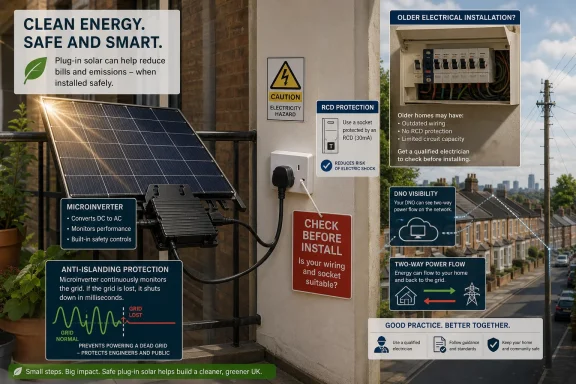
Plug-in solar kits are moving from niche energy gadget to mainstream retail product in 2026, with UK electrical bodies warning in June that self-installed balcony-style panels can create fire, shock, grid, insurance, and mounting risks if regulation and household wiring checks lag behind adoption. The warning is not an argument against small solar. It is an argument against pretending that a power-generating appliance is just another charger. The technology’s promise is real, but so is the danger of selling grid-tied generation as if it were no more consequential than plugging in a lamp.
Plug-in solar has a beguiling pitch: buy a small kit, attach one or two panels to a balcony, patio, shed, or wall, connect them to a microinverter, and feed electricity into the home through a standard socket. It is solar without scaffolding, without a roof survey, without the full paperwork burden of a conventional photovoltaic installation. For renters, flat owners, and households priced out of rooftop systems, that sounds less like a gadget and more like access.
That access story explains why governments and retailers are interested. A conventional domestic solar installation remains a capital project; plug-in solar looks like an appliance purchase. In political terms, that matters. It turns decarbonisation from something done by homeowners with suitable roofs into something that can be sold in a supermarket aisle.
But that same simplicity is where the engineering discomfort begins. A normal socket is designed around the assumption that current flows from the grid, through protective devices and wiring, into an appliance. A plug-in solar kit deliberately reverses part of that relationship. It puts generation on a circuit originally intended for consumption.
That is not inherently reckless. Microinverters, anti-islanding protections, product standards, and installation rules exist precisely because small-scale generation can be made safe. The problem is that a retail box cannot know whether the socket it is plugged into sits on a modern, well-protected circuit or behind tired wiring, overloaded adapters, corroded terminals, amateur alterations, and a consumer’s optimistic interpretation of “weatherproof.”
The core technical wrinkle is bidirectional power. Plug-in solar systems use panels to produce DC electricity, a microinverter to convert it to AC, and a plug connection to feed that power into the household installation. The power may then be consumed by nearby loads, offsetting grid import, or it may interact with the wider installation depending on the system design and local rules.
That changes how protective devices are expected to behave. Residual Current Devices in the UK, and their US cousins known as GFCIs, are built to detect leakage currents and disconnect supply quickly enough to reduce shock risk. Electrical industry bodies are worried that backfeeding and circuit conditions may compromise expected protection in some scenarios, particularly where homes have older or non-standard installations.
The awkward part is that this risk is invisible to the buyer. A plug-in kit can look tidy, modern, and certified while the circuit behind the faceplate is anything but. A loose conductor, heat-damaged socket, undersized extension lead, or miswired spur can remain hidden until additional current flow exposes it.
Industry groups have pointed to the age and condition of domestic installations as a central risk. Many properties contain wiring that has been extended, patched, or partially upgraded over time. A consumer may know that the living-room socket works; they are much less likely to know whether the circuit has been tested recently, whether connections are tight, whether protection is appropriate, or whether the ring or radial arrangement can safely accommodate generation.
This is where plug-in solar differs from most household electronics. A kettle, heater, or vacuum cleaner increases load in an obvious direction. A solar kit can reduce imported power at the meter while still energising parts of a circuit in ways that complicate assumptions about isolation, protection, and fault behaviour. The consumer sees lower bills; the electrician sees a system boundary that has quietly moved.
The fire risk is not simply that panels might burst into flames. It is that marginal wiring, poor terminations, damaged cables, and overloaded accessories can heat up under conditions nobody intended when the installation was built. Add multiple kits, extension leads, or dubious imported hardware, and the safety margin narrows further.
Electrical Safety First and other UK bodies have warned about poor-quality products entering the market before the standards environment is fully settled. That concern is not abstract. The consumer electronics market is already saturated with chargers, power banks, adapters, and extension products that use compliance language loosely or fraudulently. Solar hardware will not be magically immune to the same supply-chain incentives.
Flattened cables intended to pass under doors or through windows are a perfect example of the problem. They solve a practical consumer inconvenience while potentially creating a mechanical, weatherproofing, and insulation problem. A buyer may see elegance; an electrician may see a cable being crushed, abraded, bent, exposed to moisture, or routed through a building opening never designed for permanent electrical equipment.
The market also rewards power claims. If one small kit saves a little, two kits seem better. If a compliant unit has limits, a less compliant one may advertise more output. The pressure to maximise generation per pound spent will be intense, particularly for households buying plug-in solar because conventional rooftop systems are unaffordable.
Conventional solar systems typically come with notification, connection, and commissioning requirements. Those processes are not only bureaucratic friction; they give network operators visibility into generation capacity and allow them to assess whether local infrastructure can handle export, voltage effects, and fault conditions. Plug-in solar challenges that model by lowering the barrier to installation almost to zero.
Supporters argue that small systems below certain thresholds should not be treated like full rooftop arrays. That is reasonable. A regulatory framework that makes a two-panel balcony kit as onerous as a multi-kilowatt roof installation would kill the category before it matures. But “smaller” does not mean “irrelevant,” especially when retailers are preparing for mass-market distribution.
The safety question also includes disconnection. Microinverters are supposed to shut down when the grid is absent, preventing a system from energising a circuit during an outage. That anti-islanding behaviour is fundamental. If products are poorly designed, misconfigured, uncertified, or installed in ways that defeat expectations, the risk shifts from the purchaser to emergency workers, electricians, neighbours, and network operators.
Mounting risk is therefore not a side issue. A panel that falls from a balcony is not an energy-efficiency mishap; it is a public safety incident. The higher the building, the more serious that risk becomes. Even modest panels can become dangerous objects when poorly clamped, attached to unsuitable railings, or exposed to gusts their installer never calculated.
There is also a fire-load question. Solar panels, cabling, plastic housings, connectors, batteries where present, and mounting materials add combustible components and electrical ignition sources to places that may already be difficult for fire services to access. In high-rise settings, where external wall systems, balcony clutter, and evacuation complexity are already sensitive issues, the tolerance for casual installation should be low.
None of this means balcony solar is doomed. It means balcony solar needs to be treated as an engineered outdoor electrical installation, not a lifestyle accessory. The marketing image is a neat panel catching afternoon sun; the risk assessment has to include water ingress, strain relief, cable routing, fixings, wind loading, and what happens after two winters.
That uncertainty is especially sharp for landlords, leaseholders, and apartment dwellers. A homeowner with a detached house has one set of risks. A tenant attaching panels to a balcony in a managed block has another. Lease terms, building insurance, fire strategies, façade rules, and landlord consent may matter as much as the wiring.
The industry warning rightly frames liability as part of the safety debate rather than an administrative afterthought. Financial risk shapes behaviour. If insurers treat uncertified or poorly documented installations as grounds for dispute, consumers could discover too late that a small bill-saving device has become a large liability problem.
The lack of clarity can also slow adoption of the good products. Responsible manufacturers and retailers need rules that distinguish certified, limited, well-protected systems from dubious imports. Consumers need to know whether they are buying an appliance, an electrical installation, or something in between. Insurers need enough consistency to price risk without simply excluding the category.
But a standard is not a magic shield. US homes also vary widely in wiring quality, panel capacity, outdoor outlet protection, grounding, permitting rules, landlord restrictions, HOA controls, and utility interconnection requirements. A certified device installed in a noncompliant way can still become a problem.
The US market may in some ways be even more fragmented. Electrical codes are adopted and interpreted locally, utilities have their own interconnection processes, and state-level enthusiasm for distributed solar does not automatically translate into uniform rules at the outlet. Consumers will hear “legal in my state” and may not understand the remaining constraints.
For WindowsForum readers in the US, the lesson from the UK warning is not that British wiring quirks should dictate American policy. It is that plug-in generation sits at the intersection of product safety, home electrical systems, utility rules, and user behaviour. Any one of those can be the weak link.
What the category needs is not a moral panic but better defaults. Kits should be certified as complete assemblies, not just as collections of individually plausible components. Instructions should be brutally specific about where the device may be plugged in, how panels may be mounted, what cable routing is prohibited, and when a professional inspection is required.
Retailers also have responsibility. Selling plug-in solar next to air fryers and garden lights may help adoption, but it risks flattening the perceived seriousness of the product. A checkout page or shelf label should not imply that every household socket is equally suitable. If a purchase requires a circuit check, landlord consent, product registration, or network notification, that should be impossible to miss.
Regulators should resist two bad instincts. One is to overreact and bury small systems under rules designed for larger installations. The other is to wave products through because they align with climate targets. The right framework makes compliant products easy to identify and unsafe improvisation harder to excuse.
If the home is old, the wiring has not been inspected recently, sockets run warm, breakers trip, lights flicker, or adapters already crowd the outlet, plug-in solar should not be the next experiment. If the kit came from an obscure seller with vague certification claims, the bargain may simply be risk with a discount sticker. If the installation requires running cables through doors, windows, walkways, or improvised waterproofing, the design has probably failed before the first watt is generated.
The best version of plug-in solar will feel uneventful. It will use certified hardware, clear limits, suitable sockets, proper protection, secure mounting, weather-rated components, and documentation that survives an insurance claim. The worst version will look fine on social media until a cable overheats, a panel slips, or a fault exposes how little the buyer understood.
That distinction is why “call an electrician” is not just professional self-interest from the trade. It is sometimes the cheapest risk assessment available. A competent inspection can identify whether the installation is modern enough, protected enough, and arranged in a way that makes the kit’s safety assumptions true.
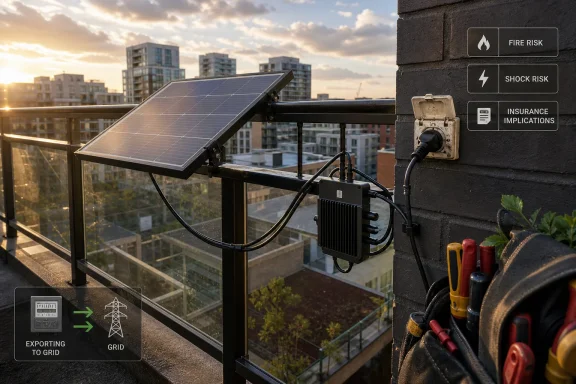 The Cheapest Solar Panel Is Also the Most Politically Tempting One
Plug-in solar has a beguiling pitch: buy a small kit, attach one or two panels to a balcony, patio, shed, or wall, connect them to a microinverter, and feed electricity into the home through a standard socket. It is solar without scaffolding, without a roof survey, without the full paperwork burden of a conventional photovoltaic installation. For renters, flat owners, and households priced out of rooftop systems, that sounds less like a gadget and more like access.That access story explains why governments and retailers are interested. A conventional domestic solar installation remains a capital project; plug-in solar looks like an appliance purchase. In political terms, that matters. It turns decarbonisation from something done by homeowners with suitable roofs into something that can be sold in a supermarket aisle.
But that same simplicity is where the engineering discomfort begins. A normal socket is designed around the assumption that current flows from the grid, through protective devices and wiring, into an appliance. A plug-in solar kit deliberately reverses part of that relationship. It puts generation on a circuit originally intended for consumption.
That is not inherently reckless. Microinverters, anti-islanding protections, product standards, and installation rules exist precisely because small-scale generation can be made safe. The problem is that a retail box cannot know whether the socket it is plugged into sits on a modern, well-protected circuit or behind tired wiring, overloaded adapters, corroded terminals, amateur alterations, and a consumer’s optimistic interpretation of “weatherproof.”
The Socket Was Never Just a Socket
The public imagination treats the plug as the universal symbol of safety. If it fits, the assumption goes, it must be allowed. That assumption has already done enough damage with cheap chargers, dubious extension leads, counterfeit power supplies, and outdoor Christmas lights routed through windows; plug-in solar raises the stakes because it adds generation rather than merely load.The core technical wrinkle is bidirectional power. Plug-in solar systems use panels to produce DC electricity, a microinverter to convert it to AC, and a plug connection to feed that power into the household installation. The power may then be consumed by nearby loads, offsetting grid import, or it may interact with the wider installation depending on the system design and local rules.
That changes how protective devices are expected to behave. Residual Current Devices in the UK, and their US cousins known as GFCIs, are built to detect leakage currents and disconnect supply quickly enough to reduce shock risk. Electrical industry bodies are worried that backfeeding and circuit conditions may compromise expected protection in some scenarios, particularly where homes have older or non-standard installations.
The awkward part is that this risk is invisible to the buyer. A plug-in kit can look tidy, modern, and certified while the circuit behind the faceplate is anything but. A loose conductor, heat-damaged socket, undersized extension lead, or miswired spur can remain hidden until additional current flow exposes it.
Britain’s Old Housing Stock Turns a Gadget Story Into a Wiring Story
The UK debate has a particularly British electrical subtext: a large share of the housing stock is old, and domestic wiring practices vary dramatically across decades of regulations, repairs, and DIY modifications. That does not mean old homes are unsafe by definition. It means the phrase “just plug it in” carries less certainty than marketing departments would like.Industry groups have pointed to the age and condition of domestic installations as a central risk. Many properties contain wiring that has been extended, patched, or partially upgraded over time. A consumer may know that the living-room socket works; they are much less likely to know whether the circuit has been tested recently, whether connections are tight, whether protection is appropriate, or whether the ring or radial arrangement can safely accommodate generation.
This is where plug-in solar differs from most household electronics. A kettle, heater, or vacuum cleaner increases load in an obvious direction. A solar kit can reduce imported power at the meter while still energising parts of a circuit in ways that complicate assumptions about isolation, protection, and fault behaviour. The consumer sees lower bills; the electrician sees a system boundary that has quietly moved.
The fire risk is not simply that panels might burst into flames. It is that marginal wiring, poor terminations, damaged cables, and overloaded accessories can heat up under conditions nobody intended when the installation was built. Add multiple kits, extension leads, or dubious imported hardware, and the safety margin narrows further.
Cheap Hardware Is the Renewable Energy Transition’s Oldest Enemy
The most predictable failure mode is not a reputable, standards-compliant kit installed exactly as directed on a healthy circuit. It is the bargain version bought from a marketplace listing, paired with questionable cables, mounted in the wrong place, and treated as a weekend shortcut. Every consumer technology category eventually discovers this gap between the product engineers’ imagined user and the real one.Electrical Safety First and other UK bodies have warned about poor-quality products entering the market before the standards environment is fully settled. That concern is not abstract. The consumer electronics market is already saturated with chargers, power banks, adapters, and extension products that use compliance language loosely or fraudulently. Solar hardware will not be magically immune to the same supply-chain incentives.
Flattened cables intended to pass under doors or through windows are a perfect example of the problem. They solve a practical consumer inconvenience while potentially creating a mechanical, weatherproofing, and insulation problem. A buyer may see elegance; an electrician may see a cable being crushed, abraded, bent, exposed to moisture, or routed through a building opening never designed for permanent electrical equipment.
The market also rewards power claims. If one small kit saves a little, two kits seem better. If a compliant unit has limits, a less compliant one may advertise more output. The pressure to maximise generation per pound spent will be intense, particularly for households buying plug-in solar because conventional rooftop systems are unaffordable.
Grid Operators Do Not Like Surprises, Even Small Ones
A single balcony panel is not a power station. Thousands of unregistered balcony panels, however, become an operational fact. Grid operators do not need to fear each device individually to worry about a class of devices that may appear unpredictably across local networks.Conventional solar systems typically come with notification, connection, and commissioning requirements. Those processes are not only bureaucratic friction; they give network operators visibility into generation capacity and allow them to assess whether local infrastructure can handle export, voltage effects, and fault conditions. Plug-in solar challenges that model by lowering the barrier to installation almost to zero.
Supporters argue that small systems below certain thresholds should not be treated like full rooftop arrays. That is reasonable. A regulatory framework that makes a two-panel balcony kit as onerous as a multi-kilowatt roof installation would kill the category before it matures. But “smaller” does not mean “irrelevant,” especially when retailers are preparing for mass-market distribution.
The safety question also includes disconnection. Microinverters are supposed to shut down when the grid is absent, preventing a system from energising a circuit during an outage. That anti-islanding behaviour is fundamental. If products are poorly designed, misconfigured, uncertified, or installed in ways that defeat expectations, the risk shifts from the purchaser to emergency workers, electricians, neighbours, and network operators.
The Balcony Is an Electrical Room With Worse Weather
The phrase balcony solar makes the hardware sound domestic and manageable. Balconies are familiar spaces; people hang lights from them, store bicycles on them, grow tomatoes on them, and dry laundry on them. But a balcony is also an exposed structure subject to wind, rain, corrosion, vibration, UV exposure, and human improvisation.Mounting risk is therefore not a side issue. A panel that falls from a balcony is not an energy-efficiency mishap; it is a public safety incident. The higher the building, the more serious that risk becomes. Even modest panels can become dangerous objects when poorly clamped, attached to unsuitable railings, or exposed to gusts their installer never calculated.
There is also a fire-load question. Solar panels, cabling, plastic housings, connectors, batteries where present, and mounting materials add combustible components and electrical ignition sources to places that may already be difficult for fire services to access. In high-rise settings, where external wall systems, balcony clutter, and evacuation complexity are already sensitive issues, the tolerance for casual installation should be low.
None of this means balcony solar is doomed. It means balcony solar needs to be treated as an engineered outdoor electrical installation, not a lifestyle accessory. The marketing image is a neat panel catching afternoon sun; the risk assessment has to include water ingress, strain relief, cable routing, fixings, wind loading, and what happens after two winters.
Insurance Will Be the System’s Unforgiving Auditor
Insurance is where cheerful DIY narratives often meet colder language. If a self-installed plug-in solar kit causes a fire, damages a neighbouring property, injures a passer-by, or contributes to an electrical fault, the question will not be whether the buyer had good intentions. It will be whether the product was compliant, installed according to instructions, permitted under local rules, and suitable for the property.That uncertainty is especially sharp for landlords, leaseholders, and apartment dwellers. A homeowner with a detached house has one set of risks. A tenant attaching panels to a balcony in a managed block has another. Lease terms, building insurance, fire strategies, façade rules, and landlord consent may matter as much as the wiring.
The industry warning rightly frames liability as part of the safety debate rather than an administrative afterthought. Financial risk shapes behaviour. If insurers treat uncertified or poorly documented installations as grounds for dispute, consumers could discover too late that a small bill-saving device has become a large liability problem.
The lack of clarity can also slow adoption of the good products. Responsible manufacturers and retailers need rules that distinguish certified, limited, well-protected systems from dubious imports. Consumers need to know whether they are buying an appliance, an electrical installation, or something in between. Insurers need enough consistency to price risk without simply excluding the category.
The United States Is Not Immune to the Same Fight
The US version of this debate is different in wiring detail but similar in character. UL Solutions has introduced UL 3700 as a certification framework for plug-in photovoltaic systems, and several states have begun moving toward laws or policies that make such systems easier for homeowners to use. That may give the American market a clearer product-safety path than countries still settling standards.But a standard is not a magic shield. US homes also vary widely in wiring quality, panel capacity, outdoor outlet protection, grounding, permitting rules, landlord restrictions, HOA controls, and utility interconnection requirements. A certified device installed in a noncompliant way can still become a problem.
The US market may in some ways be even more fragmented. Electrical codes are adopted and interpreted locally, utilities have their own interconnection processes, and state-level enthusiasm for distributed solar does not automatically translate into uniform rules at the outlet. Consumers will hear “legal in my state” and may not understand the remaining constraints.
For WindowsForum readers in the US, the lesson from the UK warning is not that British wiring quirks should dictate American policy. It is that plug-in generation sits at the intersection of product safety, home electrical systems, utility rules, and user behaviour. Any one of those can be the weak link.
The DIY Energy Era Needs Better Defaults, Not Just Better Warnings
The most frustrating part of the plug-in solar debate is that both sides are partly right. The advocates are right that small solar can democratise access to clean energy, especially for renters and people without viable rooftops. The electrical bodies are right that decentralised generation cannot be made safe by enthusiasm alone.What the category needs is not a moral panic but better defaults. Kits should be certified as complete assemblies, not just as collections of individually plausible components. Instructions should be brutally specific about where the device may be plugged in, how panels may be mounted, what cable routing is prohibited, and when a professional inspection is required.
Retailers also have responsibility. Selling plug-in solar next to air fryers and garden lights may help adoption, but it risks flattening the perceived seriousness of the product. A checkout page or shelf label should not imply that every household socket is equally suitable. If a purchase requires a circuit check, landlord consent, product registration, or network notification, that should be impossible to miss.
Regulators should resist two bad instincts. One is to overreact and bury small systems under rules designed for larger installations. The other is to wave products through because they align with climate targets. The right framework makes compliant products easy to identify and unsafe improvisation harder to excuse.
The Real Consumer Checklist Is Shorter Than the Marketing Pitch
For buyers, the practical question is not whether plug-in solar is good or bad. It is whether a specific kit, installed in a specific home, on a specific circuit, in a specific location, is safe and lawful. That is a more boring question, but it is the only one that matters.If the home is old, the wiring has not been inspected recently, sockets run warm, breakers trip, lights flicker, or adapters already crowd the outlet, plug-in solar should not be the next experiment. If the kit came from an obscure seller with vague certification claims, the bargain may simply be risk with a discount sticker. If the installation requires running cables through doors, windows, walkways, or improvised waterproofing, the design has probably failed before the first watt is generated.
The best version of plug-in solar will feel uneventful. It will use certified hardware, clear limits, suitable sockets, proper protection, secure mounting, weather-rated components, and documentation that survives an insurance claim. The worst version will look fine on social media until a cable overheats, a panel slips, or a fault exposes how little the buyer understood.
That distinction is why “call an electrician” is not just professional self-interest from the trade. It is sometimes the cheapest risk assessment available. A competent inspection can identify whether the installation is modern enough, protected enough, and arranged in a way that makes the kit’s safety assumptions true.
The Six Warnings That Should Survive the Sales Boom
The plug-in solar market will be shaped by whether consumers, retailers, and regulators treat these warnings as design requirements rather than anti-solar obstruction. The concrete risks are not exotic; they are the familiar hazards of electrical systems, outdoor mounting, cheap hardware, and unclear accountability made sharper by grid-tied generation.- Plug-in solar sends power into household wiring, so protective devices and circuit design matter more than the shape of the plug suggests.
- Old, damaged, overloaded, or poorly modified wiring can turn a small generating kit into a fire risk.
- Cheap or poorly certified hardware can undermine the safety assumptions behind the entire category.
- Network operators need visibility and predictable shutdown behaviour, even when individual systems are small.
- Landlords, leaseholders, homeowners, and insurers need clarity before damage or injury turns an energy-saving purchase into a liability fight.
- Bad mounting, bad cable routing, extension leads, adapters, and weather exposure can make the mechanical installation as important as the electrical one.
References
- Primary source: ZDNET
Published: 2026-07-02T18:52:07.078341
Considering plug-in solar at home? Electrical experts say to watch for these 6 safety risks
Several industry groups have raised public safety concerns about consumer plug-in solar kits. If in doubt about your installation, here's what to do.www.zdnet.com - Related coverage: eca.co.uk
Joint statement from ECA, Electrical Safety First, IET, NICEIC and SELECT on plug-in solar panels
The latest industry news in the electrotechnical sector.www.eca.co.uk - Related coverage: theiet.org
- Related coverage: plug-in-solar.uk
Plug-In Solar UK 2026: The Essential Guide to Balcony & Portable Solar
Prepare for plug-in solar: plug-in solar is coming. An independent guide to balcony and portable solar: what they are, what's worth buying, and how to get set up.plug-in-solar.uk - Related coverage: balconyenergy.co.uk
Is Balcony Solar Legal in the UK? 2026 Regulations Explained | Balcony Energy
Is plug-in balcony solar legal in the UK in 2026? The full legal status, BSI standard timeline, permitted development rules, and what you can and can't do right now.balconyenergy.co.uk - Related coverage: balconysolarguide.co.uk
Is Balcony Solar Legal in the UK? (2026 Update) | Balcony Solar Guide UK
The UK's legal position on plug-in solar has shifted significantly in 2026. This guide explains the current status, G98 requirements, planning rules, and what changes are expected.www.balconysolarguide.co.uk
- Related coverage: photovoltaics.co.uk
Plug-in Solar UK 2026: Legal Status, 800W Limits & Buyer's Guide
Plug-in solar is legal in the UK from 15 April 2026 under BS 7671 Amendment 4. Up to 800W AC, kits £100-£400. DNO notification rules, BSI standard timeline & realistic savings.photovoltaics.co.uk - Related coverage: solarable.org
Plug-in solar in the UK — what's actually changing in 2026 | Solarable
The UK government announced in March 2026 that plug-in solar panels under 800W will be legal to connect to mains sockets without an electrician. Here's what that actually means, who benefits, and what plug-in solar can't do. solarable.org
- Related coverage: depthoflight.co.uk
Is Balcony Solar Legal in the UK? 2026 Rules | Depth of Light
BS 7671 Amendment 4 made balcony and plug-in solar legal in the UK from April 2026. Here's what's allowed, what isn't, and what you need to install one. www.depthoflight.co.uk
- Related coverage: gov.uk
Plug-in solar electrical safety study - GOV.UK
Testing of representative plug-in solar systems to assess compatibility with UK domestic electrical installations.www.gov.uk
- Related coverage: smartsolarhomes.co.uk
Plug-In & Balcony Solar in the UK | Smart Solar Homes
BS 7671 Amendment 4 (April 2026) created the UK regulatory framework for plug-in solar up to 800W. What the rules say, costs, and whether it's worth it.smartsolarhomes.co.uk - Related coverage: electricalsafetyfirst.org.uk
More clarity needed to address potential plug-in solar panel safety concerns – report warns
 www.electricalsafetyfirst.org.uk
- Related coverage: iwantsolar.co.uk
Plug-In Solar Panels UK: Balcony Solar Rules, Costs, and What to Expect | IWantSolar
Plug-in and balcony solar panels in the UK — current rules, upcoming BS 7671 changes, costs, and realistic expectations for renters and flat-dwellers.www.iwantsolar.co.uk - Related coverage: moneyweek.com
How much solar panels cost in the UK – and are they worth installing? | MoneyWeek
Solar panels are set to be at the forefront of the government’s plans to make the UK economy greener. But are they cost effective?moneyweek.com - Related coverage: idealhome.co.uk
What are plug-in solar panels and how do they work? | Ideal Home
Solar experts explain how plug-in solar panels work, how they differ from traditional panels and reveal who plug-in variants are best suited towww.idealhome.co.uk - Related coverage: techradar.com
- Related coverage: t3.com
Solar balcony batteries are getting popular – but don’t buy one before checking these 3 things | T3
Thinking of buying a solar balcony battery? Read this firstwww.t3.com - Related coverage: assets.publishing.service.gov.uk
GB Plug-in Solar Device Interim Product Specification
</rdf:Alt> </dc:description> <dc:creator> <rdf:Seq> <rdf:li>DESNZassets.publishing.service.gov.uk
- Related coverage: cesa.org
- Related coverage: legislature.vermont.gov
S.202~Wesley Schrock~Plug In Solar Introduction Presentation~3 17 2026
PDF documentlegislature.vermont.gov