

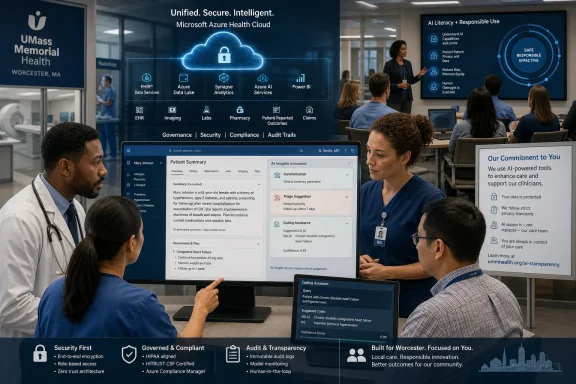
UMass Memorial Health is delaying broad AI expansion in 2026 by training its 21,000-person workforce, educating patients, and building a unified Microsoft Azure data platform before adding hundreds of clinical and administrative tools across its Worcester, Massachusetts-based health system. The argument from CEO Eric Dickson is not anti-AI; it is anti-theater. In a market crowded with pilots, copilots, agents, scribes, dashboards, and procurement decks, UMass Memorial is treating adoption as an organizational redesign problem rather than a software shopping trip. That distinction matters far beyond one hospital system, because health care is where every weak assumption about enterprise AI becomes expensive, regulated, and human.
The easiest way to misunderstand UMass Memorial’s AI strategy is to read it as caution. It is not caution in the timid sense. The health system already has dozens of AI tools in operation and expects that number to grow dramatically over the next two years.
What Dickson is rejecting is the familiar enterprise pattern in which leadership buys a tool, IT integrates it, compliance blesses it, and workers are then told that transformation has arrived. That pattern has failed with countless “digital transformation” projects, and AI does not magically escape the gravity of workplace behavior. If anything, AI makes the problem sharper because its value depends on trust, judgment, context, and repeated use.
Hospitals are particularly unforgiving environments for this kind of top-down deployment. A physician does not need another tab, another login, another alert, or another half-relevant prediction that lives outside the electronic health record. A nurse does not need a generative interface that produces plausible paperwork while adding uncertainty to a shift already defined by interruptions.
The central claim from UMass Memorial is that health systems often implement AI in the wrong order. They start with vendors and demos, then discover that the data is inconsistent, the workforce is skeptical, and the tool does not fit the way care is actually delivered. Dickson is arguing for the reverse: prepare the people, fix the data foundation, then select AI as a countermeasure to a defined operational problem.
That is a slower front end. It may also be the only way to move fast later without turning the hospital into a graveyard of abandoned pilots.
That sequencing is revealing. Microsoft has spent the past several years pushing Copilot as the new interface layer for work, from Windows and Microsoft 365 to security operations, development, and customer service. The promise is seductive: put generative AI into the tools people already use, and productivity will follow.
Health care complicates that pitch. A hospital is not a generic office tenant with a few compliance checkboxes bolted on. It is a high-stakes environment full of protected health information, clinical judgment, payer rules, staffing constraints, union realities, legacy systems, and brittle workflows. Copilot can summarize, draft, search, and automate, but it cannot decide by itself whether a process deserves to exist.
UMass Memorial’s approach suggests that Copilot-style tools become useful only after the organization has done the unglamorous work of defining who should use them, for what task, against which data, and under what rules. That is not a rejection of Microsoft’s enterprise AI strategy. It is a reminder that the strategy depends on boring prerequisites vendors tend to mention after the demo.
This is where Azure matters less as a brand and more as a bet on architecture. A data lake or unified platform does not deliver the instant dopamine of an AI assistant writing an email. But it can determine whether later AI systems are working from consistent operational truth or from a swamp of duplicate metrics, mismatched definitions, and departmental folklore.
The reason is simple: AI systems are only as useful as the data environment around them. In hospitals, the same basic concept can exist in several systems with different definitions. Bed availability, discharge readiness, length of stay, staffing capacity, referral status, and billing details can all vary depending on the source, the timing, and the department using the number.
A model trained or prompted against that confusion can produce confident nonsense. Worse, it can produce output that looks analytical enough to influence a manager or clinician while silently preserving the defects of the underlying data. In health care, that is not just a productivity issue. It is a governance issue.
The phrase single source of truth has been abused in enterprise IT for decades, but in this context it has teeth. UMass Memorial is not saying every future AI tool must be built internally or that every dataset can be perfected before use. It is saying that an organization cannot safely scale AI when its own operational facts are fragmented.
That lesson applies well beyond hospitals. Any Windows-heavy enterprise looking at Copilot, Azure AI, Fabric, Power Platform agents, or custom retrieval systems faces the same problem. If the documents are stale, the permissions are sloppy, the records are duplicated, and the business definitions are contested, AI will not fix the mess. It will make the mess conversational.
That matters because resistance to AI in health care is often framed too crudely. Workers are not simply afraid of technology, though job anxiety is real. Many are tired of tools that promise relief and deliver extra clicks. They have seen software arrive wrapped in executive optimism and leave them responsible for the cleanup.
UMass Memorial’s training program tries to invert that dynamic. Employees receive introductory education on what AI is, how it can be used responsibly, and how to write effective prompts. Managers receive additional instruction before getting access to tools such as Copilot. A smaller group of advanced users goes through certificate-style training and becomes an internal layer of expertise.
The phrase “AI ninjas” may sound like corporate whimsy, but the operating model is serious. Hospitals cannot rely entirely on central IT or outside consultants to translate every local workflow into an AI use case. They need people embedded in departments who understand both the work and the technology well enough to spot opportunities and risks.
Dickson himself has reportedly completed multiple AI certificate programs and encouraged physician leaders to do the same. That detail matters less as executive branding than as cultural signaling. If AI is presented as something the workforce must absorb while leaders remain spectators, adoption will stall. If leaders are visibly learning, the initiative becomes less like a mandate and more like an institutional project.
The same is true of AI tools that help prioritize imaging studies with urgent findings. Radiology has long been a domain where AI can assist with triage, not by replacing physician judgment, but by pushing potentially critical cases toward faster review. Coding accuracy is another practical use case because documentation and billing rules are complex, repetitive, and financially consequential.
These are not moonshot uses of AI. They are work-relief uses. That is precisely why they can matter.
The failed length-of-stay project is more instructive than the successes. UMass Memorial built an AI agent intended to predict how long patients would remain hospitalized so clinicians could plan discharges more effectively. The idea was operationally sensible, but the tool lived outside the doctors’ normal Epic workflow, and physicians did not use it.
That failure is a classic enterprise IT story in clinical clothing. The model may have been interesting, the goal may have been reasonable, and the leadership may have been sincere. But if the output requires a busy clinician to leave the system of record and consult a separate application at the wrong moment, the tool is asking the user to subsidize the implementation with their attention.
Dickson’s conclusion is blunt: the AI that works is the AI users ask for. The AI that fails is the AI leadership pushes because it looks good in a strategy deck.
That does not mean every AI feature must be native to Epic or any other EHR. It does mean clinical AI has to respect the gravitational pull of existing workflows. If the clinician’s day runs through the chart, inbox, orders, notes, results, and messaging queues, then AI that demands a separate destination is fighting the current.
This is where Windows-era enterprise instincts can mislead buyers. In many office environments, adding another app or browser tab is irritating but survivable. In a hospital, switching context can be the difference between a tool used hundreds of times a week and a tool remembered only during governance meetings.
The same principle applies to administrative staff. Revenue cycle, scheduling, supply chain, HR, and finance teams may be more accustomed to multi-application workflows, but they still judge tools by whether they reduce friction. AI that makes a process more impressive but less usable will lose to a spreadsheet, a macro, or a human workaround.
The lesson is not that integration solves everything. Badly integrated AI can be worse than a standalone tool. The lesson is that adoption follows the work, and the work has a geography.
But he is pushing back against a narrow version of ROI that treats labor experience as soft, secondary, or sentimental. In a health system facing workforce shortages, employee satisfaction can be an operating metric. If a tool helps physicians document faster, reduces pajama-time charting, or makes a nurse’s shift less chaotic, the value may show up in retention, recruiting, throughput, and fewer expensive patches to a strained system.
That is harder to model than a simple headcount-reduction spreadsheet. It is also more realistic in health care, where many AI deployments are unlikely to replace whole categories of workers in the near term. Instead, the better use cases reduce waste around skilled labor that is already scarce.
This is an important corrective to the more breathless AI narrative. A hospital does not need AI because it lacks workers with intelligence. It needs AI because too much of that intelligence is spent on documentation, coordination, searching, coding, triage, and administrative drag.
The smartest systems will measure whether AI gives clinical and operational staff time, focus, and confidence back. The least sophisticated systems will measure only whether an AI contract can be justified by an immediate reduction in paid hours.
The trust problem is delicate. If hospitals hide AI, patients may feel deceived when they discover it. If hospitals overhype AI, patients may assume machines are replacing clinicians. The practical middle ground is transparency: explain that AI can support work, but humans remain responsible for clinical decisions.
That message is especially important as generative AI blurs the line between drafting and deciding. An AI-generated clinical note may be reviewed by a physician before it becomes part of the record, but patients will reasonably want to know how their conversations are captured, stored, and protected. Imaging triage tools may help flag urgent cases, but no health system wants patients to believe a black box is independently diagnosing them.
Privacy and security sit underneath all of this. A unified data platform can improve consistency, but it also concentrates institutional reliance on access controls, auditing, governance, and vendor risk management. In health care, the data foundation is not just an architecture diagram. It is a liability surface.
For Microsoft-centric organizations, that means Azure configuration, identity management, role-based access, logging, retention, and data-loss controls are not side issues. They are the precondition for trust.
The risk is that even a thoughtful strategy can be overwhelmed by scale. Three hundred AI tools can mean three hundred governance questions, three hundred sets of users, three hundred monitoring obligations, and three hundred opportunities for drift. Even if many are small features inside larger systems, the cumulative complexity is real.
This is where the industry’s language can become dangerous. Vendors increasingly describe AI as a feature, an assistant, an agent, or a copilot, each term implying a different level of autonomy and risk. Hospitals will need clearer internal taxonomies that distinguish between summarization, prediction, triage, automation, recommendation, and clinical decision support.
They will also need a lifecycle model. AI is not a one-time install. Models change, prompts change, source data changes, clinical practice changes, and user behavior changes. A tool that performs acceptably in one department may fail in another because the patient population, workflow, or documentation habits differ.
UMass Memorial’s foundation-first strategy is designed to absorb that complexity. But the next test will be whether the organization can maintain discipline when the tool count rises and the pressure to show results intensifies.
It is also where the stakes rise dramatically. A model that drafts a note can be annoying or risky if it fabricates details, but a model that influences diagnosis has a different burden of proof. It must be evaluated not only for accuracy in aggregate, but for safety across populations, explainability at the point of use, and behavior under uncertainty.
The phrase “large medical model” captures an important distinction. General-purpose language models are trained to handle language broadly. Medical models must be grounded in clinical data, medical literature, care pathways, patient context, and the messy reality of practice. They need to support decisions without creating automation bias, where clinicians overtrust a recommendation because it appears computationally authoritative.
This is why UMass Memorial’s order of operations matters. Workforce literacy, data infrastructure, governance, workflow integration, and human oversight are not bureaucratic delays on the road to clinical AI. They are the safety rails that determine whether clinical AI can be used responsibly at all.
The temptation will be to treat administrative AI as a warm-up act and clinical AI as the real show. That is backwards. The administrative deployments are where organizations learn whether they can govern AI, train people, integrate tools, monitor results, and kill weak projects. If they cannot do that with documentation or scheduling, they are not ready to do it with diagnosis.
The better argument is that hospitals should move quickly on foundations and selectively on tools. Train people before they are overwhelmed. Consolidate data before models are scaled. Build governance before pilots multiply. Prioritize use cases where workers already feel pain. Keep clinicians in control, especially where patient care is at stake.
That is not glamorous, but it is a strategy. It recognizes that AI adoption is less like installing a new application and more like changing the nervous system of the institution. If the signals are noisy, the reflexes are wrong, and the people do not trust the system, intelligence at the edge will not save the organism.
For Windows and enterprise IT audiences, the story is also a warning about the next phase of Microsoft’s AI ecosystem. Copilot, Azure, data lakes, agents, and workflow automation can be powerful pieces of an enterprise architecture. But they do not absolve organizations from the work of process design, data hygiene, permissions discipline, and user adoption.
In that sense, UMass Memorial is not slowing down because it doubts AI. It is slowing down because it believes AI will become too important to deploy casually.
 The AI Race Has a Workflow Problem Before It Has a Model Problem
The easiest way to misunderstand UMass Memorial’s AI strategy is to read it as caution. It is not caution in the timid sense. The health system already has dozens of AI tools in operation and expects that number to grow dramatically over the next two years.What Dickson is rejecting is the familiar enterprise pattern in which leadership buys a tool, IT integrates it, compliance blesses it, and workers are then told that transformation has arrived. That pattern has failed with countless “digital transformation” projects, and AI does not magically escape the gravity of workplace behavior. If anything, AI makes the problem sharper because its value depends on trust, judgment, context, and repeated use.
Hospitals are particularly unforgiving environments for this kind of top-down deployment. A physician does not need another tab, another login, another alert, or another half-relevant prediction that lives outside the electronic health record. A nurse does not need a generative interface that produces plausible paperwork while adding uncertainty to a shift already defined by interruptions.
The central claim from UMass Memorial is that health systems often implement AI in the wrong order. They start with vendors and demos, then discover that the data is inconsistent, the workforce is skeptical, and the tool does not fit the way care is actually delivered. Dickson is arguing for the reverse: prepare the people, fix the data foundation, then select AI as a countermeasure to a defined operational problem.
That is a slower front end. It may also be the only way to move fast later without turning the hospital into a graveyard of abandoned pilots.
Microsoft’s Copilot Moment Meets the Messy Reality of Hospitals
For WindowsForum readers, the Microsoft angle is impossible to miss. UMass Memorial is using Microsoft Azure for the unified data platform that Dickson describes as the organization’s largest AI investment, even though the platform itself is not an AI application. Managers are also being trained before gaining access to tools such as Microsoft Copilot.That sequencing is revealing. Microsoft has spent the past several years pushing Copilot as the new interface layer for work, from Windows and Microsoft 365 to security operations, development, and customer service. The promise is seductive: put generative AI into the tools people already use, and productivity will follow.
Health care complicates that pitch. A hospital is not a generic office tenant with a few compliance checkboxes bolted on. It is a high-stakes environment full of protected health information, clinical judgment, payer rules, staffing constraints, union realities, legacy systems, and brittle workflows. Copilot can summarize, draft, search, and automate, but it cannot decide by itself whether a process deserves to exist.
UMass Memorial’s approach suggests that Copilot-style tools become useful only after the organization has done the unglamorous work of defining who should use them, for what task, against which data, and under what rules. That is not a rejection of Microsoft’s enterprise AI strategy. It is a reminder that the strategy depends on boring prerequisites vendors tend to mention after the demo.
This is where Azure matters less as a brand and more as a bet on architecture. A data lake or unified platform does not deliver the instant dopamine of an AI assistant writing an email. But it can determine whether later AI systems are working from consistent operational truth or from a swamp of duplicate metrics, mismatched definitions, and departmental folklore.
The Most Important AI Investment May Not Look Like AI
Dickson’s most interesting line is that UMass Memorial’s biggest AI investment has no AI associated with it at all. That is the kind of sentence enterprise buyers should tape to the wall before the next vendor briefing.The reason is simple: AI systems are only as useful as the data environment around them. In hospitals, the same basic concept can exist in several systems with different definitions. Bed availability, discharge readiness, length of stay, staffing capacity, referral status, and billing details can all vary depending on the source, the timing, and the department using the number.
A model trained or prompted against that confusion can produce confident nonsense. Worse, it can produce output that looks analytical enough to influence a manager or clinician while silently preserving the defects of the underlying data. In health care, that is not just a productivity issue. It is a governance issue.
The phrase single source of truth has been abused in enterprise IT for decades, but in this context it has teeth. UMass Memorial is not saying every future AI tool must be built internally or that every dataset can be perfected before use. It is saying that an organization cannot safely scale AI when its own operational facts are fragmented.
That lesson applies well beyond hospitals. Any Windows-heavy enterprise looking at Copilot, Azure AI, Fabric, Power Platform agents, or custom retrieval systems faces the same problem. If the documents are stale, the permissions are sloppy, the records are duplicated, and the business definitions are contested, AI will not fix the mess. It will make the mess conversational.
Training 21,000 People Is Not Change Management Theater
The second pillar of UMass Memorial’s strategy is workforce preparation, and here Dickson is unusually direct. The goal is not merely to inform employees that AI exists. The goal is to make staff literate enough to ask for tools because they understand where the technology might help.That matters because resistance to AI in health care is often framed too crudely. Workers are not simply afraid of technology, though job anxiety is real. Many are tired of tools that promise relief and deliver extra clicks. They have seen software arrive wrapped in executive optimism and leave them responsible for the cleanup.
UMass Memorial’s training program tries to invert that dynamic. Employees receive introductory education on what AI is, how it can be used responsibly, and how to write effective prompts. Managers receive additional instruction before getting access to tools such as Copilot. A smaller group of advanced users goes through certificate-style training and becomes an internal layer of expertise.
The phrase “AI ninjas” may sound like corporate whimsy, but the operating model is serious. Hospitals cannot rely entirely on central IT or outside consultants to translate every local workflow into an AI use case. They need people embedded in departments who understand both the work and the technology well enough to spot opportunities and risks.
Dickson himself has reportedly completed multiple AI certificate programs and encouraged physician leaders to do the same. That detail matters less as executive branding than as cultural signaling. If AI is presented as something the workforce must absorb while leaders remain spectators, adoption will stall. If leaders are visibly learning, the initiative becomes less like a mandate and more like an institutional project.
Pull Beats Push When the User Has Patients Waiting
UMass Memorial’s early wins reinforce the logic of a pull system. Ambient documentation is an obvious example because it targets a pain point clinicians already recognize: the burden of creating notes during and after visits. When the technology works, it gives clinicians more eye contact with patients and less after-hours documentation work.The same is true of AI tools that help prioritize imaging studies with urgent findings. Radiology has long been a domain where AI can assist with triage, not by replacing physician judgment, but by pushing potentially critical cases toward faster review. Coding accuracy is another practical use case because documentation and billing rules are complex, repetitive, and financially consequential.
These are not moonshot uses of AI. They are work-relief uses. That is precisely why they can matter.
The failed length-of-stay project is more instructive than the successes. UMass Memorial built an AI agent intended to predict how long patients would remain hospitalized so clinicians could plan discharges more effectively. The idea was operationally sensible, but the tool lived outside the doctors’ normal Epic workflow, and physicians did not use it.
That failure is a classic enterprise IT story in clinical clothing. The model may have been interesting, the goal may have been reasonable, and the leadership may have been sincere. But if the output requires a busy clinician to leave the system of record and consult a separate application at the wrong moment, the tool is asking the user to subsidize the implementation with their attention.
Dickson’s conclusion is blunt: the AI that works is the AI users ask for. The AI that fails is the AI leadership pushes because it looks good in a strategy deck.
The EHR Is Still the Center of Gravity
The failed length-of-stay tool also points to a broader truth that Microsoft, Epic, Oracle Health, Google, Amazon, and every AI startup in the hospital market must confront. In health care, the electronic health record remains the center of gravity. Tools that orbit too far away from it risk becoming invisible.That does not mean every AI feature must be native to Epic or any other EHR. It does mean clinical AI has to respect the gravitational pull of existing workflows. If the clinician’s day runs through the chart, inbox, orders, notes, results, and messaging queues, then AI that demands a separate destination is fighting the current.
This is where Windows-era enterprise instincts can mislead buyers. In many office environments, adding another app or browser tab is irritating but survivable. In a hospital, switching context can be the difference between a tool used hundreds of times a week and a tool remembered only during governance meetings.
The same principle applies to administrative staff. Revenue cycle, scheduling, supply chain, HR, and finance teams may be more accustomed to multi-application workflows, but they still judge tools by whether they reduce friction. AI that makes a process more impressive but less usable will lose to a spreadsheet, a macro, or a human workaround.
The lesson is not that integration solves everything. Badly integrated AI can be worse than a standalone tool. The lesson is that adoption follows the work, and the work has a geography.
ROI Looks Different When Burnout Is the Constraint
Dickson’s comments about return on investment are likely to make some CFOs uncomfortable, which is partly the point. He is not claiming financial ROI no longer matters. Hospitals operate under real margin pressure, and AI programs that never translate into measurable value will eventually be cut.But he is pushing back against a narrow version of ROI that treats labor experience as soft, secondary, or sentimental. In a health system facing workforce shortages, employee satisfaction can be an operating metric. If a tool helps physicians document faster, reduces pajama-time charting, or makes a nurse’s shift less chaotic, the value may show up in retention, recruiting, throughput, and fewer expensive patches to a strained system.
That is harder to model than a simple headcount-reduction spreadsheet. It is also more realistic in health care, where many AI deployments are unlikely to replace whole categories of workers in the near term. Instead, the better use cases reduce waste around skilled labor that is already scarce.
This is an important corrective to the more breathless AI narrative. A hospital does not need AI because it lacks workers with intelligence. It needs AI because too much of that intelligence is spent on documentation, coordination, searching, coding, triage, and administrative drag.
The smartest systems will measure whether AI gives clinical and operational staff time, focus, and confidence back. The least sophisticated systems will measure only whether an AI contract can be justified by an immediate reduction in paid hours.
Responsible AI Is Becoming a Patient-Facing Promise
UMass Memorial has also taken the unusual but increasingly necessary step of educating patients about AI. That matters because health care AI is not just an internal productivity story. Patients are beginning to encounter AI-generated notes, AI-assisted imaging review, automated scheduling, chat-based intake, and eventually decision-support systems that influence care conversations.The trust problem is delicate. If hospitals hide AI, patients may feel deceived when they discover it. If hospitals overhype AI, patients may assume machines are replacing clinicians. The practical middle ground is transparency: explain that AI can support work, but humans remain responsible for clinical decisions.
That message is especially important as generative AI blurs the line between drafting and deciding. An AI-generated clinical note may be reviewed by a physician before it becomes part of the record, but patients will reasonably want to know how their conversations are captured, stored, and protected. Imaging triage tools may help flag urgent cases, but no health system wants patients to believe a black box is independently diagnosing them.
Privacy and security sit underneath all of this. A unified data platform can improve consistency, but it also concentrates institutional reliance on access controls, auditing, governance, and vendor risk management. In health care, the data foundation is not just an architecture diagram. It is a liability surface.
For Microsoft-centric organizations, that means Azure configuration, identity management, role-based access, logging, retention, and data-loss controls are not side issues. They are the precondition for trust.
The Vendor Pitch Is Moving Faster Than the Institution Can Absorb
There is an uncomfortable tension in the UMass Memorial story. Dickson expects the system’s AI tools to grow from 56 today to roughly 300 over the next two years. That is not a modest number. It suggests a coming wave of AI embedded across scheduling, administration, operations, documentation, imaging, coding, and eventually clinical decision support.The risk is that even a thoughtful strategy can be overwhelmed by scale. Three hundred AI tools can mean three hundred governance questions, three hundred sets of users, three hundred monitoring obligations, and three hundred opportunities for drift. Even if many are small features inside larger systems, the cumulative complexity is real.
This is where the industry’s language can become dangerous. Vendors increasingly describe AI as a feature, an assistant, an agent, or a copilot, each term implying a different level of autonomy and risk. Hospitals will need clearer internal taxonomies that distinguish between summarization, prediction, triage, automation, recommendation, and clinical decision support.
They will also need a lifecycle model. AI is not a one-time install. Models change, prompts change, source data changes, clinical practice changes, and user behavior changes. A tool that performs acceptably in one department may fail in another because the patient population, workflow, or documentation habits differ.
UMass Memorial’s foundation-first strategy is designed to absorb that complexity. But the next test will be whether the organization can maintain discipline when the tool count rises and the pressure to show results intensifies.
Clinical Decision Support Is the Prize, but Not the Starting Line
Dickson’s forward-looking claim is that “large medical models,” not just large language models, could enable true clinical decision support within a couple of years. That is the horizon everyone in the sector is watching. Administrative AI may save money and reduce frustration, but clinical decision support is where the technology could reshape diagnosis, treatment planning, and patient safety.It is also where the stakes rise dramatically. A model that drafts a note can be annoying or risky if it fabricates details, but a model that influences diagnosis has a different burden of proof. It must be evaluated not only for accuracy in aggregate, but for safety across populations, explainability at the point of use, and behavior under uncertainty.
The phrase “large medical model” captures an important distinction. General-purpose language models are trained to handle language broadly. Medical models must be grounded in clinical data, medical literature, care pathways, patient context, and the messy reality of practice. They need to support decisions without creating automation bias, where clinicians overtrust a recommendation because it appears computationally authoritative.
This is why UMass Memorial’s order of operations matters. Workforce literacy, data infrastructure, governance, workflow integration, and human oversight are not bureaucratic delays on the road to clinical AI. They are the safety rails that determine whether clinical AI can be used responsibly at all.
The temptation will be to treat administrative AI as a warm-up act and clinical AI as the real show. That is backwards. The administrative deployments are where organizations learn whether they can govern AI, train people, integrate tools, monitor results, and kill weak projects. If they cannot do that with documentation or scheduling, they are not ready to do it with diagnosis.
UMass Memorial’s Slow Lane Is Built for Acceleration
UMass Memorial’s approach offers a useful rebuke to two popular but shallow AI positions. The first says hospitals must move as fast as possible or be left behind. The second says health care should slow AI adoption until the technology is nearly risk-free. Neither position matches the operational reality.The better argument is that hospitals should move quickly on foundations and selectively on tools. Train people before they are overwhelmed. Consolidate data before models are scaled. Build governance before pilots multiply. Prioritize use cases where workers already feel pain. Keep clinicians in control, especially where patient care is at stake.
That is not glamorous, but it is a strategy. It recognizes that AI adoption is less like installing a new application and more like changing the nervous system of the institution. If the signals are noisy, the reflexes are wrong, and the people do not trust the system, intelligence at the edge will not save the organism.
For Windows and enterprise IT audiences, the story is also a warning about the next phase of Microsoft’s AI ecosystem. Copilot, Azure, data lakes, agents, and workflow automation can be powerful pieces of an enterprise architecture. But they do not absolve organizations from the work of process design, data hygiene, permissions discipline, and user adoption.
In that sense, UMass Memorial is not slowing down because it doubts AI. It is slowing down because it believes AI will become too important to deploy casually.
The Practical Lessons Hidden Inside UMass Memorial’s AI Bet
The most useful part of the UMass Memorial story is that it turns AI strategy from abstraction into sequence. The exact tools will vary by hospital, and the same playbook will look different in manufacturing, finance, government, or education. But the order of operations is broadly portable.- A health system that trains its workforce before forcing adoption is more likely to create demand for AI than resistance to it.
- A unified data platform can be an AI investment even when no model is involved, because future tools depend on consistent and governed information.
- AI tools that live outside established workflows face a steep adoption penalty, especially in clinical environments built around the EHR.
- Employee satisfaction is not a soft metric when scarce clinicians and staff are the constraint on capacity, quality, and growth.
- The safest path to clinical AI runs through less glamorous operational use cases that teach the organization how to govern, measure, and improve the technology.
- Vendor enthusiasm should be treated as input, not strategy, because institutional readiness determines whether an AI product becomes infrastructure or shelfware.