

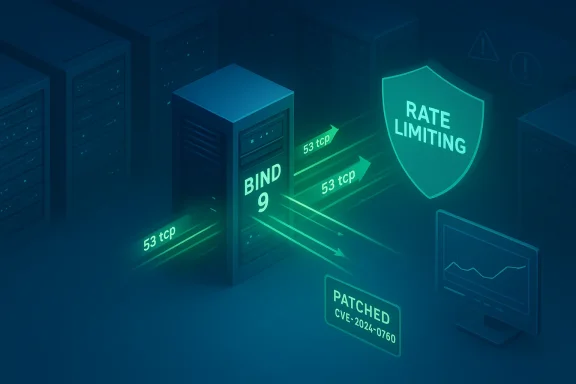
A remotely exploitable flaw in BIND 9 allows a malicious client to flood a server with DNS messages over TCP and drive the process into an unstable, unavailable state — an availability-impacting denial-of-service that can leave resolvers and authoritative servers unresponsive while the attack continues and difficult to recover from immediately after.
Background
BIND (Berkeley Internet Name Domain) is among the most widely deployed DNS server implementations on the internet and remains a fundamental piece of infrastructure for both public and private networks. In July 2024, ISC released a product security update that fixed several high-severity denial-of-service (DoS) issues affecting BIND 9. One of those was cataloged as CVE-2024-0760 and described as “a flood of DNS messages over TCP may make the server unstable.” The defect is classified as uncontrolled resource consumption (CWE-770 / CWE-400) and carries a CVSS v3.1 base score of 7.5 with an availability-only impact vector (AV:N/AC:L/PR:N/UI:N/S:U/C:N/I:N/A:H).Affected BIND 9 version ranges include many widely used branches, meaning that both resolvers and authoritative servers running affected versions are potentially exposed unless they have been upgraded to fixed releases. ISC released patched builds as part of the BIND 9 update line; downstream vendors and Linux distributions issued their own advisories and packages shortly afterward.
This article summarizes what operators need to know about CVE-2024-0760, explains how and why the issue is dangerous, lays out recommended detection and mitigation steps, and offers operational guidance for long-term resilience against TCP-based DNS flooding attacks.
What exactly is the vulnerability?
At a high level, CVE-2024-0760 stems from BIND allocating or otherwise spending server resources in response to TCP-based DNS traffic without adequate limits or throttling. An attacker that can open TCP connections to a vulnerable BIND instance and send a large number of DNS messages over those connections can cause the server to allocate resources and enter a state where it becomes unresponsive for the duration of the attack.Key pieces of the technical picture:
- The attack vector is DNS over TCP (port 53/tcp), not the usual UDP path. TCP is used in DNS for large responses, zone transfers, and (in practice increasingly) for clients that support TCP fallback, DNS-over-HTTPS, DNS-over-TLS, or when EDNS0 forces TCP fallback.
- The condition is availability focused: CVE-2024-0760 does not report arbitrary code execution or data corruption, but it can exhaust internal server resources (sockets, per-connection memory, CPU cycles, request handling capacity), causing service degradation or full unresponsiveness.
- ISC’s advisory explicitly notes that simple ACLs (access-control-lists) are not a reliable mitigation for this problem, because the attack is at the TCP handling and resource allocation level.
- A server may recover after the flood stops, but recovery is not instantaneous and may require restarting the daemon in extreme cases.
Who’s affected — scope and impact
The vulnerability affects multiple BIND 9 branches released prior to the fixes. The ranges posted by vendors and security databases covered commonly deployed series, meaning operators running any of the affected versions must treat their servers as potentially vulnerable.Where this matters most:
- Public authoritative name servers: An authoritative server driven unstable by a TCP flood can make delegation for hosted zones unreliable, impacting email delivery, web traffic, and other services dependent on DNS.
- Recursive resolvers (ISP/cached resolvers): If a resolver becomes unresponsive, dependent clients will fail name resolution or experience timeouts. That in turn cascades to application failures across an enterprise or ISP.
- On-premises and cloud DNS services that embed BIND (as part of appliances, network devices, or custom stacks) are included if the embedded BIND version falls in the impacted range.
- Windows environments: While the vulnerability targets BIND (typically running on Unix/Linux), Windows-based networks or applications that rely on affected BIND resolvers/authoritative servers—whether hosted internally or externally—can see disruption when those DNS services are impacted.
Why TCP-based flooding matters (technical analysis)
Most public conversation about DNS DoS historically centers on UDP amplification or response-rate-limiting (RRL) because UDP is connectionless and easy to spoof. TCP-based attacks are different in critical ways that make them dangerous against modern DNS servers:- TCP forces a connection handshake and per-connection state. Although that consumes more resources on the client side as well, servers traditionally allocate kernel and userspace resources to track sockets, handle buffers, and parse request streams.
- TCP-based flooding typically consumes file descriptors, memory and the server’s thread or event-loop capacity. If the implementation doesn’t enforce strict per-connection and global limits, an attacker can open many connections and then stream messages over them to keep resources consumed for long intervals.
- TCP is required for legitimate DNS behavior: large responses (zone transfers, DNSSEC-signed responses), and some clients that enforce TCP fallback. Because of that, operators can’t safely “turn off” TCP entirely without breaking legitimate functionality.
- Modern DNS features (EDNS TCP keepalive, TCP fast-reuse, HTTP/2-based DoH backends) interact with TCP behavior and can make resource consumption more complex; unwary implementations can be overwhelmed by clients that do not adhere to expected read/write patterns.
Detection — how to spot an attack or exploit attempt in your environment
Detecting TCP-based DNS flooding quickly is essential. Look for behavioral indicators rather than one-off log lines. Practical signals include:- Sudden spike in established TCP connections to port 53. Command-line checks:
- netstat -an | grep ':53 ' | grep ESTABLISHED | wc -l
- ss -tanp sport = :53
- BIND-specific statistics: modern BIND builds expose TCP-related counters. Watch for:
- Increasing
tcp-highwateror currenttcp-clientscounts (statistics names vary by BIND version). - Elevated numbers in
RateDropped,QryDropped, or other rate-limiting counters if rate-limit is enabled. rndc statsand the named statistics file will show connection and query metrics you can parse and graph.
- Increasing
- System resource exhaustion patterns:
- High file-descriptor usage and “too many open files” messages in logs.
- Growing resident set size (RSS) of named, CPU pegged by parsing loops, or a surge in context switches.
- Kernel logs and firewall counters showing large numbers of TCP SYNs/established sessions from many sources or from a single source with many ephemeral ports.
- Application-level logs: repeated incomplete queries, long-running query handling, or requests from clients that never read responses.
Short-term mitigations you can apply immediately
Because the attack vector is TCP and because vendor advisories warned that simple ACLs might not mitigate it, operators need layered, pragmatic protections while they schedule updates.- Patch first where possible
- The single most effective action is to upgrade BIND to the vendor-published patched versions. Vendor packages and ISC releases include explicit fixes aimed at resource handling and connection throttling. Test patches in staging and plan a controlled rollout.
- Network-level connection controls
- Apply firewall rules to limit inbound TCP connections to port 53 from untrusted networks. For authoritative servers, allow only the expected set of secondary/transfer peers; for resolvers exposed to the internet, consider restricting recursion to trusted clients only.
- Implement per-IP connection limits at the edge (rate-limit concurrent TCP sessions per source IP). For example, use connection-tracking limits in stateful firewalls or rate-limiting primitives in DDoS protection appliances.
- Use upstream DDoS scrubbing or mitigation services if available for any internet-facing resolvers/authoritative servers.
- BIND configuration knobs (tuning, not a substitute for patching)
- Tighten TCP-related limits in named.conf. Relevant options to consider (values shown are examples — tune to your environment):
- tcp-clients <N>; # Maximum simultaneous TCP clients accepted
- tcp-listen-queue <N>; # Queue depth for incoming TCP accepts
- tcp-keepalive-timeout <ms>; # Reduce keepalive so idle sockets close faster
- tcp-advertised-timeout <ms>;
- reserved-sockets <N>; # Ensure sufficient FD reservation for control paths
- max-cache-size <bytes>; # Limit memory the cache can grow to
- Enable or tune
rate-limitand ensuremin-table-size/max-table-sizematch expected query rates. - Configure
fetches-per-server,recursive-clients, andmax-clients-per-queryto reasonable per-server limits so upstream work does not swamp the resolver.
- Tighten TCP-related limits in named.conf. Relevant options to consider (values shown are examples — tune to your environment):
- Socket-level and OS-level hardening
- Increase or tune TCP backlog and ephemeral port settings carefully to ensure the OS enforces limits predictably.
- Enable SYN cookies where supported to keep SYN-flood consequences minimal.
- Set ulimit for named appropriately and monitor “open files” exhaustion proactively.
- Operational measures
- If the server is authoritative for a small set of zones, consider moving those zones temporarily to alternative authoritative endpoints or secondary servers while you remediate.
- For recursive resolvers serving clients, place them behind a local caching resolver or a high-capacity front-end that can absorb attack traffic.
Patching guidance — practical rollout steps
- Inventory and prioritize
- Identify every server and appliance running BIND (including container images and embedded devices). Use package management queries and process lists to compile a definitive inventory.
- Prioritize internet-facing authoritative and recursive resolvers, then internal resolvers for critical services.
- Check vendor packages
- Many distributions released security fixes in their package repositories. Use the platform’s security notice for the exact package name and fixed version. If a distro package isn’t available, obtain the patched ISC build or follow the vendor guidance.
- Test in staging
- Deploy the patched release to a staging environment that mirrors production traffic patterns. Observe TCP handling and validate that configuration options are preserved across upgrades.
- Schedule maintenance windows
- Plan a controlled upgrade with rollback capability. For multi-node resolver clusters, upgrade nodes one at a time to retain service continuity.
- Verify post-upgrade
- Validate that the named process returns to normal TCP client baselines and that the
tcp-highwaterand related counters no longer trend abnormally under simulated load. - Re-run monitoring/alerting and check logs for any regression or unexpected failures.
- Validate that the named process returns to normal TCP client baselines and that the
- Communicate
- Notify application owners about the maintenance and any expected or observed changes to DNS latency or behavior.
Longer-term hardening and resilience strategies
CVE-2024-0760 is a reminder that core protocols like DNS require continual operational attention. The following strategies improve resilience beyond a single CVE patch:- Enforce least-exposure for recursion: Only offer recursive service to trusted clients. Publicly exposed recursion is a common target for attackers.
- Use geographically distributed, redundant authoritative infrastructure. Multiple independent name servers reduce the impact of any single server being overwhelmed.
- Adopt multi-layered DDoS protections: combine edge scrubbing, rate-limiting, and upstream filtering with application-layer controls.
- Implement telemetry-driven alerting: collect named statistics, netflow data, and system metrics and drive automated triage (e.g., temporarily blocking offending addresses).
- Keep a rigorous patching cadence: central DNS implementations and name server software families receive frequent updates; apply critical security fixes quickly in staging and roll out with low-latency change processes.
- Consider managed DNS providers for public authoritative services if operating your own high-availability DNS is not feasible. Managed providers often have large-scale DDoS protections in place.
Detection playbook — step-by-step checklist
If you suspect an active TCP-based DNS flood:- Confirm the signal
- Run netstat/ss to count TCP port 53 established sessions.
- Check named statistics with rndc stats or by reading the statistics file.
- Identify sources
- Use connection tracking or firewall logs to detect per-source connection counts and rates.
- Apply temporary network controls
- Rate-limit or block offending addresses at the firewall. If traffic appears botnet-like with many distributed sources, engage upstream scrubbing services.
- Reduce exposure
- If it’s a recursive resolver that should not be public, immediately block or restrict external access to recursion.
- Monitor while mitigating
- Keep monitoring counters and system logs while making configuration changes to avoid introducing unintended service disruptions.
- Patch and harden
- Schedule upgrade to patched BIND release as high priority post-incident.
- Post-incident review
- Review logs and telemetry to determine attack vector, duration, and the effectiveness of applied mitigations. Update runbooks accordingly.
Operational caveats and risks
- Restarting named during an attack can be a double-edged sword: restart frees resources but risks transient DNS resolution failures for clients; weigh the trade-offs and coordinate with stakeholders.
- ACLs and simple allow/deny lists are not sufficient as a standalone fix for CVE-2024-0760. The problem is at the TCP resource handling layer, so network-level rate-limiting and patched software are the reliable remedies.
- Overly aggressive limits (for example, setting tcp-clients extremely low) can unintentionally block legitimate spike traffic and hurt service availability. Tune parameters against normal baselines.
- Embedded devices and appliances may use older BIND versions and may not receive vendor patches promptly; in such cases, network-level segregation or replacement may be advised.
- Be conservative with kernel-level socket tuning. Increasing buffers and file descriptors can help under normal load, but they also allow an attacker to provoke larger resource allocations.
Case study and lessons learned
Operational teams that responded well to TCP-based DNS floods in recent incidents combined rapid detection, network controls, and staged patching:- Detection: pre-existing dashboards surfaced an anomalous spike in TCP client counts and a concurrent drop in successful DNS responses. Early alarms reduced mean-time-to-detect by hours.
- Containment: network ACLs were used to restrict recursion quickly while keeping authoritative responses available from dedicated servers. This bought time to implement more precise per-IP rate-limits.
- Recovery: patched BIND builds were deployed to resolvers in rolling fashion, avoiding cluster-wide disruption. Metrics showed a return to baseline without needing a full service restart.
- Postmortem: teams updated their runbooks, added TCP-session metrics to their alerting rules, and re-evaluated whether any appliances in their estate needed replacement because vendor patch timelines were too long.
Final recommendations — an actionable checklist for operators
- Immediately identify all servers running BIND (including appliances and containers).
- Prioritize internet-facing resolvers and authoritative servers for upgrade to patched BIND releases.
- If a vendor package is not yet available, consider building the patched upstream release in a controlled manner, or isolate the service until a vendor patch is provided.
- Implement network-level per-IP connection limits and rate-limiting at the edge to minimize attack surface.
- Tune BIND’s TCP-related configuration options (tcp-clients, tcp-listen-queue, tcp-keepalive-timeout, reserved-sockets, and rate-limit table sizes) in a tested staging environment.
- Monitor TCP session counts to port 53, BIND
tcp-highwaterand related statistics, and set alerts on anomalous thresholds. - Document and rehearse your incident response steps for DNS-layer DoS events.
- Consider deploying authoritative services across multiple providers if you can’t guarantee the necessary DDoS capacity yourself.
DNS is a foundational internet service — its availability underpins almost every networked application. CVE-2024-0760 is a clear reminder that attacks do not always rely on exploitation of memory-safety bugs; protocol-level resource exhaustion and insufficient throttling are equally dangerous and often easier for attackers to weaponize. The correct operational response is straightforward: prioritize patching, apply layered network protections, tune server resource limits thoughtfully, and strengthen detection so you know quickly when a flood starts. Doing so will significantly reduce the risk of a TCP-based DNS flood rendering your name servers unstable and will improve overall resilience against future resource-exhaustion vectors.
Source: MSRC Security Update Guide - Microsoft Security Response Center
