

Microsoft’s short, product‑scoped attestation — that “Azure Linux includes this open‑source library and is therefore potentially affected” — is accurate and actionable for Azure Linux customers, but it is not a categorical proof that no other Microsoft product can or does include the same vulnerable AMD GPU kernel code. Microsoft has published that attestation as the result of an inventory for Azure Linux and has committed to update the CVE/VEX/CSAF mapping if additional Microsoft products are found to ship the same upstream component.
CVE‑2025‑38426 is an upstream Linux kernel fix in the AMD GPU driver (drm/amdgpu) that adds validation of the RAS (Reliability, Availability, Serviceability) header read from EEPROM. Without the new checks, a corrupted header could cause the driver to attempt to allocate an unreasonably large block of memory when reading RAS records — an availability risk that can lead to kernel instability or denial‑of‑service. The fix was merged into the kernel stable trees and is tracked in public vulnerability databases. Two important, verifiable technical facts:
How to read that statement correctly:
Caution about public scoring: At the time of publication some databases listed CVSS or severity as Pending or Moderate, and EPSS/weaponization metrics were low or absent; this CVE has not been widely reported as an immediate privilege‑escalation vector. The operational impact is availability — patching remains the right course.
Other Microsoft artifacts that are plausible carriers — and therefore should be checked — include:
If further detail is desired — for example, a ready‑to‑use script that automates the inventory checks across WSL clients and Azure VM fleets, or a short actionable runbook tailored to an enterprise patching pipeline (PowerShell + Azure CLI + linux shell snippets) — those can be provided as a follow‑up deliverable with exact commands and automation suggestions.
Source: MSRC Security Update Guide - Microsoft Security Response Center
 Background / Overview
CVE‑2025‑38426 is an upstream Linux kernel fix in the AMD GPU driver (drm/amdgpu) that adds validation of the RAS (Reliability, Availability, Serviceability) header read from EEPROM. Without the new checks, a corrupted header could cause the driver to attempt to allocate an unreasonably large block of memory when reading RAS records — an availability risk that can lead to kernel instability or denial‑of‑service. The fix was merged into the kernel stable trees and is tracked in public vulnerability databases. Two important, verifiable technical facts:- The vulnerability lives in kernel driver code (drm/amdgpu), so exposure is determined by whether a shipped kernel image includes that code path and whether the shipped kernel revision predates the upstream fix.
- The upstream remediation is a defensive validation check — it prevents oversized allocations when parsing a potentially corrupted RAS header — and is therefore primarily an availability/robustness fix rather than a direct confidentiality or remote code‑execution fix.
What Microsoft actually said — and why the wording matters
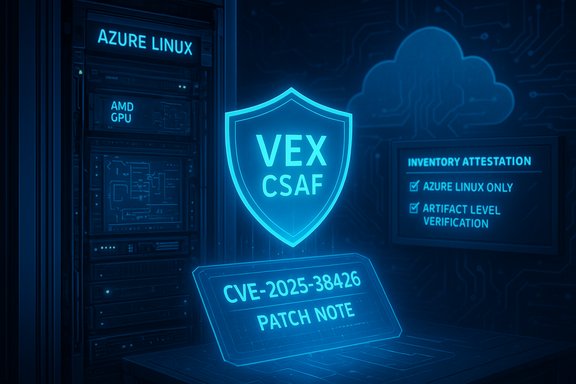
Microsoft’s MSRC entry for the CVE contains the line quoted in the question: Azure Linux includes the implicated open‑source library and is therefore potentially affected. That entry also records Microsoft’s operational commitment to publish machine‑readable CSAF/VEX attestations (which began with Azure Linux) and to update CVE mappings if other Microsoft products are later found to include the same upstream component.How to read that statement correctly:
- It is an attestation: Microsoft has completed an inventory for the Azure Linux images it builds/publishes and found the amdgpu code in those kernels. The attestation is therefore the authoritative, machine‑readable signal for Azure Linux customers.
- It is not a guarantee of exclusivity: absence of other Microsoft product names in the attestation is absence of attestation, not independent proof those products don’t include the vulnerable code. Microsoft explicitly says it will update the CVE if additional products are identified.
Technical validation and cross‑checks
To verify the technical claims and confirm the CVE details, independent authoritative sources were cross‑checked:- Kernel commits and the upstream fix are published on kernel.org; the patch that adds validation for the RAS header is visible in the stable trees referenced from public CVE pages. This is the primary, canonical proof that the vulnerability was addressed upstream.
- National vulnerability databases and vendor trackers (NVD, SUSE security pages, Tenable, Debian/Rapid7 mirrors) list CVE‑2025‑38426 with the same description and map it to patched kernel trees and distribution updates. These independent trackers corroborate the technical description (corrupted EEPROM RAS header → oversized allocation risk → add header validation) and provide distro‑specific remediation guidance where available.
Caution about public scoring: At the time of publication some databases listed CVSS or severity as Pending or Moderate, and EPSS/weaponization metrics were low or absent; this CVE has not been widely reported as an immediate privilege‑escalation vector. The operational impact is availability — patching remains the right course.
Why Azure Linux shows up in Microsoft’s mapping (and why other Microsoft products might as well)
Microsoft’s initial VEX/CSAF rollout started with Azure Linux because Azure Linux is a Microsoft‑managed, Microsoft‑published Linux distribution image: Microsoft builds, curates, and publishes the kernel and images for Azure Linux, which makes per‑artifact inventorying and attestation straightforward. Once Microsoft inspects a product’s build provenance and SBOMs and confirms the presence or absence of an upstream component, that product can be labeled in a machine‑readable VEX/CSAF file. Microsoft has said it started with Azure Linux and will expand the mapping as it inventories other products.Other Microsoft artifacts that are plausible carriers — and therefore should be checked — include:
- Windows Subsystem for Linux (WSL2) kernels that Microsoft publishes and maintains; the WSL kernel source tree includes the drivers/gpu/drm area (so the amdgpu sources are present in the repo used to build WSL kernels). Presence in source control is a plausible carriage vector, but whether a shipped WSL kernel is vulnerable depends on the build configuration and kernel revision.
- linux‑azure kernel packages and kernels used by some Azure images or Marketplace appliances where Microsoft maintains or packages kernels. Distribution trackers have historically included linux‑azure variants in mappings for kernel CVEs.
- Azure Marketplace images and third‑party appliances where Microsoft is the publisher or where Microsoft supplies kernel components; these are separate supply‑chain artifacts and must be inventoried individually.
Practical, prioritized runbook for operators (inventory → verify → remediate)
The operational approach is the same regardless of vendor wording: inventory your artifacts for Microsoft‑published images and verify whether they ship—or expose—a vulnerable amdgpu kernel. The following checklist is prioritized for speed and clarity.- Inventory Microsoft‑supplied artifacts in your environment (high priority)
- Azure Linux VM images (attested by Microsoft). These are high‑priority because Microsoft has already flagged them.
- WSL2 installations across developer machines and build agents.
- Azure Marketplace images, custom Marketplace appliances, and any Microsoft‑published container hosts.
- AKS node images and GPU‑enabled node pools.
- On each Linux host or image, run these rapid checks:
- Confirm running kernel: uname -r
- Check for AMDGPU module: lsmod | grep amdgpu
- Inspect module files: ls -l /lib/modules/$(uname -r)/kernel/drivers/gpu/drm/amd
- Check kernel config for AMD GPU drivers: zcat /proc/config.gz 2>/dev/null | egrep 'CONFIG_DRM_AMDGPU|CONFIG_DRM' || grep -i CONFIG_DRM_AMDGPU /boot/config-$(uname -r)
- Verify presence of /dev/dri device nodes and their permissions: ls -l /dev/dri/*
- For WSL environments:
- Inside WSL: uname -r and compare the release to patched kernel versions.
- Determine whether the WSL binary is Microsoft‑supplied or a custom kernel (use wsl --status and .wslconfig kernel path).
- If using Microsoft’s WSL kernel, ensure Windows Update or the WSL kernel package has been updated; if you use a custom kernel, rebuild with the patched upstream commits.
- Map kernel versions to upstream fixes:
- Cross‑reference the running kernel and vendor package version with distribution security advisories or the kernel.org stable commit IDs that fixed CVE‑2025‑38426. Use distro changelogs to confirm whether the fix has been backported.
- Immediate mitigations if patching is not yet possible:
- Restrict access to DRM device nodes (/dev/dri/*): tighten udev rules; remove untrusted users from video/render groups.
- Avoid mounting host GPU devices into untrusted containers (no --device=/dev/dri unless necessary).
- Isolate GPU‑enabled hosts from multi‑tenant workloads or untrusted CI runners.
- Patch and verify:
- Apply vendor/distro kernel updates that include the kernel stable commit(s) for CVE‑2025‑38426 and reboot into the patched kernel.
- Validate by reproducing (safely) any prior workload that could stress the RAS path and confirm logs show no oversized allocation attempts or driver oopses.
Risk assessment: what the Microsoft attestation does — and does not — buy you
What you gain from Microsoft’s Azure Linux attestation:- A high‑confidence, machine‑readable signal (VEX/CSAF) that the specific Azure Linux product family was inspected and mapped to this CVE. That lets automation and patch pipelines target Azure Linux artifacts immediately.
- It does not prove that Windows Subsystem for Linux, linux‑azure kernels embedded in other images, Marketplace appliances, or developer images are free of the vulnerable driver. Those artifacts either have not been attested yet or are outside the attestation’s current scope. Treat their status as unverified rather than unaffected.
Notable strengths and potential risks of Microsoft’s disclosure approach
Strengths:- Machine‑readable VEX/CSAF attestations enable automated triage and reduce ambiguity for the Microsoft product family that has been attested (Azure Linux). This is good supply‑chain hygiene and helps large enterprise patching pipelines target relevant artifacts quickly.
- Microsoft’s commitment to update the CVE/VEX mapping if additional products are found to include the component provides a clear operational promise: they will expand attestation coverage as inventory work completes.
- Phased attestation leaves a window where other Microsoft artifacts may be unverified. Organizations running WSL or other Microsoft‑distributed kernels could be exposed until Microsoft either attests those products or customers perform artifact‑level checks.
- VEX/CSAF is only as useful as the completeness of a vendor’s inventory. The attestation model assumes vendors can inventory all product artifacts and SBOMs; where inventory is incomplete (third‑party Marketplace images, partner appliances), customers must exercise additional caution.
Conclusion — the short, defensible answer
- Azure Linux is the only Microsoft product Microsoft has publicly attested as including the open‑source component implicated in CVE‑2025‑38426 at the time of Microsoft’s advisory. That attestation is authoritative and actionable for Azure Linux customers.
- However, Azure Linux is not necessarily the only Microsoft product that could include the same upstream amdgpu code. Other Microsoft artifacts that ship or host Linux kernels — WSL2 kernels, linux‑azure kernels, Marketplace images, appliance kernels — may also carry the vulnerable code depending on kernel build and configuration. Absence of a product from the VEX/CSAF file is absence of attestation, not proof of absence. Artifact‑level verification is required for any Microsoft‑supplied image or kernel you run.
- The recommended operational posture is immediate inventory, prioritized patching for Azure Linux instances (per Microsoft’s attestation), and artifact verification for all other Microsoft‑distributed kernels in your estate. Apply vendor/distribution kernel updates that include the upstream fix and use mitigations (restrict /dev/dri access, isolate GPU hosts) until you can patch and validate.
If further detail is desired — for example, a ready‑to‑use script that automates the inventory checks across WSL clients and Azure VM fleets, or a short actionable runbook tailored to an enterprise patching pipeline (PowerShell + Azure CLI + linux shell snippets) — those can be provided as a follow‑up deliverable with exact commands and automation suggestions.
Source: MSRC Security Update Guide - Microsoft Security Response Center
