Microsoft’s pitch that unified data and AI can help colleges move from reaction to anticipation — improving student success, streamlining operations, and accelerating research — is both persuasive and practical on paper, but the reality for campus IT leaders is a complex blend of technical lift, governance demands, cost management, and cultural change that institutions must navigate deliberately if they hope to convert vendor promise into measurable outcomes.
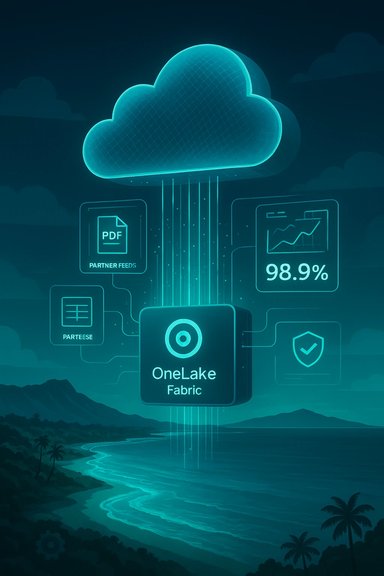
Higher education is under two acute pressures: enrollment volatility and an operational imperative to demonstrate better student outcomes with fewer resources. EDUCAUSE placed “The Data‑Empowered Institution” at the top of its 2025 Top 10 IT Issues, explicitly linking institutional resilience to improved data management, analytics, and governed AI adoption. This sector-level priority frames why vendors such as Microsoft are pushing integrated platform solutions that combine data lakes, analytics, identity, and AI services into a single stack. Microsoft’s narrative centers on Microsoft Fabric (with OneLake and Azure-hosted AI services) as the “single, AI-powered foundation” to break down data silos, speed insight generation, and deliver governed AI experiences across administration, IT, research, and student-facing services. The vendor’s campaign emphasizes three ideas: unify data into a governed lake, apply analytics and generative AI on that foundation, and democratize access with role-based controls and Copilot-style assistants. The company notes that success is not just a technology rollout but a cultural and governance process. The claims and early customer stories highlighted by Microsoft and related reporting show tangible wins — faster reporting, time savings for staff, research acceleration, and new student services — but they also illuminate the complexity and pitfalls of institutional transformation. Many of the case studies below are instructive: they demonstrate feasible outcomes, the technical architecture used, and the operational tradeoffs campus leaders should expect.
Practical next steps for WindowsForum readers (IT leaders and practitioners)
Source: insightintoacademia.com Microsoft Helps Colleges Harness AI and Data to Drive Student Success | Insight Into Academia
 Background / Overview
Higher education is under two acute pressures: enrollment volatility and an operational imperative to demonstrate better student outcomes with fewer resources. EDUCAUSE placed “The Data‑Empowered Institution” at the top of its 2025 Top 10 IT Issues, explicitly linking institutional resilience to improved data management, analytics, and governed AI adoption. This sector-level priority frames why vendors such as Microsoft are pushing integrated platform solutions that combine data lakes, analytics, identity, and AI services into a single stack. Microsoft’s narrative centers on Microsoft Fabric (with OneLake and Azure-hosted AI services) as the “single, AI-powered foundation” to break down data silos, speed insight generation, and deliver governed AI experiences across administration, IT, research, and student-facing services. The vendor’s campaign emphasizes three ideas: unify data into a governed lake, apply analytics and generative AI on that foundation, and democratize access with role-based controls and Copilot-style assistants. The company notes that success is not just a technology rollout but a cultural and governance process. The claims and early customer stories highlighted by Microsoft and related reporting show tangible wins — faster reporting, time savings for staff, research acceleration, and new student services — but they also illuminate the complexity and pitfalls of institutional transformation. Many of the case studies below are instructive: they demonstrate feasible outcomes, the technical architecture used, and the operational tradeoffs campus leaders should expect.How campuses are using unified data and AI today
Xavier College: rapid consolidation and a foundation for AI
Xavier College (an independent Australian school) is an instructive early example. Plagued by 130 disparate systems, the college executed a migration of current and historic student and staff data into Azure and modernized core systems (Dynamics 365, Dataverse, Synapse). According to the published case, the migration was mapped and completed in under seven months, enabling the school to reduce the number of active platforms and begin piloting AI-enabled automation and analytics. This kind of consolidation — moving from dozens of isolated systems to a governed cloud estate — is the exact technical prerequisite Microsoft promotes for applying Fabric’s analytics and AI layers. What Xavier did well:- Completed an expansive mapping exercise before migration.
- Centralized identity with Azure Entra ID to provide single sign-on and usage telemetry.
- Built user-facing portals and scenarios (parent, student, alumni) to deliver value immediately rather than indefinitely postponing UX benefits behind backend work.
Oregon State University: AI in the security operations center
Oregon State University (OSU) used Microsoft Sentinel, Defender, and Security Copilot to overhaul its security posture after a major incident exposed detection and response gaps. OSU reports a dramatic reduction in time-to-detection and a drop in open incident volumes, while Copilot for Security helps analysts generate KQL queries, summarize incidents, and automate playbooks — allowing student analysts and staff to focus on higher-value tasks. The campus credits this combined approach with compressing years of maturity gains into a shorter timeframe. What OSU demonstrates:- A coordinated security toolchain (SIEM + endpoint + AI augmentations) can materially reduce mean time to detect and respond (MTTD/MTTR).
- Security Copilot should be introduced with SOC process redesign and analyst training; it is not a drop-in replacement for experienced SOC practitioners.
Georgia Tech: research acceleration using Azure OpenAI
Researchers at Georgia Tech used Azure OpenAI Service to process large, multilingual, unstructured datasets about electric vehicle charging behavior. The team estimated that manual curation and labeling would have taken roughly 99 weeks of human effort, a work estimate that AI processing dramatically compressed. By training models with expert‑guided examples, the team achieved classification performance that exceeded human expert baselines on some tasks and enabled rapid, reproducible research outputs. This shows how generative and classification models, paired with domain supervision, can transform labor-intensive research pipelines. What the Georgia Tech story teaches us:- Large language models plus retrieval-augmented pipelines are effective at extracting structure from noisy, multilingual datasets — but they require careful prompt engineering and human-in-the-loop validation to reach research-quality results.
- Provenance and reproducibility demand logging prompts, model versions, and fine-tuning artifacts.
University of Waterloo: AI to simplify the co-op job search
The University of Waterloo built JADA (Job Aggregator and Digital Assistant), an Azure OpenAI–backed tool that aggregates postings and provides on-demand co‑op guidance. JADA offers a searchable aggregator, match scoring against uploaded résumés, and an assistant that answers process questions — a pragmatic use of AI that reduces student friction and centralizes fragmented services.California State University San Marcos: AI-driven student engagement
CSUSM consolidated communications and lifecycle data into Dynamics 365 Customer Insights and used Copilot-driven automation to create more than 1,700 personalized student journeys. By reducing message noise and providing targeted, timely outreach, CSUSM illustrates how AI-augmented CRM workflows can materially affect retention, event attendance, and administrative responsiveness.Why these results are credible — and where to be skeptical
These case studies are credible for three main reasons:- Independent institutional pages and research offices corroborate vendor case studies (Georgia Tech, Waterloo, OSU, CSUSM, Xavier College are all documented in academic or university communications).
- The technical pattern is consistent: consolidate source systems, enforce identity and access control, apply governance and cataloging, then layer analytics and model-based services. This sequence reduces a host of operational friction points and is a standard architecture in cloud analytics programs.
- Gains described (faster reporting, reduced analyst time, rapid experiment cycles for research) match independent analyses of cloud + LLM acceleration effects in enterprise and research contexts.
- Vendor-provided time and ROI claims are often measured from internal baselines and may not account for total cost of ownership (integration, ongoing compute, training, governance staff). Independent validation of ROI is rare in the public case literature.
- Quantitative claims such as “would have required 99 weeks of human effort” are valid as comparative estimates for scale, but they should be treated as illustrative rather than exact guarantees; real-world outcomes vary by data quality, model engineering, and governance overhead. The Georgia Tech team’s assertion is plausible and supported by the research write-ups, but it remains an estimate tied to that dataset and approach.
- Many customer stories emphasize rapid migrations (e.g., Xavier’s seven months) but gloss over prerequisite investments: mapping exercises, staff upskilling, and vendor consulting that often make the timeline realistic only with sufficient budget and attention.
Strengths: what unified data + AI does well for campuses
- Breaks down data silos: Centralizing student records, finance, CRM, LMS logs, and research metadata into a governed lake eliminates inconsistent metrics and enables institution‑wide KPIs and predictive models.
- Speeds actionable insight: Direct Lake and near‑real‑time analytics shorten reporting cycles and power interventions (targeted outreach to at‑risk students, automated case management).
- Accelerates research: LLMs plus retrieval systems convert unstructured research artifacts into analyzable datasets, shortening months of manual curation into days or hours when done with human oversight.
- Improves operational efficiency: Copilot-style assistants and Copilot for Security reduce repetitive writing, triage, and query-writing time, freeing staff for higher‑value activities.
- Enables student-facing automation: Chat-based agents and job‑matching assistants (JADA) reduce friction in high-volume processes like registration, co‑op matching, and advising.
Risks, unknowns, and governance obligations
Implementing an integrated data-and-AI platform raises multiple operational, ethical, and legal risks:- Data privacy and compliance: Student records, health data, and research IP often carry FERPA, HIPAA, or contractual constraints. Contracts with cloud providers must explicitly address non‑training assurances, data residency, retention, deletion, and audit rights. Institutional procurement needs to lock those terms down before enabling Copilot-style connectors to sensitive systems. This is not an optional legality; it’s a requirement for compliance and trust.
- Model hallucination and academic integrity: Generative models can produce plausible but incorrect outputs. When models are used to support coursework, advising, or research, institutions must require provenance (source attachments, retrieval contexts) and confirmatory human review for high-stakes decisions. Assessment design must evolve to require artifact provenance and process evidence.
- Vendor lock-in and portability concerns: Building workflows around proprietary connectors, model APIs, or managed model environments increases migration costs later. Campuses should maintain canonical data exports and an exit strategy (open formats, snapshot backups) as part of procurement.
- Uneven adoption and equity: Provisioning tools is necessary but insufficient. Faculty, adjuncts, and students differ in access and skills; without robust training and micro-credentialing, early adopters gain outsized advantage and institutional benefits are unevenly distributed.
- Hidden operational costs: Consumption-based pricing, storage, and model inference can outstrip initial forecasts. Cost governance, tagging, and real-time dashboards are essential to avoid runaway spend.
- Governance and auditability: AI tools introduce new evidence surfaces (interaction logs, model outputs, prompt history) that may be subject to records retention and eDiscovery policies. Institutions must treat these as formal records when they inform grading, research, or HR decisions.
A practical roadmap for campus leaders (prioritized, sequential)
- Executive sponsorship and cross-functional governance board
- Include academic affairs, legal, records, disability services, campus police/HR, and student representation.
- Data classification and mapping (mandatory)
- Map each dataset’s sensitivity, owner, and compliance constraints; this was a critical step in Xavier’s fast migration.
- Start with a scoped pilot (3–6 months)
- Pick a bounded, measurable use case: e.g., personalized outreach for at‑risk cohorts, a controlled research pipeline, or a job‑matching assistant.
- Configure platform controls before scale
- Enforce Entra ID, private endpoints, tenant-level DLP, and catalog lineage (or Unity Catalog equivalents) before broadening data access.
- Pedagogy and assessment redesign
- Redesign high-stakes assessments to emphasize process, provenance, and reflection; require AI interaction logs as a submission artifact when appropriate.
- Faculty and staff training micro-credentials
- Require certified training for instructors embedding AI in coursework; provide just-in-time workshops for administrative staff who use Copilot-driven journeys.
- Cost governance and meter-based controls
- Implement consumption caps, cost tags, and monthly review meetings that include finance and academic stakeholders.
- Measure and publish KPIs
- Track measurable outcomes: retention lift, time saved per staff FTE, incident response time reductions, model error rates, and equity of access metrics.
- Maintain an exit strategy
- Keep canonical datasets in neutral formats and ensure contract clauses for data export and non-training assurances are in place.
- Iterate and publish lessons learned
- Use governance advisory boards to refine policy and scale successful pilots.
Technical verification of key claims
- EDUCAUSE prioritized “The Data‑Empowered Institution” as the #1 2025 Top 10 IT Issue, explicitly connecting data modernization and governance to student success and institutional resilience. This is a sector-level validation of the problem statement vendors address.
- Xavier College’s migration from 130 disparate systems into Azure and the subsequent modernization using Dynamics 365, Dataverse, and Synapse is documented in Microsoft’s customer story; the institution reports completing the migration of current and historic data in less than seven months after a six‑month mapping exercise. This corroborates the feasibility of rapid consolidation when leadership commits to mapping, scope control, and vendor engagement.
- Oregon State University’s security transformation — moving to Microsoft Sentinel and Defender and piloting Copilot for Security — is corroborated by Microsoft’s customer documentation and OSU’s own technology pages that describe Copilot’s role in the SOC and improved detection/response times. These outcomes are tied to SOC modernization and vendor partnership, not just a product purchase.
- Georgia Tech’s use of Azure OpenAI Service to scale EV charging research — including the claim that manual curation would have required 99 weeks of human work — is described in Microsoft’s case story and Georgia Tech’s research communications; the figure represents a plausible effort estimate for massive multilingual unstructured datasets and is presented as an explanatory metric rather than a guaranteed benchmark for every project. Institutions should treat such estimates as context for expected acceleration rather than a contractual promise.
- University of Waterloo’s JADA, a job aggregator and digital assistant built with Azure OpenAI Service, is documented on the university’s AI institute pages and co-op office communications; JADA is an example of using AI to consolidate search sources and provide match scoring and on-demand support for students.
Governance checklist for IT leaders (technical, legal, and academic)
- Identity & Access
- Enforce Azure Entra ID / RBAC and multi-factor authentication for administrative roles.
- Use conditional access and least privilege for AI tool connectors.
- Network & Storage
- Use private endpoints, VNet isolation, and storage encryption.
- Implement OneLake/Unity Catalog or equivalent for lineage and controlled access.
- Data Contracts & Privacy
- Ensure procurement includes non‑training clauses (where required), deletion and retention terms, and audit rights.
- Validate FERPA, HIPAA, and GDPR obligations for datasets.
- Model Governance
- Version models, log prompts and outputs, and archive training datasets for reproducibility.
- Use retrieval-augmented generation with verified, indexed sources to reduce hallucination risk.
- Pedagogical Safeguards
- Require AI-use declarations in syllabi for courses that permit model assistance.
- Redesign high-stakes assessments to include oral components, staged submissions, or process artifacts.
- Cost & Vendor Management
- Apply consumption caps, cost tags, and an exit strategy for critical services.
- Negotiate SLAs for uptime, support, and security response.
Final assessment and recommendation
Microsoft’s Fabric/OneLake + Azure AI message is aligned with a real need in higher education: data fragmentation blocks predictable decision-making, and generative AI requires high-quality, governed data to be useful. The vendor’s platform approach — centralize data, secure it, and then enable analy tics and AI — is sensible and replicable in well-resourced institutions that commit to governance and skills development. Real-world campus stories (Xavier, OSU, Georgia Tech, Waterloo, CSUSM) demonstrate that substantive gains are possible, and they provide clear implementation patterns institutions can follow. However, the platform is not a silver bullet. The most common institutional failure modes are organizational: insufficient governance, underinvested staff training, lack of procurement safeguards, and poor cost management. To get the upside, campus leaders must pair platform investments with:- rigorous pilots and measurable acceptance criteria,
- cross-functional governance that includes academic leadership,
- clear procurement clauses on data usage and model training,
- ongoing training and equitable access programs for faculty and students.
Practical next steps for WindowsForum readers (IT leaders and practitioners)
- Audit your data estate and classify datasets by sensitivity and owner.
- Run a short, scoped pilot with a clear ROI metric and a bounded budget.
- Negotiate procurement terms with non‑training assurances and robust export clauses.
- Build a governance board that includes academic leadership and representative students.
- Publish a monthly dashboard of pilot KPIs (costs, time savings, outcome metrics) and iterate.
Source: insightintoacademia.com Microsoft Helps Colleges Harness AI and Data to Drive Student Success | Insight Into Academia