

Microsoft’s new Data Security Index frames a clear but urgent proposition: organizations must accelerate AI-driven innovation while fundamentally rethinking how they discover, govern, and protect the information that fuels that innovation. The 2026 report — based on survey responses from more than 1,700 security leaders — identifies three interlocking priorities that will determine whether generative AI becomes a productivity multiplier or a new vector for catastrophic data exposure: move from fragmented tools to unified data security, manage AI-powered productivity with deliberate controls, and use generative AI to strengthen security operations. These priorities are not abstract; the report supplies concrete signals — including that 47% of surveyed organizations are implementing generative AI–specific controls, 32% of data incidents now involve generative AI, and 82% are planning to embed generative AI into security operations — that show enterprises are already racing to operationalize secure AI while wrestling with real trade-offs and technical complexity.
The rapid arrival of generative and agentic AI in business workflows has changed the fundamental shape of data risk. AI can ingest, infer, and reproduce sensitive facts at scale; it can automate decisions across identity, access, and data handling; and it can create new ephemeral interactions — chat histories, agents, and generated artifacts — that traditional discovery and governance tools were not built to track. The Data Security Index positions those changes against a simple observation: existing security toolsets are often fragmented and siloed, creating blind spots precisely where oversight must be strongest.
This year’s findings place three themes front and center:
Siloed tooling creates three concrete hazards:
Key operational benefits of DSPM:
Nearly half (47%) of surveyed organizations have implemented generative AI–specific controls, an increase year-over-year. This reflects a rapid response from security teams working to codify safe AI usage without throttling productivity.
Practical uses include:
Key cautionary notes:
Benefits of consolidation:
But success requires sustained organizational discipline. Technical investments in DSPM, DLP, and telemetry are necessary but insufficient without governance, human oversight, and adversarial testing. Leaders must avoid two temptations: treating a platform purchase as a completed program, and throwing AI automation at security problems without rigorous validation and human-in-the-loop safeguards.
For organizations that combine unified discovery, policy-driven enforcement, and accountable AI-assisted operations, generative AI can become a force multiplier for security rather than an accelerant for exposure. The critical next step is to translate the report’s priorities into concrete, measurable programs — and to treat AI governance as an ongoing operational capability, not a one-time project.
Conclusion
The Data Security Index makes a pragmatic case: to harness AI safely, organizations must stop tolerating fragmented visibility and ad-hoc controls. They must adopt continuous discovery and DSPM, assert control over how AI systems access and use sensitive data, and deploy generative AI carefully within security operations with human oversight and rigorous testing. Those that do will unlock AI’s productivity gains while materially reducing the risk of data exposure. Those that delay or do the minimum risk transforming generative AI from a competitive advantage into a persistent liability. The choice is operational, measurable, and urgent — and it deserves to be an executive-level priority backed by tactical investment and disciplined governance.
Source: Microsoft New Microsoft Data Security Index report explores secure AI adoption to protect sensitive data | Microsoft Security Blog
 Background
The rapid arrival of generative and agentic AI in business workflows has changed the fundamental shape of data risk. AI can ingest, infer, and reproduce sensitive facts at scale; it can automate decisions across identity, access, and data handling; and it can create new ephemeral interactions — chat histories, agents, and generated artifacts — that traditional discovery and governance tools were not built to track. The Data Security Index positions those changes against a simple observation: existing security toolsets are often fragmented and siloed, creating blind spots precisely where oversight must be strongest.This year’s findings place three themes front and center:
- Consolidation: organizations are prioritizing integrated platforms that reduce dashboard fragmentation and improve visibility.
- Control: enterprises are adding generative AI–specific policies and technical controls to govern both sanctioned and unsanctioned AI use.
- Augmentation: defenders are increasingly deploying generative AI to automate discovery, detection, investigation, and response.
Why unified data security is now non-negotiable
The visibility problem
Security leaders surveyed in the report repeatedly cited poor integration, lack of a unified view across environments, and disparate dashboards as top pain points. These are not cosmetic complaints: without a single pane of glass for data discovery, classification, and access telemetry, teams cannot triage risk, prioritize controls, or measure the impact of AI-related workflows.Siloed tooling creates three concrete hazards:
- Incomplete discovery leaves sensitive data unclassified and therefore unprotected.
- Fragmented controls create inconsistent enforcement that adversaries and insiders can exploit.
- Disparate telemetry prevents correlation between AI-related artifacts (e.g., prompts, agent activity) and data access events, hampering incident response.
DSPM as a foundation
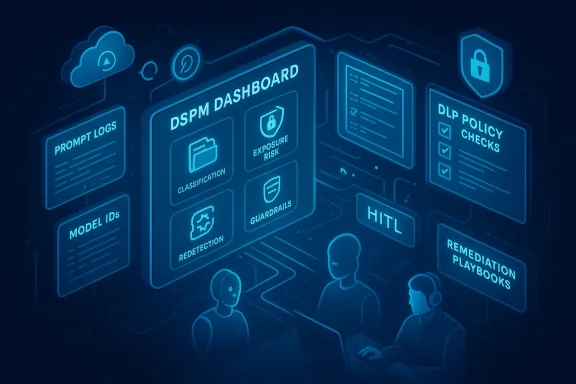
A central prescription in the report is the adoption of Data Security Posture Management (DSPM) to provide continuous, automated discovery and prioritization of data exposure risk. DSPM combines data discovery, classification, exposure analysis, and risk scoring so teams can focus on the highest-impact issues rather than chasing alerts across ten fragmented consoles.Key operational benefits of DSPM:
- Continuous discovery across cloud, SaaS, and on-premises data stores.
- Prioritization of exposures based on business context and access risk.
- Policy-driven remediation workflows that reduce manual toil.
Managing AI-powered productivity securely
The changing incident profile
Generative AI is no longer an exotic niche: the report indicates 32% of data security incidents now involve generative AI tools. Whether incidents arise from employees pasting confidential material into public chatbots, agents that materialize sensitive outputs, or model-driven automation making unauthorized calls to data stores, the risk profile has shifted. Security programs must therefore evolve from a perimeter-and-endpoint centric model to one that monitors how data moves through prompts, inference logs, and agent behaviors.Nearly half (47%) of surveyed organizations have implemented generative AI–specific controls, an increase year-over-year. This reflects a rapid response from security teams working to codify safe AI usage without throttling productivity.
What effective generative AI controls look like
Controls that meaningfully balance productivity and risk fall into four categories:- Preventive controls
- Data loss prevention (DLP) for AI interactions: blocking or redacting sensitive content before it leaves sanctioned environments.
- Access segmentation for model endpoints to limit which services and identities can invoke models with sensitive inputs.
- Detective controls
- Prompt logging and correlation: retaining and indexing prompts and model responses for audit and investigation.
- Anomaly detection on model usage: surfacing unusual volumes or patterns that indicate exfiltration or unauthorized automation.
- Governance controls
- Approved-model registries and whitelisting for agents and APIs.
- Policy-driven UI nudges and in-app guardrails that encourage safe behavior.
- Remediation controls
- Automated policy enforcement workflows that quarantine or revoke access when risky patterns are detected.
- Incident playbooks that explicitly include AI-specific steps (e.g., snapshotting chat sessions, freezing model activity).
Strengthening security with generative AI: the paradox of using AI to secure AI
From threat to tool
The report documents rapid uptake of generative AI within security teams: 82% of organizations plan to embed generative AI into data security operations, up from 64% the previous year. That trend reflects a strategic shift: defenders are applying the same technologies exploited for efficiency to the task of defense.Practical uses include:
- Rapid discovery: AI-assisted scanning and classification to surface sensitive assets that traditional regex or fingerprinting misses.
- Triage and investigation: generative agents that summarize, correlate, and prioritize alerts for human analysts.
- Policy generation and translation: turning high-level compliance requirements into implementable data-protection rules.
- Automation of remediation: agents that propose or apply fixes with human approval.
Risks of AI-assisted security
Embedding generative AI into security introduces its own set of hazards:- Over-reliance: automation can create single points of failure if humans stop validating AI decisions.
- Hallucination: language models may generate plausible but incorrect remediation steps or policy translations.
- Adversarial manipulation: attacker-crafted inputs could bias or poison AI-assisted classifiers or analysts’ recommendations.
- Data leakage: feeding sensitive telemetry into third-party models or improperly provisioned internal models risks exposing the very data being protected.
Operationalizing secure AI at enterprise scale
Architecture and telemetry
A secure, operational AI-data architecture ties model access, data classification, and telemetry into a sturdy loop. Essential elements include:- Centralized policy engine that ties classification tags to enforcement actions (e.g., encryption, redaction, access tokens).
- Fine-grained model access control where identity and intent determine whether a workload may use sensitive data.
- Immutable logging of prompts, responses, and agent actions with tamper-evident storage for audits and investigations.
- Data flow mapping so teams can reason about where sensitive attributes may enter models or agents.
Integrations that matter
The report highlights integration between data governance (DSPM), DLP, cloud-app security, and endpoint controls as essential. Successful deployments intertwine:- DSPM for continuous discovery and prioritization.
- DLP for inline prevention and redaction.
- Cloud access security brokers (CASB) for controlling third-party AI service usage.
- SIEM/SOAR for central incident aggregation and automated response.
Governance, culture, and the human factor
Policies that scale
Policy design must address both sanctioned and unsanctioned AI usage. Effective policy sets include:- Approved model lists and acceptable use definitions.
- Data-handling rules tied to classification labels, specifying what data can be used for training, inference, or prompt enrichment.
- Escalation procedures and retention policies for AI artifacts (prompts, responses, agent traces).
Training and change management
People remain the pivotal risk and the decisive defense. Organizations that succeed with secure AI invest in:- Role-specific training (developers, analysts, knowledge workers) on safe prompt practices and handling AI outputs.
- Clear user experiences that make it easier to do the right thing — for example, templates that remove the need to paste raw sensitive text into a general-purpose chatbot.
- Executive sponsorship and measurable objectives (e.g., percent of sensitive data covered by DSPM, average time to contain AI-related exposure).
What the statistics tell us — and what they don’t
The report’s headline figures — including the rise to 47% of organizations implementing generative AI controls and the growth in DSPM adoption — show that enterprises are moving quickly. But numbers alone mask nuance. Survey responses reflect intent and self-reported adoption; implementation quality varies widely.Key cautionary notes:
- Adoption ≠ maturity. Saying you have a DSPM program or AI controls does not guarantee coverage, quality of classification, or integration into incident response.
- Self-reporting bias: leaders who completed the survey may skew towards organizations already engaged in security transformation.
- Regional and industry variation matter. The same control set that works for a regulated finance firm may under- or over-index for smaller, less-regulated organizations.
Trade-offs and risks: vendor consolidation vs. resilience
A central operational choice the report highlights is consolidation: organizations prefer fewer vendors and broader platforms that centralize discovery, policy, and enforcement. Consolidation reduces integration overhead and improves visibility. However, it introduces trade-offs:Benefits of consolidation:
- Unified visibility and consistent policy enforcement.
- Reduced integration and operational burden.
- Faster ability to trace data flows and enforce controls across cloud, SaaS, and on-premises.
- Vendor lock-in and reduced negotiation leverage.
- Single points of failure if the platform experiences outages or misconfiguration.
- Monoculture risk: an exploited platform component could yield systemic exposure.
Tactical checklist: next 90 days for security leaders
- Map critical data flows that intersect with AI usage and agents. Identify top repositories and services where sensitive data is most likely to appear.
- Deploy or validate DSPM discovery across those high-risk data stores. Prioritize coverage for regulated workloads and high business-impact assets.
- Instrument prompt and model usage logging. Ensure prompts, model identifiers, and response metadata are retained in an auditable store.
- Apply classification-linked DLP policies to AI touchpoints. Start with blocking or redaction for the highest-risk labels.
- Define an approved-model registry and enforce it via API gateways or model access controls.
- Establish HITL gates for automated remediation: set confidence thresholds and require human approval for high-impact actions.
- Run tabletop exercises explicitly modeling AI-induced data incidents and measure MTTR (mean time to respond).
- Train staff on safe prompt practices and create pre-approved prompt templates for common tasks.
- Validate vendor SLAs and data handling practices for any third‑party AI services. Ensure contractual protections and the ability to audit.
- Schedule a red-team engagement that includes AI-specific scenarios (prompt exfiltration, agent misuse).
Long-term governance: metrics that matter
To ensure progress, track measurable outcomes rather than checkbox milestones:- Percentage of sensitive data discovered and classified by DSPM.
- Number and severity of AI-related data incidents (trend over time).
- Mean time to detect and contain AI-related exposures.
- Percent of model invocations that pass DLP policy checks.
- False positive rate for AI-assisted remediation actions.
- Coverage of approved-model registry across development and production environments.
Final analysis: opportunity tempered by discipline
Generative AI promises a dramatic leap in productivity, creativity, and operational efficiency. The 2026 Microsoft Data Security Index frames that promise alongside hard-earned realism: AI introduces new data flows and failure modes that existing, fractured security toolsets struggle to contain. The path forward the report recommends — unify visibility with DSPM, apply deliberate AI-specific controls, and harness generative AI to accelerate security workflows — is strategically sound and operationally feasible.But success requires sustained organizational discipline. Technical investments in DSPM, DLP, and telemetry are necessary but insufficient without governance, human oversight, and adversarial testing. Leaders must avoid two temptations: treating a platform purchase as a completed program, and throwing AI automation at security problems without rigorous validation and human-in-the-loop safeguards.
For organizations that combine unified discovery, policy-driven enforcement, and accountable AI-assisted operations, generative AI can become a force multiplier for security rather than an accelerant for exposure. The critical next step is to translate the report’s priorities into concrete, measurable programs — and to treat AI governance as an ongoing operational capability, not a one-time project.
Conclusion
The Data Security Index makes a pragmatic case: to harness AI safely, organizations must stop tolerating fragmented visibility and ad-hoc controls. They must adopt continuous discovery and DSPM, assert control over how AI systems access and use sensitive data, and deploy generative AI carefully within security operations with human oversight and rigorous testing. Those that do will unlock AI’s productivity gains while materially reducing the risk of data exposure. Those that delay or do the minimum risk transforming generative AI from a competitive advantage into a persistent liability. The choice is operational, measurable, and urgent — and it deserves to be an executive-level priority backed by tactical investment and disciplined governance.
Source: Microsoft New Microsoft Data Security Index report explores secure AI adoption to protect sensitive data | Microsoft Security Blog
