

Advantech WebAccess/SCADA operators need to act now: a coordinated advisory published today documents multiple high‑severity vulnerabilities in WebAccess/SCADA that — when chained or exploited individually — can let an authenticated attacker read or modify remote databases, perform path traversal and file overwrite, upload dangerous file types, and in some cases achieve remote code execution with system‑level impact.
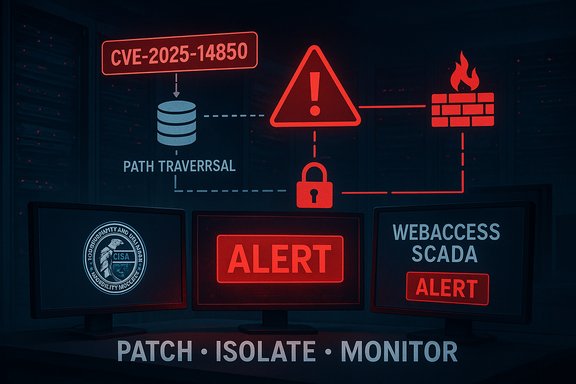
Advantech WebAccess/SCADA is a widely deployed, browser‑based supervisory control and data acquisition (SCADA) and HMI platform used across critical manufacturing, energy, water/wastewater and building automation environments. The product family has a long history of security advisories; CISA and vendor notices dating back several years repeatedly call out path traversal, input‑validation failures, buffer overflows, and other web‑application weaknesses in WebAccess/SCADA. The most recent coordinated notification lists the following CVE identifiers as affecting WebAccess/SCADA: CVE‑2025‑14850, CVE‑2025‑14849, CVE‑2025‑14848, CVE‑2025‑46268, CVE‑2025‑67653, with a vendor‑reported CVSS baseline in the high range (CVSS v3 ≈ 8.8 for several findings). The advisory warns that successful exploitation could allow an authenticated attacker to read or modify a remote database — a finding that materially raises the operational risk for sites where WebAccess stores historian or configuration data.
Advantech publicly publishes product downloads, EoS/EoL notices, and patches on its support portal; operators should verify installed build numbers against vendor notices immediately. Advantech’s support index shows a WebAccess/SCADA V9.x product family with downloads and an EoS notice posted in 2025 for older branches, so administrators must match their specific build to vendor remediation guidance before taking irreversible actions.
If vendor patches are available, apply them promptly after proper testing. If not, apply compensating controls — isolation, access hardening, and enhanced monitoring — while coordinating with vendor support and governmental incident responders as required. The stakes are high: WebAccess/SCADA often sits at the intersection of monitoring, control, and historical recordkeeping, and a successful breach can have operational, safety, and reputational consequences far beyond an ordinary IT server compromise.
Source: CISA Advantech WebAccess/SCADA | CISA
 Background / Overview
Advantech WebAccess/SCADA is a widely deployed, browser‑based supervisory control and data acquisition (SCADA) and HMI platform used across critical manufacturing, energy, water/wastewater and building automation environments. The product family has a long history of security advisories; CISA and vendor notices dating back several years repeatedly call out path traversal, input‑validation failures, buffer overflows, and other web‑application weaknesses in WebAccess/SCADA. The most recent coordinated notification lists the following CVE identifiers as affecting WebAccess/SCADA: CVE‑2025‑14850, CVE‑2025‑14849, CVE‑2025‑14848, CVE‑2025‑46268, CVE‑2025‑67653, with a vendor‑reported CVSS baseline in the high range (CVSS v3 ≈ 8.8 for several findings). The advisory warns that successful exploitation could allow an authenticated attacker to read or modify a remote database — a finding that materially raises the operational risk for sites where WebAccess stores historian or configuration data.Advantech publicly publishes product downloads, EoS/EoL notices, and patches on its support portal; operators should verify installed build numbers against vendor notices immediately. Advantech’s support index shows a WebAccess/SCADA V9.x product family with downloads and an EoS notice posted in 2025 for older branches, so administrators must match their specific build to vendor remediation guidance before taking irreversible actions.
What the advisory actually says (concise summary)
- A cluster of web‑application and file‑handling flaws were reported that include: path traversal, unrestricted upload of dangerous file types, absolute path traversal / file overwrite, and SQL injection that affects WebAccess/SCADA’s database operations.
- The reported impact: authenticated attacker ability to read and modify remote databases; in practical terms this can lead to configuration theft, historian data tampering, credential exposure, and in some deployment models, remote code execution or service compromise.
- Affected product families and version cutoffs are listed in the vendor/agency advisory and require operators to confirm whether their deployed build is in scope. The advisory recommends immediate defensive measures: remove Internet exposure, segment and firewall control networks, and prioritize vendor patches where available.
Technical analysis — what these weaknesses mean in practice
Path traversal and absolute path overwrite
Path traversal (CWE‑22 / CWE‑73) flaws let an attacker submit crafted file/filename parameters such that the server resolves paths outside its intended directory root. In WebAccess/SCADA, such issues can permit reading arbitrary files (configuration files, keys) or writing files into privileged locations if upload or file‑write endpoints accept attacker‑controlled paths.- Consequences:
- Disclosure of credentials, connection strings, and backup files.
- Overwriting of service scripts or configuration files to implant persistent backdoors.
- Tampering with historian files to falsify telemetry evidence or alter alarm archives.
Unrestricted upload of dangerous file types
Upload handlers that fail to validate content type or sanitize filenames allow attackers to store executable artifacts (webshells, scripts) in web‑accessible locations. On systems that host interpreters or that serve content directly to the application runtime, uploaded artifacts can be triggered to obtain remote command execution.- Practical vectors:
- Upload a script (e.g., .aspx/.php/.jsp depending on platform) to a web‑accessible folder and trigger it via HTTP to execute arbitrary operations.
- Combine upload with path traversal to place the file where service daemons load code.
SQL Injection in database routines
SQL injection (CWE‑89) in management or backup handlers — particularly those touching historian or user management databases — can allow attackers to:- Exfiltrate hashed credentials and configuration entries.
- Modify or delete records (historian data, alarm logs).
- Achieve blind injection to escalate privileges or write a persistent payload that later enables code execution.
Chaining attacks — the real danger
Individually these flaws are high risk; chained together they become devastating. A typical chain seen historically is:- Authenticated but low‑privileged user uploads a file due to lax upload filtering.
- Path traversal writes the uploaded artifact into a location read by a scheduled service.
- SQL injection or a separate command‑execution bug escalates to full service compromise.
- Attacker modifies historian data or inserts scheduled tasks to persist across reboots.
Affected versions, patch status, and vendor posture
Advantech maintains versioned releases and support notices for WebAccess/SCADA. Operators should consult the vendor’s support portal and match exact build numbers; Advantech’s support index lists version series (V8.4.x, V9.0.x, V9.1.x) and an EoS notice for older branches that was posted earlier in 2025. Because vendor fixes and advisory text can use product‑family naming that maps to multiple build identifiers, accurate inventory is essential before remediation. Two important operational facts emerge from the vendor and agency material:- Advantech historically has published updates to address WebAccess security issues; past advisories show incremental fixes and recommended upgrade targets (for example, earlier advisories recommended upgrades to 8.4.5, 9.0.1, or newer builds).
- Where vendors declare End‑of‑Support (EoS) or End‑of‑Life (EoL) for older branches, those builds no longer receive security fixes and therefore require migration, replacement, or strict network isolation. Advantech’s support pages list EoS/EoL notices that administrators must consult.
Operational impact on Windows and OT environments
Many WebAccess/SCADA installations run on Windows servers or interact with Windows‑based HMI and historian clients. The operational consequences for Windows environments include:- Elevated attack surface: a compromise of WebAccess can give an attacker a foothold on a Windows host running IIS or other services, potentially enabling lateral movement to engineering workstations or domain resources.
- Credential theft: SQL injection or exposed backups can reveal Windows service credentials or domain admin material cached in project files.
- Evidence tampering: historian modification undermines incident investigation and operational safety.
- Supply‑chain risk: exposed development or maintenance interfaces can be abused to distribute malicious updates or configuration templates into downstream sites.
Detection and immediate containment — a practical playbook
When an advisory like this is published, speed and accuracy matter. Below is a prioritized, practical checklist to reduce exposure immediately:- Inventory (first 60 minutes)
- Identify every WebAccess/SCADA host and record exact build numbers, OS platform, and network location.
- Search for default management ports and service banners (HTTP ports such as 80/443/8080/8443 are commonly used).
- Containment (within hours)
- Block any WebAccess hosts that are reachable from the Internet via firewall rules or remove port forwarding.
- Limit management access to hardened jump hosts and trusted administrative subnets.
- Short‑term mitigations (same day)
- Disable public upload endpoints or tighten server‑side upload filters if configuration allows quick changes.
- Rotate high‑value credentials that may be present in configuration backups or database exports.
- Increase logging on SQL and file‑write operations; forward logs to a secure SIEM or centralized collector for correlation.
- Patch and remediate (48–72 hours)
- Apply vendor‑recommended patches or upgrade to the fixed builds specified by Advantech.
- If no patch is available or product is EoL, isolate the system onto an air‑gapped or strictly firewalled segment and plan migration.
- Hunt and verify (days 1–7)
- Search for indicators of compromise: unexpected scheduled tasks, new webshell artifacts, unusual SQL queries or schema changes, and outbound connections to suspicious IPs.
- Forensic snapshot: capture memory and disk images of suspect hosts before applying irrevocable changes.
- Post‑incident controls
- Conduct a full change review of historian entries and configuration exports; validate integrity with offline backups.
- Rebuild compromised hosts from known good images if any sign of persistence is found.
Risk mitigation: long‑term hardening and detection
Beyond emergency containment, organizations should adopt the following durable controls:- Strong network segmentation: isolate control networks from enterprise networks with strict firewall rules and deny‑by‑default policies.
- Least privilege and credential hygiene: remove embedded or default credentials, enforce role‑based access, and rotate secrets regularly.
- Patching and lifecycle management: maintain an accurate asset inventory, test vendor patches in staging, and plan for EoL migration.
- Application‑level protections: input validation, proper upload handling, and parameterized DB queries to prevent SQLi.
- Monitoring and logging: deploy anomaly detection for ICS telemetry, alerting for unusual historian writes, and correlate with Windows event logs for lateral movement indicators.
- Secure remote access: use MFA, ephemeral VPN access, and jump hosts for administrative tasks; treat VPN endpoints as high‑risk assets and keep them patched.
Strengths and weaknesses of the advisory and vendor messaging
Notable strengths
- The coordinated advisory succinctly flags multiple high‑impact classes of vulnerability and maps functional consequences (read/modify database, path traversal, upload flaws) to operational outcomes — this makes risk prioritization straightforward for defenders.
- CISA’s playbook emphasizes network isolation and defense‑in‑depth, which aligns with established ICS security best practices and is repeatable across organizations of any size.
Potential weaknesses and caveats
- Vendor and public CVE/NVD records can lag the initial advisory: exact CVE→patch mappings are sometimes delayed in public trackers. Operators should not rely solely on NVD for urgent response; instead, prioritize vendor and CISA guidance.
- Some claims in circulated CSAF/third‑party summaries have historically included CVE identifiers or EoL claims that could not be independently verified in vendor portals; administrators must validate EoL/EoS statements directly with Advantech support before planning replacement programs.
- The advisory notes that the database read/modify capability requires authentication; however, authenticated does not mean trusted in OT contexts — attackers commonly obtain low‑privilege credentials via phishing or exposed engineering workstations, so the authentication requirement may be a modest barrier at best. Treat authenticated vulnerabilities as high priority.
Recommended prioritized action checklist (for Windows and OT administrators)
- Immediately identify all WebAccess/SCADA hosts and confirm build numbers. (Inventory)
- If any instance is directly reachable from the Internet, remove that exposure now. (Containment)
- Check Advantech support for vendor‑issued patches or fixed builds and apply them in a controlled manner. If the build is EoL, plan migration or isolating compensating controls. (Remediation)
- Rotate admin and service credentials stored in configuration files or in databases that the product uses. (Credential hygiene)
- Increase logging and hunt for suspicious file writes, new web artifacts, SQL anomalies, and unexpected service restarts. (Detection)
- Plan for a security posture review of the WebAccess deployment model, including whether the system must be internet‑facing at all. (Strategic)
Final assessment and conclusion
This advisory is a serious escalation for operators who run Advantech WebAccess/SCADA. The combination of file‑handling flaws (path traversal, unrestricted uploads) and database weaknesses (SQL injection / database modification) creates practical, high‑impact attack chains that can distort telemetry, expose credentials, and enable persistent access. CISA’s standard advice — minimize Internet exposure, segment networks, use secure remote access, and implement defense‑in‑depth — is appropriate and urgent in this case. Administrators must treat authenticated database‑modification capabilities as more than a theoretical risk: in OT environments where engineering workstations and vendor tools often share credentials and network paths, that “authenticated” qualifier does not materially reduce severity. Operators should inventory, contain, patch, and hunt now — then follow up with long‑term hardening and a verified incident response plan that includes historian integrity verification and controlled rebuilds of any host showing indicators of compromise.If vendor patches are available, apply them promptly after proper testing. If not, apply compensating controls — isolation, access hardening, and enhanced monitoring — while coordinating with vendor support and governmental incident responders as required. The stakes are high: WebAccess/SCADA often sits at the intersection of monitoring, control, and historical recordkeeping, and a successful breach can have operational, safety, and reputational consequences far beyond an ordinary IT server compromise.
Source: CISA Advantech WebAccess/SCADA | CISA
