

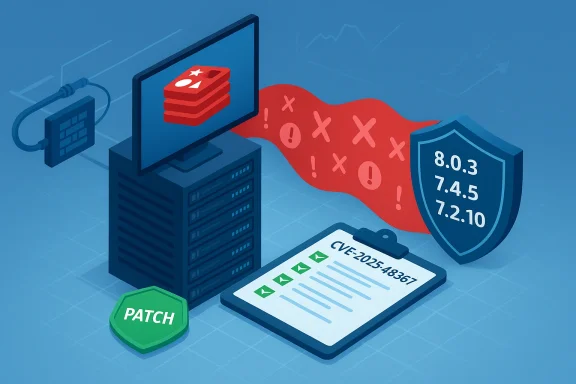
Redis administrators need to act now: a denial-of-service flaw tracked as CVE‑2025‑48367 allows an unauthenticated network connection to trigger repeated connection-level errors that can starve legitimate clients and render Redis instances unavailable until patched or otherwise mitigated. The issue is fixed in Redis 8.0.3, 7.4.5, 7.2.10, and 6.2.19; operators should prioritize verification and patching, or apply compensating controls immediately if updates cannot be performed at once.
Redis is a ubiquitous, in‑memory datastore used as a cache, session store, message broker, and fast key/value engine across modern applications and cloud services. Its low latency and simple TCP protocol make it a natural fit for horizontally scaled systems, microservices and edge caches. That same network‑facing simplicity is precisely why availability defects in Redis are operationally dangerous: many deployments accept connections directly from application tiers or are reachable inside relatively large trust boundaries.
CVE‑2025‑48367 is an availability‑first vulnerability: a defect in how Redis handles problematic connections can be induced by a remote, unauthenticated actor to produce repeated IP/protocol errors, which in turn cause client starvation — legitimate clients cannot make or sustain connections — culminating in a denial of service. The networking nature means the vulnerability is exploitable over the network with low complexity and no user interaction.
While the public advisories do not present a full, line‑by‑line code walkthrough in the vendor advisory text, the fix implemented across Redis release branches indicates the root cause: the server must retry accepting connections properly even when an accepted connection immediately reports an error. The upstream patch family applies analogous logic to several branches, which strongly suggests the fix ensures the listening socket and accept loop remain healthy even when individual accepted sockets fail immediately.
The fix is simple in concept — correct the accept/error handling and ensure the accept loop remains resilient — but the operational consequences of unpatched instances are real and already well understood by operators: cache failures propagate quickly.
Do not await proof‑of‑concept exploits to appear in the wild before acting. Because the vulnerability requires no authentication and directly impacts availability, proactive patching and network hardening will save time and reduce the risk of service outages that cascade through your application stack.
Source: MSRC Security Update Guide - Microsoft Security Response Center
 Background / Overview
Redis is a ubiquitous, in‑memory datastore used as a cache, session store, message broker, and fast key/value engine across modern applications and cloud services. Its low latency and simple TCP protocol make it a natural fit for horizontally scaled systems, microservices and edge caches. That same network‑facing simplicity is precisely why availability defects in Redis are operationally dangerous: many deployments accept connections directly from application tiers or are reachable inside relatively large trust boundaries.CVE‑2025‑48367 is an availability‑first vulnerability: a defect in how Redis handles problematic connections can be induced by a remote, unauthenticated actor to produce repeated IP/protocol errors, which in turn cause client starvation — legitimate clients cannot make or sustain connections — culminating in a denial of service. The networking nature means the vulnerability is exploitable over the network with low complexity and no user interaction.
What the vulnerability actually is
High-level summary
- The defect stems from incorrect handling of connection errors at the point a Redis instance accepts new client sockets.
- An attacker can make unauthenticated connection attempts that provoke repeated IP‑level/protocol errors.
- Those repeated errors lead to a state where Redis cannot accept or service legitimate client connections — described in operator terms as client starvation.
- The practical outcome is a denial of service (DoS): either sustained while the attack continues or persistent if the process or runtime state does not recover automatically.
Why this matters technically
The vulnerability is an example of uncontrolled resource or control‑path failure: when an accepted connection reports an error the daemon fails to recover in a way that preserves the accept loop and normal connection handling. Rather than logging the error and continuing, the implementation can enter a state where connection accepts fail repeatedly or are starved by the error handling path, preventing servicing of new clients.While the public advisories do not present a full, line‑by‑line code walkthrough in the vendor advisory text, the fix implemented across Redis release branches indicates the root cause: the server must retry accepting connections properly even when an accepted connection immediately reports an error. The upstream patch family applies analogous logic to several branches, which strongly suggests the fix ensures the listening socket and accept loop remain healthy even when individual accepted sockets fail immediately.
Affected versions and severity
- Affected releases: All Redis versions prior to 8.0.3, 7.4.5, 7.2.10, and 6.2.19.
- Fixed in: Redis 8.0.3, 7.4.5, 7.2.10, 6.2.19.
- Impact: Availability — High.
- Typical CVSS characterization: Network attack vector, low complexity, no privileges required, no confidentiality/integrity impact, high availability impact.
Real-world risk and operational impact
Redis is often in the critical path for web applications, API rate limiting, session management and background job processing. A DoS of Redis can therefore lead to:- Application timeouts, request failures, and increased load on origin databases (because caches no longer serve traffic).
- Cascading outages where multiple services depend on the same Redis tier; failure of the cache can cause application pools to exhaust resources.
- Business impact: user-facing downtime, failed transactions, or degraded performance of essential services.
- For clustered or replicated topologies, repeated failures can complicate failover, cause split‑brain conditions, or increase recovery time if the control plane depends on the same Redis layer.
Exploitability and attacker model
- Attacker capability: Remote network access to the Redis TCP port (default 6379) or any fronting interface that forwards to Redis.
- Privileges required: None (unauthenticated).
- Complexity: Low — the attack requires sending connection attempts or malformed connection interactions that provoke the flawed error path.
- Exploitability in the wild: At disclosure there were no high‑confidence public exploit chains showing privilege escalation or data theft; the dominant, high‑confidence effect is availability loss. Nevertheless, the low bar for causing DoS makes opportunistic scanning and automated DoS probes likely if instances are reachable.
Detection and hunting guidance
Detecting attempts to exploit this vulnerability or identifying vulnerable, impacted systems requires both inventory and runtime telemetry.Inventory checks (first priority)
- Identify Redis instances and record versions. Use package manager queries, container images tags, or run the
redis-server --versionequivalent to confirm versions. - Confirm whether the instance is reachable from untrusted networks (public Internet, shared networks, or broadly accessible subnets).
Runtime signals and troubleshooting metrics
Monitor for these operational symptoms which may indicate exploitation or attempted exploitation:- Sudden spikes in the number of failed connection attempts, socket errors, or repeated connection accept failures on hosts running Redis.
- Elevated connection backlog, listening socket saturation (many pending SYNs), or sustained high counts of ephemeral sockets in TIME_WAIT.
- Redis process restarts, crashes, or repeated loss of accepted client connections coincident with unusual inbound connection patterns.
- Application errors showing Redis connection timeouts or heavy cache miss rates at the same time as network anomalies.
- Review Redis logs and systemd journals for repeated accept errors or socket-related messages.
- Use
ss -sornetstat -anto inspect socket states and counts. - Instrument application‑side error rates (increased latency or connection errors to Redis).
- Correlate source IPs and connection patterns to decide whether traffic is malicious or misconfiguration.
Immediate mitigations and workarounds
If you cannot patch immediately, mitigate exposure with these compensating controls while scheduling upgrades:- Network‑level controls
- Block or restrict access to Redis ports at the perimeter: ensure only known application subnets and trusted hosts can reach Redis.
- If Redis must be accessible across networks, put it behind a trusted proxy with rate limiting and connection throttling capability.
- Bind and authentication
- Ensure Redis is not bound to 0.0.0.0 unless explicitly required; bind to localhost or internal interfaces.
- Enforce robust ACLs and require authentication (the Redis ACL model and requirepass reduce misuse risk, though this CVE does not require auth to trigger the initial condition).
- Connection rate limiting and filtering
- Use host firewall rules (iptables/nftables) or cloud security groups to rate‑limit incoming connection attempts and drop obvious abusive patterns.
- Container & orchestration controls
- For containerized deployments, restrict external network access via Kubernetes NetworkPolicies and ensure Services/LoadBalancers are scoped.
- Managed services
- If you run Redis as a managed service (ElastiCache, Memorystore, Azure Cache, etc.), verify the provider’s advisory and apply any recommended actions. Many managed providers will apply vendor fixes on their schedule; confirm patch status with the vendor and consider moving affected workloads to patched clusters.
Patching and upgrade guidance
Prioritize patching by exposure and criticality. Recommended steps:- Inventory and prioritize
- List all Redis instances, their versions, whether they are clustered or standalone, and their exposure (public vs internal).
- Test the upgrade
- Apply the vendor‑recommended upgrade in a staging environment or to a small cohort first. Watch for functional regressions and client compatibility.
- Rolling upgrade strategy
- For singletons: schedule a maintenance window and restart with the patched binary.
- For Sentinel or clustered setups: follow Redis cluster upgrade procedures to avoid data loss. Patch nodes in a rolling fashion, ensuring replication/sync completes before taking nodes offline.
- Verify
- Confirm the process is running the patched version and that normal client connections are restored.
- Re‑run acceptance tests and monitor for error regressions.
- Post‑patch monitoring
- Monitor connection counts, latency, and logs for at least several hours after the rollout.
- If you use distribution packages (apt, yum/dnf), check your vendor security advisory and the package version they provide; some vendors may have backported fixes into earlier package versions.
- If you use container images, upgrade to the vendor/publisher image that includes the fix (or rebuild from patched source).
- If you deployed Redis via Helm/Bitnami charts or other orchestration tooling, follow chart upgrade paths (helm upgrade or your orchestration’s recommended approach).
Cloud, managed services and third‑party considerations
- Managed Redis services may patch the infrastructure automatically or provide vendor guidance. Contact your managed service provider or check their security bulletins to confirm whether your instance has been patched.
- For Redis within cloud provider marketplace images or managed database offerings, follow provider‑specific guidance and verify whether a restart is required.
- Third‑party Redis distributions (e.g., vendor forks or Redis Enterprise variants) may have separate advisories. Confirm fixed versions with your vendor.
Hardening recommendations to reduce future risk
Beyond fixing CVE‑2025‑48367, take these steps to reduce the blast radius of future availability defects:- Network segmentation: place Redis behind internal-only networks and restrict who can reach it by default.
- Authentication and authorisation: enable Redis ACLs; remove default open configurations and use strong credentials and least privilege for service accounts.
- Transport protections: enable TLS where supported to avoid malicious network injection between clients and Redis.
- Connection handling: use client libraries and connection pools that implement backoff and retry logic rather than hammering the server when connections fail.
- Observability: instrument Redis metrics and exporter telemetry; alert on connection errors, accepted connection rates, and sudden surges of ephemeral sockets.
- Capacity planning and kernel tuning: tune backlog and file descriptor limits, and ensure system-level limits (SOMAXCONN, ulimit) are compatible with expected peaks to avoid treating legitimate load as an error path.
- Automated recovery: ensure automated service supervision and graceful failover are configured so that an instance can recover or be replaced with minimal manual effort.
- Regular patching cadence: incorporate vendor security advisories into release pipelines and test upgrades regularly.
Practical checklist for administrators (actionable)
- Verify: Check Redis versions across inventory and mark unpatched instances as high priority.
- Isolate: Restrict network access to Redis instances immediately where possible.
- Patch: Schedule and apply upgrades to 8.0.3, 7.4.5, 7.2.10, or 6.2.19 as appropriate for your version family.
- Test: Validate application connectivity and Redis behavior in staging before broad rollout.
- Monitor: After patching, monitor for connection errors, restarts, and latency spikes.
- Communicate: Inform downstream application teams about maintenance windows and expected behavior changes.
Caveats and what remains uncertain
- Public advisories focus on availability effects and the fix descriptions indicate accept/retry handling changes. The advisories do not publish a step‑by‑step exploit PoC or show exact internal function call traces, which is a common vendor practice to avoid helping attackers weaponize the issue.
- There is no authoritative public evidence tying this CVE to data confidentiality breaches or code execution. The high‑confidence outcome is DoS. Operators should nonetheless treat any evidence of active probing as urgent because availability attacks are disruptive and straightforward.
- Some downstream packages may have backported fixes to different version numbers; confirm with your distribution or vendor rather than assuming a single package name maps directly to upstream version numbers.
Why immediate action matters
This vulnerability combines three dangerous factors: network exposure, no required privileges, and the potential to render a service widely used for caching and critical fast‑path operations unavailable. Even if an environment has strong authentication elsewhere, many Redis deployments are reachable by service networks and automation agents; an unauthenticated vector that causes client starvation can therefore be trivially weaponized in poorly segmented setups.The fix is simple in concept — correct the accept/error handling and ensure the accept loop remains resilient — but the operational consequences of unpatched instances are real and already well understood by operators: cache failures propagate quickly.
Conclusion
CVE‑2025‑48367 is an availability vulnerability that should be treated as urgent for any Redis deployment that is reachable from untrusted networks or that supports many client connections. The safe, practical route is straightforward: inventory your Redis fleet; prioritize public and high‑availability instances; apply the patches (8.0.3, 7.4.5, 7.2.10, 6.2.19) in a staged manner; and use compensating controls (network restrictions, rate limiting, ACLs) where immediate patching is not possible.Do not await proof‑of‑concept exploits to appear in the wild before acting. Because the vulnerability requires no authentication and directly impacts availability, proactive patching and network hardening will save time and reduce the risk of service outages that cascade through your application stack.
Source: MSRC Security Update Guide - Microsoft Security Response Center
