

The U.S. Department of Commerce has quietly withdrawn a proposed rule that would have barred the import of Chinese-made drones — including market leader DJI — a last-minute reprieve that arrives amid high-level diplomatic thawing between Washington and Beijing ahead of a planned Trump–Xi summit in April, even as the Federal Communications Commission’s existing restrictions on approvals for new foreign-made drone hardware remain firmly in place.
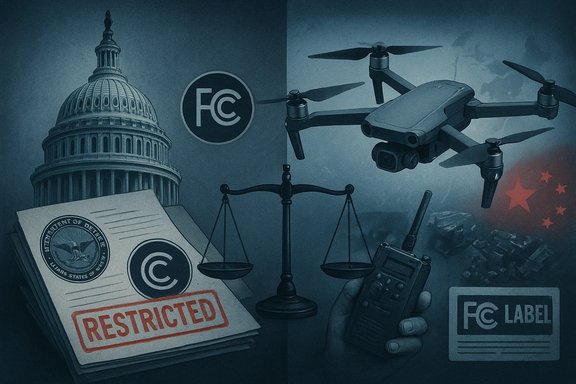
The policy debate over Chinese-made drones has three parallel tracks: trade and import controls under the Department of Commerce, communications and equipment authorization under the Federal Communications Commission (FCC), and national-security designations and legal challenges tied to the Department of Defense (DoD) and Congress. Each track uses different legal tools and carries different consequences for manufacturers, buyers, public-safety operators, and the supply chain that supports drone maintenance and repair.
For months, the Commerce Department had been preparing a rule aimed at restricting imports on national-security grounds. That plan — submitted for White House review in the autumn — has now been retracted, a move officials say is tied to diplomatic considerations amid re-engagement between the two presidents. At the same time, the FCC put many foreign-made drones and key components on a “Covered List” that prevents those products from receiving equipment authorizations required to operate legal radio transmitters in the U.S. That FCC list and process are separate from Commerce import rules; it means a company could theoretically still import devices that meet customs rules, but without FCC authorization new models that contain regulated communications gear cannot be sold or legally marketed. The FCC’s approach has already been applied broadly and remains a principal regulatory barrier to fresh drone imports and certifications. Meanwhile, the DoD’s designation of DJI as a “Chinese military company” under a statutory program has survived litigation in federal court, a ruling that rejected many of the DoD’s allegations but ultimately left the designation intact. That judicial outcome has layered additional reputational and procurement constraints onto the company, affecting eligibility for U.S. government contracts and raising political pressure in Congress.
From a strategic and operational perspective, the story is not simply about one company's fortunes; it is about a regulatory architecture in which legal timing, spectrum control, procurement rules, and geopolitical diplomacy interact. That architecture can produce policy whiplash: sudden pauses, continuing bans, and an uneven landscape for buyers and integrators. Operators and public agencies should treat the Commerce move as a temporary easing, not a return to predictable market conditions — and they should plan accordingly for a future in which access to certain foreign platforms becomes increasingly conditional, contested, and politicized. Community discussion about the broader policy implications — from export controls to supply-chain resilience — has been active in technical forums and trade groups, underlining that this debate is as much about strategic industrial policy as it is about immediate device security.
Source: Tom's Hardware US Department of Commerce lifts planned crackdown on Chinese drones, including DJI — company gets reprieve ahead of Xi-Trump meeting in April, but the FCC ban still stands
 Background
The policy debate over Chinese-made drones has three parallel tracks: trade and import controls under the Department of Commerce, communications and equipment authorization under the Federal Communications Commission (FCC), and national-security designations and legal challenges tied to the Department of Defense (DoD) and Congress. Each track uses different legal tools and carries different consequences for manufacturers, buyers, public-safety operators, and the supply chain that supports drone maintenance and repair.For months, the Commerce Department had been preparing a rule aimed at restricting imports on national-security grounds. That plan — submitted for White House review in the autumn — has now been retracted, a move officials say is tied to diplomatic considerations amid re-engagement between the two presidents. At the same time, the FCC put many foreign-made drones and key components on a “Covered List” that prevents those products from receiving equipment authorizations required to operate legal radio transmitters in the U.S. That FCC list and process are separate from Commerce import rules; it means a company could theoretically still import devices that meet customs rules, but without FCC authorization new models that contain regulated communications gear cannot be sold or legally marketed. The FCC’s approach has already been applied broadly and remains a principal regulatory barrier to fresh drone imports and certifications. Meanwhile, the DoD’s designation of DJI as a “Chinese military company” under a statutory program has survived litigation in federal court, a ruling that rejected many of the DoD’s allegations but ultimately left the designation intact. That judicial outcome has layered additional reputational and procurement constraints onto the company, affecting eligibility for U.S. government contracts and raising political pressure in Congress.
What the Commerce Department did — and why it matters
The withdrawn import restriction: scope and rationale
The Commerce Department had drafted a rule targeting information and communications technology contained in some foreign-made drones, with the aim of preventing devices that could be exploited for surveillance or data exfiltration from entering U.S. markets and networks. That proposal was formally submitted for White House review in October, then pulled back in early January as officials reassessed the enforcement posture against the backdrop of renewed diplomatic engagement with China. The public rationale provided by officials emphasizes the short-term strategic value of reducing bilateral friction ahead of scheduled leader-level meetings. This withdrawal does not amount to a policy reversal so much as a pause: regulatory proposals can be resubmitted in revised form, and the Commerce Department still retains authorities (and technical teams) that can be reactivated if national-security analysts identify an urgent risk. The episode does, however, remove an immediate administrative lever that would have directly stopped shipments at the U.S. border.Short-term impact: what the Commerce move changes, and what it doesn’t
- It removes the imminent risk of a sweeping import ban coming directly from Commerce regulation.
- It does not restore any FCC approvals or reverse the FCC’s Covered List constraints.
- It does not affect DoD designations, court opinions, or congressional mandates already enacted into law.
FCC action: why the equipment-authorization ban still bites
The mechanics of FCC control
The FCC regulates radio-frequency emissions and issues equipment authorizations for devices that include transmitters. In late 2025 the Commission placed many foreign-made drones and critical components on a Covered List and adopted rules to prevent new equipment authorizations for devices containing those components. In practice, that means manufacturers cannot get FCC sign-off for new models or components that depend on covered supply chains — a practical bar to selling the latest foreign-made drones in the U.S. market. The FCC also signaled the authority to make certain bans retrospective in narrowly defined cases, intensifying uncertainty about whether authorized devices might later lose certification.Why FCC rules are functionally decisive
Even with Commerce’s import proposal retracted, FCC approvals remain the gating mechanism for mainstream retail and enterprise drone sales. Without equipment authorization:- New domestic or foreign models that include radios cannot be legally marketed in the U.S.
- Retail chains and OEMs cannot rely on U.S.-based repair channels that require FCC‑certified radio parts.
- Public-safety and enterprise buyers face procurement risk: a model they approve today might not have replacement components certified tomorrow.
Legal fights and the DoD designation: the court outcome and its implications
What the court decided
DJI sued to overturn the DoD’s decision listing it as a “Chinese military company” under Section 1260H of the FY2021 National Defense Authorization Act. A federal judge in the District of Columbia ultimately rejected the plaintiffs’ claims for summary judgment and sided with the DoD on the legal sufficiency of its designation, while explicitly rejecting — or at least not relying upon — many of the DoD’s factual allegations about direct control by the Chinese Communist Party. The ruling affirmed that the DoD’s determination met statutory standards, even if the court found the government’s reasoning incomplete on several points.Practical consequences beyond the courtroom
A DoD designation, even where the court examines and narrows the government’s claims, carries consequences that extend well beyond litigation:- Contracting exclusion: many federal procurement programs either bar or heavily restrict purchases from listed entities.
- Political pressure: the designation deepens congressional appetite for broader measures, including statutory bans or restrictions tied to appropriations and federal grants.
- Commercial effects: U.S. partners, integrators, and resellers reassess exposure and may shift to alternative vendors to avoid legal or reputational risk.
Congress, the NDAA trigger and the “automatic” risk
Section 1709 and the deadline construct
The FY2025 National Defense Authorization Act included a provision (Section 1709) that required an “appropriate national security agency” to conduct a security evaluation of certain foreign-made drone manufacturers within a statutory period — effectively creating a deadline. If no agency completes the evaluation in time, the law provides for automatic consequences: the affected companies can be added to the FCC’s Covered List, with regulatory and commercial consequences that follow. That timing mechanism created a high-stakes, “do‑or‑else” window in which bureaucratic inaction could itself trigger market exclusion rather than a substantive finding of insecurity. Coverage of the NDAA process and the potential December trigger last year highlighted how legislative timing, not only adjudicated risk, can determine market access.The bureaucratic trap and why it matters
Critics — including DJI and trade-reliant industry groups — argued that the NDAA language created a procedural trap: Congress mandated a review but did not assign a specific executing agency, leaving multiple agencies able to defer responsibility. If no agency stepped forward by the deadline, the result would be an automatic listing regardless of any underlying evidence. That design has been described in industry reporting as a policy that risks “punishing by default,” creating outcomes driven by calendar rather than technical assessment. The upshot: even when Commerce steps back from a proposed rule, statutory deadlines in the NDAA and the FCC’s independent authority still create a regulatory bottleneck shaped more by lawmaking mechanics than by technical risk assessments.What this means for users, businesses, and public-safety organizations
The immediate practical picture
- Existing devices: current, already-authorized drones remain legal to use; owners will not suddenly lose the ability to fly equipment that has been previously certified or sold in the U.S. The FCC and regulatory agencies have been careful to say that current models are not immediately deactivated by these moves.
- New purchases: new models that lack FCC equipment authorization will be effectively blocked from mainstream U.S. retail channels unless they qualify for an explicit exemption or are domestically sourced with non‑covered components.
- Support and repairs: the looming or actual inclusion of parts on the FCC Covered List will constrict the availability of replacement radios, modules, and certified components — a slow-moving service problem that can strand hardware as parts dry up.
Supply-chain and lifecycle risks
- Parts scarcity will raise total cost of ownership as third-party parts become more expensive or impossible to certify for U.S. operation.
- Firmware updates and security patches — normally pushed by the manufacturer — may become delayed, creating operational and safety hazards for operators who rely on vendor-supplied updates.
- Secondary markets and grey imports will expand to fill demand, but those channels erode warranties and increase provenance risk for commercial and government users.
For public-safety agencies and enterprise fleets
Municipalities, first responders, and infrastructure operators that standardized around DJI products face procurement and lifecycle stress. Their choices are now constrained by:- Procurement rules that limit purchases from designated entities.
- Operational requirements that demand predictable vendor support and parts availability.
- Long lead times to certify and deploy alternative platforms that meet technical and regulatory specifications.
Strategic analysis — strengths, risks, and geopolitical implications
Strengths of the U.S. regulatory posture
- Multi‑agency controls create overlapping checks: customs, equipment authorization, and procurement rules together impose high barriers for technology threats.
- The FCC’s authority over spectrum is a durable regulatory lever that aligns with the technical reality: RF-transmitting devices are governed by communications rules, so limiting certifications is effective.
- Judicial review and internal agency processes provide legal safeguards and transparency when agencies act.
Risks and unintended consequences
- Overbroad or hasty restrictions can harm U.S. industry and public-safety procurement by removing widely used commercial platforms without ready domestic substitutes.
- A bureaucracy-driven “automatic” ban (function of legislative timing) risks excluding firms without a considered security assessment, undermining due process and potentially provoking trade retaliation.
- Supply-chain disruptions may drive buyers toward grey markets or non‑certified imports, worsening the very security concerns regulators seek to fix.
What to watch next — dates, agencies, and practical signals
- April (presidential diplomacy): the high-level Trump–Xi interactions scheduled for April — including reciprocal visits announced by both administrations — are a diplomatic backdrop that could shape near-term regulatory choices and bilateral trade discussions. Public statements tied to those meetings may influence whether administrative enforcement intensifies or moderates.
- Agency assignments: whether any specific national-security agency formally accepts responsibility to conduct the NDAA-mandated review will determine whether the automatic-listing mechanism is triggered. Watch statements from DoD, DHS, ODNI, and FCC docket filings for movement.
- FCC rulemaking and exemptions: the Commission continues to refine exemptions and the scope of the Covered List; changes to component rules or carve-outs for certain suppliers would materially alter market access.
- Court and legislative action: additional litigation or congressional hearings could recalibrate the legal guardrails; any statutory fixes (clarifying agency duties in Section 1709) would materially reduce the risk of an “automatic” listing.
Practical advice for drone operators, integrators and IT managers
- Inventory and document: catalog existing drone models, firmware versions, component part numbers, and FCC authorization records. This creates a clear baseline for compliance and future procurement decisions.
- Stock critical spares: where possible and legal, secure an adequate supply of certified replacement parts and spare radios for mission-critical fleets.
- Plan procurement transitions: evaluate alternative suppliers and test interoperability now — process takes months, and late switching risks operational gaps.
- Legal review for public agencies: coordinate procurement lawyers and cyber teams to assess whether ongoing contracts are exposed to designation risk and to design contingency procurement frameworks.
- Monitor agency dockets: sign up for FCC, DoD, and Commerce public-docket notices; regulatory changes often appear in rulemaking filings before public announcements.
Conclusion
The Commerce Department’s decision to withdraw a proposed import ban gave DJI and other Chinese drone makers a short-term reprieve — and it temporarily reduced the likelihood of immediate customs-level seizures — but it is not a systemic fix. The FCC’s equipment-authorization rules continue to function as the primary barrier to new foreign-made drone hardware entering the U.S. market, and congressional deadlines, DoD designations, and court outcomes have already re-shaped the field.From a strategic and operational perspective, the story is not simply about one company's fortunes; it is about a regulatory architecture in which legal timing, spectrum control, procurement rules, and geopolitical diplomacy interact. That architecture can produce policy whiplash: sudden pauses, continuing bans, and an uneven landscape for buyers and integrators. Operators and public agencies should treat the Commerce move as a temporary easing, not a return to predictable market conditions — and they should plan accordingly for a future in which access to certain foreign platforms becomes increasingly conditional, contested, and politicized. Community discussion about the broader policy implications — from export controls to supply-chain resilience — has been active in technical forums and trade groups, underlining that this debate is as much about strategic industrial policy as it is about immediate device security.
Source: Tom's Hardware US Department of Commerce lifts planned crackdown on Chinese drones, including DJI — company gets reprieve ahead of Xi-Trump meeting in April, but the FCC ban still stands
