

Even as winter tightens its grip and electricity prices stay elevated, a quiet revolution in electric-vehicle technology is moving from pilots to pilot‑ready products — one that could let your EV function as an emergency generator, a household battery, and even a money‑making grid asset. Vehicle‑to‑Grid (V2G) and bidirectional charging are no longer lab curiosities: recent large pilots in Gothenburg and an emerging generation of V2G‑ready chargers show that many EV owners could use their cars to keep the lights on and shave energy bills, provided the right equipment, agreements and software are in place.
Vehicle‑to‑Grid (V2G) — sometimes called Vehicle‑to‑Home (V2H) or Vehicle‑to‑Building (V2B) depending on the use case — is the capability to move energy both ways between an electric vehicle’s battery and the electrical system it’s connected to. Instead of only charging from the grid, a bidirectional system allows a car to discharge energy back to a home during an outage, supply ancillary services to the grid, or sell stored energy at peak prices.
In recent high‑profile pilots and industry announcements, automakers, utilities and charger manufacturers have pooled resources to test both the technical and commercial aspects of V2G. One of Europe’s largest coordinated pilots is based in Gothenburg, Sweden: manufacturers, the national grid operator, local distribution companies and university researchers are testing fleets of V2G‑capable vehicles, new chargers, and software that orchestrates when and how cars move energy. Manufacturer commitments — including bi‑directional capable models like the Polestar 3 — and the arrival of chargers explicitly marketed as V2G‑ready show the ecosystem is shifting from experimental to operational.
A few realistic calculations:
(Important caution: exact backup durations must be calculated for the specific EV model, the household’s real consumption profile, and the chosen V2H configuration.
Key considerations:
That said, some widely‑circulated claims deserve caution. Headlines that promise universal “two‑day” backup, or specific uplifts like “40% annual energy bill savings” for the average household, are illustrative but conditional: they depend on battery size, load management, tariff structures, export rules and how conservatively a user manages battery use. Similarly, survey numbers about consumer awareness can vary by region and sample methodology; any striking statistic should be read alongside the original survey design.
For homeowners considering V2G this winter: the tech is mature enough to pilot in real homes. Start small, insist on certified hardware and trained installers, and model economics for your tariff and usage profile rather than relying on marketing shortcuts. For utilities and policymakers, V2G is an important flexibility tool; enabling it safely and equitably will require clear rules, standardised hardware requirements and fair market access so distributed batteries can support both household resilience and the broader energy transition.
This winter, an EV can indeed become a home’s ally — but getting the most from that promise requires realistic expectations, the right kit, and careful attention to standards, safety and economics.
Source: Luxurious Magazine Winter Warmth And Savings: The EV Technology You Didn’t Know You Needed
 Background / Overview
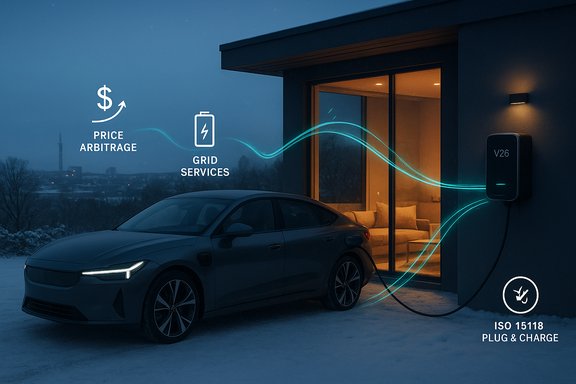
Vehicle‑to‑Grid (V2G) — sometimes called Vehicle‑to‑Home (V2H) or Vehicle‑to‑Building (V2B) depending on the use case — is the capability to move energy both ways between an electric vehicle’s battery and the electrical system it’s connected to. Instead of only charging from the grid, a bidirectional system allows a car to discharge energy back to a home during an outage, supply ancillary services to the grid, or sell stored energy at peak prices.In recent high‑profile pilots and industry announcements, automakers, utilities and charger manufacturers have pooled resources to test both the technical and commercial aspects of V2G. One of Europe’s largest coordinated pilots is based in Gothenburg, Sweden: manufacturers, the national grid operator, local distribution companies and university researchers are testing fleets of V2G‑capable vehicles, new chargers, and software that orchestrates when and how cars move energy. Manufacturer commitments — including bi‑directional capable models like the Polestar 3 — and the arrival of chargers explicitly marketed as V2G‑ready show the ecosystem is shifting from experimental to operational.
Why V2G matters this winter
- Backup power in outages. A fully charged large EV battery can support household essential loads for many hours or even days (depending on battery size and how many loads are curtailed), providing a resilience layer when winter storms or grid disturbances hit.
- Energy bill reduction. Smart charge/discharge routines and price arbitrage (charging when prices are low, discharging when high) can reduce household electricity spending; in theory, optimized home charging plus V2G participation can produce meaningful savings.
- Grid services and revenue. Aggregated fleets can supply frequency‑response, reserve and balancing services to grid operators. When aggregated as a Virtual Power Plant (VPP), distributed EV batteries become a flexible market resource.
- Higher renewable usage. V2G can soak up excess solar and wind output and release it later, smoothing renewable intermittency and reducing curtailment.
How the Gothenburg pilot shows the way
The Gothenburg V2G pilot brings together carmakers, local and national grid operators, charger manufacturers and university researchers to test large‑scale V2G scenarios. Key features of the project model:- Fleet of V2G‑enabled cars committed to the pilot (Polestar 3 is a lead example).
- Use of V2G‑ready wallboxes and chargers tailored for bidirectional power flow.
- Integration with distribution and transmission operators to trial grid services and emergency backup use cases.
- Academic partners running user behaviour, optimisation and battery impacts research.
Technical primer: what V2G actually needs
Charging hardware and standards
- Bidirectional inverter/charger: To send AC power from a DC car battery back to a home or grid, power must be inverted and controlled. That capability can be in the vehicle, the charger, or a combination of both.
- Compatible communications protocol: Secure, standardised communication (e.g., the ISO 15118 family) lets the vehicle and charger negotiate charging rates, authentication (Plug & Charge), and, crucially, V2G discharging actions.
- Physical interface: Historically, CHAdeMO supported early V2G trials. Today, CCS (Combined Charging System) vendors and ISO 15118‑compatible flows are the primary path for mainstream bidirectional charging, but implementation differences still exist across regions and products.
- Site hardware: For home V2H, installations often require an automatic transfer switch or dedicated panel configuration to safely isolate the home from the grid when discharging, plus an approved meter for billing if energy is sold back to the grid.
Software and orchestration
- Local energy management: Apps and controllers decide whether the car should charge, hold, or discharge to meet household needs and economic targets.
- Aggregator/VPP platforms: These pool many vehicles to meet grid operator requirements for speed, predictability and reliability when providing services.
- Market interfaces: Participation in frequency and reserve markets requires prequalification, telemetry and proven performance to get paid.
Battery health and degradation
A common concern is whether frequent V2G cycles will harm long EV battery life. Early research and pilot results suggest that with careful dispatch strategies (e.g., limiting depth‑of‑discharge, avoiding unnecessary cycling and optimising SoC windows), the incremental degradation can be managed and may be acceptable versus the value delivered. The jury is still out for long‑term fleet‑level economics because degradation depends on chemistry, thermal systems, and real usage patterns.Practical numbers: how long can an EV power a home?
Estimating backup duration requires two numbers: the vehicle battery capacity (kWh) and the household consumption (kWh/day). Typical modern EV battery sizes range widely — from around 40 kWh for smaller models up to 110 kWh or more in high‑end SUVs. Household consumption also varies: a compact apartment might use 10–15 kWh/day, a typical suburban household 20–35 kWh/day, and energy‑hungry houses (electric heating, EV charging, large HVAC) can exceed 50 kWh/day.A few realistic calculations:
- A 60 kWh car battery used conservatively (only 80% usable to protect battery life => 48 kWh usable) powering a 24 kWh/day household could supply about 48 / 24 ≈ 2 days if non‑essential loads (heating, EV charging) are curtailed and only critical systems run.
- A 100 kWh battery (usable ~80 kWh) for the same 24 kWh/day home could, in principle, sustain full household loads for ~3.3 days — again depending heavily on how much power appliances draw and how much of the battery’s capacity is made available.
(Important caution: exact backup durations must be calculated for the specific EV model, the household’s real consumption profile, and the chosen V2H configuration.
Money matters: how much can V2G reduce your bills?
The idea is simple: charge when power is cheap, discharge to cover home demand or sell into high prices. Savings derive from:- Time‑of‑Use (ToU) arbitrage — buy low, sell high.
- Reduced peak consumption charges where those exist.
- Participation revenues from grid services (frequency response, reserves).
Key considerations:
- If your market has large price spreads between off‑peak and peak, then daily arbitrage can produce meaningful savings — sometimes double‑digit percentage reductions versus naïve charging.
- Adding revenue from aggregated grid services can improve economics, but service markets require reliability and prequalification; aggregators typically take a share of revenue.
- Local taxes, meter rules and billing mechanisms (e.g., whether your home meter can separately measure exported energy) materially affect net returns.
The hardware you’ll need (practical checklist)
- A V2G‑capable vehicle (OEM support for bidirectional charging is required).
- A V2G‑ready charger/wallbox capable of bidirectional energy flow or an inverter that enables V2H operation.
- A certified installation that separates home and grid circuits appropriately for safe islanding during outages.
- Software: either the OEM’s energy app, an aggregator platform for grid services, or a home energy management system to automate schedules and protect battery health.
- Metering & approvals: depending on where you live, exporting energy may require a MID‑certified meter, an export agreement with your retailer, or grid connection approval.
Risks, limits and unresolved issues
Safety and regulatory integration
- Grid safety requires robust anti‑islanding and automatic transfer mechanisms. Homes must be isolated from the grid while discharging to avoid back‑feeding lines during an outage.
- Export and revenue models depend on local regulation: not every market permits small distributed assets to join grid‑services markets, and billing mechanisms for exported kWh vary.
Interoperability and standards
- The V2G ecosystem is fragmented: CHAdeMO enabled early trials, ISO 15118 (and its successors) defines modern plug‑and‑charge and communications, while hardware and software implementations still vary in the field.
- Without consistent standards across vehicles, chargers and aggregators, large‑scale roll‑out will be slower and more costly.
Cybersecurity and privacy
- Bidirectional chargers and VPP platforms exchange sensitive control and billing data. Secure authentication, certificate management and robust over‑the‑air update practices are non‑negotiable.
- Implementers must guard the chain from vehicle to cloud to aggregator to grid operator. Weaknesses at any link create safety and financial risks.
Battery degradation and warranty issues
- OEMs and researchers are increasingly modelling battery effects; many OEMs are offering V2G in ways that mitigate undue cycling (for example, limiting depth‑of‑discharge when used for grid services).
- Consumers should check vehicle warranty terms regarding frequent discharge. Battery degradation costs must be included when calculating the economics of V2G participation.
How to prepare if you’re an EV owner
- Check whether your vehicle supports bidirectional charging or if the manufacturer plans an update.
- If V2G is a priority, choose chargers labelled V2G‑ready and confirm installer experience with bidirectional systems.
- Talk to your electricity supplier about export rules, ToU tariffs and whether you can participate in aggregator schemes.
- Start with conservative settings: limit depth‑of‑discharge and prioritise emergency backup before revenue maximisation.
- Factor battery wear into the economics. If an aggregator pays for cycles or the OEM covers certain degradation impacts, that materially improves returns.
Strengths and notable benefits
- Resilience: By enabling home backup, V2G bolsters household resilience during winter storms and outages.
- Flexibility: Aggregated EV fleets acting as VPPs are one of the most scalable, distributed storage assets available today.
- Lower infrastructure costs: By using existing batteries on wheels, grid operators can defer or avoid expensive network upgrades in some circumstances.
- Decarbonisation: V2G supports higher penetration of wind and solar by time‑shifting renewable energy.
What to watch next (policy, products, and pilots)
- Regulatory frameworks that clarify how small distributed assets can participate in balancing markets and how exported energy is metered and compensated.
- Wider OEM adoption of ISO 15118‑20 or equivalent communications and certificate management frameworks for secure plug‑and‑charge + V2G functionality.
- Aggregator business models that share revenues with owners fairly and transparently while preserving battery life.
- Charger vendors shipping certified, field‑tested V2G hardware for home and commercial deployments.
- Long‑term battery degradation studies published by impartial research partners tracking fleet performance after thousands of V2G cycles.
Final assessment: practical, promising, but conditional
Vehicle‑to‑Grid and Vehicle‑to‑Home are no longer theoretical. Well‑organised pilots and a new generation of V2G‑ready chargers have proven technical feasibility and practical use cases — from winter backup to grid services. The model works when equipment, software and market rules align.That said, some widely‑circulated claims deserve caution. Headlines that promise universal “two‑day” backup, or specific uplifts like “40% annual energy bill savings” for the average household, are illustrative but conditional: they depend on battery size, load management, tariff structures, export rules and how conservatively a user manages battery use. Similarly, survey numbers about consumer awareness can vary by region and sample methodology; any striking statistic should be read alongside the original survey design.
For homeowners considering V2G this winter: the tech is mature enough to pilot in real homes. Start small, insist on certified hardware and trained installers, and model economics for your tariff and usage profile rather than relying on marketing shortcuts. For utilities and policymakers, V2G is an important flexibility tool; enabling it safely and equitably will require clear rules, standardised hardware requirements and fair market access so distributed batteries can support both household resilience and the broader energy transition.
This winter, an EV can indeed become a home’s ally — but getting the most from that promise requires realistic expectations, the right kit, and careful attention to standards, safety and economics.
Source: Luxurious Magazine Winter Warmth And Savings: The EV Technology You Didn’t Know You Needed