

Virgin Media customers across the UK were again left scrambling for connectivity after a fresh outage knocked Wi‑Fi and TV services offline in several areas, underscoring ongoing reliability questions for one of Britain’s largest broadband providers.
The most recent disruption was first reported in the late evening, with users logging problems on popular outage‑tracking platforms and social media. Early reports suggested thousands of affected customers, with a visible spike in problem reports overnight; the peak number of reports varied between platforms and times, and official details from the company were limited at first. This incident follows a larger, well‑publicised outage earlier in the year that affected tens of thousands of customers for several hours and drew national media attention.
Virgin Media — now operating as part of the combined Virgin Media O2 group following the 2021 merger — provides broadband, TV and phone services to millions of UK households and businesses, and intermittent large‑scale outages have outsized impacts on remote work, streaming, online learning and small business operations. While absolute uptime figures for consumer broadband providers are never perfect, repeat incidents invite scrutiny about causes, operator communications and remediation processes.
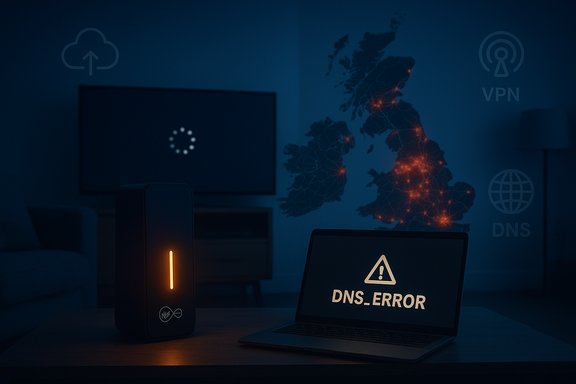
Evidence from prior incidents indicates that at least some recent large outages were consistent with routing and DNS issues: users reported partial workarounds by changing DNS or using VPNs, and several cloud‑hosted service integrations (e.g., certain productivity suites) were intermittently affected. That pattern is generally more indicative of routing/configuration problems than of simple physical cable damage.
However, network modernisation is a complex programme: it involves maintaining legacy systems while transitioning customers, upgrading core routing and DNS infrastructure, and expanding peering and transit relationships. That complexity can increase the short‑term surface area for faults, especially during configuration changes and large‑scale software releases.
Outages of varying scale have occurred multiple times across many providers in recent years — sometimes caused by third‑party cloud vendors or shared transit issues — but repeated or large outages are an invitation for regulators and customers to demand better transparency and faster recovery guarantees.
For now, customers facing interruptions should follow practical mitigation steps, document their experience for compensation, and expect providers to offer clearer explanations and meaningful remediation if outages become frequent or prolonged.
Source: NationalWorld Virgin Media suffers outage leaving thousands without WiFi
 Background
The most recent disruption was first reported in the late evening, with users logging problems on popular outage‑tracking platforms and social media. Early reports suggested thousands of affected customers, with a visible spike in problem reports overnight; the peak number of reports varied between platforms and times, and official details from the company were limited at first. This incident follows a larger, well‑publicised outage earlier in the year that affected tens of thousands of customers for several hours and drew national media attention.Virgin Media — now operating as part of the combined Virgin Media O2 group following the 2021 merger — provides broadband, TV and phone services to millions of UK households and businesses, and intermittent large‑scale outages have outsized impacts on remote work, streaming, online learning and small business operations. While absolute uptime figures for consumer broadband providers are never perfect, repeat incidents invite scrutiny about causes, operator communications and remediation processes.
What happened this time
- The outage began in the evening, with customers reporting dropped broadband, unavailable TV streams and unresponsive hubs.
- Reports on public outage‑tracking sites spiked during the early hours, then fell, while some areas continued to see intermittent problems into the following day.
- Customers described receiving automated communications indicating the provider was aware of the problem and working towards a fix, and at least one customer‑facing timeframe for repairs was provided that extended into the following afternoon.
- Where the incident was large enough to be measured (earlier outages this year reached multiple thousands of reports), many users experienced simply ‘no connection’ and could not reach online services, while others saw partial degradations — e.g., DNS resolution failures, app log‑ins failing, or services hosted in specific cloud platforms being unreachable.
Timeline and shape of the outage
Initial reports and escalation
The first wave of user complaints typically appears on social media and outage dashboards within minutes of the failure. Because these services aggregate voluntary reports, the numerical spike gives a quick but imperfect sense of scale: multiple hundreds or thousands of reports generally mean a regional or national problem, whereas local incidents usually stay in the tens.Company acknowledgement and progress updates
Operators usually publish short statements to affected customers and post updates to service status pages. In large incidents the language is initially limited — “we’re aware of intermittent issues” — while network teams triage. Customers often see intermittent service restoration as routing tables propagate or as engineers apply configuration changes and bring affected systems back into service.Full restoration and post‑mortem
In most recent incidents, providers have confirmed that services were restored after several hours, apologised to impacted customers, and noted that engineers continued to monitor the network. Formal post‑incident reports or technical root‑cause statements are less common for consumer outages unless the disruption is prolonged or leads to regulatory inquires.Technical analysis — likely causes and what the clues point to
Large broadband outages tend to fall into a few broad categories; understanding these helps explain why users see the symptoms they do.1. Routing and peering problems (software configuration)
When routing or peering between major networks goes wrong — due to a configuration error, an update that doesn’t roll out cleanly, or flapping BGP announcements — large numbers of users can lose access to wide swathes of the internet. The tell‑tale hardware‑independent clues include:- Some services working (local LAN access) while external sites do not;
- Workarounds like using a VPN or switching DNS providers allowing partial access;
- Outage maps showing geographically dispersed but linked complaints.
2. DNS resolution failures
Damage to or misconfiguration of DNS (Domain Name System) infrastructure produces symptoms where you appear connected (pings to numeric IPs may succeed) but domain names don’t resolve. Users often find that switching to a public DNS (for example, Google Public DNS or other third‑party resolvers) provides a temporary workaround. DNS problems can stem from faulty configurations, DDoS protection actions, or issues with upstream DNS providers.3. Physical damage to local infrastructure
A more prosaic but still common cause is physical damage — for example, a vehicle striking a street cabinet, cable cuts by construction, or local chamber fires. These events usually produce concentrated local outages: whole streets or towns without service while the wider network remains fine. Where cables feed multiple neighborhoods, the scale can look much larger.4. Software/automation/human error during upgrades
Modern networks rely heavily on automation for configuration changes and scaling. An automation bug — or a human error that writes bad configuration into provisioning systems — can propagate rapidly across a network and take large parts of the service offline until the change is rolled back.5. Third‑party cloud or CDN failures
When critical services (login systems, management consoles, app backends) live on third‑party cloud providers or Content Delivery Networks (CDNs), outages at those vendors can be seen as the operator being “down.” In those cases, the broadband link might be fine but the apps that customers use to authenticate, pay bills, or stream video are unavailable.Evidence from prior incidents indicates that at least some recent large outages were consistent with routing and DNS issues: users reported partial workarounds by changing DNS or using VPNs, and several cloud‑hosted service integrations (e.g., certain productivity suites) were intermittently affected. That pattern is generally more indicative of routing/configuration problems than of simple physical cable damage.
Impact on customers and business continuity
The immediate consequences of large broadband outages are practical and measurable:- Remote workers lose access to video conferencing, VPNs and cloud tools — often in the middle of the working day — increasing business disruption and potential revenue loss.
- Households reliant on the internet for entertainment or education are blocked from streaming and online learning platforms.
- Small businesses that depend on cloud point‑of‑sale, card terminals or online booking are left unable to trade or process transactions.
- Healthcare, emergency and community services that depend on digital communications can be affected in localised cases.
How the provider responded (communications and remedial action)
Operators typically follow an incident playbook that combines technical remediation and customer communications:- Rapid acknowledgement on social channels and automated emails to affected users.
- Status page updates and targeted fix‑time estimates where possible.
- Deployment of network engineers to apply configuration changes or replace/repair hardware.
- Monitoring of user reports until DownDetector and internal telemetry show normal traffic levels again.
Historical context — is this a trend?
Virgin Media and the combined Virgin Media O2 business have undertaken large multi‑year network modernisation and fibre rollouts to move customers from older cable technology to fibre‑based infrastructure. These long‑term upgrades are intended to deliver higher speeds and more resilient services.However, network modernisation is a complex programme: it involves maintaining legacy systems while transitioning customers, upgrading core routing and DNS infrastructure, and expanding peering and transit relationships. That complexity can increase the short‑term surface area for faults, especially during configuration changes and large‑scale software releases.
Outages of varying scale have occurred multiple times across many providers in recent years — sometimes caused by third‑party cloud vendors or shared transit issues — but repeated or large outages are an invitation for regulators and customers to demand better transparency and faster recovery guarantees.
Compensation, rights and what customers should expect
Most UK broadband providers operate an automatic compensation scheme for total loss of service that is not fixed within a set number of working days after the fault is reported. Key practical points for customers:- Compensation typically only applies after you report the fault to your provider and the problem remains unresolved for the provider’s stated qualifying period (commonly calculated as two full working days).
- The compensation is usually applied automatically as an account credit once the fault is closed, but customers should keep records — screenshots of service‑checker pages, timestamps, and any communications — in case manual follow‑up is needed.
- Not all service degradations qualify; brief or partial outages often fall below compensation thresholds.
- For business customers or critical services, separate service level agreements (SLAs) may apply, and those agreements should be reviewed for credits or contractual remedies.
Practical troubleshooting and mitigation (what customers can do when an outage hits)
While customers cannot fix operator‑side failures, several practical actions can reduce pain during and after an outage:- Restart your hub and boosters
- Unplug the primary hub, wait 30 seconds, and power it back on. This can clear localised faults.
- Check the provider service status page and outage maps
- These pages and third‑party trackers will often show whether the issue is regional or widespread.
- Try alternative DNS servers
- Temporarily configure devices or your router to use a public DNS (e.g., 8.8.8.8, 1.1.1.1) to see if name resolution is the problem.
- Use a mobile hotspot or tethering
- If you have a mobile data allowance, tether your laptop to the mobile network to keep working.
- Try a VPN
- A VPN can sometimes route around regional routing issues; it’s not a universal fix but it can restore access to remote work resources in some routing incidents.
- Document the outage
- Take screenshots of error messages, outage maps and any communications from your provider. Record times and durations for compensation claims.
- Report the fault formally
- Use official channels (service checker or telephone) so the outage is logged on your account; this is commonly required to trigger automatic compensation.
- Check your devices
- If only a single device is affected, verify Wi‑Fi settings, proxies and local DNS caches. Flush local DNS caches if needed.
Broader implications — regulation, competition and resilience
Repeated high‑profile outages highlight several structural issues for the telecoms sector:- Resilience of centralised systems: Heavy reliance on centralised DNS, single peering points, or third‑party cloud services creates single points of failure. Diversification and multi‑cloud/peering strategies reduce risk but add cost.
- Transparency and post‑incident reporting: Regulators and customers increasingly expect timely, transparent post‑mortems describing root causes and corrective actions. Greater transparency builds trust and helps the industry learn.
- Competition and churn: Frequent outages are a driver for customer churn and may strengthen the position of rival ISPs and emerging alternatives such as fixed wireless and satellite broadband.
- Regulatory scrutiny: National regulators may push for tougher obligations on outage reporting, compensation and service continuity, particularly where broadband is essential for home working, education and emergency access.
Strengths in how providers handle outages — and the risks that remain
Notable strengths
- Rapid detection: Modern monitoring and telemetry allow providers to detect large incidents within minutes and prioritise fixes.
- Communication channels: Social media and status pages allow fast customer updates and operational transparency.
- Automatic compensation frameworks: When applied correctly, these reduce the burden on individual customers to chase refunds.
Persistent risks
- Incomplete explanations: Customers and businesses are often left with high‑level apologies but few technical details, which fuels frustration and distrust.
- Cascade failures: The interconnected nature of routing, DNS, CDNs and cloud services means a single misconfiguration can cascade into widespread outages.
- Uneven remediation: Large networks can be restored for most customers quickly, while small pockets remain offline for much longer, complicating satisfaction and compensation.
What operators need to improve
- Publish clearer, technical post‑incident reports for major outages, including root cause, corrective steps and safeguards against recurrence.
- Make service status pages more reliable and granular (showing impact per postcode/area and per service type).
- Increase diversity in peering and DNS architecture to avoid single‑point failures and provide clear fallback strategies.
- Tighten change management and automation safeguards to reduce the risk of human or automation errors propagating widely.
Conclusion
Large broadband outages are more than a nuisance; they disrupt work, education and commerce and test the resilience of national digital infrastructure. The latest Virgin Media disruption reinforces the need for improved transparency, better technical safeguards around routing and DNS, and more dependable customer communications. Providers must balance the complexity of modernising networks with the imperative to keep customers online — and regulators, businesses and consumers will all be watching for meaningful steps to reduce the risk and impact of the next incident.For now, customers facing interruptions should follow practical mitigation steps, document their experience for compensation, and expect providers to offer clearer explanations and meaningful remediation if outages become frequent or prolonged.
Source: NationalWorld Virgin Media suffers outage leaving thousands without WiFi
