

Google-owned Mandiant has sounded a clear alarm: financially motivated extortion groups, including those associated with the ShinyHunters brand, are running coordinated vishing campaigns that pair real-time voice social engineering with highly convincing credential‑harvesting pages to compromise SSO‑protected SaaS accounts, enroll attacker‑controlled MFA devices, and steal sensitive cloud data for extortion.
Mandiant’s threat intelligence describes a wave of attacks observed in early to mid‑January 2026 in which threat clusters tracked as UNC6661, UNC6671, and UNC6240 (the latter commonly linked to the ShinyHunters extortion activity) used coordinated voice calls and fake login flows to steal single sign‑on (SSO) credentials and multi‑factor authentication (MFA) responses, then register their own devices t access to victim SaaS tenants.
These intrusions are not exploiting code weaknesses in SSO products; instead they attack the identity lifecycle and human trust around helpdesk and MFA processes. Attackers have reportedly used the stolen access to exfiltrate content from cloud mailboxes, SharePoint/OneDrive, and other SaaS stores, and to carry out follow‑on phishing and extortion, including harassment directed at victim personnel.
Mandiant’s analysis—corroborated by other security vendors and media reporting—also notes ths the extortion phase included harassment of employees, highlighting an escalation from purely financial demands to reputational and psychological pressure. However, the exul intrusions and the total volume of exfiltrated data remain partially undisclosed; public reporting describes “an increase” and lists sample high‑profile victims, but precise campaign scale is still being enumerated by vendors and affected organizations. Treat specific prevalence numbers as evolving until vendor telemetry and law enforcement disclosures provide definitive tallies.
However, there are realistic limits and open risks:
That said, some public claims about campaign size and attribution remain fluid; where numbers or origin stories are not backed by vendor telemetry or law enforcement confirmation, treat them cautiously and prioritize observable TTPs and mitigation actions. This is a moment to convert strategic guidance into operational controls: strengthen helpdesk verifications, invest in phishing‑resistant authentication, and tune detection to the specific choreography of voice + web attacks.
The security community has the playbook to blunt this class of attack; the challenge now is organizational execution at scale. Start with the identity hygiene items you can fix this week—log retention, conditional access tweaks, and helpdesk process changes—and build a roadmap to replace relay‑vulnerable MFA with cryptographic, phishing‑resistant options. The sooner those controls are in place, the less effective this wave of vishing and extortion will be.
Source: itsecuritynews.info Google Owned Mandiant Finds Vishing Attacks Against SaaS Platforms - IT Security News
 Overview
Mandiant’s threat intelligence describes a wave of attacks observed in early to mid‑January 2026 in which threat clusters tracked as UNC6661, UNC6671, and UNC6240 (the latter commonly linked to the ShinyHunters extortion activity) used coordinated voice calls and fake login flows to steal single sign‑on (SSO) credentials and multi‑factor authentication (MFA) responses, then register their own devices t access to victim SaaS tenants. These intrusions are not exploiting code weaknesses in SSO products; instead they attack the identity lifecycle and human trust around helpdesk and MFA processes. Attackers have reportedly used the stolen access to exfiltrate content from cloud mailboxes, SharePoint/OneDrive, and other SaaS stores, and to carry out follow‑on phishing and extortion, including harassment directed at victim personnel.
Background: why this matters now
The shift in criminal tradecraft described by Mandiant is notable for three converging reasons:- The widespread adoption of SSO and cloud SaaS platforms concentrates sensitive business data behind a smaller set of identity gates.
- Attackers have improved real‑time phishing toolkits that can mimic complex SSO flows and dynamically render MFA prompts in sync with the attacker’s login attempts.
- Social engineering via telephone (vishing) reintroduces a human element that, when combined with a live, tailored web session and convincing caller pretext, dramatically raises success rates against non‑phishing‑resistant MFA.
Technical breakdown: the attack chain, step by step
Mandiant and corroborating analysts describe a repeatable choreography. Understanding it helps defenders write precise detections and mitigations.- Reconnaissance and targeting
- Attackers profile target organizations, gather public contacts, internal support numbers, and identify identity provider (IdP) flows in use. Where available, leaked or reused credentials accelerate targeting.
- Telephony social engineering (vishing)
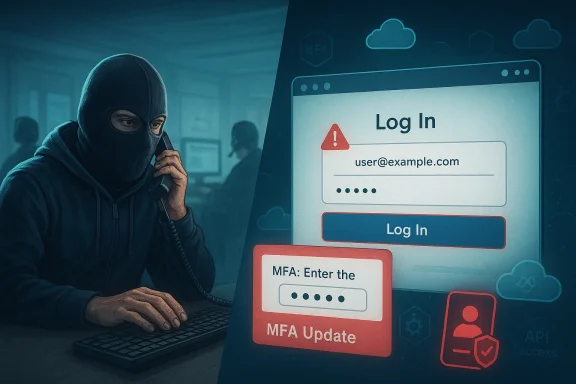
- A caller, often spoofing an internal number or a known vendor, convinces an employee to perform an “MFA update,” visit a provided URL, or scan a QR code. The voice pretext is scripted and practiced to reduce suspicion.
- Live credential and MFA harvesting
- Victims are directed to company‑branded fake login portals that are synchronized to the attacker’s backend. When a victim enters credentials, the attacker uses them to attempt a real login at the IdP, causing the legitimate service to issue an MFA challenge. The phishing kit mirrors that exact challenge to the victim and instructs them how to respond (approve push, enter TOTP code, etc.). This real‑time relay is the critical enabler.
- Device registration and session persistence
- After the attacker authenticates, they often enroll their own device for MFA or register persistent application tokens, creating access points that survive password resets or basic remediation. This device‑enrollment step is a common post‑compromise pivot used to preserve long‑term access.
- SaaS access, data theft, and extortion
- With SSO control they extract emails, documents, internal chats, and application data; in some cases attackers use compromised accounts to send follow‑on phishing or to delete evidence. Exfiltrated material is weaponized into extortion letters and harassment campaigns.
Which groups are being tracked and what that implies
Mandiant is tracking related activity across multiple clusters—UNC6661, UNC6671, and UNC6240—to reflect observable variations in infrastructure, victimology, and extortion follow‑through; this suggests either multiple independent crews converging on the same successful tradecraft or a single flexible operation using compartmentalized infrastructure.- UNC6661: Observed impersonating IT staff in mid‑January 2026 and directing victims to credential harvesting links; registrations pointed to specific registrars and hosting patterns.
- UNC6671: Similar vishing‑driven SSO compromise techniques but with differences in infrastructure (different registrars and extortion messaging). In some observed incidents this cluster used PowerShell to extract data from OneDrive/SharePoint.
- UNC6240 (ShinyHunters): The extortion‑branded activity historically associated with large data dumps and ransom demands; Mandiant sees overlap and reuse of methods between this cluster and the UNC66xx clusters.
Why these attacks are succeeding: human, technical, and tooling factors
Several factors combine to make this tradecraft effective:- Real‑time toolkit sophistication: Modern phishing kits now replicate full SSO flows (not just passwords) and can dynamically render MFA‑style screens that look and behave like genuine prompts.
- Caller legitimacy and psychology: A believable phone call lowers suspicion. When someone who sounds like IT walks you through a login, many people follow instructions—especially if it’s framed as urgent device security maintenance.
- Weak MFA vectors: Push notifications, SMS, and TOTP codes remain vulnerable to real‑time relay and social engineering. These factors are less resistant to phishing than cryptographic, origin‑bound methods such as FIDO2/WebAuthn or hardware security keys.
- Disposable infrastructure: Attackers consistently use ephemeral domains, bulletproof VPS providers, and payment‑friendly services to make takedown and tracking difficult.
Verified examples, reported impacts and scale
Multiple industry outlets and incident responders have linked ongoing January 2026 activity to high‑value SaaS compromises. Reported victim sectors include cryptocurrency firms, tech, biotech, and professional servicesften host valuable IP or financial information in cloud storage and are therefore especially attractive for extortion. Reported techniques include the enrollment of attacker devices, use of stolen credentials to send further phishing, and use of PowerShell to pull SharePoint/OneDrive content.Mandiant’s analysis—corroborated by other security vendors and media reporting—also notes ths the extortion phase included harassment of employees, highlighting an escalation from purely financial demands to reputational and psychological pressure. However, the exul intrusions and the total volume of exfiltrated data remain partially undisclosed; public reporting describes “an increase” and lists sample high‑profile victims, but precise campaign scale is still being enumerated by vendors and affected organizations. Treat specific prevalence numbers as evolving until vendor telemetry and law enforcement disclosures provide definitive tallies.
Detection and hunting: what SOCs should prioritize
Mandiant’s practical guidance and independent analyst playbooks converge on a common set of detections and hunts that SOCs and IR teams should implement immediately:- Monitor for anomalous device enrollments and new MFA device registrations in identity provider logs; flag enrollments made shortly after a successful SSO authentication.
- Alert on same‑second credential replays: if credentials submitted by a user are used to login from another network origin within seconds, treat it as high‑risk behavior.
- Correlate telephone helpdesk reports with authentication events: include call timestamps in incident triage and compare to login/MFA approval times.
- Hunt for rapiant creation and unusual enterprise application tokens, which may indicate token‑based persistence or exfiltration via API.
- Look for web session choreography: repeated hits to identical fake login flows across employees, or near‑simultaneous login attempts targeted at the same IdP endpoints.
Mitigations: technical and operational controls that reduce risk
Stopping these attacks requires layered changes to authentication posture, network controls, helpdesk proior. Key priorities:- Move to phishing‑resistant MFA
- FIDO2/WebAuthn hardware keys and platform passkeys provide cryptographic, origin‑bound authentication that cannot be trivially relayed via phishing kits. Mandiant and identity providers consistently recommend s as the most reliable defense.
- Harden identity and access policies
- Enforce conditional access that restricts high‑risk logins by location, device attestation, and network zone. Deny logins from known anonymizing services and disposable IP ranges. Use tenant access allowlists where possible.
- Lock down helpdesk flows
- Mandate independent call‑back procedures for password resets or MFA changes. Avoid public posting of internal support numbers, and require verification tokens or case IDs that can be validated out‑of‑band. Train helpdesk to treat any unsolicited request to approve an MFA push as suspicious.
- Reduce attack surface
- Disable legacy protocols and flows that bypass conditional access (e.g., basic auth, ROPC) and enforce least‑privilege for OAuth and enterprise application grants. Monitor and restrict app consent flows.
- Improve telemetry and detection
- Centralize IdP, SSO, and application logging; forward logs to SIEM and retain them sufficiently long for retrospective investigations. Create Sigma/KQL rules to detect rapid credential relay and device enrollments.
- Simulate and rehearse vishing scenarios
- Update phishing exercises to include voice‑guided scenarios and train employees to refuse MFA approvals that they did not initiate. Document and exercise incident response actions specific to voice +es.
Business and legal implications
The exfiltration of internal communications, customer data, or intellectual property transforms these incidents into regulatory and contractual crises. Organizations may face notification requirements under privacy laws, breach reporting duties under sectoral regulations, and contractual liabilities if third‑party data is exposed. Extortion demands and harassment further complicate disclosures and remediation timelines. Business continuity teams should treat identity compromises as material incidents and coordinate legal, communications, and incident response workstreams early.Critical analysis: strengths and gaps in current reporting and defenses
Mandiant’s public reporting is operationally valuable: it converts high‑level warnings into actionable TTPs and prioritized detection playbooks that SOCs can implement quickly. The use of multiple cious and aids defenders in correlating telemetry without overreaching attribution. These technical, practical recommendations—especially the push toward FIDO2—are the right direction.However, there are realistic limits and open risks:
- Telemetry gaps: Many organizations lack the IdP and management telemetry needens of device registration or OAuth abuse. Without those logs, these attacks can dwell undetected.
- Overreliance on indicators: Atomic IOCs (domains, IPs, file hashes) age qul infrastructure. Behavioral detection and tightening identity controls matter more than static lists.
- Moving large enterprises to FIDO2 or passkeys is nontrivial—supply, onboarding, legacy system compatibility, and user experience challenges slow adoption. Until broad adoption occurs, many organizations will remain exposed.
- Extortion escalation: The documented harassment and targeted extortion increases t incidents and raises the bar on what “successful remediation” entails; locking down credentials is necessary but not always sufficient to stop reputational damage or coercion.
Practical checklist for Windows and enterprise IT teams (prioritized)
- Immediate (hours)
- Block suspicious domains and IPs seen in phishing campaigns; force MFA re‑auth and revoke suspicious sessions/tokens for any impacted accounts.
- Isolate and preserve logs and artifacts: Entra/Azure AD/Okta sign‑in logs, OAuth grants, device registration events, and any inbound/outbound mail logs.
- Short term (days)
- Enforce conditional access tightening: require device attestation, block anonymous proxies for authentication, and restrict high‑risk app consents.
- Train helpdesk on call‑back verification and start internal comms warning employees about vishing.
- Medium term (weeks–months)
- Roll out phishing‑resistant MFA (FIDO2/passkeys) for highstrators; plan broader adoption enterprise‑wide.
- Implement detection rules to flag same‑second credential relays and new device enrollments following logins.
- Long term (quarterly+)
- Reassess third‑party helpdesk and vendor telephony trust models; require explicit attestations and per‑device allowlists for administrative remote‑management features.
- Mature incident playbooks to include identity compromise scenarios and coordinate legal/regulatory readiness.
Final assessment and cautionary notes
The Mandiant findings are a timely reminder that identity is the new perimeter. These vishing campaigns represent an evolutionary step in extortion tradecraft: inexpensive to operate at scale, reliant on social engineering rather than zero‑day exploits, and able to extract high‑value cloud content rapidly. Defenders must treat identity controls—particularly device registration and MFA mechanisms—as high‑priority security projects.That said, some public claims about campaign size and attribution remain fluid; where numbers or origin stories are not backed by vendor telemetry or law enforcement confirmation, treat them cautiously and prioritize observable TTPs and mitigation actions. This is a moment to convert strategic guidance into operational controls: strengthen helpdesk verifications, invest in phishing‑resistant authentication, and tune detection to the specific choreography of voice + web attacks.
The security community has the playbook to blunt this class of attack; the challenge now is organizational execution at scale. Start with the identity hygiene items you can fix this week—log retention, conditional access tweaks, and helpdesk process changes—and build a roadmap to replace relay‑vulnerable MFA with cryptographic, phishing‑resistant options. The sooner those controls are in place, the less effective this wave of vishing and extortion will be.
Source: itsecuritynews.info Google Owned Mandiant Finds Vishing Attacks Against SaaS Platforms - IT Security News
