

Vitess operators and cloud teams must treat their backups like a live attack surface: a recently disclosed vulnerability shows that anyone with read/write access to backup storage can weaponize manifest metadata to execute arbitrary commands during restore and gain unauthorized access to production environments. (nvd.nist.gov)
Vitess is a widely used database clustering system that enables horizontal scaling of MySQL for large-scale services. Its backup and restore machinery stores metadata about each backup in a
The issue was assigned CVE-2026-27965 and is tracked in the NVD. A coordinated patch was merged into Vitess and shipped in the security-focused releases v22.0.4 and v23.0.3; operators are strongly advised to upgrade. (nvd.nist.gov)
Caveat: there are no widely reported public exploits tied to this CVE at the time of writing, and no public proof-of-concept walkthroughs have been verified by authoritative incident responders. Operators should nonetheless treat the risk as real because the exploitation vector requires no user interaction beyond writing to backup storage and has a direct privileged execution path during restore. Treat lack of public exploit reports as a lagging indicator, not assurance of safety. (nvd.nist.gov)
However, several residual risks remain and must be managed:
Vitess’ CVE-2026-27965 is a sharp reminder that metadata can be an attack vector when systems conflate what is stored with what is trusted to run. The community response and rapid patches are a strong mitigation step, but operators must now treat backup artifacts and their storage as first-class security concerns. Upgrade promptly, lock down backup storage, and harden restore workflows — because in distributed infrastructure, the path from object storage to production execution is shorter than many teams expect. (github.com)
Source: MSRC Security Update Guide - Microsoft Security Response Center
 Background / Overview
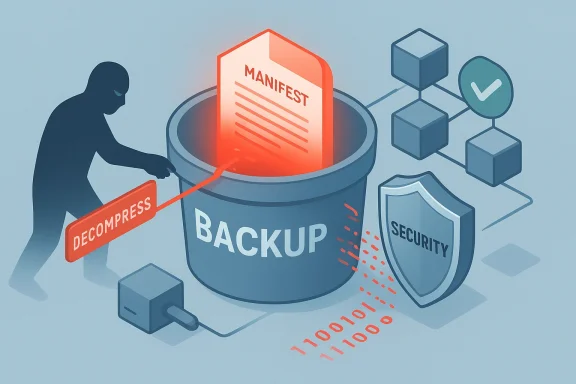
Vitess is a widely used database clustering system that enables horizontal scaling of MySQL for large-scale services. Its backup and restore machinery stores metadata about each backup in a MANIFEST file that, until this fix, could include an external decompressor command used during restore. That behavior created a dangerous trust boundary: the backup storage location (for example, an S3 bucket) became a point where a user with write privileges could inject a command that would later be executed in the context of the Vitess process performing the restore.The issue was assigned CVE-2026-27965 and is tracked in the NVD. A coordinated patch was merged into Vitess and shipped in the security-focused releases v22.0.4 and v23.0.3; operators are strongly advised to upgrade. (nvd.nist.gov)
What went wrong: the technical root cause
How Vitess used backup MANIFEST metadata
Vitess supports both built-in compression engines and external compressor/decompressor commands for backups. When an external compressor is used, Vitess historically saved the decompressor command in the backupMANIFEST so that future restores could automatically pick the right decompression pipeline without operator input. During restore, if the running process did not have a configured --external-decompressor flag, Vitess would fall back to the decompressor stored in the MANIFEST. This implicit trust of manifest content is the root of the problem.How an attacker can weaponize the manifest
An attacker who has write access to the backup storage can modify theMANIFEST to include a malicious decompressor command. When a restore runs and uses that manifest-provided command, the Vitess process launches the external command and streams input/output to it. Because that child process runs with the privileges of the Vitess service, a crafted command can run arbitrary OS commands, escalate privileges within the environment, place web shells, exfiltrate secrets, or otherwise expand access in the production deployment. This is effectively an OS command injection triggered by a manipulated manifest. (nvd.nist.gov)Why this is worse than a typical backup tamper
Backups are designed to be recoverable snapshots of systems — but they are rarely treated as executable artifacts. The difference here is that the metadata included execution instructions and that the restore path invoked those instructions automatically. That converts what many teams consider a storage-only asset into an execution channel. Because restores are often performed in privileged environments (for example, inside application clusters, with access to topology or operator secrets), a successful manifest manipulation can produce a high-impact compromise far beyond mere tampering of archived files. (nvd.nist.gov)Affected versions and timeline
- Affected: Vitess versions v22.0.3 and older, and v23.0.0 through v23.0.2. (github.com)
- Patched: Vitess v22.0.4 and v23.0.3 include fixes that make using the
MANIFEST-specified external decompressor opt-in and prevent several related restore-time abuses. - CVE assigned: CVE-2026-27965; an NVD record was created that documents the issue and suggests workarounds including explicit
--external-decompressorvalues. (nvd.nist.gov)
MANIFEST an explicit opt-in operation and adds the new flag to control that behavior. This was released as part of the security updates referenced above. (github.com)Real-world impact: what attackers can achieve
This is not a theoretical concern. The attack path grants the following practical capabilities to a malicious actor with write access to backup storage:- Execute arbitrary OS commands in the context of the Vitess runtime during a restore operation. (nvd.nist.gov)
- Write files or binaries into the restore environment (including placing backdoors or web shells). (github.com)
- Exfiltrate configuration files, credentials, or secrets accessible to the process performing restore. (nvd.nist.gov)
- Use the process ability to run further commands to pivot to other systems in the cluster or orchestration environment. (nvd.nist.gov)
Caveat: there are no widely reported public exploits tied to this CVE at the time of writing, and no public proof-of-concept walkthroughs have been verified by authoritative incident responders. Operators should nonetheless treat the risk as real because the exploitation vector requires no user interaction beyond writing to backup storage and has a direct privileged execution path during restore. Treat lack of public exploit reports as a lagging indicator, not assurance of safety. (nvd.nist.gov)
Detection and indicators of compromise
Detecting exploitation after the fact is possible but not always straightforward. You should look for these indicators:- Unexpected or unknown external-decompressor values inside any
MANIFESTfiles in your backup storage buckets. Search manifests for suspicious command strings, shell metacharacters, or references to netcat, curl, wget, bash, sh -c, python, perl, or other general-purpose command interpreters. - Restore-time child process invocations that do not match your documented operational baseline. Check
ps, process spawning logs, and container runtime audit logs for unexpected external processes launched byvttablet,vtbackup, or restore jobs. (github.com) - Unexpected network connections or data transfer during restore operations. Because a malicious decompressor may attempt to exfiltrate data, look for outbound connections from restore nodes during job windows. (nvd.nist.gov)
- Presence of dropped files in the filesystem after a restore that do not match the expected backup contents. Path traversal or intentional writes outside the restore directory can leave artifacts; prior fixes also addressed path-traversal issues related to manifests.
- Export a list of all backups and their
MANIFESTcontents from your backup bucket, then run a pattern match for suspicious strings. - Compare recent restore job invocations to a baseline of allowed commands and arguments.
- Review IAM or ACL change logs for the backup storage location to determine whether write permissions were granted unexpectedly.
- Correlate restore timestamps with infrastructure logs (container runtime, orchestration, kube-apiserver, cloud provider logs) for anomalies.
Immediate remediation steps (what to do right now)
If you operate Vitess clusters, follow this prioritized checklist immediately:- Patch: Upgrade Vitess to v22.0.4 or v23.0.3 (or later) on all nodes handling backup/restore operations. These releases contain the fix that no longer reads decompressor commands from
MANIFESTby default. - If you cannot patch immediately, set an explicit decompressor: run
vttabletandvtbackupwith--external-decompressorset to a safe, non-executing command such ascatorteeto ensure no harmful command from theMANIFESTis used. NVD and the Vitess advisory both document this as a viable workaround. (nvd.nist.gov) - Disable manifest-based decompressor use: after patching, do not enable
--external-decompressor-use-manifestunless you have a specific, documented need and have secured the storage location and signed the manifests. The default change in patched releases makes manifest use opt-in to reduce risk. (github.com) - Harden backup storage permissions: enforce least privilege on your S3 buckets or object stores. Only allow trusted processes/accounts to write backups. Use cloud IAM or ACL policies to limit who can update or overwrite
MANIFESTfiles. Consider separate roles for backup writers and for restore operators. (nvd.nist.gov) - Enable object locking / immutability where supported: if your cloud provider supports immutability or retention (for example, S3 Object Lock or equivalent), use it to prevent or complicate arbitrary manifest tampering. Note that this should be implemented in line with retention and recovery policies. (nvd.nist.gov)
- Rotate credentials and secrets accessible to restore environments: if there is any suspicion of tampering, rotate cloud keys, database credentials, and any service account tokens that may have been exposed. Assume compromise if you detect suspicious manifest entries. (nvd.nist.gov)
Forensics and incident response playbook
If you discover malicious manifests or signs of a restore-time compromise, take these steps:- Stop further restores immediately and isolate restore nodes from production networks.
- Preserve evidence: snapshot the backup bucket (make a copy), export
MANIFESTfiles, capture process trees and process accounting logs from restore hosts, and retain container filesystem images for analysis. - Search for lateral movement indicators: review orchestration logs, kube events, and any operator job logs for commands executed after the suspected restore.
- Assume credentials in the restore environment may be exposed; rotate everything scoped to those hosts/services.
- If you detect exfiltration or suspect broader impact, treat this as a potential data breach and follow your incident disclosure and regulatory reporting obligations.
- Communicate quickly with internal stakeholders (security, platform, legal) and external parties as required by policy.
Hardening backups for the long term
This vulnerability exposes a broader principle: backups must be protected and treated as executable artifacts when metadata controls behavior. The following are recommended long-term practices:- Immutability and object-locking applied to backups to reduce the window for tampering.
- Signed manifests: maintain cryptographic signatures for
MANIFESTfiles so that restore-time code verifies the manifest signature before executing commands stored within it. If Vitess or your tooling does not support signatures, implement a wrapper that verifies integrity prior to restore. - Zero-trust for backup storage: assume the object store may be accessible to multiple teams; separate roles and enable strong logging, monitoring, and alerting on write operations.
- Policy-driven restores: require manual approval or a verified automation gate for restore operations that could access production secrets or run with elevated privileges.
- Least-privilege runtime: run restore processes with the minimum privileges necessary (drop capabilities, use read-only mounts where possible, and run as unprivileged container users).
- Periodic backup integrity audits: regularly validate backups in a controlled environment and verify
MANIFESTcontents against a known-good repository or signatures.
Operational and governance considerations
This CVE should prompt organizations to revisit backup governance. Backups are not just compliance archives; they are also a potential attack vector that combines storage, metadata, and execution.- Inventory: add backup storage locations to your critical asset inventory and include them in vulnerability and risk assessments.
- Vendor and upstream tracking: monitor upstream project advisories and CVE feeds; ensure your maintenance processes can perform emergency patching for critical infrastructure projects such as Vitess. The maintainers’ rapid release (v22.0.4 / v23.0.3) demonstrates the importance of timely upgrades.
- Managed services: if you use managed Vitess offerings or hosted MySQL clusters that include Vitess under the hood, engage your vendor for confirmation of whether their deployments were patched and whether backup storage under their control was affected. Do not assume managed providers have patched unless they confirm. Operators must get explicit confirmation and timelines. (nvd.nist.gov)
Risk assessment and attacker models
Who is most at risk?- Organizations that store backups in object storage with broad write permissions (for example, cross-team buckets or service accounts with unnecessary write access).
- Multi-tenant or shared environments where backup buckets are accessible to multiple projects or teams.
- Deployments that perform automatic or scheduled restores in environments with elevated privileges, or that run restore agents with access to secrets.
- Managed Vitess services that rely on user-provided backup buckets without enforcing strict validation of manifest content.
- Strict IAM and RBAC on backup storage, targeted monitoring and logging of writes, and the absence of automatic, privileged restore automation. These controls reduce the likelihood that an adversary will be able to manipulate a manifest file or trigger the restore in a high-privilege context. (nvd.nist.gov)
Final analysis: strengths of the fix and remaining risks
The Vitess maintainers produced a focused, practical fix: the codebase now does not trust the manifest-stored decompressor by default and requires operators to opt in explicitly to that behavior. That change raises the bar significantly: restores will no longer blindly execute attacker-controlled commands. The patch also added protections against manifest path traversal attacks in related PRs, addressing a second, complementary vector. (github.com)However, several residual risks remain and must be managed:
- Legacy deployments that cannot upgrade quickly remain vulnerable. Workarounds exist (explicit
--external-decompressor), but these require operational discipline and audit to ensure they are applied consistently. (nvd.nist.gov) - Backup storage misconfiguration remains a fundamental exposure: unless you lock down write access, an attacker can still tamper with backup artifacts that other tools may trust. The fix narrows the specific attack vector but does not remove the need for proper backup storage security. (nvd.nist.gov)
- Opt-in flags (such as
--external-decompressor-use-manifest) present a policy trap: they are necessary for certain workflows but dangerous if enabled without compensating controls like manifest signing and restricted write permissions. (github.com)
Checklist for platform teams (quick reference)
- [ ] Patch Vitess to v22.0.4 or v23.0.3 (or later).
- [ ] If patching is delayed, set
--external-decompressortocatorteeforvttablet/vtbackup. (nvd.nist.gov) - [ ] Audit backup bucket IAM/ACLs; remove any unnecessary write permissions. (nvd.nist.gov)
- [ ] Enable object immutability/locking where supported. (nvd.nist.gov)
- [ ] Search all
MANIFESTfiles for suspicious decompressor values and retain copies for forensics. - [ ] Implement restore-time verification (signatures or manual approvers) before executing external commands.
Vitess’ CVE-2026-27965 is a sharp reminder that metadata can be an attack vector when systems conflate what is stored with what is trusted to run. The community response and rapid patches are a strong mitigation step, but operators must now treat backup artifacts and their storage as first-class security concerns. Upgrade promptly, lock down backup storage, and harden restore workflows — because in distributed infrastructure, the path from object storage to production execution is shorter than many teams expect. (github.com)
Source: MSRC Security Update Guide - Microsoft Security Response Center
