

Vodafone’s latest pivot is no marketing tweak: it is an explicit attempt to recast a legacy, asset-heavy carrier as a software-first, developer-friendly platform spanning 5G, edge, IoT, cloud and programmable network APIs. The company is redeploying balance-sheet capital, selling passive infrastructure, and signing deep hyperscaler partnerships so that its mobile and fixed networks become products developers and enterprises can embed — not merely the plumbing that runs underneath other people’s apps.
Vodafone Group plc sits today at the intersection of two hard truths about modern telecoms. One is structural: national-scale networks demand ongoing, high capital expenditure for 5G and fiber just as competitive pressure squeezes consumer ARPU. The other is commercial: cloud-native software economics reward platforms, APIs and developer ecosystems far more richly than commoditized connectivity. Vodafone’s strategic response stitches together balance-sheet actions (tower carve-outs and portfolio simplification) with product moves (IoT scale, API exposure, and edge-cloud alliances) to pursue a hybrid utility‑plus‑platform identity.
This is not purely rhetorical. Vodafone has explicitly monetized towers via staged sales and joint-control structures, while publicly describing a roadmap that foregrounds IoT and programmable connectivity. Those moves aim to free capital and focus engineering resources on higher-margin software products rather than purely on radio and passive infrastructure.
(AD HOC NEWS coverage summarized and contextualized above.
Key corroborating evidence cited in this analysis:
Source: AD HOC NEWS Vodafone Group plc Is Rewiring the Telco: From Commodity Carrier to Digital Platform
 Background / Overview
Vodafone Group plc sits today at the intersection of two hard truths about modern telecoms. One is structural: national-scale networks demand ongoing, high capital expenditure for 5G and fiber just as competitive pressure squeezes consumer ARPU. The other is commercial: cloud-native software economics reward platforms, APIs and developer ecosystems far more richly than commoditized connectivity. Vodafone’s strategic response stitches together balance-sheet actions (tower carve-outs and portfolio simplification) with product moves (IoT scale, API exposure, and edge-cloud alliances) to pursue a hybrid utility‑plus‑platform identity.This is not purely rhetorical. Vodafone has explicitly monetized towers via staged sales and joint-control structures, while publicly describing a roadmap that foregrounds IoT and programmable connectivity. Those moves aim to free capital and focus engineering resources on higher-margin software products rather than purely on radio and passive infrastructure.
Inside the flagship: what Vodafone is actually building
Network as a multi-layered product
At the base sits Vodafone’s national-scale radio and fiber footprint across Europe and a meaningful presence in Africa via Vodacom and other units. Layered on top are converged consumer offers (mobile + fixed broadband + content/security bundles), and — more strategically — enterprise-facing stacks for IoT, cloud-edge compute and network APIs that expose operator capabilities directly to developers. The intent is to convert formerly undifferentiated kilobytes into callable, billed features.- Core network: 4G base, accelerating 5G Standalone (5G SA) deployments in multiple markets.
- Infrastructure monetisation: progressive sell‑downs of Vantage Towers to infrastructure investors to lower leverage.
- Product stack: IoT management, API‑exposed network functions, distributed edge compute tied to hyperscaler clouds.
IoT and connected devices — scale, stickiness, margins
Vodafone Business IoT publicly reports device counts in the hundreds of millions and a global footprint that reaches 180+ countries through partner networks. In April 2025 Vodafone celebrated a milestone of roughly 200 million connected IoT devices on its managed network, underlining the scale argument that underpins its enterprise pitch. That installed base is the lever for higher-margin managed services: SIM/eSIM lifecycle and subscription management, fleet analytics, device security and vertical-specific integrations that make switching expensive for customers. Two points matter here. First, scale in IoT is not only about devices but about management complexity: enterprises prefer a single pane of glass for multi-country device fleets. Second, most of the large headline numbers are company-reported; they are directional signals of scale but should be validated as part of procurement or investor due diligence.API-first: turning network primitives into developer-facing products
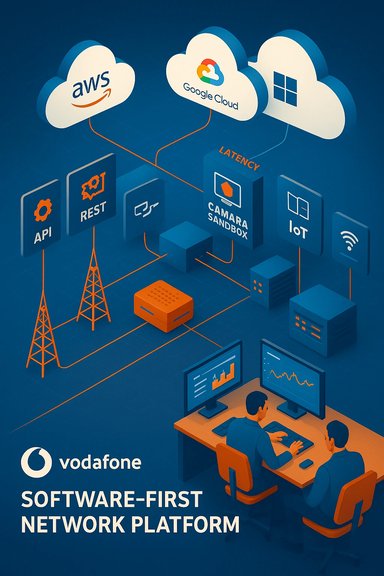
Vodafone is pushing to expose network capabilities through standardized APIs — quality‑on‑demand, number verification, SIM/swap checks, device location and event subscriptions — rather than burying them inside operator silos. That approach plugs telecom intelligence into modern, REST-driven developer workflows and marketplaces. Industry efforts like CAMARA and the GSMA Open Gateway provide the standards and templates that make this approach interoperable across operators; Vodafone is a visible participant in those projects and hosts CAMARA sandbox APIs on its developer marketplace. If apps and platforms can call operator services natively, the operator moves from a passive pipe to an active layer in the application stack — a meaningful upgrade in value capture if developers and enterprise buyers adopt and pay for those APIs at scale.Cloud and edge alliances: hyperscalers as partners, not only competitors
To make low-latency, policy-driven services credible, Vodafone is pairing its 5G SA deployments with distributed edge compute and deep hyperscaler alliances. Examples include AWS Wavelength integrated into Vodafone edge nodes, a long-standing strategic data platform relationship with Google Cloud, and a multi-year set of collaborations with Microsoft around cloud, AI and edge services. These arrangements let Vodafone offer combined network+compute solutions — essential for latency-sensitive use cases such as factory robotics, cloud gaming and immersive media. Two important clarifications: (1) hyperscalers can both enable and threaten operator economics — partnerships reduce friction but also increase hyperscaler influence over the software and developer relationship; (2) the depth of the partnership matters (SDKs, co-engineered products, joint GTM), and Vodafone has publicly signed multi-market efforts with the major cloud vendors while also keeping a clear stake in owning spectrum and local regulatory relationships.Reshaping the portfolio: towers, markets and leverage
Vodafone has systematically monetized passive infrastructure to strengthen its balance sheet. The staged sales and co‑control partnerships around Vantage Towers have generated multi‑billion‑euro proceeds and materially reduced net leverage, while allowing Vodafone to retain a strategic operating relationship with the tower business. The July 2024 sale of a further 10% stake in Vantage Towers (bringing total net proceeds to roughly €6.6bn) illustrates this playbook. Independent press coverage and Vodafone corporate statements confirm the transactions and their intended deleveraging effect. That monetisation unlocks two capabilities:- Reallocate capital from passive assets to software and 5G/fiber modernisation.
- Reduce balance-sheet drag so the group can invest selectively in priority markets (core Europe and Africa), and where needed, exit or restructure subscale operations.
The competitive landscape: incumbents and big‑tech
Europe’s telco rivals — similar moves, different emphases
- Deutsche Telekom emphasizes premium connectivity, converged bundles and a high-performance domestic network; it has also been an early mover to productize network features and 5G SA in selected markets. Vodafone counters with breadth across Europe and Africa and an explicitly pan‑regional platform posture.
- Orange positions itself as a full-stack digital operator with strong systems integration and cybersecurity offerings via Orange Business; its enterprise GTM often emphasizes managed services and SI-style partnerships more than pure API productization. Vodafone’s public messaging skews more to platformization and developer APIs.
- Telefónica focuses on regional strength and cloud-first initiatives in Latin markets; where Telefónica sells integrated IT+network projects, Vodafone sells programmable network primitives intended to plug directly into cloud stacks.
Hyperscalers: the adjacent existential threat
AWS, Microsoft and Google are investing heavily in operator-grade cloud services — private 5G, edge compute zones and telco-ready cloud tooling. These companies can outspend telcos on software and developer outreach, which turns the strategy into a race not only of product but of channel. Vodafone’s counterplay is to make its network indispensable in the cloud stack: owning spectrum, local compliance know‑how, and national operational experience; and exposing network intelligence via APIs so cloud-native apps treat the operator as a partner rather than a last‑mile commodity. That is the strategic logic behind the aforementioned hyperscaler alliances.Why Vodafone might win — and where the limits are
The company’s potential competitive edges
- Programmable connectivity: Exposing network features as callable services moves the product from megabytes to features — a high-margin shift if developers buy and enterprises adopt. CAMARA and GSMA Open Gateway lower the integration friction.
- IoT scale and stickiness: Large multinational fleets value a single vendor that solves cross-border SIM management, governance, and device lifecycle. Vodafone’s global IoT footprint and management portals are positioned to be that vendor.
- Geographic mix: A combined European/African footprint provides exposure to high-value Western markets and faster-growth African markets (including fintech and mobile-money opportunities) — a diversification rare among European incumbents.
- Asset-light evolution: Selling towers and partnering on cloud/edge lets Vodafone shrink capital intensity while retaining the regulated, national network that confers a durable moat.
The execution challenges and tangible risks
- Regulatory and data-sovereignty friction. Cross-border telemetry, identity checks, and API-based services intersect a patchwork of national regulations; legal compliance must be engineered into every product instance.
- Hyperscaler dependence and vendor lock-in. Deep cloud integrations speed time-to-market but can create costly exit paths and bargaining power asymmetries. Portability contracts, open data formats and FINOPS discipline are essential guardrails.
- Operational maturity (SRE, FinOps, security). Running developer APIs and large IoT fleets at scale requires site reliability engineering, observability, and cost controls to avoid runaway cloud bills and SLA breaches. Lessons from other telco cloud migrations show this is a non-trivial program of work.
- Commercial proof points. Productized APIs must show measurable ARPU uplift and retention improvements; otherwise the market will continue to value Vodafone as a capital-intense utility rather than a software platform. Investors and buyers will watch developer onboarding, API call volumes, and edge deals.
Product-by-product snapshot (what’s credible and where to verify)
IoT: the headline and the due diligence
- Claim: Vodafone has crossed roughly 200 million IoT connections (announced April 2025). This is corroborated by Vodafone’s own press and multiple trade outlets; treat the number as a company-reported scale metric, significant but not an independently audited universal truth. Verify with contract-level ARPU and managed-services revenue breakdowns during procurement.
Network APIs and CAMARA
- Claim: Vodafone is implementing CAMARA-standard APIs and exposing sandboxes on its developer marketplace. This is verifiable via CAMARA project releases and Vodafone’s developer pages; those resources demonstrate active participation and early API releases. Track developer adoption metrics (onboarding time, successful calls, SLA adherence) as the primary commercial KPI.
Edge + 5G SA + network slicing
- Claim: Vodafone is deploying 5G SA in multiple markets and running network slicing pilots for low-latency, QoS-differentiated offers. Public trials and demos (UK festival tests, 5G+ pilots) and operator press show these capabilities are in testing and early commercial use; the technology is real, but broad monetisation at scale is still nascent across the industry.
Hyperscaler partnerships
- AWS Wavelength: integrated into Vodafone MEC in multiple European markets.
- Google Cloud: multi-year strategic data platform collaboration (Nucleus/Dynamo) and cloud migration projects across Vodafone units.
- Microsoft: multiple partnership touchpoints — Azure services, AI adoption (Copilot) and joint edge offerings are documented in Microsoft and industry announcements. Some press and trade outlets report a large multi-year investment figure in the hundreds of millions to low billions; that dollar figure is treated here with caution unless corroborated in Vodafone’s official corporate disclosures. Where dollar-values are quoted in trade press, treat them as reported but requiring confirmation.
Impact on valuation and the market’s view
Vodafone’s equity has long been priced with the baggage of heavy legacy capex and regulatory risk. Recent market data shows share-price recovery episodes tied to asset disposals (Vantage Towers sell-downs, portfolio simplification) and merger outcomes, but the market still prizes visible, repeatable revenue and margin expansion from new product categories. Public market tickers and delayed LSE quotes indicate Vodafone’s share price has traded in ranges that reflect both skepticism and upside optionality; investors must rely on live quotes when making decisions. Key investor watchpoints:- Quarterly evidence of ARPU lift or margin improvement driven by IoT, API revenues and enterprise edge deals.
- Successful productized case studies (multi‑year contracts, measured SLAs) rather than one-off pilots.
- Sustained deleveraging from asset monetisation and visible FinOps discipline on hyperscaler spend.
Practical checklist for enterprise buyers and CIOs
- Request hardened SLAs for any network‑exposed API: p50/p95 latency, availability, billing fidelity and dispute mechanisms.
- Validate data-residency and lawful‑access mappings for each jurisdiction where telemetry flows.
- Insist on portability: confirm data export mechanisms (Delta/Parquet, standard formats), documented exit paths and renegotiation clauses for cloud-hosted components.
- Run a compact technical due diligence: synthetic API load tests, latency fingerprinting across edge sites, and a small pilot that measures business impact before wide rollout.
- Build FinOps accountability for any long-running analytics or IoT workloads: tag costs by team, run monthly reviews, and set alert thresholds for unplanned autoscaling.
What to watch next (12–24 months)
- Developer traction: onboarding velocity, active API consumer counts and monetized call volumes.
- IoT managed-services revenue growth vs. generic connectivity ARPU declines.
- Edge commercial wins: signed enterprise contracts that bundle 5G SA, edge compute and app-level QoS.
- Demonstrable FinOps and SRE improvements: predictable cloud spend and transparent incident metrics.
- Regulatory developments: national guidance on operator API exposure, identity services and lawful-intercept frameworks.
Conclusion — sober optimism, but the proof will be in products and margins
Vodafone’s strategic repositioning from commodity carrier to programmable platform is a coherent response to modern telecom economics. The company has taken practical, verifiable steps — tower monetisation, hyperscaler deals, active participation in CAMARA and public IoT milestones — to build a credible platform story. That said, the transformation is not automatic. The two most decisive things to watch are (1) commercial evidence that developers and enterprises will pay materially for operator-exposed capabilities, and (2) Vodafone’s operational discipline in governing hyperscaler relationships, cloud costs and regulatory complexity. Absent measurable margin expansion from the new product stack, the market will keep valuing the group by its legacy assets. If Vodafone can show repeated, measurable outcomes — ARPU lift, recurring enterprise contracts, and edge deals that move business economics — it will have a genuine shot at reclassification from a capital-intensive utility into a hybrid infrastructure + software franchise.(AD HOC NEWS coverage summarized and contextualized above.
Key corroborating evidence cited in this analysis:
- Vodafone press and corporate disclosures on IoT and Vantage Towers transactions.
- Independent reporting of tower sell‑downs and proceeds.
- CAMARA and GSMA Open Gateway activity and Vodafone’s CAMARA sandbox presence.
- AWS Wavelength, Google Cloud and Microsoft partnership descriptions and industry coverage.
- 5G SA rollouts and network‑slicing trials/demos in Vodafone markets.
- Market and price context from live market tickers (delayed quotes).
Source: AD HOC NEWS Vodafone Group plc Is Rewiring the Telco: From Commodity Carrier to Digital Platform
