

Voice is no longer a niche add‑on for Microsoft‑centric MSPs — it is the raw data layer that will decide who captures the first-mover advantage in practical, revenue‑driving AI services.
For years managed service providers (MSPs) treated telephony as a peripheral product: a way to preserve margins on legacy PBX migrations, win a little ARPU, and offer customers a “one‑stop” communications bill. That model is changing fast. Voice interactions — the calls, voicemails and meeting audio that happen every day between businesses and their customers — contain behavioral and contextual signals that text alone does not capture: cadence, interruptions, sentiment shifts, turning points in a negotiation, and embedded intent that only becomes clear across multi‑turn conversations. Embedding that signal into AI workflows changes the nature of what automation and Copilot‑style assistants can deliver. The warning signs are clear for MSPs that treat AI like a checkbox: enterprise AI initiatives are increasingly getting cut back or abandoned, often because the underlying data is incomplete, fragmented or governed poorly. Independent market trackers reported that the share of companies scrapping most AI initiatives rose sharply — from the low‑teens to roughly four in ten — and analysts flagged data, governance and integration failures as the primary causes. These are not abstract worries; they directly map to the MSP’s day job: delivering reliable pipelines, clean identities, and trusted telemetry into the AI stack.
(Quoted industry findings and practical guidance in this article draw on reporting and vendor commentary from recent Unified Communications and AI coverage, including industry analysis on voice as an AI data layer and operational playbooks for Teams Phone integrations.
Source: UC Today Voice Is the Hidden Weapon MSPs Can’t Afford to Ignore
 Background
For years managed service providers (MSPs) treated telephony as a peripheral product: a way to preserve margins on legacy PBX migrations, win a little ARPU, and offer customers a “one‑stop” communications bill. That model is changing fast. Voice interactions — the calls, voicemails and meeting audio that happen every day between businesses and their customers — contain behavioral and contextual signals that text alone does not capture: cadence, interruptions, sentiment shifts, turning points in a negotiation, and embedded intent that only becomes clear across multi‑turn conversations. Embedding that signal into AI workflows changes the nature of what automation and Copilot‑style assistants can deliver. The warning signs are clear for MSPs that treat AI like a checkbox: enterprise AI initiatives are increasingly getting cut back or abandoned, often because the underlying data is incomplete, fragmented or governed poorly. Independent market trackers reported that the share of companies scrapping most AI initiatives rose sharply — from the low‑teens to roughly four in ten — and analysts flagged data, governance and integration failures as the primary causes. These are not abstract worries; they directly map to the MSP’s day job: delivering reliable pipelines, clean identities, and trusted telemetry into the AI stack. Why voice matters now — the technical and commercial case
Voice is a different class of data
Text is discrete and sparse; voice is continuous and richly textured. A single conversation can reveal:- Emotional state and urgency through tone and prosody.
- Interaction patterns (who interrupts, who asks the close‑question) that map to decision momentum.
- Multi‑turn intent that only resolves after follow-ups.
These are inputs that improve retrieval, ranking, and contextual grounding for LLM‑based agents — and they increase the probability of meaningful automation outcomes (accurate recaps, correct CRM updates, proactive follow‑ups).
AI vendors are betting on voice as a first‑class signal
Microsoft’s recent product and model work demonstrates vendor commitment to voice as a strategic input: Copilot voice features now produce transcripts, and Microsoft’s MAI‑Voice‑1 model is explicitly aimed at expressive, low‑latency speech generation — a technical foundation for conversational assistants and automated recaps. That creates a clear commercial pathway: ingest voice → transcribe and enrich → surface to Copilot/agent → execute or recommend actions. MSPs who own that ingestion and governance layer control a higher‑value part of the stack.Business consolidation favors bundled providers
Customers increasingly prefer fewer vendors for mission‑critical stacks. Organizations often juggle many providers for collaboration, telephony, contact‑center and analytics; MSPs that can safely consolidate voice, Microsoft 365, Azure services and AI governance under a single contract are better placed to reduce churn and increase ARPU. This is where voice shifts from “bolt‑on” to a differentiator in managed services packaging.The cold reality: why AI pilots stumble — and how voice fixes part of the problem
Multiple industry analyses show alarming abandonment and low ROI for AI pilots. One market survey found that roughly 42% of firms abandoned most of their AI initiatives amid rising cost, privacy and integration barriers; other research suggests a tiny fraction of pilots move to sustained P&L impact. The pattern is consistent: pilots fail when data is fragmented, when integrations are shallow, and when governance is absent. Voice fixes some of those failure modes:- It supplies richer, session‑level context to retrieval systems, reducing hallucination triggers.
- It creates an auditable interaction record for downstream actions, improving traceability for business processes.
- It unearths behavioral telemetry that helps prioritize automation opportunities with measurable ROI (e.g., upsell prompts, churn signals, compliance monitoring).
From bolt‑on to strategic advantage: a practical blueprint for MSPs
Phase 0 — Stop treating voice as optional
- Inventory where voice touches the customer experience: sales calls, support lines, account management calls, meetings, and contact‑center queues.
- Map data sensitivity per use case and identify regulations (two‑party consent, data residency) that apply to recordings and transcripts.
Phase 1 — Low‑friction foundations (start small, measure fast)
- Enable structured capture: route recordings and speaker‑attributed transcripts into a secure, Azure‑native store that the MSP controls.
- Automate the low‑risk productivity bits: CRM updates, meeting note drafts, and email follow‑ups generated by Copilot or equivalent. These are measurable wins that prove value quickly.
- Rapid time‑to‑value with minimal model engineering.
- Clear, quantifiable KPIs (time saved per rep, reduction in manual note errors, faster ticket resolution).
- A safe sandbox for governance rules before scaling.
Phase 2 — Expand to analytics and business intelligence
- Add sentiment analysis and topic‑clustering to detect churn signals and upsell openings.
- Feed structured call events into Power BI or Microsoft Fabric for cross‑tenant dashboards that tie voice outcomes to sales and support metrics.
Phase 3 — Operationalize and productize
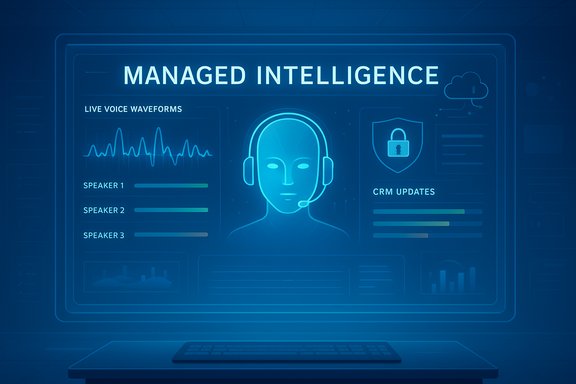
- Offer a Managed Intelligence product line that includes:
- Secure voice ingestion and lifecycle management.
- Copilot integrations for drafting and automation.
- Analytics and alerting for client account teams.
- Compliance and retention policy enforcement as an SLA item.
This is the point where an MSP becomes a Managed Intelligence Provider (MIP) — selling outcomes, not minutes or licenses.
Security, privacy and governance — non‑negotiable operational controls
Bringing voice into AI pipelines expands attack surface and regulatory obligations. MSPs must make the following controls core to any voice‑AI offering:- Explicit consent and disclosure flows for all recorded channels, with regional opt‑in tracking and audit trails.
- Encryption in transit and at rest, with strict role‑based access control and least‑privilege for model connectors.
- Data residency options and retention policies that map to regulatory needs (banking, healthcare, public sector).
- Non‑training guarantees or contractual clauses that specify whether vendor or platform providers may use transcripts to train models.
- Human‑in‑the‑loop gating for any automation that performs material actions (pushing invoices, transferring funds, approving discounts).
Technical choices: Teams Phone, Direct Routing, Operator Connect and where voice AI sits
MSPs servicing Microsoft environments need to make deliberate architecture decisions.- Teams Phone models: Microsoft Calling Plans, Operator Connect and Direct Routing each offer different control, compliance and billing trade‑offs. Direct Routing gives maximum control for complex, global deployments; Operator Connect reduces operational burden at the cost of some control. MSPs must map these trade‑offs to client requirements for emergency calling, number ownership and SBC survivability.
- Ingestion and normalization: capture raw audio, CDRs, STT transcripts, speaker attribution and associated metadata (call direction, participants, trunk used). Normalize and index into a data lake designed for downstream model access and BI.
- Model hosting: most MSPs should avoid hosting and training large voice models. Prefer Azure‑native, enterprise‑grade connectors that expose transcripts and embeddings to Copilot, or trusted third‑party CCaaS platforms that integrate with Teams — but always demand contractual clarity on training and retention. Microsoft’s Copilot features already support voice interactions and transcript exports; integrate with these APIs rather than bypassing them where possible.
Pricing, packaging and KPIs MSPs should sell
Voice‑enabled intelligence is a premium product. Consider multi‑tier packaging:- Base: secure voice capture + 30‑day transcript retention + CRM automation.
- Pro: sentiment analysis, monthly BI report, SLA for transcript export and redaction.
- Enterprise: full governance playbook, on‑prem or dedicated region storage, custom analytics, and annual compliance audits.
- Time saved per user (minutes saved on note‑taking and follow‑ups).
- Percentage reduction in ticket handling time for voice‑initiated cases.
- ARPU uplift attributable to voice AI features (tracked via cohort pilots).
- Churn delta for customers adopting consolidated voice+M365 bundles.
Risks and how to mitigate them
- Data privacy and legal exposure
- Mitigation: consent flows, per‑tenant retention policies, encrypted storage, redaction and legal review.
- Model hallucinations and incorrect automations
- Mitigation: human‑in‑the‑loop confirmations, deterministic backend validations for financial or compliance actions.
- Deepfake and impersonation attacks
- Mitigation: multi‑signal authentication (device attestations, OTPs), fraud monitoring and synthetic‑media detection.
- Vendor lock‑in and portability issues
- Mitigation: design for export — maintain canonical copies of raw audio and transcripts for portability; demand APIs and contractual exit rights.
- Cost at scale (audio processing can be expensive)
- Mitigation: tiered processing (lightweight transcripts for low‑value calls; enriched processing for high‑value channels), sampling strategies and latency‑sensitive on‑device fallbacks where available.
A realistic pilot plan MSPs can execute in 90 days
- Scope (Week 0–1)
- Select a single client team (50 seats sales or support) and define 3 measurable goals: meeting recap accuracy, CRM update rate, and agent handle time reduction.
- Foundation (Week 2–4)
- Deploy secure ingestion to an Azure region the customer approves; enable transcription and speaker attribution. Document data flows and consent.
- Integrations (Week 5–8)
- Automate CRM updates (first pass as suggestions, then move to semi‑automated mode). Connect Copilot to the transcript store for draft email and task generation.
- Measure (Week 9–10)
- Collect baseline vs pilot metrics: time saved, error rates, user satisfaction. Run security and compliance review.
- Iterate (Week 11–12)
- Add sentiment detection, escalate governance items, and prepare an executive one‑pager with measured ROI and next‑steps roadmap.
Market realities and vendor signals you must watch
- Microsoft’s Copilot voice stack and in‑house MAI models make voice a first‑class input — but they also shift the procurement and governance questions to enterprise tenants and their MSPs. Expect pressure to clarify training‑use, retention, and model provenance as MAI features become mainstream.
- CCaaS and middleware vendors are racing to offer white‑label Teams voice bridges and orchestration layers. These solutions simplify onboarding and protect PBX investments — but their marketing claims (“deploy in minutes”, “instant ARPU uplift”) require validation via pilot data and runbooks. Treat vendor anecdotes as directional until validated.
- The rising rate of AI project abandonment is a market opportunity if you offer disciplined, governed, measurable alternatives. Many organizations have tried “point solutions” and then cut projects when they failed to integrate with workflows; MSPs that design for integration first will be rewarded.
Final recommendations — what MSPs should do this quarter
- Reclassify voice from “bolt‑on” to “data product”: include it in discovery, risk assessments, and AI readiness audits.
- Build a repeatable 12‑week pilot playbook that demonstrates measurable productivity or revenue outcomes.
- Lock governance into contracts: retention windows, region choices, redaction, and non‑training clauses must be explicit.
- Price as outcomes: bundle voice ingestion, Copilot integrations and analytics as a premium “Managed Intelligence” SKU.
- Partner selectively: prefer Azure‑native, compliant ingestion paths and verified CCaaS partners — avoid point solutions that hide portability risk.
Conclusion
Voice is the hidden weapon MSPs can no longer afford to ignore — not because it's a shiny feature, but because it materially improves the fidelity and business value of AI assistants when captured, normalized, and governed correctly. The industry’s current AI disappointment cycle is mostly about integration and data quality; voice is one of the highest‑value, underutilized signals MSPs can unlock to reverse that trend. MSPs who act first — by operationalizing secure voice ingestion, integrating it with Copilot and BI workflows, and productizing the outcome as Managed Intelligence — will trade a commoditized telco play for a differentiated, stickier, and higher‑margin managed offering.(Quoted industry findings and practical guidance in this article draw on reporting and vendor commentary from recent Unified Communications and AI coverage, including industry analysis on voice as an AI data layer and operational playbooks for Teams Phone integrations.
Source: UC Today Voice Is the Hidden Weapon MSPs Can’t Afford to Ignore
