

Volkswagen’s decision to dust off Drivers Wanted and put it back in front of a Super Bowl audience this winter is more than a nostalgia play — it’s a strategic bet that the culture around cars still matters, even as autonomy, electrification and AI remake the mobility landscape.
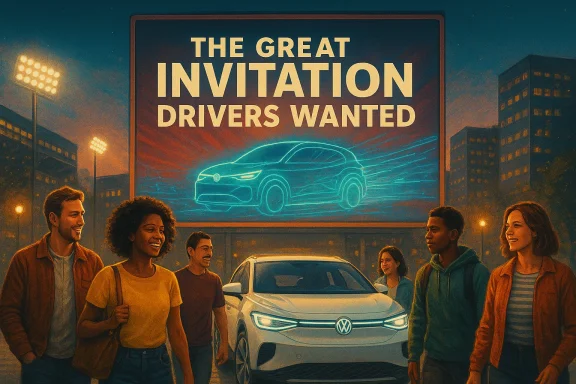
The original Drivers Wanted campaign helped reposition Volkswagen in the U.S. in the mid‑1990s by making car ownership an expression of identity. That same cultural framing is at the heart of the 2026 reboot: a 90‑second film titled “The Great Invitation: Drivers Wanted” accompanied by a 30‑second Big Game cut, set to House of Pain’s “Jump Around,” and built by agency Johannes Leonardo under the direction of Leigh Powis. The creative centers on invitations — small, human moments that celebrate saying “yes” to life — and it’s intentionally a cultural statement rather than a technical product pitch.
Volkswagen has positioned the campaign as a year‑long platform that will roll beyond the broadcast spot into premium out‑of‑home, creator and podcast partnerships, and targeted owner activations within its owner app. That mix signals the company’s intent: use the Super Bowl to catalyze an integrated, always‑on effort that ties brand meaning to lived experiences.
Automakers have struggled when marketing heritage and autonomy at the same time. If a brand leans too hard on driver identity while simultaneously signaling that cars will be autonomous, it risks confusing consumers. Volkswagen’s approach — focusing on human agency, lifestyle and identity — is smart, but it must be backed by product clarity: which models are driver‑centric experiences, which are optimized for shared mobility, and how ownership benefits evolve across that spectrum.
Two other realities complicate the picture. First, the industry’s migration toward AI‑enabled experiences is already underway — automakers and suppliers are deploying conversational assistants and personalization systems with measurable benefits — and brands must treat these technologies as core experience elements rather than marketing add‑ons. Second, creators and cultural storytelling amplify messages faster than ever, but amplification is a double‑edged sword: when things go right it accelerates reach; when it goes wrong it accelerates risk. Volkswagen’s program shows promise because it appears to marry craft with systems thinking. Execution will determine whether Drivers Wanted is a watershed moment in refocusing brand equity for a new mobility era — or another expensive, nostalgic halftime show moment.
Source: ADWEEK Drivers Wanted (Again): Volkswagen Balances Automation With the Human Side of Mobility
 Background: why the comeback matters now
The original Drivers Wanted campaign helped reposition Volkswagen in the U.S. in the mid‑1990s by making car ownership an expression of identity. That same cultural framing is at the heart of the 2026 reboot: a 90‑second film titled “The Great Invitation: Drivers Wanted” accompanied by a 30‑second Big Game cut, set to House of Pain’s “Jump Around,” and built by agency Johannes Leonardo under the direction of Leigh Powis. The creative centers on invitations — small, human moments that celebrate saying “yes” to life — and it’s intentionally a cultural statement rather than a technical product pitch. Volkswagen has positioned the campaign as a year‑long platform that will roll beyond the broadcast spot into premium out‑of‑home, creator and podcast partnerships, and targeted owner activations within its owner app. That mix signals the company’s intent: use the Super Bowl to catalyze an integrated, always‑on effort that ties brand meaning to lived experiences.
Overview: what Volkswagen is trying to achieve
At a high level, Volkswagen’s 2026 marketing playbook does three things at once:- Reassert brand identity by reclaiming a beloved brand line and connecting it to personal agency in mobility.
- Build cultural and creator‑driven resonance so that messaging travels beyond paid placements into social, creator content and earned conversation.
- Bridge the emotional past with a technical future — reminding audiences that Volkswagen’s heritage sits alongside ongoing investments in electrification, personalization and eventual autonomy.
Creative strategy: nostalgia as a cultural signaling device
The mechanics of a rebooted anthem
The classic advertising playbook uses nostalgia to shortcut emotional engagement. Volkswagen’s team amplifies this by not merely replaying old creative but by reframing the original idea for a new era. The updated spot frames the driver not as a technical operator but as an agent of possibility — a subtle repositioning that turns the product question (which car is right?) into the identity question (who do I want to be?). The creative decisions — song choice, casting of everyday moments, and a long‑form film leading into a Big Game cut — are designed for dual purposes: deliver immediate mass reach and provide modular content for social and experiential extensions.Why the Super Bowl placement matters differently today
Historically the Super Bowl has been a brand theater — expensive, but effective for mass cultural reach. Volkswagen’s play is textbook: validate the creative first, then buy the media. By ensuring the creative held its own as a piece of cultural storytelling before committing to a Big Game buy, Volkswagen is signaling long‑term brand thinking rather than a one‑off splash. That discipline is noteworthy given the cost and attention around the event. The Super Bowl presence is intended to be an opening salvo for an integrated, dealer‑forward campaign rather than a stand‑alone commercial.The role of creators: authenticity at scale
Creator influence as emotional proof
Volkswagen’s team emphasizes creator partnerships and “real voices” to build authenticity around ownership. This isn’t lip service: the contemporary buyer — particularly younger cohorts — often trusts peer voices and creators more than polished corporate messaging. Research and industry commentary show increasing percentages of car shoppers consulting influencer content during the consideration phase, and brands have seen measurable lift when creators provide demonstrable, lived experiences rather than scripted endorsements. For high‑involvement purchases like cars, creators act as translators who make ownership feel tangible.The tensions of creator programs
Creator programs scale authenticity but introduce new risks. Brands must manage:- Consistency of message across creators with varied tones and audiences.
- Compliance and disclosure in paid relationships.
- Reputation risks when an influencer’s off‑brand behavior surfaces.
- Measurement complexity: linking creator content to long purchase cycles remains a nontrivial systems problem.
Technology and CX: AI, personalization and the modern CMO
Marketing leadership that speaks data and story
Rachael Zaluzec’s framing of the modern CMO — as a hybrid storyteller and data strategist — is apt. Brands now must orchestrate cross‑channel experiences, integrate first‑party data, and measure across long funnels while retaining creative power. Volkswagen’s focus on personalization through digital integration and owner app activations suggests investment in first‑party data and CRM capabilities that can make cultural messaging actionable at the individual level.Where AI fits in the customer experience
AI is no longer an experimental novelty in automotive CX. Leading vendors and platform partners are embedding conversational agents, personalization layers and predictive services into vehicle experiences and dealership systems. Automakers and suppliers are using AI for:- In‑vehicle virtual assistants that handle natural dialogue and context‑aware prompts.
- Real‑time personalization for offers and service reminders.
- Predictive maintenance and service scheduling that preempt customer friction.
- Enhanced digital retail experiences, including AR showrooms and personalized finance offers.
Risks: privacy, governance and dealer channels
AI-driven personalization creates the perennial tradeoff: convenience versus privacy. Auto brands sit on deeply sensitive data — travel patterns, location history, finance and ownership details — that requires robust governance. Deploying AI inside vehicles and across dealer systems introduces risk vectors:- Data governance and consent must be airtight or consumer trust will erode rapidly.
- Dealers — who still control many test‑drive and purchase touchpoints — can be disintermediated if brands centralize too much of the customer relationship without local enablement.
- Regulatory regimes (privacy laws, safety standards for in‑vehicle AI) vary across jurisdictions and are evolving quickly.
Tying heritage to autonomy: a delicate brand tightrope
The emotional vs. technical promise
Volkswagen’s narrative centers on reclaiming the driver. That emotional positioning must be reconciled with a product roadmap that increasingly includes electrified models and long‑term autonomous ambitions. Bridging those worlds requires honesty in messaging: celebrate what driving means today while being transparent about future mobility services.Automakers have struggled when marketing heritage and autonomy at the same time. If a brand leans too hard on driver identity while simultaneously signaling that cars will be autonomous, it risks confusing consumers. Volkswagen’s approach — focusing on human agency, lifestyle and identity — is smart, but it must be backed by product clarity: which models are driver‑centric experiences, which are optimized for shared mobility, and how ownership benefits evolve across that spectrum.
Operational tensions: dealers, incentives and ecosystem
Transitioning from an outreach campaign to sustained commercial impact requires operational alignment. Volkswagen’s activation plan (Times Square OOH, podcast integrations, owner app promotions) can create awareness, but conversion depends on dealer readiness, inventory strategy and incentives. There’s a well‑documented gap between brand advertising and dealer follow‑through; closing that loop takes:- Training and incentives for dealers to convert campaign interest into test drives.
- Seamless digital to physical handoffs (bookings, contactless test drives, tailored offers).
- Analytics that attribute downstream sales activity back to campaign touchpoints.
Measurement and governance: what success should look like
KPIs that matter for culture‑led campaigns
Traditional ad metrics (reach, GRPs) remain useful for a Super Bowl launch, but Volkswagen’s stated intent implies the need for a broader performance framework tied to both short and long‑term outcomes. Recommended KPIs include:- Awareness lift and brand equity measures among target cohorts.
- Consideration and intent lift mapped across creative exposures (long form vs short form).
- Creator‑driven engagement and content amplification metrics (view‑throughs, shares, time‑spent).
- Digital retail funnel metrics: test drive bookings, quote requests, owner app activations.
- Dealer conversion rates and incremental sales lift attributable to campaign cohorts.
A governance checklist for AI and personalization
If Volkswagen scales personalization via the myVW app and dealer systems, governance is nonnegotiable. A practical checklist:- Define clear data use cases and obtain explicit, granular consent for each.
- Implement a privacy‑by‑design model with data minimization and retention policies.
- Centralize accountability: name a data steward and cross‑functional council (legal, security, product, marketing).
- Audit AI models regularly for bias, safety and explainability.
- Provide consumers with simple controls to view, export and delete their data.
Career and organizational implications: what marketers need to do
Cross‑functional talent is table stakes
Volkswagen’s CMO narrative insists that marketing leaders must understand HR, product operations and digital systems to execute modern brand programs. That means building teams with hybrid skill sets: creative directors who know data, analytics leaders who understand storytelling, and product owners who can translate marketing briefs into dealer‑facing digital features. Organizations that silo these functions will be slower to act and less able to measure impact.Practical steps for CMOs
- Map the customer journey end‑to‑end and assign cross‑functional owners for experience gaps.
- Invest in a unified data platform for first‑party signals; prioritize integration with dealer CRMs.
- Build an always‑on creator program with clear governance and measurable objectives.
- Pilot AI use cases in low‑risk domains (post‑sale service notifications, appointment scheduling) before scaling to in‑vehicle experiences.
- Measure both cultural and commercial outcomes, and align incentives across marketing, sales and dealer operations.
What could go wrong: realistic risks and mitigation
Risk 1 — Nostalgia misfires with younger buyers
Nostalgia resonates with some cohorts but can alienate younger buyers who may view the messaging as retro‑centric or out of touch. Mitigation: pair nostalgia with distinctly modern, creator‑led content that foregrounds new‑model experiences and EV benefits.Risk 2 — Creator authenticity collapses into transactional noise
Overly commercial influencer flows can dilute trust. Mitigation: long‑term creator partnerships, experiential content (real test drives, owner stories) and transparent FTC disclosures.Risk 3 — Privacy backlash from heavy personalization
If customers feel surveilled, the campaign’s human‑centric promise will ring hollow. Mitigation: privacy‑first design, clear opt‑in choices and visible consumer controls.Risk 4 — Dealer misalignment
Dealers who aren’t prepped for campaign demand can create negative customer experiences. Mitigation: partner with dealer networks on incentives, training and matching digital bookings to local inventory.Risk 5 — Mixed signals about autonomy and the driver
Promising the joy of driving while investing in autonomy without clear segmentation risks confusing buyers. Mitigation: transparent product roadmaps and model‑level storytelling about what owning looks like today versus in shared or autonomous scenarios.Strategic recommendations — how to make the campaign convert
- Embed measurement into every phase: creative testing, launch, creator amplification and dealer conversion. Use A/B testing and incrementality studies to quantify impact.
- Make creators partners in measurement: provide unique offer codes or trackable owner app activations tied to specific creator content.
- Prioritize dealer enablement: pre‑qualified leads, digitally assisted test drives and a unified follow‑up cadence reduce friction at the point of sale.
- Phase AI deployments: focus first on high‑ROI CX tasks (service scheduling, FAQs, appointment reminders) while building governance for more sensitive in‑vehicle experiences.
- Keep the brand narrative honest: celebrate driving as an emotional choice while clearly segmenting products optimized for driver control versus shared/autonomous use cases.
Final analysis: balancing culture and technology
Volkswagen’s rebooted Drivers Wanted is smart precisely because it understands the limitations of technology as a brand proposition. In a future where cars may increasingly be software and services, emotional ownership remains a differentiator brands can own. The campaign’s strength lies in pairing a culturally resonant idea with modern distribution and creator amplification. That said, the hard work is operational: aligning data, AI governance, dealer networks and measurement systems so that the story produces tangible outcomes.Two other realities complicate the picture. First, the industry’s migration toward AI‑enabled experiences is already underway — automakers and suppliers are deploying conversational assistants and personalization systems with measurable benefits — and brands must treat these technologies as core experience elements rather than marketing add‑ons. Second, creators and cultural storytelling amplify messages faster than ever, but amplification is a double‑edged sword: when things go right it accelerates reach; when it goes wrong it accelerates risk. Volkswagen’s program shows promise because it appears to marry craft with systems thinking. Execution will determine whether Drivers Wanted is a watershed moment in refocusing brand equity for a new mobility era — or another expensive, nostalgic halftime show moment.
Takeaway: what to watch next
- Watch the owner app activations and dealer conversion metrics that follow the campaign; these will be the clearest indicators of commercial success.
- Track Volkswagen’s AI/CX pilots for transparency and consumer control features; early governance choices will shape long‑term trust.
- Observe how creator partnerships are structured: long‑term authenticity bets will outperform one‑off sponsored posts.
- Treat any public claims about sales declines or macro headwinds as provisional unless confirmed by official Volkswagen financial communications; trade press sometimes aggregates commentary that requires further verification.
Source: ADWEEK Drivers Wanted (Again): Volkswagen Balances Automation With the Human Side of Mobility
