

The headline claim of the submitted third‑party piece is simple and important: using a Virtual Private Server (VPS) for algorithmic trading reduces technical latency and improves platform stability—but it is not a substitute for risk management, and it does not guarantee profits. That balance is the guiding principle of this 2026 guide: explain which VPS features materially affect automated trading performance, verify which vendor claims are realistic, and give pragmatic, testable configuration and procurement guidance for retail and professional algo traders alike.
Algorithmic trading is a systems problem as much as a strategy problem. Trades are executed by software that depends on compute, network connectivity, time synchronization, and platform reliability. A VPS lets you move that software off a domestic PC and into a data center that is geographically and topologically closer to your broker or liquidity venue. That proximity materially reduces network round‑trip time (RTT) to the broker’s matching engine and removes many of the common desktop failure modes (local power, ISP instability, sleeping devices), but it cannot remove market risk, execution slippage caused by liquidity, or bad strategy parameters.
Specialist trading hosts and colocated providers explicitly advertise low single‑digit millisecond or even sub‑millisecond pings to major exchange gateways and ECNs; these claims are real when the VPS is physically hosted in the same data center or network fabric as the venue, but they depend on the vendor’s network topology and the exact rack location. Examples from the professional side include financial cloud providers that offer both VPS and colocation with direct exchange connectivity, while consumer MetaTrader‑focused VPS providers advertise sub‑5ms pings to common broker locations—claims that should be validated with live tests before you commit your production trading engine.
Source: thesenior.com.au VPS features for algo: A 2026 guide
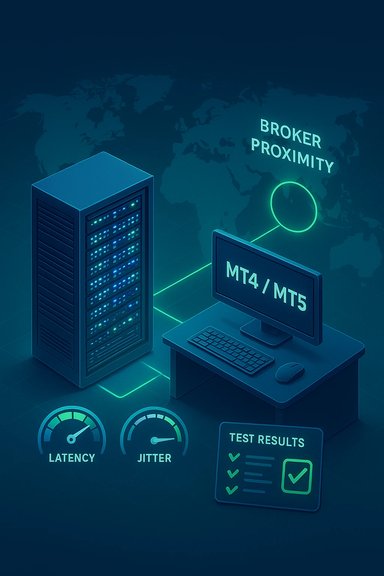 Background / Overview
Algorithmic trading is a systems problem as much as a strategy problem. Trades are executed by software that depends on compute, network connectivity, time synchronization, and platform reliability. A VPS lets you move that software off a domestic PC and into a data center that is geographically and topologically closer to your broker or liquidity venue. That proximity materially reduces network round‑trip time (RTT) to the broker’s matching engine and removes many of the common desktop failure modes (local power, ISP instability, sleeping devices), but it cannot remove market risk, execution slippage caused by liquidity, or bad strategy parameters.Specialist trading hosts and colocated providers explicitly advertise low single‑digit millisecond or even sub‑millisecond pings to major exchange gateways and ECNs; these claims are real when the VPS is physically hosted in the same data center or network fabric as the venue, but they depend on the vendor’s network topology and the exact rack location. Examples from the professional side include financial cloud providers that offer both VPS and colocation with direct exchange connectivity, while consumer MetaTrader‑focused VPS providers advertise sub‑5ms pings to common broker locations—claims that should be validated with live tests before you commit your production trading engine.
Why a VPS matters for algorithmic trading
- Lower latency and lower jitter. For time‑sensitive strategies (scalping, market‑making, latency‑sensitive order placement), every millisecond of RTT matters. Moving your execution logic into a VPS located near the broker reduces RTT and, crucially, jitter (variance in latency), which is often more damaging than a steady but slightly higher baseline ping. Practical measurements show common home broadband pings of 30–120ms down to 1–10ms when correctly colocated.
- Higher availability and platform stability. Data centers offer redundant power, enterprise networking, and infrastructure staff. A VPS eliminates many single‑point‑of‑failure problems common to home traders (power blips, router resets, local Windows updates). Managed VPS and colocation vendors also provide monitoring and SLAs for uptime. However, SLA text matters; network/power SLAs are not the same as application‑level uptime guarantees.
- Predictable environment for backtests and optimization. A consistent runner for backtesting or grid search (with stable CPU, memory, and I/O performance) reduces noisy results caused by local machine variability.
- Platform compatibility. Many retail EAs (Expert Advisors), trade copiers, and Windows‑only trading platforms require Windows; other stacks use headless Linux services and can benefit from the stability and scripting environment of Linux VPSes.
Core VPS features that matter (and why)
Below are the features that materially affect algorithmic trading performance, ranked by typical impact.1) Location, latency, and network topology
- Why it matters: physical distance and the number of network hops determine RTT. Sub‑millisecond or single‑digit millisecond pings are possible only when the VPS is in the same data center or immediately adjacent network region as the broker’s server or exchange gateway. Specialist trading providers advertise low‑latency fabric and direct exchange connectivity; co‑location is the only way to approach microsecond latencies used by professional HFT shops.
- What to require:
- VPS or colocation in the same data center as your broker or a listed nearby PoP.
- Ask vendors for measured pings to your broker hostnames (rather than “to city” claims).
- Look for low‑jitter SLAs and details on peering and backbone providers.
2) Uptime SLA and maintenance windows
- Why it matters: a brief maintenance reboot during open hours can cause missed fills or unexpected behavior during volatile markets.
- What to require:
- 99.95% or better availability for production bots.
- Clear maintenance windows and advance notice.
- Compensation/credits structure and the process to claim them (some vendors require claims rather than automatic credits).
3) Operating system and platform support
- Why it matters: many retail tools (MetaTrader 4/5, TradeStation, NinjaTrader) are Windows‑centric; others (custom Python or Java engines) often run better on Linux.
- What to require:
- For MT4/MT5: a Windows Server image (2019/2022/2025 where supported) with RDP access and enough CPU/RAM.
- For Python/Java/C++ engines: a hardened Linux image with container or process supervision options.
- Root/admin access for installation of custom dependencies and exact binary builds.
4) CPU, memory, and storage performance
- Why it matters: backtesting, optimization and ML inference need CPU and I/O. However, raw single‑thread latency (CPU frequency) can matter more than core count for highly serialized strategy code; for high concurrency, prioritize more vCores and RAM.
- Practical guidance:
- Entry developer VPS: 2 vCPU, 2–4 GB RAM, 30–50 GB NVMe.
- Multi‑EA retail: 4–8 vCPU, 8–16 GB RAM, 50–200 GB NVMe.
- Intensive backtesting / ML inference: 8+ vCPU, 32+ GB RAM, NVMe RAID or dedicated disk. Use processors with modern single‑thread performance (Ryzen/EPYC family are commonly offered).
5) Dedicated vs shared resources and noisy neighbors
- Why it matters: noisy neighbor CPU or shared storage can ruin latency consistency during data crunching or bursts.
- What to require:
- Prefer single‑tenant or dedicated CPU allocations for production trading.
- Validate that advertised “dedicated” actually maps to pinned vCPUs and not oversubscribed cores.
6) Network bandwidth, port speed, and peering
- Why it matters: trading itself rarely consumes large bandwidth, but port speed affects queuing and burst behavior (and the vendor’s charge model).
- What to require:
- Guaranteed port speed with clear unmetered vs metered policy.
- Ask if bandwidth is billed by port speed or per‑GB egress; pay attention to egress caps.
7) Time synchronization (NTP/PTP)
- Why it matters: order timestamps and logs must be consistent across systems for debugging and regulatory needs. Some execution strategies rely on tightly synchronized clocks.
- What to require:
- Ability to run system‑level NTP or PTP sync.
- For high‑precision needs, ask about access to precision time protocols and timestamping features.
8) Monitoring, visibility, and control plane features
- Why it matters: real‑time telemetry (CPU, memory, network RTT, full disk health) is essential to detect failing bots before they lose money.
- What to require:
- Built‑in monitoring with alerting hooks (email/SMS/webhook).
- Snapshot/restore and scheduled backup options.
- APIs for automation and orchestration.
9) Security, isolation, and compliance
- Why it matters: trading credentials, API keys and PII must be protected.
- What to require:
- Hardened images, OS updates, firewall rules, and the ability to use customer‑managed keys or VPNs.
- For institutional users: SOC‑2 / ISO 27001 where required.
10) GPU & accelerators (when relevant)
- Why it matters: ML‑based strategies that run inference for signals or risk scoring may need GPU acceleration; many VPS vendors offer GPU instances or allow GPU passthrough in colocation.
- What to require:
- Dedicated GPU instances with explicit driver and CUDA/ROC availability.
- Confirm pricing and thermal/availability constraints for GPU nodes.
Co‑location vs VPS: where each makes sense
- VPS (cloud or managed) is the correct choice for most retail and small institutional algos:
- Lower cost, faster time to deploy, managed networking, and easier scaling.
- Provides the latency improvements that matter for most retail EAs when placed in the right region.
- Co‑location (your hardware in the exchange data center) is appropriate when:
- You are seeking microsecond latency or direct market access for institutional HFT strategies.
- You need full control over NICs, kernel tuning, or specialized hardware.
- Beeks and other financial cloud providers explicitly position colocation and private cages for traders that need direct exchange links; for most retail users, the cost and operational overhead are disproportionate.
Realistic latency expectations and measurements
- Home broadband to regional brokers: typically 30–120ms.
- Cross‑continent connections: 80–200ms+.
- VPS located in a broker‑adjacent data center: typically 1–10ms; specialized trading hosts publish sub‑5ms and even sub‑1ms to local exchange gateways when colocated.
- Ask for measured ping and traceroute to the broker server hostnames from the exact data center and SKU you intend to buy.
- Run your own tests (ping, mtr/traceroute, arping) from a trial or test instance.
- Use platform GUI latency displays (MT4/MT5 shows server pings) and measure order round‑trip time with synthetic orders during low‑volume test sessions.
- Measure jitter (standard deviation of RTT) and packet loss over representative trading hours—not just single pings at off‑peak times.
Practical VPS configuration recommendations (tiered)
Developer / Experimentation (entry)
- CPU: 2 vCPU
- RAM: 2–4 GB
- Storage: 30–50 GB NVMe
- Network: 1 Gbps
- OS: Windows Server (for MT) or Ubuntu 22.04 (for Python stacks)
- Use cases: single EA, proof‑of‑concept, light backtests
Live retail trading (multi‑EA, retail scalper)
- CPU: 4–8 vCPU (pinned)
- RAM: 8–16 GB
- Storage: 50–200 GB NVMe (for logs, local DB, caching)
- Network: 1–10 Gbps with low jitter; choose colocated/near‑broker region
- OS: Windows Server 2022 / Hardened Linux for non‑Windows stacks
- SLA: 99.95%+, automatic snapshot backups
Professional / institutional (heavy optimization, low latency)
- CPU: 8+ vCPU, dedicated cores, or bare metal
- RAM: 32+ GB
- Storage: NVMe RAID for low tail‑latency I/O
- Network: 10–100 Gbps fabrics, private links to exchanges or MPLS/Direct Connect
- Option: colocation in the same data center as the broker/matching engine
- Time sync: PTP or specialized time service
- Monitoring: full telemetry, synthetic order testing, runbooks and automated failover
Step‑by‑step deployment checklist (numbered)
- Identify the broker/exchange hosts and the physical data center locations they operate from.
- Shortlist VPS providers that have presence in those data centers or immediate network peering (include at least one specialist trading host and one mainstream cloud provider for comparison).
- Request measured latency and jitter samples to your broker hostnames from the specific data center and SKU.
- Test a short trial instance and run:
- ping, mtr/traceroute to broker endpoints
- MT4/MT5 latency readings
- Synthetic order round‑trip measurement (with extremely small, manual sized orders in a test account)
- Configure OS hardening, install and pin critical services (EA processes), and set up process monitoring with automatic restarts.
- Implement backups and snapshot schedules; test snapshot restores to ensure RTO/RPO are acceptable.
- Configure time sync and logging, and centralize telemetry (alerts for CPU, memory, latency spikes and order failures).
- Document incident runbooks and contact SLAs; verify how to escalate with vendor support.
- Move production only after at least several days of real‑time monitoring during live market hours.
Testing and verification: what to measure and how
- Ping and traceroute to broker IP/hostnames (average, max, minimum).
- Jitter (standard deviation) across peak trading windows.
- Packet loss percentage over 24–72 hours.
- Order round‑trip time: place a test order in a demo account and measure time between order submission and trade confirmation.
- Platform health: CPU and GC pauses (for Java/.NET engines), memory usage patterns, and disk I/O tail latencies.
- Recovery drills: simulate power/network incident and validate automatic restart and restore time.
Choosing a provider: negotiation checklist and red flags
Ask providers for:- Exact rack/data center location and peering partners.
- Demonstrated ping times and a method to reproduce measurements.
- SLA details, maintenance windows, and the credit claim process.
- Dedicated CPU and pinned core guarantees.
- Port speed and egress billing model.
- Support escalation procedures during market hours and availability of emergency RDP/console access.
- Vague latency claims (“low latency to the city” without broker host tests).
- SLA that excludes scheduled maintenance without reasonable notice.
- Oversold “dedicated” CPU that maps to noisy shared hosts.
- High renewal premiums or hidden control panel licensing fees for Windows.
Notable providers and positioning (examples and tradeoffs)
- Specialist financial cloud and colocation firms (example: Beeks Financial Cloud) offer trading‑centric VPS and colocation with direct exchange connections and ISO/27001 facilities—appropriate for firms that need exchange connectivity and low judicial latency. Expect higher costs and contractual onboarding but real access to exchange fabrics.
- MetaTrader‑focused VPS shops (QuantVPS, is*hosting and similar) publish Windows SKUs and measured pings to Chicago/New York broker hubs and often include trade‑centric support and configuration for MT4/MT5. These are practical for most retail traders who need a Windows environment and low latency to common brokers. Validate ping claims via trial.
- General cloud providers (AWS, Azure, GCP, Vultr, DigitalOcean): flexible, globally distributed, and useful for Linux‑native engines. They can achieve good latency if you choose the correct regions and placement groups, but they often require more manual networking tuning to match specialized trading hosts. For pure latency work, ask about placement/availability zones that are nearest to broker PoPs and consider direct connect options.
- Cheap generic VPS hosts: fine for testing and low‑frequency strategies; not recommended for live low‑latency production due to oversubscription and noisy neighbors.
Risks, limitations and regulatory/operational cautions
- A VPS reduces technical latency but does not protect from market volatility, liquidity gaps or strategy risk. The original third‑party disclaimer is correct: past performance is not predictive. Always maintain proper risk controls. (User‑provided third‑party content emphasized this balance.
- Vendor claims can be technically correct but operationally misleading (e.g., ping measured from the vendor’s monitoring host, not your actual instance). Always verify yourself.
- Windows licensing: moving MT4/MT5 to VPS often incurs Windows Server licensing costs baked into the vendor price; verify whether the vendor’s price includes licensing or whether you bring your own license.
- Vendor lock‑in and data portability: snapshot and image formats differ between hosts. Maintain infrastructure as code and migration scripts.
- Security exposure: a VPS hosted in a public cloud without careful firewalling and credential management can leak API keys or session tokens. Use principle of least privilege and rotate keys.
Final assessment: where to spend your effort and budget
- Spend on location and consistent low jitter first. The majority of measurable execution improvement comes from placing execution logic close to the broker and removing chaotic desktop environments.
- Invest in monitoring, automated failover and runbooks second. Recovery speed and early detection usually prevent bigger losses than shaving an extra millisecond off latency.
- For most retail algorithmic traders, specialist trading VPS providers or a well‑configured mainstream cloud instance in the right region balance cost and performance best.
- Reserve colocation or dedicated exchange connectivity for strategies that demonstrably require microsecond or sub‑millisecond latencies and can justify the operational and financial overhead.
Conclusion
A VPS for algorithmic trading is a force multiplier when chosen and configured correctly: the right location, guaranteed resources, low jitter, and robust monitoring materially improve order execution reliability and reproducibility. Vendor marketing often highlights headline latency numbers—use them as a starting point, but always validate claims with real tests and read SLA fine print before you commit. Operational maturity (failover plans, monitoring, tested restores) and careful procurement will deliver more consistent trading outcomes than chasing a single extra millisecond of theoretical ping time. The submitted third‑party guidance is sound in its headline caution (VPS helps but does not guarantee profit); treat vendor latency claims skeptically, verify with live tests, and prioritize stability and observability when you move your algos into production.Source: thesenior.com.au VPS features for algo: A 2026 guide
