

The end of general support for vSphere 7 in October 2025 is more than a product milestone — it’s a hard business inflection point that exposes the commercial and technical consequences of Broadcom’s post‑acquisition strategy for VMware, forces painful renewal and migration choices, and reshapes how enterprises evaluate hypervisor risk, cost and long‑term vendor dependency.
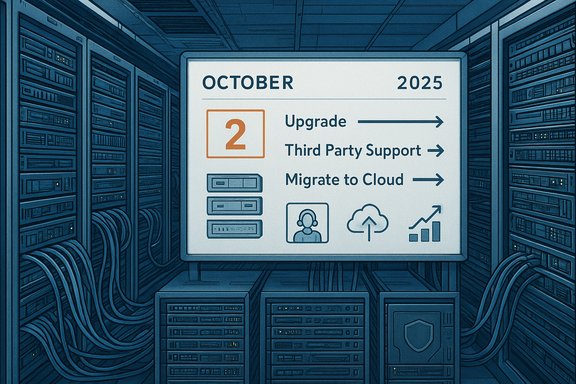
vSphere 7.x (including ESXi 7.x and vCenter 7.x) will reach its End of General Support on October 2, 2025, after Broadcom extended the original April 2025 cut‑off by six months to give customers more runway. After that date, Broadcom will stop providing new fixes, security patches and Broadcom support for those releases; previously released service packs and fixes remain available for download within existing maintenance windows, but forward security maintenance stops. The current landscape traces back to Broadcom’s acquisition of VMware — a roughly $61 billion deal announced in 2022 and completed under regulatory scrutiny in 2023 — which brought VMware into Broadcom’s software portfolio and triggered a series of rapid commercial changes: SKU consolidation, a push from perpetual to subscription models, and new license and renewal mechanics intended to increase recurring revenue and simplify product lines. These changes are now colliding with the vSphere 7 end‑of‑support deadline. Across the market, customers report three immediate realities:
Enterprises now balance three forces: an immovable technical deadline, a transformed commercial model, and a risk environment where delay has measurable security and compliance costs. The practical strategy is deliberate: inventory, quantify, negotiate and time‑box. Those who treat the October 2 support cutoff as an operational lever — not merely an IT calendar event — will retain control over cost and risk as the market continues to adjust around Broadcom’s new licensing reality.
Source: TechRadar vSphere 7 support ends: the challenges of Broadcom’s new licensing and pricing models
 Background / Overview
vSphere 7.x (including ESXi 7.x and vCenter 7.x) will reach its End of General Support on October 2, 2025, after Broadcom extended the original April 2025 cut‑off by six months to give customers more runway. After that date, Broadcom will stop providing new fixes, security patches and Broadcom support for those releases; previously released service packs and fixes remain available for download within existing maintenance windows, but forward security maintenance stops. The current landscape traces back to Broadcom’s acquisition of VMware — a roughly $61 billion deal announced in 2022 and completed under regulatory scrutiny in 2023 — which brought VMware into Broadcom’s software portfolio and triggered a series of rapid commercial changes: SKU consolidation, a push from perpetual to subscription models, and new license and renewal mechanics intended to increase recurring revenue and simplify product lines. These changes are now colliding with the vSphere 7 end‑of‑support deadline. Across the market, customers report three immediate realities:- A firm support deadline for a large, mission‑critical hypervisor release.
- A changed vendor commercial model that can materially raise renewal bills and change how licenses are measured.
- New operational and compliance choices for staying patched and supported versus migrating to alternatives or third‑party support.
What Broadcom changed — practical, verifiable facts
The vSphere 7 support date and what it means
- vSphere 7.x EoGS: October 2, 2025. After this date, Broadcom will not issue new security patches or accept support cases for those releases. Customers can still download previously published fixes for the duration of their maintenance period, but no new updates will be produced for vSphere 7.x.
License and pricing mechanics Broadcom has introduced
Broadcom has reworked VMware’s packaging and commercial rules in several concrete ways that affect cost and procurement strategy:- SKU consolidation and bundle-first offerings: Broadcom simplified VMware’s large SKU set into a smaller number of bundled subscriptions (for example, unified packages around Cloud Foundation or vSphere Foundation), which can force customers to buy capacity or modules they don’t need in order to retain certain features.
- Minimum core licensing increase: Starting in 2025 Broadcom moved to a substantially higher minimum core purchase threshold for some license purchases — publicly reported as an increase from 16 minimum licensed cores to 72 cores — which directly raises list spend for smaller hosts and edge deployments.
- Penalties for late renewals: Memo and partner communications indicate Broadcom applied retroactive penalties for missed subscription anniversaries (a reported 20% surcharge on the first year of subscription in some partner communications).
Why this matters now — security, compliance and operational risk
The immediate technical consequences of EoGS are straightforward and binary: once Broadcom stops issuing OS‑level fixes for vSphere 7.x, any new hypervisor vulnerability discovered after the cut‑off will not receive a vendor patch for that release. For production virtualization platforms that host critical workloads, that increases exposure in predictable ways:- Exploit window growth: Newly discovered hypervisor bugs that allow privilege escalation, VM‑escape or host compromise become permanent risks on unpatched vSphere 7 hosts.
- Compliance and audit risk: Regulated organizations that require vendor patching as part of their controls may find running out‑of‑support hypervisors creates compliance gaps unless mitigations or compensating controls are demonstrably in place.
- Operational drag: Running mixed estates (vSphere 7 + newer versions) increases the complexity of patching, backup/restore, automation and training for operations teams.
The market reaction — migration, alternatives and third‑party support
Broadcom’s commercial moves have produced three clear responses from enterprises:- Accelerated upgrade planning: Large customers with modern estates are accelerating plans to move to supported vSphere 8.x versions or adopt Broadcom‑offered bundles while they can control the timing and pricing of migration projects.
- Evaluation of alternative hypervisors: Some customers are actively testing alternatives — Microsoft Hyper‑V in Windows‑centric environments, Nutanix for HCI scenarios, and KVM‑based stacks (Proxmox, RHEL/KVM, OpenStack variants) for cost flexibility and open‑ecosystem controls. Practical hypervisor selection criteria remain workload fit, ecosystem tooling, licensing TCO, and vendor contract certainty.
- Third‑party support and extended maintenance: Independent support vendors and specialist support providers have announced offerings to keep vSphere 7 customers operational and patched beyond Broadcom’s EoGS date — offering an alternative to immediate migration for customers that need time. For example, third‑party support vendors are marketing indefinite support programs to bridge the gap after Broadcom support ends.
Third‑party support: what it buys and what it doesn’t
Third‑party maintenance specialists typically offer:- Continued security coverage for known vulnerabilities (based on vendor community analysis and micro‑patching).
- Technical troubleshooting and extended lifecycle guidance tailored to vSphere 7 environments.
- Time to plan and execute a measured upgrade or migration without being forced into immediate Broadcom pricing resets.
Claims, verification and caution — separating fact from narrative
Several headline claims have circulated in press commentary and vendor opinion pieces. It’s important to verify the load‑bearing numbers and flag unverifiable statements.- vSphere 7 EoGS date: Verified — Broadcom / VMware Cloud Foundation publicly set the revised End of General Support date to October 2, 2025.
- Broadcom acquisition price and strategy: Verified — Broadcom’s acquisition of VMware was marketed as approximately $61 billion and has triggered the licensing and packaging changes described above.
- Minimum core and late‑renewal penalty mechanics: Verified reporting from trade outlets shows Broadcom increased minimum licensing thresholds and introduced renewal penalties in partner communications. These are material commercial changes that have been publicly reported.
- Market intensity and price shock: Multiple outlets report materially higher renewal costs for some customers and market friction resulting from bundle‑first approaches; independent reporting and vendor statements indicate renewal increases can be substantial, though the precise percentage or multiplier depends on customer‑specific footprint and historical discounts.
- The TechRadar piece references that “98% of customers currently [are] considering moving away from VMware altogether” and that “enterprises have reported spending 8–15 times more” since the acquisition. Those two figures appear in a single article and are not corroborated by Broadcom, VMware, or other independent surveys available in the public record at scale. Treat these as attributed claims (an editorial or quoted opinion from the TechRadar piece or its contributors) rather than independently validated industry‑wide measurements. When claims like that are used in procurement or board decisions they should be verified with primary customer surveys or vendor contract audits.
Strategic choices for IT leaders: a pragmatic decision framework
Enterprises now face three broad, defensible paths — each with operational tradeoffs. The choice should be workload‑driven and time‑boxed.1) Upgrade in place to a supported VMware release (the least‑risky technical route)
Benefits:- Maintains vendor support and security patches.
- Preserves existing operational runbooks and ecosystem integrations.
- Potentially high immediate renewal and migration cost under new Broadcom terms.
- Upgrades can be complex for large estates with tight change windows.
- Inventory all vSphere 7 hosts, dependencies, and third‑party integrations.
- Run impact analysis on feature usage (vSAN, NSX, vMotion, DRS) to identify required SKU/feature set under Broadcom bundles.
- Negotiate renewal terms early; ask for transitional pricing, multi‑year caps or grandfathering where possible.
2) Buy time with third‑party support and a staged migration plan (risk‑managed runway)
Benefits:- Buys breathing room when Broadcom terms produce unmanageable short‑term costs.
- Enables a measured, less disruptive migration to a long‑term target.
- Third‑party support is not identical to vendor support for all technical issues.
- Long runs on third‑party maintenance can complicate eventual vendor upgrades and compatibility assurance.
- Select a reputable third‑party support provider with verified case studies and clear SLAs for hypervisor security and bug mitigation.
- Define a firm sunset and migration timeline — treat third‑party support as a time‑boxed bridge.
- Reallocate savings to a modernization or migration fund (cloud migration, HCI refactor, or replatforming).
3) Migrate away from VMware (longer‑term commercial decoupling)
Benefits:- Potentially lower long‑run licensing costs and reduced vendor dependency.
- Opportunity to modernize applications and embrace cloud‑native architecture.
- High migration cost, application refactoring burdens, and operational retraining.
- Not all workloads migrate cleanly — some mission‑critical systems are tightly coupled to VMware features.
- Prioritize workloads by risk/reward: lift‑and‑shift stateless apps first, then stateful DBs and VDI.
- Run pilot migrations (small clusters, representative workloads) and measure operational costs, not only runtime CPU/I/O.
- Consider hybrid approaches (Azure VMware Solution, AWS VMware Cloud) if a phased cloud migration is desirable — these preserve VMware tooling while shifting to cloud economics, though they carry their own cost profile.
Financial planning and procurement playbook
When pricing volatility is in play, procurement must change tactics:- Run scenario modelling: Create TCO models for (a) upgrade under Broadcom bundles, (b) third‑party support + delayed upgrade, and (c) migration to alternative hypervisor/cloud. Include human ops, testing, cutover windows and hardware refresh timing in the model.
- Negotiate sensible exit terms: If you must renew with Broadcom, seek price caps for a fixed period, transparent core counting rules, and written assurances about future core minimums.
- Demand SKU transparency: Ask for SKU mappings from old perpetual licenses to new bundles showing which features are included and which are add‑ons.
- Audit your entitlement history: Reconcile historical discounts and enterprise agreements; vendors sometimes apply new terms inconsistently — a careful audit uncovers leverage.
Technical and operational checklist — 30/90/180 day plan
Weeks 0–4: Triage and inventory- Identify all vSphere 7 hosts, affected clusters, management networks and dependent services.
- Map critical business applications to host dependencies and recovery objectives.
- Apply hardening and isolation for vSphere 7 management planes (RBAC, MFA, network segmentation).
- Plan backup/restore and test DR on representative systems.
- Execute pilots for (a) upgrade to vSphere 8, (b) third‑party support path, or (c) migration alternative.
- Validate vendor feature parity and integration in the pilot (vSAN, NSX, backup, monitoring).
- Execute large‑scale waves with rollback plans, operational runbooks and change windows.
- Freeze new feature adoption until stabilization; focus on security and compliance closure.
The political and regulatory angle
Broadcom’s post‑merger behavior has attracted regulatory attention in Europe and vocal criticism from cloud service provider groups who argue that tighter licensing and bundling can be anti‑competitive for cloud providers and the broader ecosystem. Those challenges remain active in public filings and formal appeals in Europe. For procurement teams, this means the commercial backdrop is uncertain and may change if regulators enforce remedies or penalties — but relying on regulatory relief as a procurement strategy is speculative and slow.Final assessment — risks, strengths and a pragmatic verdict
- Strengths of the current path: Upgrading to a supported vSphere release preserves vendor support, avoids compliance risk and minimizes immediate security exposure. Broadcom’s bundles can simplify the long tail of SKUs and, for large, uniform estates, may offer operational simplicity.
- Primary risks: Pricing shocks driven by minimum core increases, bundle requirements, and retroactive renewal penalties are real and documented; these can materially raise TCO. Running unpatched vSphere 7 hosts after October 2, 2025, carries clear security and compliance risk.
- Practical verdict: There is no universal “right” answer — the correct choice is workload‑driven, time‑boxed and financially modelled. For organizations that cannot accept Broadcom’s new economics, third‑party support can buy a limited, well‑defined runway to migrate without taking immediate commercial pain. For others, negotiating clear commercial protections while planning an orderly upgrade remains the lowest operational risk path.
- Treat October 2, 2025 as a hard date for support changes and plan accordingly.
- Run a renewal TCO and negotiation sprint today — modelling the minimum core mechanics and identifying where discounts or contract language can be applied.
- If Broadcom terms are unaffordable, evaluate third‑party support as a time‑boxed bridge and execute pilots for alternative hypervisors or cloud migration.
- Flag any single‑source sensational figures (for example, “98% of customers” or “8–15x spend increases”) and demand primary data before making board‑level decisions; treat such figures as attributed claims until independently validated.
Enterprises now balance three forces: an immovable technical deadline, a transformed commercial model, and a risk environment where delay has measurable security and compliance costs. The practical strategy is deliberate: inventory, quantify, negotiate and time‑box. Those who treat the October 2 support cutoff as an operational lever — not merely an IT calendar event — will retain control over cost and risk as the market continues to adjust around Broadcom’s new licensing reality.
Source: TechRadar vSphere 7 support ends: the challenges of Broadcom’s new licensing and pricing models
