

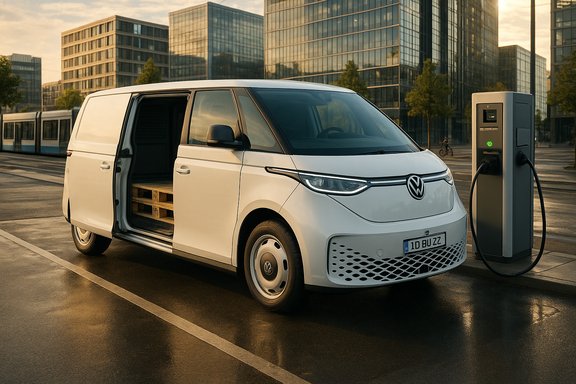
Volkswagen’s commercial take on the retro‑futurist ID. Buzz — the ID. Buzz Cargo — is officially in production for Europe and already staking a strong claim as the electric cargo van most likely to dominate city streets, small business fleets, and even race‑team paddocks across the continent. The Cargo keeps the passenger Buzz’s charm while swapping rear seats for a practical, low‑floor load bay sized to swallow two Euro pallets and light commercial kit. Mechanically it mirrors the short‑wheelbase passenger model: a rear‑drive electric motor fed by a roughly 77 kWh usable battery, DC fast‑charging capability that can take the pack from ~5% to ~80% in roughly 30 minutes, and support for bidirectional charging. Volkswagen positions the vehicle squarely at urban fleets and premium small‑business operators rather than as a heavy‑duty transporter, and the company has made clear the Cargo will be sold across Europe — but not in the U.S., a gap explained largely by tariff economics and market shape.
The ID. Buzz Cargo is the commercial offshoot of Volkswagen’s ID. Buzz family, a production realization of VW’s much‑loved Microbus concept that first returned in full EV form as a show car. The Cargo variant traces to preview concepts and early commercial‑vehicle demos presented at trade shows, and the production Cargo launched with the short‑wheelbase (SWB) footprint built in Volkswagen’s Hanover commercial‑vehicle plant. That SWB platform is the same “skateboard” MEB architecture used by VW’s ID family, which places the battery under the floor and the motor(s) above the rear axle for a low center of gravity and a flat load floor in the Cargo. From a dimensional standpoint the SWB ID. Buzz (and the Cargo) measure roughly 4,712 mm long (about 185.5 inches), a 2,988 mm wheelbase (117.6 in), and an overall height near 1,938 mm — numbers that put the Buzz close to compact crossovers in length but with a taller, boxier profile suited to cargo. Volkswagen offers the Cargo with pragmatic exterior choices — standard 18‑inch steel wheels, a single sliding side door with an option for a second, and a tailgate configuration that can be either a top‑hinged hatch or split barn doors depending on spec.
For European fleets the Buzz Cargo checks many practical boxes: two Euro pallets, a low and manageable load floor, DC fast‑charging that enables quick turnarounds, and a cabin that improves the day‑to‑day life of drivers. The vehicle also points to the broader next phase of electrified commercial transport, where user experience and brand value matter as much as cargo volume. For U.S. buyers, the Cargo’s current absence is the product of trade rules, production strategy, and market realities — not a reflection of product capability. If Volkswagen elects to localize production or release a dedicated U.S. Cargo in future model cycles, American fleets will gain a stylish and practical EV van option; until then, the Buzz Cargo will remain a distinctly European phenomenon.
Source: Super Nowości https://supernowosci24.pl/eeeedxshop/roadshow/news/volkswagen-id-buzz-cargo-electric-van-debut/
 Background / Overview
The ID. Buzz Cargo is the commercial offshoot of Volkswagen’s ID. Buzz family, a production realization of VW’s much‑loved Microbus concept that first returned in full EV form as a show car. The Cargo variant traces to preview concepts and early commercial‑vehicle demos presented at trade shows, and the production Cargo launched with the short‑wheelbase (SWB) footprint built in Volkswagen’s Hanover commercial‑vehicle plant. That SWB platform is the same “skateboard” MEB architecture used by VW’s ID family, which places the battery under the floor and the motor(s) above the rear axle for a low center of gravity and a flat load floor in the Cargo. From a dimensional standpoint the SWB ID. Buzz (and the Cargo) measure roughly 4,712 mm long (about 185.5 inches), a 2,988 mm wheelbase (117.6 in), and an overall height near 1,938 mm — numbers that put the Buzz close to compact crossovers in length but with a taller, boxier profile suited to cargo. Volkswagen offers the Cargo with pragmatic exterior choices — standard 18‑inch steel wheels, a single sliding side door with an option for a second, and a tailgate configuration that can be either a top‑hinged hatch or split barn doors depending on spec. What’s under the floor: drivetrain, battery and charging
Powertrain and battery
- The standard Cargo ships with the same rear‑axle single‑motor setup available on the SWB passenger Buzz: a 150 kW (around 201 hp) electric motor producing roughly 310 Nm (about 229 lb‑ft) of torque. VW’s announced gross/net battery configuration for the SWB models is 82 kWh gross / 77 kWh usable — the figure that underpins the Cargo’s real‑world operating envelope.
Charging and bi‑directional capability
- Volkswagen specifies DC fast‑charging peak power in the neighborhood of 170–185 kW on SWB models, which is quoted to allow a battery refill from about 5% to 80% in roughly 30 minutes under ideal conditions. An 11 kW three‑phase onboard AC charger is standard for depot or slow overnight charging in Europe. The Cargo can also be specified with bidirectional (V2X/V2H) capability — enabling the van to feed power back to a home or a facility — although how that feature is monetized or offered varies by market and regulator.
Cargo architecture and payload: how much fits inside
The ID. Buzz Cargo’s headline cargo metric is a load volume of up to ~3.9 cubic metres (roughly 137.7 cubic feet), and VW says the van can carry two Euro pallets loaded side‑by‑side thanks to a wide, low sill and minimally intrusive wheel arches. That payload sits well for urban last‑mile operators, tradespeople, and small‑goods fleets where parcel density is high and route lengths are moderate. The load bay is finished with durable surfaces, floor rings and side bars for securing cargo, and options exist for a fixed partition (with or without a passthrough window) between the cabin and load area. Measured loading geometry from multiple regional brochures and independent writeups gives loading lengths in the low‑2,200 mm range (with tailgate or wing doors configurations affecting the exact usable length) and a maximum internal width above the wheel arches of about 1.23 m — enough for typical Euro‑format sheet goods and palletized loads, but narrower than larger midsize vans. Prospective buyers should verify precise internal dimensions for their key load items, especially taller or irregularly shaped tools and racking systems.Cabin and ergonomics: more van than tractor
One of the ID. Buzz Cargo’s strongest assets is its car‑like cabin that elevates driver comfort and daily usability compared with many traditional light‑commercial vehicles. VW retains much of the passenger Buzz’s refined dash architecture but simplifies trim and vents to suit commercial use. Seating is available as a three‑across bench (Commerce spec) or two individual captain’s chairs, and the cab features multiple secure storage pockets, USB‑C ports, and modern infotainment options — up to a 12.9‑inch touchscreen in higher specs. A practical feature for trades is the optional pass‑through in the partition that allows long items to extend into the cabin, increasing effective load length. For businesses that prioritize driver time and wellbeing, this interior represents a meaningful workflow upgrade: better ergonomics, connectivity and heated seating as standard on several trims reduce driver fatigue and can improve retention for multi‑vehicle operations.Market positioning and use cases
Who benefits most
- Urban delivery and last‑mile couriers that value zero‑emission operation in low‑emission zones.
- Tradespeople and small service fleets that need a compact footprint but reliable load volume and easy access.
- Retailers and marketing teams using branded vehicles as mobile billboards — the Buzz’s retro styling is an asset here.
- Motorsport and event teams seeking a stylish, practical paddock van (a natural nod to the Microbus’s historical presence in racing circles).
Why fleets will consider the Cargo
- Electric drivetrains cut fuel and maintenance costs and can access restricted urban zones where diesel vans may be penalized.
- The Buzz’s distinct look offers a brand differentiator for businesses that rely on visibility.
- Eligibility for national and regional incentives (where they exist) and dealer finance offers in Europe reduce up‑front cost barriers; the UK, for example, has positioned the Cargo to qualify for business incentives in certain configurations.
Competitors: how the Buzz fits the landscape
There’s a growing field of electric light‑commercial vehicles in Europe — from compact rivals to larger medium vans — but the ID. Buzz Cargo occupies a defined niche: a premium, design‑forward small van with car‑like comfort and a competitive load bay for Euro pallets.- Against compact van peers (e.g., older‑generation Metris/Connect style vans), the Buzz offers distinctive design, a more modern EV architecture, and VW’s brand familiarity.
- Versus larger purpose‑built electric vans (such as full‑size e‑vans and panel‑vans), the Buzz trades absolute payload and towing capacity for maneuverability, driver comfort, and style. For customers whose core mission is heavy loads or maximum payload density, a larger commercial vehicle still makes more sense.
Pricing, variants and timeline (Europe)
Volkswagen launched the ID. Buzz Cargo in Europe with a Commerce trim and has since expanded the lineup with additional battery options and 4Motion (all‑wheel‑drive) variants over time. A 59 kWh entry battery was added to broaden the segment reach and reduce entry price for cost‑sensitive operators, while the 77 kWh usable pack remains the standard for longer‑range SWB models. Price positioning keeps the Cargo in a premium slice of the small‑van market, reflecting its build quality and hardware. Delivery and ordering windows have been staggered since the initial 2022/2023 launch, and VW reports solid interest and orderbooks across multiple European markets. Verification note: national incentives and price‑before‑tax vary widely across Europe; fleets and businesses should check country‑specific net costs and grant eligibility before budgeting purchases.Why the Cargo won’t be coming to the U.S. (for now)
A recurring question among North American enthusiasts is “Why not?” The short answer is economics and regulatory taxonomy: the so‑called Chicken Tax, a longstanding 25% tariff on certain imported light trucks, makes importing a European‑built commercial van uneconomical without local production or re‑engineering plans. Volkswagen has publicly signalled that the passenger long‑wheelbase (LWB) ID. Buzz — reworked for North American tastes — will be offered in the U.S., but the Cargo commercial variant is not planned for North America because it would be classified as a light truck and subject to the tariff, which would materially inflate sticker price and undercut competitiveness. Journalists and analysts have repeatedly cited the Chicken Tax as the decisive factor, alongside production allocation choices and the expectation that the passenger Buzz will be VW’s priority in the U.S. market. Caveat: corporate plans can change; if Volkswagen chooses to manufacture the Cargo locally or reassign production, the availability calculus would change. Until an explicit production or import plan is published, statements about U.S. availability should be treated as provisional.Strengths — why the ID. Buzz Cargo matters
- Design that sells: unique, brandable styling is a commercial asset for small businesses and fleets that use vehicles as rolling advertisements.
- Practical urban packaging: the low loading sill, capacity for two Euro pallets and tight turning circle make it highly usable in dense city environments.
- Modern EV architecture: the MEB underfloor battery provides good handling balance and enables intelligent thermal and charging systems shared with VW’s ID family.
- Bidirectional charging potential: V2H/V2G enables new use cases — emergency power, depot load management, and grid services — that can improve total cost of ownership if local charging ecosystems and tariffs support them.
Risks & trade‑offs — candid assessment for buyers
- Payload limits vs diesel workhorses: the Buzz Cargo’s payload is adequate for many applications but lower than heavier midsize vans; businesses that haul dense loads will lose economy versus diesel alternatives or purpose‑built heavy electric vans. Vet payload requirements carefully.
- Real‑world range sensitivity: vans are inherently less aerodynamic than passenger cars. Real‑world range will fall well below WLTP peak numbers when loaded and driven at highway speeds — crucial for route planning and multi‑shift fleet operations. Expect the Cargo to be ideal for short to medium urban routes rather than cross‑country heavy hauls.
- Charging ecosystem & depot readiness: fleets must invest in depot chargers with adequate power, and bidirectional setups require certified wallboxes and regulatory clarity for export or grid participation. V2G economics are promising but conditional on hardware, aggregator access, and local market rules. Avoid over-optimistic V2G payback assumptions without a modeled pilot.
- Price premium: the Buzz Cargo sits at a higher price point than many traditional small vans. Although grants and lower running costs can offset that, total cost of ownership calculations are essential before switching an entire fleet.
Fleet adoption checklist — practical steps for buyers
- Confirm payload and internal dimensions against your heaviest / bulkiest loads.
- Map actual route distance and duty cycles to projected energy consumption — model worst‑case loading and ambient conditions.
- Select battery capacity (59 kWh vs 77 kWh and beyond) based on range needs and total cost of ownership.
- Plan depot charging infrastructure and consider V2G readiness only after assessing charger availability and local regulation.
- Evaluate financing and incentives unique to your country or city; government grants can materially change the acquisition calculus.
- Pilot a single vehicle for 3–6 months to validate operational assumptions (range, charging times, payload handling, maintenance).
Final verdict: where the ID. Buzz Cargo fits in the transition to electric fleets
The ID. Buzz Cargo is an important product for Europe’s transition to electrified urban logistics. It blends iconic design with a practical cargo layout and modern EV architecture, creating a compelling option for businesses that prioritize brand image, driver experience and zero‑emission access to city centers. The Cargo is not a wholesale replacement for larger diesel panel vans where raw payload and towing matter most; rather, it is a calculated, premium alternative for urban use‑cases where range demands are moderated and operational savings from electrification can be realized.For European fleets the Buzz Cargo checks many practical boxes: two Euro pallets, a low and manageable load floor, DC fast‑charging that enables quick turnarounds, and a cabin that improves the day‑to‑day life of drivers. The vehicle also points to the broader next phase of electrified commercial transport, where user experience and brand value matter as much as cargo volume. For U.S. buyers, the Cargo’s current absence is the product of trade rules, production strategy, and market realities — not a reflection of product capability. If Volkswagen elects to localize production or release a dedicated U.S. Cargo in future model cycles, American fleets will gain a stylish and practical EV van option; until then, the Buzz Cargo will remain a distinctly European phenomenon.
Closing thoughts
The ID. Buzz Cargo is more than a novelty because it is built from the ground up as an EV commercial vehicle with real attention to the needs of urban fleets and small businesses. It is emblematic of the direction light commercial vehicles are taking: smarter packaging, lower running costs, and a stronger emphasis on human‑centric cab design. Prospective operators should treat the Buzz as a well‑engineered, premium tool for the right mission profile — urban, predictable routes with frequent stops and a need for strong brand presence — and not as a drop‑in replacement for older, heavier‑duty diesel vans. When matched correctly to operations, it offers a compelling mix of form, function, and electric efficiency; when mismatched to freight density or long‑haul routes, its limitations become clear. Planning, measurement, and a defensive approach to charging strategy will be the keys to unlocking value from the ID. Buzz Cargo.Source: Super Nowości https://supernowosci24.pl/eeeedxshop/roadshow/news/volkswagen-id-buzz-cargo-electric-van-debut/