

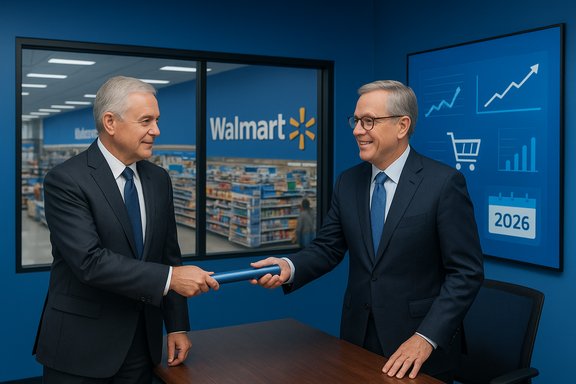
Walmart’s board has announced a major leadership change: long‑time CEO Doug McMillon will retire at the end of January 2026 and John Furner, the company’s U.S. president and a three‑decade Walmart veteran, has been named president and chief executive officer effective February 1, 2026. This is a planned but abrupt‑feeling handover at the helm of the world’s largest retailer—one that will carry immediate market and strategic implications for Walmart’s employees, suppliers, investors and the broader retail sector.
Doug McMillon has served as Walmart’s CEO since 2014 and will step down on January 31, 2026; the company says he will remain on the board until the next annual shareholders’ meeting and serve as an adviser through fiscal 2027 to ensure a smooth transition. Under McMillon’s leadership Walmart completed a long, public transformation—spending heavily on e‑commerce, logistics technology, and a growing advertising business—helping global revenue reach $681.0 billion in fiscal year 2025. John Furner, 51, will take over the CEO role after a long internal career path that began on the store floor; he most recently oversees Walmart U.S., the group’s largest and highest‑margin segment. Furner has held leadership roles across operations, merchandising, Sam’s Club and international assignments—an operational insider with deep store‑level and supply‑chain experience. Storyboard18 covered the broader leadership-repositioning narrative in retail and noted the prominence of internal successions in this cycle of executive moves.
The key question for market watchers is not whether the strategy will change overnight—internal succession strongly suggests it won’t—but whether Furner can sustain both the operating momentum and the disciplined expansion into higher‑margin businesses that investors now expect. His early moves, the staffing decisions he makes for Walmart U.S. and Sam’s Club, and the clarity of his capital allocation priorities will be the clearest signals that this leadership overhaul will translate into a durable next chapter for one of the world’s largest retailers.
Source: Storyboard18 Walmart announces leadership overhaul as Doug McMillon steps down; John Furner named new CEO
 Background / Overview
Doug McMillon has served as Walmart’s CEO since 2014 and will step down on January 31, 2026; the company says he will remain on the board until the next annual shareholders’ meeting and serve as an adviser through fiscal 2027 to ensure a smooth transition. Under McMillon’s leadership Walmart completed a long, public transformation—spending heavily on e‑commerce, logistics technology, and a growing advertising business—helping global revenue reach $681.0 billion in fiscal year 2025. John Furner, 51, will take over the CEO role after a long internal career path that began on the store floor; he most recently oversees Walmart U.S., the group’s largest and highest‑margin segment. Furner has held leadership roles across operations, merchandising, Sam’s Club and international assignments—an operational insider with deep store‑level and supply‑chain experience. Storyboard18 covered the broader leadership-repositioning narrative in retail and noted the prominence of internal successions in this cycle of executive moves.Why this matters now
- Walmart is the retail sector’s barometer. Decisions at the top ripple through supplier negotiations, logistics contracts, and commodity sourcing.
- The handover comes at a delicate macroeconomic moment—consumer spending patterns have been inconsistent, tariffs and trade policy remain a tail risk, and labor and logistics costs are still evolving. Market reaction to the announcement was immediate: shares dropped in premarket trading following the news.
- From a governance point of view, a planned internal succession reduces the chances of strategic discontinuity, but it also locks the company’s next phase of leadership to the same institutional DNA that shaped the previous decade.
McMillon’s legacy: what changed under his watch
Scale, digitalisation and margin diversification
Under Doug McMillon, Walmart doubled down on a two‑front strategy: preserve everyday low prices through relentless operational discipline, and invest in platforms that extend revenue beyond transactions. Key outcomes include:- Revenue growth and scale: Fiscal 2025 revenue reached $681 billion, a milestone that reflects continued growth across stores and online.
- E‑commerce expansion: Walmart substantially closed the gap with online competitors through store‑fulfilled pickup and delivery capabilities and selective digital acquisitions. Global eCommerce growth was a notable percentage of FY25 results.
- New businesses: Advertising (Walmart Connect), fintech initiatives, and services (membership and fulfillment innovations at Sam’s Club) added higher‑margin revenue streams that helped operating income growth outpace sales growth in FY25.
Workforce and culture
McMillon’s tenure also pushed on people initiatives—wage increases, expanded parental leave and training programs—psychologically re‑anchoring the company’s public image and internal morale around associate investment. These moves matter for an employer with roughly 2.1 million associates worldwide.The strategic playbook he leaves behind
The company McMillon built is a platform play: stores plus micro‑fulfillment and tools, unified inventory and omnichannel flows, and a data‑driven advertising arm. That positioning makes Walmart not just a retailer but a logistics and commerce platform with growing B2B and marketplace influence. Those are structural assets and constraints for the incoming CEO.John Furner: profile and likely mandate
Who is John Furner?
- A Walmart lifer who began as an hourly associate in 1993, John Furner rose through store operations, merchandising and supply‑chain roles, later serving as CEO of Sam’s Club and then president and CEO of Walmart U.S.
- Furner’s track record centers on store operations, membership models, merchandising discipline and converting stores into fulfillment assets—skills that are directly relevant to Walmart’s immediate operational levers.
What Furner is likely being asked to do
- Preserve and protect the core U.S. retail engine (price leadership, store productivity).
- Scale distribution efficiency and fulfill the promise of store‑as‑hub for online orders.
- Maintain momentum in advertising and higher‑margin services while tightening cost control where necessary.
- Be a steady hand for suppliers and investors during a macro environment that could penalize missteps in pricing or inventory.
Strategic implications: continuity versus change
Continuity (the case for stability)
- An internal promotion signals the Board’s desire to avoid disruption. Furner is steeped in Walmart’s operating playbook and is positioned to keep the company on its current strategic course—important for long supply chains and partner relationships that prize predictability.
- Operational improvements and small‑win optimizations (store productivity, inventory turns) are more likely under a leader who knows the mechanics of field execution.
Change (the case for a new agenda)
- Promoting the U.S. president to global CEO often elevates U.S. priorities; stakeholders should watch whether global units (International, Sam’s Club) gain or lose strategic bandwidth.
- Investors will expect evidence of margin accretion from higher‑growth segments: advertising, membership services, fintech. Furner will need to show he can oversee both the day‑to‑day of stores and the growth levers of platform businesses.
Market reaction and investor pressures
The market’s initial response—an intraday premarket drop in Walmart shares—reflects two overlapping signals: surprise at the timing and uncertainty about the new CEO’s ability to match McMillon’s strategic stewardship. Analysts and commentators pointed out that McMillon oversaw a significant expansion of the business and that following that kind of long‑serving leader is a reputational and execution test. Investors will ask for:- Firm guidance on succession timing beyond the headline (who succeeds Furner at Walmart U.S. and Sam’s Club).
- Clear KPIs and an early 100‑day agenda from Furner to show how the company will balance pricing, inventory and investments.
- Assurance that the advisory period (McMillon through FY2027) will provide genuine continuity rather than a protracted transition.
Operational and strategic risks to watch
1. Execution risk in a single‑leadership handover
Titles and continuity matter, but the real risk is in operational handoffs: named successors for critical functional roles, updates to compensation plans and supplier contracts, and clarity in who owns major transformation projects.2. Macro sensitivity: tariffs and consumer spending
Walmart’s FY25 guidance and FY26 outlook assume modest growth in a volatile policy environment; new tariffs or sustained consumer pullback could squeeze margins and test the new CEO’s tradeoffs between price leadership and margin protection.3. Platform concentration and regulatory spotlight
Walmart’s growth into advertising and financial services increases regulatory and competitive attention. Furner must manage those businesses with the governance and compliance rigor that larger platforms require.4. Talent and succession management
If Furner is promoted from within, internal candidates for his prior role may be contested or poached by competitors. A failure to lock down key operational leaders could cause short‑term disruption in stores and fulfillment centers.5. Perception risk with suppliers and associates
Suppliers depend on predictable buying patterns and long planning cycles. Any hint of strategic pivot—inventory rationalization, private‑label push, or payment‑term changes—will reverberate through supplier planning and cost structures.Near‑term watchlist: what to expect in the next 90 days
- Formal announcement of Furner’s successor at Walmart U.S. and Sam’s Club leadership plans. Investors will treat these named appointments as the first signal of strategic continuity or change.
- A public 100‑day roadmap from Furner outlining top priorities for operations, margin management, e‑commerce and the advertising business.
- Management commentary during the next earnings call and investor outreach clarifying capital allocation and investment priorities for FY26.
- Any early organizational changes or role consolidations in technology, supply chain or merchandising that signal shifts in execution models.
- Supplier and retailer forum reactions—distributor contracts or procurement negotiations may change cadence as the new leadership tests supplier relationships.
What this means for different stakeholders
For associates and store managers
Expect operational continuity but prepare for leadership changes at regional and divisional levels—documented handovers and named interim contacts will reduce friction.For suppliers and manufacturers
Push for contractual clarity and demand early visibility into buying plans. Large retailers sometimes use leadership transitions to renegotiate terms; a proactive supplier playbook is prudent.For investors
Look for Furner’s early commitments on capital allocation, margin targets and how he will steward growth businesses (advertising, membership, fintech). Monitor share reactions and analyst guidance updates closely.For IT and logistics partners
Stability in platform roadmaps matters. Expect renewed focus on store‑as‑fulfillment investments and incremental automation programs; suppliers should validate SLAs and integration timelines to avoid project slips.Strengths and opportunities in the transition
- Continuity of institutional knowledge: Promoting an internal operational leader reduces onboarding friction and helps preserve relationships with key partners.
- Operational discipline: Furner’s background suggests a focus on walkable, measurable operational gains that can improve margins without requiring disruptive strategic pivots.
- Opportunity to accelerate platform monetization: If Furner balances store performance with disciplined scaling of higher‑margin services, Walmart could reap disproportionate benefits from its advertising and membership channels.
Potential downsides and cautionary notes
- The announcement was unexpected to markets; surprise transitions can unsettle suppliers and capital markets even when planned internally.
- Promoting from inside can ossify existing policies and reduce the chance of radical course correction if the business needs it.
- The advisory overlap (McMillon staying until mid‑2026 and advising through FY2027) creates ambiguity: it can be stabilizing, but it can also prolong decision‑making or blur accountability unless roles are tightly defined.
How to assess Furner’s early success: a short scorecard
- Clarity and speed of U.S. leadership succession appointments (internal stability).
- Maintenance or improvement in U.S. comparable‑store performance and inventory health over two quarters.
- Revenue and margin trajectory for platform businesses (advertising, membership).
- Disciplined capital allocation and a transparent plan for any major projects or acquisitions.
- Supplier and associate sentiment metrics—turnover rates, supplier‑facing NPS or similar indicators.
Final analysis: continuity with tests ahead
The appointment of John Furner as CEO is a board decision that prioritizes operational continuity and store leadership at a time when Walmart must manage incremental digital growth alongside very large, low‑margin retail volumes. The handover preserves the company’s existing strategic architecture—stores as fulfillment hubs, digital acceleration, and platform monetization—while placing a premium on executional rigor.The key question for market watchers is not whether the strategy will change overnight—internal succession strongly suggests it won’t—but whether Furner can sustain both the operating momentum and the disciplined expansion into higher‑margin businesses that investors now expect. His early moves, the staffing decisions he makes for Walmart U.S. and Sam’s Club, and the clarity of his capital allocation priorities will be the clearest signals that this leadership overhaul will translate into a durable next chapter for one of the world’s largest retailers.
What to watch next (brief checklist)
- Named replacements for Furner’s prior roles and the timeline for those appointments.
- Furner’s first public roadmap or investor presentation laying out FY26 priorities and KPIs.
- Management commentary in the next earnings call for incremental guidance changes.
- Supplier and partner contract amendments or renegotiations that might reveal shifts in purchasing strategy.
- Any regulatory filings or proxy disclosures that reveal compensation changes or performance targets tied to the succession.
Source: Storyboard18 Walmart announces leadership overhaul as Doug McMillon steps down; John Furner named new CEO
