

Washington lawmakers are advancing a set of targeted, high‑visibility proposals this legislative session that aim to constrain the most visible harms from generative AI—especially around companion chatbots, child safety, transparency about what models were trained on, and rights for creators—while also building state capacity to audit and oversee AI used by government agencies and vendors. The package mixes consumer‑protection enforcement, mandatory disclosures for model developers, and operational controls for public‑sector deployments; it sits against a fraught national backdrop where federal lawmakers and agencies are simultaneously pushing for uniform rules and industry groups are urging minimal, innovation‑friendly standards.
Lawmakers in Washington have moved from exploratory task forces to concrete statutory proposals that reflect lessons learned from high‑profile harms and from other state experiments. The Attorney General’s office established a formal Artificial Intelligence Task Force in 2024 to study risks, equity, and enforcement levers—an institutional step that signals the state intends to regulate thoughtfully and proactively rather than reactively. That task force is scheduled to deliver recommendations to the Governor and Legislature by a set deadline in 2026. At the same time, the state’s executive branch has backed several Governor Request bills for the 2026 session that explicitly target AI companion chatbots and require stronger safety measures for minors, crisis‑referral protocols when users display suicidal ideation, and public disclosures from chatbot developers about their safety protocols. These measures are paired with bipartisan bills in the House and Senate on training‑data transparency and detection tools for AI‑generated content such as images and text. This state movement comes as Congress faces pressure to produce a single federal framework—efforts that at points have proposed limiting state regulation altogether. That tension raises a live policy conflict: states are crafting local protections aimed at identifiable harms, while federal proposals and executive actions have tried to balance uniformity and competitiveness. Washington’s approach so far leans into narrow, enforceable consumer protections and procurement standards rather than broad preemption fights.
Key elements proposed include:
Lawmakers are aware of technical limits and therefore typically aim detection mandates at major providers (for example, models with more than a defined user base) to avoid imposing disproportionate burdens on startups. The bills are often structured to be technology‑neutral and to allow evolving technical standards rather than mandating a single technical fix.
At the same time, technical limitations (watermark fragility, detection error rates), definitional complexity, and federal politics will shape the final laws. Policymakers should:
Washington’s effort is not an endpoint but an early, influential chapter in a national experiment: it tests whether state governments can impose meaningful, enforceable AI guardrails that are both protective and technically realistic. The outcome will matter not only to Washingtonians but to the evolving architecture of AI governance across the United States.
Source: Kiowa County Press https://kiowacountypress.net/content/how-washington-state-lawmakers-want-regulate-ai]
 Background and overview
Lawmakers in Washington have moved from exploratory task forces to concrete statutory proposals that reflect lessons learned from high‑profile harms and from other state experiments. The Attorney General’s office established a formal Artificial Intelligence Task Force in 2024 to study risks, equity, and enforcement levers—an institutional step that signals the state intends to regulate thoughtfully and proactively rather than reactively. That task force is scheduled to deliver recommendations to the Governor and Legislature by a set deadline in 2026. At the same time, the state’s executive branch has backed several Governor Request bills for the 2026 session that explicitly target AI companion chatbots and require stronger safety measures for minors, crisis‑referral protocols when users display suicidal ideation, and public disclosures from chatbot developers about their safety protocols. These measures are paired with bipartisan bills in the House and Senate on training‑data transparency and detection tools for AI‑generated content such as images and text. This state movement comes as Congress faces pressure to produce a single federal framework—efforts that at points have proposed limiting state regulation altogether. That tension raises a live policy conflict: states are crafting local protections aimed at identifiable harms, while federal proposals and executive actions have tried to balance uniformity and competitiveness. Washington’s approach so far leans into narrow, enforceable consumer protections and procurement standards rather than broad preemption fights. What Washington lawmakers want to regulate (the core proposals)
1. AI companion chatbots: safety, disclosure, and protection for minors
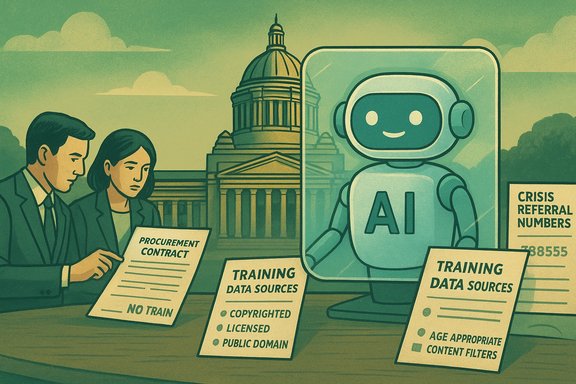
Washington’s proposed companion‑chatbot bill—sponsored in the Senate and the House as part of the Governor’s slate—targets conversational systems marketed or positioned as companions (apps that simulate a friend, romantic partner, or therapeutic presence). The bill requires developers to:- Implement and publicly disclose protocols to detect and respond to self‑harm and suicidal ideation.
- Provide clear crisis‑referral mechanisms and timely connections to licensed crisis services.
- Enforce age‑appropriate filters for sexually explicit content and prohibit manipulative engagement techniques directed at minors.
- Provide transparent notices when users are interacting with an AI rather than a human.
2. Training‑data transparency and provenance (HB 1168 and related measures)
A separate set of bills addresses training‑data transparency for generative models. Sponsors argue transparency about what data went into a model is a practical way to protect intellectual property, help regulators assess bias risk, and allow copyright holders to determine whether licensed or protected materials were used.Key elements proposed include:
- A requirement for developers to publish documentation listing training data sources at an aggregate level (owners, whether copyrighted, licensed, public domain, or purchased).
- Descriptions of whether datasets contain personal data and, if so, what safeguards are in place.
- Thresholds for reporting that focus on large platforms or models meeting specific user counts to balance compliance burdens.
3. Detection tools and “labeling” mandates (HB 1170 and variants)
Some Washington proposals would require large developers to provide or fund free, industry‑standard detection tools to help identify AI‑generated content (images, audio, or text). Sponsors argue that accessible detection lowers the cost of enforcement for rights holders and news organizations, and helps platforms moderate synthetic media.Lawmakers are aware of technical limits and therefore typically aim detection mandates at major providers (for example, models with more than a defined user base) to avoid imposing disproportionate burdens on startups. The bills are often structured to be technology‑neutral and to allow evolving technical standards rather than mandating a single technical fix.
4. Public‑sector procurement, audits, and recordkeeping
Washington proposes operational guardrails for state procurement and use of AI tools:- Government contracts must include explicit clauses on data use, no‑train/non‑derivative commitments, and audit rights.
- Prompt and output logging must be preserved to satisfy public‑records laws and FOIA requests.
- Sensitive data must be routed only to certified, tenant‑isolated enterprise deployments or on‑premise solutions.
- Agencies deploying high‑risk models must run independent third‑party audits and red‑team testing.
Why these proposals matter: strengths and immediate benefits
- Child and consumer protection are prioritized. By singling out companion chatbots and mandating crisis protocols, Washington targets a concrete, politically salient risk where state-level law can intervene rapidly and defensibly. The move aligns with other states that have enacted protections focused on minors.
- Transparency aids accountability. Requiring documentation of training datasets and provenance creates traceable artifacts that can help judges, regulators, and copyright owners evaluate misuse, bias, and IP violation claims. Such requirements also improve public trust and offer a baseline for forensic analysis.
- Operational guardrails reduce systemic vendor risk. Contractual no‑train clauses, tenant isolation, and mandatory logging make public‑sector deployments auditable and limit the downstream risk that state data will be used to improve opaque commercial models. Those steps are realistic and implementable within procurement frameworks already familiar to IT teams.
- Enforcement path is clear. Tying violations to the Consumer Protection Act creates an existing legal mechanism—one that Washington has used for deceptive or unfair trade practices—which can accelerate enforcement without creating a brand‑new regulatory agency.
Technical reality check: what will and won’t work
Washington’s agenda mixes policy and technical prescriptions; not every technical fix is mature or foolproof.- Watermarking and detection are useful but fragile. Invisible or cryptographic watermarks (like Google’s SynthID or Adobe’s Content Credentials) can mark AI‑generated assets, but research and stress‑tests show watermark schemes are not invulnerable. Academic competitions and adversarial research have repeatedly demonstrated watermark removal or evasion techniques, especially as diffusion‑based image editing becomes more powerful. Policymakers should treat watermarking as one tool in a layered strategy—not a silver bullet.
- Training‑data provenance is necessary but hard. Publishing aggregate metadata about training corpora (owners, license status, presence of personal data) is feasible; publishing full lists of individual files is not realistic at scale and raises privacy and security problems. Documentation should be standardized using model cards or dataset manifests so auditors can evaluate risk without forcing commercial disclosure of proprietary information.
- Detection tools have limits. Automated detectors produce false positives and false negatives; adversaries can adapt. Requiring providers to offer detection APIs or tools helps downstream actors, but reliance on detectors alone will not eliminate misuse. Complementary measures—transparency, provenance, public‑education, and enforcement—are needed.
- Human‑in‑the‑loop remains essential. For any high‑stakes decision, humans must retain final authority and verification responsibilities. Models should be used for assistance, not unilateral action, and governments must staff verification roles and audits accordingly.
Legal and political risks: where the bills could run into trouble
- Preemption and federal pushback. At the national level, proposals that would limit state AI regulation have been floated and contested. A federal drive for uniformity—if it advances formulas that bar state action or tie federal funding to a moratorium—could conflict with state laws aimed at protecting consumers and children. Although recent federal votes weakened a full 10‑year moratorium, the political fight is unresolved and could produce legal challenges. Washington’s bills are likely crafted to be defensible, but the preemption question remains a live risk.
- Overbroad or vague definitions. Legal challenges may target imprecise bill language—what counts as a “companion chatbot”? Which models must report training data? Courts often strike down statutes that sweep too broadly or chill legitimate innovation. Drafting precision matters: narrow, targeted definitions of scope, thresholds, and exemptions will make statutes more resilient.
- Compliance cost and economic competitiveness concerns. Transparency and detection mandates impose engineering and legal costs that could favor larger firms with compliance teams. Legislators must balance protecting residents with maintaining a hospitable innovation environment for local startups. Carve‑outs, phased compliance, and technical assistance can help calibrate burdens.
- First Amendment and compelled‑speech questions. Provisions that require models to alter output or to embed specific content could raise constitutional questions; crafting disclosure and provenance requirements—rather than forcing model outputs to change—reduces exposure, but careful legal vetting is necessary.
Practical implementation: recommendations and operational checklist for Washington agencies
- Adopt an AI project registry. Require agencies to log planned AI projects, risk tiers, data inputs, vendor contracts, and retention plans. Use the registry as the basis for audits and KPIs such as inventory completion rate and mean time to remediation.
- Standardize contract clauses now. Negotiate template procurement clauses that include no‑train language, audit rights, model‑version pinning, exportable prompt logs, and rapid breach/incident notification timelines. Require independent third‑party audits for any high‑risk supplier.
- Build technical controls and monitoring. Deploy DLP and role‑based access to block high‑sensitivity prompts from being sent to consumer models. Enforce tenant isolation for enterprise deployments and require immutable logging with export capabilities.
- Run red teams and pilots before scale. Mandate adversarial testing (prompt injection, agent misuse) and staged, time‑bound pilots with public reporting. Use independent evaluators for high‑impact systems.
- Train staff and designate AI stewards. Provide mandatory training for procurement officers, records staff, and program managers. Assign named AI compliance officers to each agency to manage incident response and FOIA obligations.
Likely outcomes and what to watch this session
- Narrow consumer protections are most likely to survive. Measures that directly address child safety, crisis referrals, and deceptive impersonations have strong political support and clearer statutory footing. Washington’s companion‑chatbot bill is positioned to be one of those.
- Transparency measures will be negotiated down. Training‑data disclosure and detection mandates will likely be calibrated to avoid crushing compliance costs for smaller developers; expect thresholds, phased timelines, and technical standard‑setting provisions to be added.
- Contractual procurement rules will become standard. Regardless of statutory outcomes, the state’s procurement offices are likely to adopt the operational recommendations—no‑train clauses, logging, and audit rights—through rulemaking or procurement policy updates.
- Federal/state friction will continue. If Congress or the White House pursues a uniform federal framework that preempts state laws, Washington’s statutes could be litigated or face funding‑conditional pressures. The state’s existing AG and legislative leadership have signaled resistance to broad federal bans, suggesting they will defend state prerogatives.
Final assessment: balanced, pragmatic steps with unavoidable tradeoffs
Washington lawmakers are pursuing a pragmatic middle path: targeted consumer protections where harms are clear, transparency requirements designed to improve accountability, and operational procurement safeguards that make government use auditable. These are reasonable and defensible priorities for a state that wants to protect residents—especially children—without imposing blunt‑force bans that might chill beneficial innovation.At the same time, technical limitations (watermark fragility, detection error rates), definitional complexity, and federal politics will shape the final laws. Policymakers should:
- Build flexible, technology‑neutral standards that can adapt as detection and provenance techniques evolve.
- Phase in requirements with clear compliance timelines and support for smaller developers.
- Embed independent audit and red‑team requirements so rules are verifiable and enforceable.
Washington’s effort is not an endpoint but an early, influential chapter in a national experiment: it tests whether state governments can impose meaningful, enforceable AI guardrails that are both protective and technically realistic. The outcome will matter not only to Washingtonians but to the evolving architecture of AI governance across the United States.
Source: Kiowa County Press https://kiowacountypress.net/content/how-washington-state-lawmakers-want-regulate-ai]
