

Marina Borzova’s PhD work maps a pragmatic route to turn construction and glass waste into high-performance, low-density silica aerogel insulation — not by a single laboratory trick, but through a multiscale programme that combines fundamental gel chemistry, scalable ambient-pressure processing, waste-based silica extraction, and full life‑cycle thinking to make aerogels affordable, circular, and deployable at building scale.
Silica aerogels are among the most thermally insulating solid materials known: nanoporous silica networks trap air in a matrix of extremely low thermal conductivity, giving aerogels thermal performance that outclasses conventional insulation by thickness and R‑value. Yet despite stellar properties, aerogels remain a niche product because of high precursor costs, energy‑intensive drying methods (especially supercritical CO2 drying), and production complexity. Borzova’s thesis and related papers focus squarely on those barriers, proposing a combined pathway of synthesis simplification, raw‑material substitution with waste streams, and lifecycle optimization to bring aerogels closer to mainstream building use.
Borzova’s work takes a multiscale experimental approach to the gelation step, identifying conditions that:
Key LCA findings include:
Key technical and environmental data referenced in the article:
Source: Eindhoven University of Technology Turning waste into high-performance insulation
 Background / Overview
Silica aerogels are among the most thermally insulating solid materials known: nanoporous silica networks trap air in a matrix of extremely low thermal conductivity, giving aerogels thermal performance that outclasses conventional insulation by thickness and R‑value. Yet despite stellar properties, aerogels remain a niche product because of high precursor costs, energy‑intensive drying methods (especially supercritical CO2 drying), and production complexity. Borzova’s thesis and related papers focus squarely on those barriers, proposing a combined pathway of synthesis simplification, raw‑material substitution with waste streams, and lifecycle optimization to bring aerogels closer to mainstream building use. Understanding how silica aerogels form
Gelation chemistry: the levers that control performance and cost
At the material heart of any aerogel is the sol‑gel route: a silica precursor (often tetraethyl orthosilicate, TEOS, or sodium silicate) hydrolyses and condenses to form a wet gel — a continuous solid network swollen with pore liquid. How that network forms (reaction rate, particle aggregation, branched vs. compact clusters) determines pore size distribution, mechanical resilience, and how the gel behaves during drying.Borzova’s work takes a multiscale experimental approach to the gelation step, identifying conditions that:
- reduce the number of process stages,
- limit solvent and reagent consumption, and
- control network topology to improve mechanical robustness during ambient‑pressure drying.
Why controlled gelation matters for ambient‑pressure drying
Ambient‑pressure drying (APD) avoids the costly supercritical or freeze‑drying stages, but it exposes the gel to capillary forces that cause shrinkage and collapse. Contemporary APD success depends on tuning surface chemistry (to reduce capillary stress), network topology (to allow a “spring‑back” recovery), and thermal post‑treatments that restore porosity. Recent studies show that annealing and surface modification can recover volume and open pores after APD — a key enabler for monolithic aerogels made without supercritical equipment. Borzova integrates those chemical controls with APD‑friendly recipes to preserve performance while lowering processing complexity.From waste to high‑performance materials
Which wastes work — and how they become silica precursors
A core contribution of Borzova’s programme is systematic valorization of two abundant demolition and industrial streams:- Mixed soda‑lime glass fractions recovered from municipal and industrial sorting operations, and
- Waste mineral (stone) wool salvaged from demolition and refurbishment.
Performance of waste‑based aerogels: measured results
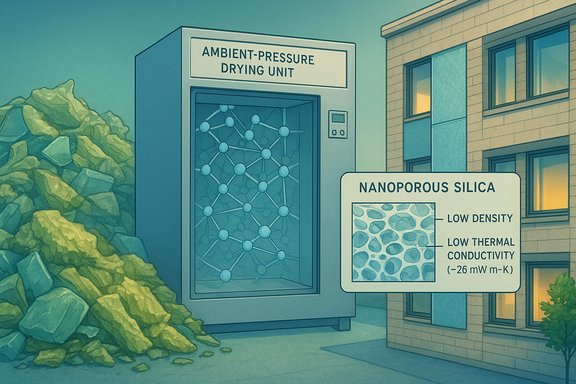
Crucially, the aerogels produced from these waste sources show thermal and structural performance comparable to lab‑grade references:- Aerogels made from waste mineral wool via APD produced hydrophobic monoliths with thermal conductivity in the 22–26 mW·m−1·K−1 range, specific surface area in the 600–675 m2·g−1 band, and bulk densities of roughly 86–136 kg·m−3. Those numbers place waste‑derived aerogels in the same ballpark as many commercial aerogel blankets and panels.
- Aerogels made from mixed waste soda‑lime glass likewise achieved ≈26 mW·m−1·K−1 thermal conductivity, with comparable surface area and density after process tuning and heat treatment. Borzova’s work shows that a 24‑hour alkaline dissolution at around 80 °C (4 M NaOH, L/S ≈10) produces an extract sufficiently pure for APD aerogel synthesis while keeping the route scalable.
Measuring environmental impact and planning for recycling
Life‑cycle assessment: where the environmental burden sits
Turning waste into feedstock adds processing steps, so the sustainability case requires quantitative LCA. Borzova independently (and with collaborators) performed a cradle‑to‑gate life‑cycle assessment comparing laboratory and upscaled industrial scenarios.Key LCA findings include:
- At laboratory scale, electricity use and small‑scale inefficiencies dominate, yielding high impacts (reported examples show ~428 kg CO2‑eq per kg of aerogel produced at bench scale); scaling to an industrialized, optimized plant dramatically reduces that footprint because energy per unit falls with capacity.
- In an upscaled industrial model, the carbon footprint can drop by an order of magnitude (examples report ~34 kg CO2‑eq per kg of aerogel at larger, better‑engineered scale), with raw‑material choices and solvent/reagent recycling becoming the major contributors to residual impact. These LCA numbers highlight two points: the promise of scale economies, and the critical importance of solvent/chemical circulation and energy sourcing in achieving genuine sustainability gains.
End‑of‑life and circularity: design for disassembly and recycling
Borzova extends sustainability thinking to end‑of‑life. Aerogel composites in buildings will face mechanical stresses, moisture cycles, and thermal aging; recycling strategies must recover either silica, reinforcing fibers, or both. Her programme explores:- Chemical methods to dissolve and recover silica from aged aerogel composites,
- Mechanical separation and valorization pathways for embedded fibers (glass, mineral wool, polymeric matrices),
- Process design to minimize hazardous waste streams and enable reagent reuse.
Technical strengths and breakthroughs
- Proven waste feedstocks: Demonstrated conversion of both mixed glass and mineral‑wool waste into silica precursors, backed by peer‑reviewed performance data. These are abundant, geographically dispersed feedstocks that can reduce dependency on virgin chemicals.
- Ambient‑pressure processing: APD routes validated with hydrophobic treatment and thermal post‑annealing give cost and equipment advantages over supercritical drying, enabling decentralised or lower‑capex plants closer to waste sources. APD performance is now supported by mechanistic studies on spring‑back and thermal recovery.
- Quantified LCA at multiple scales: The research provides concrete LCA numbers that show how bench‑scale burdens collapse with industrial scaling — a pragmatic, evidence‑based narrative crucial for investors and policy makers.
- Integration of chemistry and engineering: The programme does not end at lab synthesis; it follows through with process‑level choices (dissolution recipes, liquid‑to‑solid ratios, reaction temperatures) that are chosen with industrial scalability in mind.
Risks, trade‑offs and open challenges
While the work is promising, several practical challenges remain before waste‑based aerogels scale into mainstream construction markets.- Contaminants and feedstock variability: Demolition waste and mixed glass streams vary in composition and contamination (organics, pigments, metal inclusions). Extraction chemistry can tolerate many impurities, but pre‑sorting costs and variable extraction yields can erode the economic calculus. Borzova’s experiments model a range of demolition contamination levels, but large‑scale sorting logistics still require investment.
- Energy and reagent loops: The LCA shows that electricity and raw reagent production dominate impacts unless plants are engineered for solvent recovery and low‑carbon energy supply. Without robust recycling of NaOH, ethanol or other solvents, the environmental advantage of waste feedstock can shrink. Industrial process integration is essential to lock in the benefits observed at scale.
- Manufacturing cost and market acceptance: Aerogels retain a price premium versus fiberglass or mineral wool. Market studies and industry reports consistently show aerogel’s per‑unit cost is higher by multiple factors, even as their superior performance can justify the expense in tight‑space or high‑value applications. Waste‑based feedstock and APD cut cost, but price volatility in chemical markets and capital for new plants will determine how quickly widespread adoption occurs. These market claims are regionally variable and should be treated as indicative rather than absolute.
- Mechanical fragility & installation losses: Aerogels are brittle and can generate waste during installation. Composite design (reinforced blankets, fiber matrices) mitigates this, but retrofit applications present handling challenges that raise effective installed cost relative to nominal material cost. Continued engineering of flexible aerogel composites is necessary to reduce installation waste.
How this research maps to industrial scaling: a practical roadmap
To translate lab success into viable industrial supply, the following sequential steps are logical and supported by Borzova’s findings:- Pilot the extraction and APD synthesis near a reliable waste feedstock (glass recycling plant or demolition processing yard).
- Invest in chemical recovery and solvent circulation systems to minimize fresh reagent inputs and waste emissions.
- Use low‑carbon energy (grid decarbonization or on‑site renewables) to reduce the electricity share of the footprint, which is especially impactful at industrial scale.
- Produce aerogel composites (blankets or panels) rather than monoliths for building retrofit to reduce handling fragility and improve ease of installation.
- Design product assemblies for disassembly so that at end‑of‑life silica and reinforcing fibers can be recaptured economically.
Policy and industry implications
The research is a clear signal to three stakeholder groups:- Industry: Waste processors and insulation manufacturers should evaluate co‑location of extraction and APD synthesis to reduce transport and capture economies of scale. Process R&D should prioritise reagent recycling and product robustness for installation.
- Policymakers: Support for pilot plants (capital grants, low‑interest loans) and procurement rules that value lifecycle carbon savings would accelerate commercial adoption. Waste‑to‑material policies that incentivize high‑value recovery (vs. landfilling) will make industrial feedstocks more reliable and cheaper.
- Standards bodies: Developing test metrics for waste‑derived aerogel panels and specifying end‑of‑life recovery pathways will reduce market friction and ease approval for building codes and green procurement. LCA‑informed standards (including system boundaries that reward solvent recycling and decarbonized energy) are important to prevent perverse outcomes.
What to watch next
- Pilot plant scale‑up data: The step from laboratory to small industrial batches is decisive. Watch for published pilot performance and updated LCA numbers reflecting solvent recovery loops and realistic energy mixes. Current modelling suggests an order‑of‑magnitude drop in kg CO2‑eq per kg aerogel when moving to industrial operations, but those numbers depend on real plant data.
- Composite product rollouts: Expect commercial entrants to first market flexible aerogel blankets and reinforced boards that incorporate recovered silica. These are easiest to install and require less on‑site handling care than brittle monoliths.
- Policy incentives and circular procurement: If large public retrofit programmes tie procurement to lifecycle emissions and material circularity, demand will shift rapidly toward recovered‑input insulation options.
Conclusion
Marina Borzova’s multiscale research demonstrates an actionable path from demolition and glass waste to functional, high‑performance silica aerogel insulation. By combining deep chemical understanding of gelation, pragmatic extraction recipes for mixed glass and mineral wool, ambient‑pressure processing strategies, and rigorous life‑cycle assessment, the programme delivers more than proof‑of‑concept: it supplies a tested blueprint for circular, lower‑carbon aerogel production that industry and policymakers can act on now. The environmental payoff depends on engineering plants for reagent recovery and low‑carbon energy, and the economic case depends on continued advances in composite design to lower handling losses and installation costs — but the core message is clear: waste can be converted into insulation that competes on both performance and sustainability if systems are designed end‑to‑end with circularity in mind.Key technical and environmental data referenced in the article:
- Waste mineral‑wool derived aerogels: thermal conductivity 22–26 mW·m−1·K−1, specific surface area ~603–676 m2·g−1, density ~86–136 kg·m−3.
- Waste glass‑derived aerogels: thermal conductivity ~26 mW·m−1·K−1 after optimized alkaline extraction and APD.
- Life‑cycle modelling sample results: ~428 kg CO2‑eq/kg (lab scale) versus ~34 kg CO2‑eq/kg (upscaled industrial model), highlighting the importance of scale, energy source, and solvent/reagent recovery.
Source: Eindhoven University of Technology Turning waste into high-performance insulation
