

On June 4, 2026, Microsoft published a Canada-focused education story about Waterloo Catholic District School Board educators using Microsoft Copilot and related AI training programs to introduce generative AI through teacher guidance, privacy controls, and classroom pedagogy rather than blanket bans. The piece is corporate storytelling, but it lands on a real fault line in education: schools are past the point where pretending AI can be kept outside the classroom is a strategy. The practical question now is whether districts can make AI boring enough, governed enough, and human enough to serve learning instead of swallowing it. Waterloo’s answer is not “let the machines teach,” but something more durable: put teachers in front, keep approved tools inside a trust boundary, and treat AI literacy as part of modern schooling.
Microsoft’s story is nominally about educators in Canada, but it is also about the company’s broader effort to make Copilot feel less like a workplace productivity product and more like basic public infrastructure for an AI-shaped society. That shift matters. If Microsoft can persuade schools that Copilot is the safe, sanctioned route through generative AI, it wins more than product adoption; it helps define the habits of the next generation of workers.
The Waterloo Catholic District School Board example is useful because it avoids the cartoon version of AI in education. The teachers and consultants in the story are not promising a classroom revolution where AI tutors replace instructors, grade every assignment, and personalize learning into submission. Instead, they describe a slower, messier institutional process: frightened educators, curious students, anxious families, privacy reviews, professional development, and a growing recognition that banning AI tools can become an unwinnable game of whack-a-mole.
That framing is also convenient for Microsoft. The company can present Copilot as the respectable middle path between unmanaged consumer chatbots and institutional paralysis. It is a familiar enterprise play: the technology is already here, so the vendor’s approved, managed, policy-friendly version becomes the safest way to cope with it.
The uncomfortable truth for schools is that Microsoft is not wrong about the first half. Generative AI is already in the classroom, whether administrators have a policy or not. Students can reach it from phones, home computers, browser extensions, search engines, writing tools, and study apps. A district that says “no AI” without building literacy and norms is often just outsourcing the decision to whatever tool a student discovers first.
Education has been here before. Calculators, Wikipedia, smartphones, cloud documents, translation tools, and search engines all arrived first as threats to assessment and attention. Each forced schools to separate the skill worth teaching from the tool newly available. Sometimes schools adjusted well; sometimes they simply recreated old anxieties in new policy language.
Generative AI is more destabilizing because it does not merely retrieve information or accelerate calculation. It can produce plausible prose, summarize readings, generate code, draft lab reports, explain concepts, fabricate sources, and imitate the surface features of student work. That makes it unusually corrosive to traditional homework and take-home assessment, especially when those assignments were already measuring compliance as much as understanding.
A ban can still have a place in particular contexts. A teacher can prohibit AI on a diagnostic writing sample, a math proof, or an assessment meant to capture unaided reasoning. But as a system-wide posture, prohibition is brittle. It turns every teacher into an investigator and every student into a suspect, while doing little to prepare either group for a world in which AI-assisted work is increasingly normal.
Waterloo’s approach, as described by Microsoft, is more realistic because it starts from exposure rather than denial. The district appears to be saying that if AI will be present, the job is to make its use visible, bounded, and connected to learning goals. That is less emotionally satisfying than a ban, but it is much closer to governance.
That test cuts against both hype and panic. A teacher using Copilot to draft three versions of a reading prompt for students at different levels may be doing sensible instructional work. A student asking a chatbot to write a reflection they never reflected on is probably bypassing the learning. A department using AI to create a first draft of a rubric may save time. A school using AI-generated feedback as a substitute for teacher judgment would be taking a very different step.
The Microsoft piece emphasizes lesson planning, classroom materials, adaptation, and teacher workflow. Those are the least controversial early uses of generative AI in schools because they keep the educator as editor, evaluator, and accountable professional. They also match the way many workers are actually adopting AI: not as an autonomous agent, but as a drafting and brainstorming layer.
That distinction matters for WindowsForum readers because it is the same divide IT departments face with Copilot in business environments. The risk is not merely whether the tool can answer a question. The risk is whether the organization understands what data it can access, what outputs require review, how users are trained, and where accountability remains human. Schools are now having the same conversation as enterprises, only with minors, parents, curriculum standards, and assessment integrity layered on top.
Student information is not ordinary productivity data. It can include names, grades, learning accommodations, behavioral notes, family circumstances, health-related information, and identifiers tied to children. An educator pasting that information into an unapproved AI tool may be trying to help a student, but good intentions do not erase governance failures.
This is where Microsoft’s argument for trusted platforms becomes strongest. A managed tool inside an education tenant, subject to administrative controls and institutional policy, is a very different proposition from a random AI website that collects prompts under opaque terms. That does not make Copilot magic, and it does not absolve schools from scrutiny. It does mean the platform question is not just procurement bureaucracy; it is part of student safety.
For IT administrators, the lesson is familiar. Shadow AI grows when official tools are absent, slow, confusing, or over-restricted. Users do not stop experimenting; they just move experimentation into places the organization cannot see. In a school board, that shadow behavior can expose student data and undermine trust with families.
The better path is neither permissive chaos nor lockdown theater. It is a defined set of approved tools, clear examples of acceptable and unacceptable use, ongoing training, and a culture where teachers can ask questions without being treated as reckless. That seems to be the model Waterloo is trying to build.
Teaching is an act of judgment under changing conditions. The teacher reads the room, notices confusion, decides when to slow down, knows which student is masking uncertainty, adapts examples, handles conflict, interprets silence, and connects content to lives that are not reducible to prompt variables. AI can assist pieces of that work, but it does not inhabit the classroom community.
Steve Bryson’s use case in the Microsoft story illustrates the better version of AI adoption. He describes using Copilot to streamline planning and generate materials so he has more time to interact with students. That is the productivity argument at its most defensible: not “do more with less” as a budget slogan, but “spend less time on repetitive preparation and more time on human instruction.”
Still, schools should be wary of how quickly that argument can be inverted. If AI helps teachers reclaim time, it can be a professional tool. If administrators use AI as proof that teachers should absorb more students, more documentation, more differentiation, and more unpaid complexity, the technology becomes another instrument of overload.
This is why “human-led AI” has to mean more than a warm phrase in a case study. It has to show up in staffing decisions, workload expectations, assessment design, and professional autonomy. A teacher who is merely supervising machine-generated content at industrial scale is not leading AI; they are being managed by it.
Traditional homework has always been an imperfect signal. Parents help, tutors intervene, students collaborate, and the internet has long supplied shortcuts. Generative AI intensifies the problem because it can produce customized, plausible work that resembles learning. It does not just give students an answer; it can give them an answer in the requested tone, format, and length.
That forces schools to ask what they actually want to assess. If the goal is polished prose, AI complicates the picture. If the goal is reasoning, teachers may need more in-class writing, oral defense, process logs, drafts, conferences, demonstrations, and assignments rooted in local or personal context. If the goal is responsible tool use, then students need to disclose, critique, and revise AI assistance rather than pretend it never happened.
This is not a small adjustment. It asks teachers to redesign tasks while also learning the technology and managing policy ambiguity. It also asks parents and universities to accept that the familiar markers of academic rigor may need to change.
The temptation will be to buy detection tools and declare the problem solved. That would be a mistake. AI detectors have a troubled history, especially with false positives and uneven performance across writing styles. A school culture built around accusing students based on probabilistic detection is not a stable foundation for trust.
The harder but better answer is assessment redesign. That does not mean every assignment must become an elaborate project. It means teachers need enough time, training, and institutional permission to align assessment with a world in which first drafts are cheap and authentic thinking is more valuable.
That is not inherently bad. Schools need help, and Microsoft has the money, infrastructure, and enterprise credibility to provide it. Many districts already run on Microsoft 365, Teams, Intune, Entra, Windows, and related services. For those environments, Copilot can appear as an incremental extension rather than a new foreign object.
But vendor-led literacy has limits. A curriculum about responsible AI should not be indistinguishable from onboarding to a product suite. Students need to understand model limitations, bias, hallucination, data privacy, labor implications, environmental costs, copyright disputes, and the economics of platform dependency. Those subjects are bigger than any one vendor’s approved tool.
The risk is subtle. If schools teach AI primarily through one company’s interface, students may learn a managed workflow without developing broader technological judgment. That would be the opposite of the human-led approach Microsoft is praising.
The best version of Microsoft’s involvement is as infrastructure plus training, not ideology. Copilot can be one classroom tool; it should not become the definition of AI literacy. Educators need room to compare systems, critique outputs, and discuss the business incentives behind the tools students are being asked to use.
The Catholic school context adds another layer. Values language around human dignity, ethical use, community, and responsibility can provide a framework for AI decisions that is not merely technical. Whether one shares that religious framework or not, the broader point holds: schools need a moral vocabulary for AI, not just an acceptable-use checklist.
AI in education is ultimately about power. Who gets to decide what counts as learning? Who benefits when teacher labor is automated? Who is protected when student data flows through platforms? Who is disadvantaged when AI tools reflect biased assumptions or when access differs by income, device, or language?
Those questions cannot be answered by IT alone. They require teachers, students, families, administrators, privacy officers, accessibility specialists, and policymakers. The Waterloo story is interesting because it shows AI adoption as a conversation among those groups rather than a software rollout with a training webinar attached.
For Windows enthusiasts and IT pros, that may sound inefficient. In reality, it is what durable adoption looks like. The fastest deployment is not always the one that survives contact with users.
That student concern deserves more weight. Young people are being told, often in the same breath, that AI will transform work, that they must learn to use it, that it may automate entry-level tasks, and that cheating with it will undermine their education. No wonder the future looks unstable.
Schools should resist reducing AI literacy to employability. Preparing students for future jobs matters, but education is not merely workforce pre-processing. Students also need to know how to judge information, protect themselves, recognize manipulation, understand automation, and preserve their own agency when systems can generate persuasive content at scale.
The human skills McKinley emphasizes — critical thinking, problem solving, creativity, adaptability — are not soft extras. They are the point. AI makes them more important because it increases the volume of plausible material while weakening the old assumption that effort and output are visibly connected.
A student who can prompt a model but cannot evaluate the result is dependent. A student who can critique, revise, question, contextualize, and decide when not to use AI is learning something more durable. That is the difference between tool fluency and education.
Guided adoption has visible policies, approved platforms, teacher training, privacy rules, and assessment redesign. It gives students a language for disclosure and gives teachers enough confidence to use AI without pretending to be experts overnight. It also creates channels for revising policy as the tools change.
Unguided adoption is what happens when institutions move too slowly. Students use whatever is available. Teachers quietly experiment with personal accounts. Administrators issue broad statements that do not match classroom reality. Parents receive mixed messages, and IT teams discover data flows after the fact.
Microsoft’s story presents Waterloo Catholic as an example of guided adoption. That may be polished corporate framing, but the underlying model is sound. The safest AI environment is not the one where no one uses AI. It is the one where use is legible, bounded, and teachable.
For sysadmins, that means procurement and identity management are only the start. The deeper work is policy translation: turning abstract privacy and responsible-use principles into everyday decisions a teacher can make at 9:15 p.m. while preparing tomorrow’s lesson. If the policy cannot survive that moment, it is not operational.
That is where the next few years of education technology will be decided. If schools treat AI as a shortcut, it will cheapen learning and intensify surveillance. If they treat it as a governed tool inside a teacher-led culture, it may do something more modest and more valuable: give educators back time, give students better questions, and make digital literacy honest about the world students already inhabit.
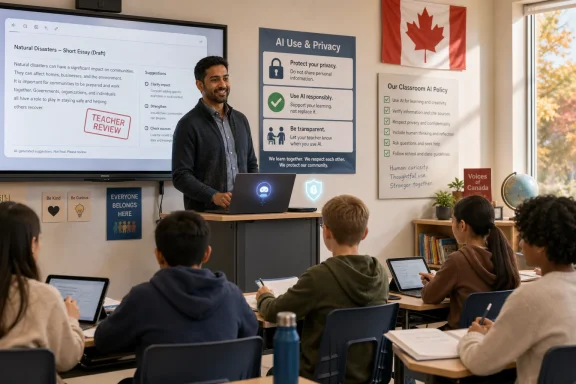 Microsoft Finds Its Best AI Education Pitch in the Classroom, Not the Data Center
Microsoft’s story is nominally about educators in Canada, but it is also about the company’s broader effort to make Copilot feel less like a workplace productivity product and more like basic public infrastructure for an AI-shaped society. That shift matters. If Microsoft can persuade schools that Copilot is the safe, sanctioned route through generative AI, it wins more than product adoption; it helps define the habits of the next generation of workers.The Waterloo Catholic District School Board example is useful because it avoids the cartoon version of AI in education. The teachers and consultants in the story are not promising a classroom revolution where AI tutors replace instructors, grade every assignment, and personalize learning into submission. Instead, they describe a slower, messier institutional process: frightened educators, curious students, anxious families, privacy reviews, professional development, and a growing recognition that banning AI tools can become an unwinnable game of whack-a-mole.
That framing is also convenient for Microsoft. The company can present Copilot as the respectable middle path between unmanaged consumer chatbots and institutional paralysis. It is a familiar enterprise play: the technology is already here, so the vendor’s approved, managed, policy-friendly version becomes the safest way to cope with it.
The uncomfortable truth for schools is that Microsoft is not wrong about the first half. Generative AI is already in the classroom, whether administrators have a policy or not. Students can reach it from phones, home computers, browser extensions, search engines, writing tools, and study apps. A district that says “no AI” without building literacy and norms is often just outsourcing the decision to whatever tool a student discovers first.
The Ban Was Always the Weakest Form of Control
The most telling line from the Microsoft piece is not the praise for Copilot. It is Katrina Gouett’s observation that banning AI tools would become whack-a-mole. That is the sentence every school system has either said out loud, whispered internally, or learned the hard way.Education has been here before. Calculators, Wikipedia, smartphones, cloud documents, translation tools, and search engines all arrived first as threats to assessment and attention. Each forced schools to separate the skill worth teaching from the tool newly available. Sometimes schools adjusted well; sometimes they simply recreated old anxieties in new policy language.
Generative AI is more destabilizing because it does not merely retrieve information or accelerate calculation. It can produce plausible prose, summarize readings, generate code, draft lab reports, explain concepts, fabricate sources, and imitate the surface features of student work. That makes it unusually corrosive to traditional homework and take-home assessment, especially when those assignments were already measuring compliance as much as understanding.
A ban can still have a place in particular contexts. A teacher can prohibit AI on a diagnostic writing sample, a math proof, or an assessment meant to capture unaided reasoning. But as a system-wide posture, prohibition is brittle. It turns every teacher into an investigator and every student into a suspect, while doing little to prepare either group for a world in which AI-assisted work is increasingly normal.
Waterloo’s approach, as described by Microsoft, is more realistic because it starts from exposure rather than denial. The district appears to be saying that if AI will be present, the job is to make its use visible, bounded, and connected to learning goals. That is less emotionally satisfying than a ban, but it is much closer to governance.
“Pedagogy First” Is the Right Slogan Because It Implies a Test
The phrase “pedagogy first, tool second” can sound like the kind of slogan vendors and school boards reach for when everyone wants reassurance. But it is also a useful test. If an AI use case cannot explain what teaching problem it solves, it probably should not be in the lesson.That test cuts against both hype and panic. A teacher using Copilot to draft three versions of a reading prompt for students at different levels may be doing sensible instructional work. A student asking a chatbot to write a reflection they never reflected on is probably bypassing the learning. A department using AI to create a first draft of a rubric may save time. A school using AI-generated feedback as a substitute for teacher judgment would be taking a very different step.
The Microsoft piece emphasizes lesson planning, classroom materials, adaptation, and teacher workflow. Those are the least controversial early uses of generative AI in schools because they keep the educator as editor, evaluator, and accountable professional. They also match the way many workers are actually adopting AI: not as an autonomous agent, but as a drafting and brainstorming layer.
That distinction matters for WindowsForum readers because it is the same divide IT departments face with Copilot in business environments. The risk is not merely whether the tool can answer a question. The risk is whether the organization understands what data it can access, what outputs require review, how users are trained, and where accountability remains human. Schools are now having the same conversation as enterprises, only with minors, parents, curriculum standards, and assessment integrity layered on top.
Privacy Is the Part of AI Literacy Schools Cannot Treat as Optional
The Waterloo educators’ concern about student privacy is the most important practical issue in the story. It is easy to talk about AI in education as a philosophical debate over cheating or creativity. It is harder, and more necessary, to talk about data handling.Student information is not ordinary productivity data. It can include names, grades, learning accommodations, behavioral notes, family circumstances, health-related information, and identifiers tied to children. An educator pasting that information into an unapproved AI tool may be trying to help a student, but good intentions do not erase governance failures.
This is where Microsoft’s argument for trusted platforms becomes strongest. A managed tool inside an education tenant, subject to administrative controls and institutional policy, is a very different proposition from a random AI website that collects prompts under opaque terms. That does not make Copilot magic, and it does not absolve schools from scrutiny. It does mean the platform question is not just procurement bureaucracy; it is part of student safety.
For IT administrators, the lesson is familiar. Shadow AI grows when official tools are absent, slow, confusing, or over-restricted. Users do not stop experimenting; they just move experimentation into places the organization cannot see. In a school board, that shadow behavior can expose student data and undermine trust with families.
The better path is neither permissive chaos nor lockdown theater. It is a defined set of approved tools, clear examples of acceptable and unacceptable use, ongoing training, and a culture where teachers can ask questions without being treated as reckless. That seems to be the model Waterloo is trying to build.
The Teacher Becomes More Important When the Machine Gets More Fluent
A strange thing happens when generative AI gets better: the teacher’s role becomes easier to underestimate and harder to replace. If a chatbot can produce a lesson outline in seconds, the casual observer may wonder why lesson planning needed so much human effort in the first place. Any experienced educator knows the answer: the outline is not the lesson.Teaching is an act of judgment under changing conditions. The teacher reads the room, notices confusion, decides when to slow down, knows which student is masking uncertainty, adapts examples, handles conflict, interprets silence, and connects content to lives that are not reducible to prompt variables. AI can assist pieces of that work, but it does not inhabit the classroom community.
Steve Bryson’s use case in the Microsoft story illustrates the better version of AI adoption. He describes using Copilot to streamline planning and generate materials so he has more time to interact with students. That is the productivity argument at its most defensible: not “do more with less” as a budget slogan, but “spend less time on repetitive preparation and more time on human instruction.”
Still, schools should be wary of how quickly that argument can be inverted. If AI helps teachers reclaim time, it can be a professional tool. If administrators use AI as proof that teachers should absorb more students, more documentation, more differentiation, and more unpaid complexity, the technology becomes another instrument of overload.
This is why “human-led AI” has to mean more than a warm phrase in a case study. It has to show up in staffing decisions, workload expectations, assessment design, and professional autonomy. A teacher who is merely supervising machine-generated content at industrial scale is not leading AI; they are being managed by it.
Assessment Is Where the Old School Model Breaks First
The Microsoft article touches on assessment anxiety, and rightly so. For many educators, AI did not first appear as an exciting creative tool. It appeared as a threat to the credibility of student work.Traditional homework has always been an imperfect signal. Parents help, tutors intervene, students collaborate, and the internet has long supplied shortcuts. Generative AI intensifies the problem because it can produce customized, plausible work that resembles learning. It does not just give students an answer; it can give them an answer in the requested tone, format, and length.
That forces schools to ask what they actually want to assess. If the goal is polished prose, AI complicates the picture. If the goal is reasoning, teachers may need more in-class writing, oral defense, process logs, drafts, conferences, demonstrations, and assignments rooted in local or personal context. If the goal is responsible tool use, then students need to disclose, critique, and revise AI assistance rather than pretend it never happened.
This is not a small adjustment. It asks teachers to redesign tasks while also learning the technology and managing policy ambiguity. It also asks parents and universities to accept that the familiar markers of academic rigor may need to change.
The temptation will be to buy detection tools and declare the problem solved. That would be a mistake. AI detectors have a troubled history, especially with false positives and uneven performance across writing styles. A school culture built around accusing students based on probabilistic detection is not a stable foundation for trust.
The harder but better answer is assessment redesign. That does not mean every assignment must become an elaborate project. It means teachers need enough time, training, and institutional permission to align assessment with a world in which first drafts are cheap and authentic thinking is more valuable.
Microsoft’s Education Push Is Also a Platform Strategy
It would be naive to read Microsoft’s story only as an education article. It is also a platform narrative. Microsoft Elevate for Educators, Copilot, Microsoft Learn, education credentials, and AI literacy programs all reinforce a larger ecosystem in which Microsoft supplies the tools, the training language, the professional community, and the trust framework.That is not inherently bad. Schools need help, and Microsoft has the money, infrastructure, and enterprise credibility to provide it. Many districts already run on Microsoft 365, Teams, Intune, Entra, Windows, and related services. For those environments, Copilot can appear as an incremental extension rather than a new foreign object.
But vendor-led literacy has limits. A curriculum about responsible AI should not be indistinguishable from onboarding to a product suite. Students need to understand model limitations, bias, hallucination, data privacy, labor implications, environmental costs, copyright disputes, and the economics of platform dependency. Those subjects are bigger than any one vendor’s approved tool.
The risk is subtle. If schools teach AI primarily through one company’s interface, students may learn a managed workflow without developing broader technological judgment. That would be the opposite of the human-led approach Microsoft is praising.
The best version of Microsoft’s involvement is as infrastructure plus training, not ideology. Copilot can be one classroom tool; it should not become the definition of AI literacy. Educators need room to compare systems, critique outputs, and discuss the business incentives behind the tools students are being asked to use.
The Canadian Context Makes the Governance Problem More Visible
Canada’s education systems are not uniform, and school boards operate within provincial rules, local expectations, and institutional cultures. That fragmentation can slow adoption, but it can also encourage practical experimentation. Waterloo Catholic’s approach is one example of a board trying to create guidance before every classroom improvises its own rules.The Catholic school context adds another layer. Values language around human dignity, ethical use, community, and responsibility can provide a framework for AI decisions that is not merely technical. Whether one shares that religious framework or not, the broader point holds: schools need a moral vocabulary for AI, not just an acceptable-use checklist.
AI in education is ultimately about power. Who gets to decide what counts as learning? Who benefits when teacher labor is automated? Who is protected when student data flows through platforms? Who is disadvantaged when AI tools reflect biased assumptions or when access differs by income, device, or language?
Those questions cannot be answered by IT alone. They require teachers, students, families, administrators, privacy officers, accessibility specialists, and policymakers. The Waterloo story is interesting because it shows AI adoption as a conversation among those groups rather than a software rollout with a training webinar attached.
For Windows enthusiasts and IT pros, that may sound inefficient. In reality, it is what durable adoption looks like. The fastest deployment is not always the one that survives contact with users.
Students Are Not Just Future Workers in Training
One of the more revealing moments in Microsoft’s article is the contrast between administrators, teachers, and students. Administrators focused on efficiency. Teachers focused on assessment. Students worried about the future.That student concern deserves more weight. Young people are being told, often in the same breath, that AI will transform work, that they must learn to use it, that it may automate entry-level tasks, and that cheating with it will undermine their education. No wonder the future looks unstable.
Schools should resist reducing AI literacy to employability. Preparing students for future jobs matters, but education is not merely workforce pre-processing. Students also need to know how to judge information, protect themselves, recognize manipulation, understand automation, and preserve their own agency when systems can generate persuasive content at scale.
The human skills McKinley emphasizes — critical thinking, problem solving, creativity, adaptability — are not soft extras. They are the point. AI makes them more important because it increases the volume of plausible material while weakening the old assumption that effort and output are visibly connected.
A student who can prompt a model but cannot evaluate the result is dependent. A student who can critique, revise, question, contextualize, and decide when not to use AI is learning something more durable. That is the difference between tool fluency and education.
The Real Divide Will Be Between Guided AI and Unsupervised AI
The next stage of AI in schools will not be a simple divide between districts that use AI and districts that do not. The real divide will be between guided and unguided adoption.Guided adoption has visible policies, approved platforms, teacher training, privacy rules, and assessment redesign. It gives students a language for disclosure and gives teachers enough confidence to use AI without pretending to be experts overnight. It also creates channels for revising policy as the tools change.
Unguided adoption is what happens when institutions move too slowly. Students use whatever is available. Teachers quietly experiment with personal accounts. Administrators issue broad statements that do not match classroom reality. Parents receive mixed messages, and IT teams discover data flows after the fact.
Microsoft’s story presents Waterloo Catholic as an example of guided adoption. That may be polished corporate framing, but the underlying model is sound. The safest AI environment is not the one where no one uses AI. It is the one where use is legible, bounded, and teachable.
For sysadmins, that means procurement and identity management are only the start. The deeper work is policy translation: turning abstract privacy and responsible-use principles into everyday decisions a teacher can make at 9:15 p.m. while preparing tomorrow’s lesson. If the policy cannot survive that moment, it is not operational.
Waterloo’s AI Lesson Is Smaller Than the Hype and Bigger Than the Tool
The concrete message from this Canadian case study is not that every classroom needs Copilot tomorrow. It is that AI adoption in schools succeeds or fails at the layer where pedagogy, privacy, workload, and trust meet. That is a more demanding standard than either the boosters or the banners usually admit.- Schools cannot ban their way out of generative AI, because students and staff already have access to powerful tools outside institutional control.
- Approved AI platforms reduce some privacy and security risks, but they do not replace the need for clear local rules and professional judgment.
- The best early classroom uses keep teachers in charge of planning, adaptation, feedback, and accountability.
- Assessment needs redesign because AI makes polished take-home output a weaker proxy for student understanding.
- Vendor programs can accelerate AI literacy, but schools should teach students to critique platforms rather than merely operate them.
- The central promise of AI in education is not automation for its own sake, but more time and space for human teaching.
That is where the next few years of education technology will be decided. If schools treat AI as a shortcut, it will cheapen learning and intensify surveillance. If they treat it as a governed tool inside a teacher-led culture, it may do something more modest and more valuable: give educators back time, give students better questions, and make digital literacy honest about the world students already inhabit.
References
- Primary source: Microsoft Source
Published: Thu, 04 Jun 2026 15:53:13 GMT
- Official source: microsoft.com

Introducing Microsoft innovations and programs to support AI-powered teaching and learning | Microsoft Education Blog
Announcing Microsoft Elevate for Educators—connecting educators, community, professional learning, and AI tools to enhance teaching. Join us.www.microsoft.com - Official source: blogs.microsoft.com

Building AI infrastructure the Community-First way in Canada
Discover how Microsoft is putting AI commitments into action through a Community‑First infrastructure approach tailored to Canada’s communities and institutions. blogs.microsoft.com
- Official source: elevateforeducators.microsoft.com
Microsoft Elevate for Educators
elevateforeducators.microsoft.com
- Official source: learn.microsoft.com
Create and Engage with AI - Training
Educators use AI as creative partners maintaining critical judgment and responsible practice using guided experiences and practices grounded in the AI Literacy Framework.learn.microsoft.com - Related coverage: ncce.org
New Microsoft Elevate for Educators program - NCCE
NCCE serves educational institutions across the globe providing professional learning opportunities. NCCE embraces every opportunity to work closely with schools and districts of any size to ensure delivery of relevant and rigorous professional learning experiences. ncce.org


- Official source: cdn-dynmedia-1.microsoft.com
- Related coverage: educatorstechnology.com