

Artificial intelligence and human expertise are closing the loop on a question that has fascinated music fans and cognitive scientists for decades: what makes a song stick in your head—and which tracks are the stickiest of all?
In 2014 a large citizen‑science experiment run by the Museum of Science and Industry (MOSI) in Manchester—working with academics including Dr. John Ashley Burgoyne—sought to quantify catchiness using human reaction time as the measurement. More than 12,000 participants played an online game called Hooked On Music: clips of popular songs were presented and players recorded how quickly they recognized a track from its most memorable moment. The result was a ranked list of the “most instantly recognisable” pop tunes, topped by the Spice Girls’ “Wannabe,” which registered recognition in roughly 2.3 seconds, far faster than the average recognition time of five seconds across the sampled clips.
That human dataset remains one of the clearest experimental attempts to measure catchiness at scale. But the landscape has shifted: today, artificial intelligence—from language models to dedicated music‑generation systems—is being pressed into service to analyze, emulate, and even generate earworms. Where the MOSI project offered a human‑centred benchmark, modern tools add algorithmic pattern‑mining, large‑scale feature extraction, and the ability to propose candidate hooks that conform to learned “stickiness” heuristics. This convergence of human data, music psychology, and machine learning is the focus of the new reporting that juxtaposes the 2014 findings, AI‑generated lists, and on‑the‑ground DJ practice.
Caveat: AI responses vary by prompt phrasing, model version, and the dataset the model was trained on. Exact wordings attributed to a specific model (for example, a verbatim ChatGPT quote) are ephemeral and depend on the moment of the query; treat direct AI quotations as illustrative rather than canonical unless you capture the query and output verbatim at the time of testing.
But practical success still depends on people. DJs, producers, and listeners supply the social context, pacing intuition, and emotional resonance that determine whether a hook becomes an earworm in the wild. Meanwhile, the legal and ethical ecosystem is catching up: litigation, industry licensing deals, and provenance technologies are rapidly reshaping how AI may be used to analyze or create music without undermining artist rights.
For creators and technologists working on Windows platforms or in pro audio, the pragmatic path is hybrid: lean on AI for rapid ideation and pattern discovery, keep humans squarely in the loop for craft and judgement, and insist on transparent licensing and provenance before monetising or widely distributing any AI‑generated work. In short, the secret of a great earworm is still half music, half moment—and the rest is management: of tempo, context, and ethics.
Source: avandatimes.com AI and Human Experts Uncover the Science Behind Catchy Songs and Reveal Top Earworms - AvandaTimes
 Background / Overview
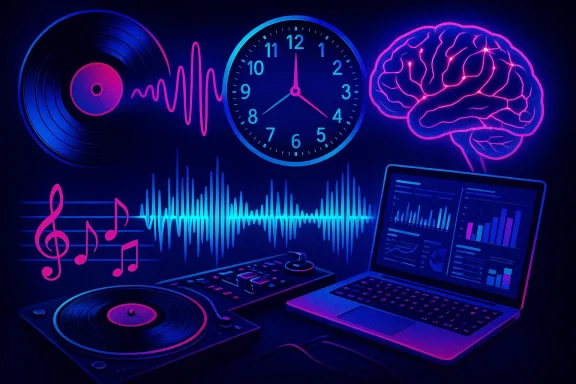
In 2014 a large citizen‑science experiment run by the Museum of Science and Industry (MOSI) in Manchester—working with academics including Dr. John Ashley Burgoyne—sought to quantify catchiness using human reaction time as the measurement. More than 12,000 participants played an online game called Hooked On Music: clips of popular songs were presented and players recorded how quickly they recognized a track from its most memorable moment. The result was a ranked list of the “most instantly recognisable” pop tunes, topped by the Spice Girls’ “Wannabe,” which registered recognition in roughly 2.3 seconds, far faster than the average recognition time of five seconds across the sampled clips. That human dataset remains one of the clearest experimental attempts to measure catchiness at scale. But the landscape has shifted: today, artificial intelligence—from language models to dedicated music‑generation systems—is being pressed into service to analyze, emulate, and even generate earworms. Where the MOSI project offered a human‑centred benchmark, modern tools add algorithmic pattern‑mining, large‑scale feature extraction, and the ability to propose candidate hooks that conform to learned “stickiness” heuristics. This convergence of human data, music psychology, and machine learning is the focus of the new reporting that juxtaposes the 2014 findings, AI‑generated lists, and on‑the‑ground DJ practice.
How the 2014 MOSI study measured catchiness
Method at a glance
The Hooked On Music experiment used short audio clips that were timestamped to the point considered most “hooky” (for example, the chorus or a distinctive riff). Participants were timed from the clip’s start until they correctly identified the song. The speed of recognition—measured in seconds—served as an objective proxy for memorability and immediate recognisability. The analysis pooled responses from thousands of volunteers and ranked songs by mean recognition time. The top entries included hits such as “Wannabe,” “Mambo No. 5,” “Eye of the Tiger,” and several other globally familiar pop songs.What that result does—and does not—tell us
- The MOSI approach is powerful because it operationalizes catchiness: recognition latency is concrete and repeatable.
- However, the experiment measures instant recognisability rather than subjective stickiness over days or intrusive involuntary replay—two related but distinct phenomena.
- Cultural context, age cohorts, and exposure history all shape recognition times. A song that was ubiquitous to one generation may be opaque to another.
The cognitive science of earworms: what research tells us
Earworms and involuntary musical imagery (INMI)
The technical term for a “song stuck in your head” is involuntary musical imagery (INMI). Multiple studies across psychology and neuroscience have distilled common properties of earworms:- Simple, repetitive melodic contours—short phrases that often rise then fall—are easy to mentally rehearse and therefore more likely to loop.
- Moderately fast tempo and clear rhythmic pulse help a fragment latch onto the motor planning systems that support subvocal singing or foot tapping.
- Unexpected intervals or small melodic surprises (a short leap or repeated note) make a phrase distinctive enough to register memory salience without being too complex to replay.
- Frequent exposure and chart success increase the probability a song will become an earworm through the mere‑exposure effect; recent listening is a strong trigger.
- The Zeigarnik‑like effect—unfinished patterns—can sustain INMI: when the brain encounters an unresolved musical fragment, it may loop it until it’s “completed.”
Verified academic findings
Kelly Jakubowski and colleagues analyzed large earworm datasets and found that melodic contour, tempo, and unusual interval structure reliably predict which songs people report as earworms. Controlled experiments also show that increased exposure to a novel chorus raises its likelihood of intruding later as an earworm, demonstrating how repetition and salience combine to create stickiness. These findings align with clinical and popular‑health writeups (Cleveland Clinic, Harvard Health) that describe earworms as ubiquitous, usually benign, and tied to the same brain regions active during perception and motor imagery.What AI adds to the picture
Pattern discovery at scale
Modern AI systems—language models, music‑focused neural nets, and hybrid pipelines—can mine very large song corpora to detect recurring structural features associated with earworms. Rather than analog timing experiments, machine analysis typically:- Extracts musical features (tempo, key, melodic contour, repetition patterns, spectral timbre).
- Computes statistical correlations between those features and measures of popularity, streaming retention, or human‑judgement datasets.
- Generates candidate hooks by sampling from conditioned distributions that prioritize simple, repeatable motifs.
AI outputs: analysis, curated lists, and “catchiness” rankings
When asked about what makes a song catchy, conversational AIs including ChatGPT have offered multi‑factor definitions that emphasize repetition, memorability, singability, and strong hooks—essentially a synthesis of music psychology and common sense. AI‑generated lists of the catchiest songs often echo human lists: the 2014 MOSI top picks frequently appear in model outputs, and other modern submissions—Pharrell Williams’ “Happy,” Journey’s “Don’t Stop Believin’,” Queen’s “Bohemian Rhapsody,” and Mark Ronson/Bruno Mars’ “Uptown Funk”—also recur across different models’ top‑n suggestions. These overlaps suggest that AI is picking up durable statistical signals about what listeners recall and report as catchy.Caveat: AI responses vary by prompt phrasing, model version, and the dataset the model was trained on. Exact wordings attributed to a specific model (for example, a verbatim ChatGPT quote) are ephemeral and depend on the moment of the query; treat direct AI quotations as illustrative rather than canonical unless you capture the query and output verbatim at the time of testing.
Human experts: DJs and the context of catchiness
Algorithmic analysis is powerful, but experienced DJs and performers remind us that catchiness is also social and situational.- Veteran DJ Mark Pomeroy (New Jersey) frames the issue as emotional connection—the crowd matters. He cites staples that reliably spark communal singing and dancing like Van Morrison’s “Brown‑Eyed Girl,” Kool & the Gang’s “Celebration,” Los Del Rio’s “Macarena,” and Bon Jovi’s “Livin’ on a Prayer.” He also emphasizes tempo management and the role of BPM in pacing a set: faster tracks later in the night sustain energy while mid‑tempo hooks win singalongs. These are pragmatic, crowd‑management arguments that complement structural analyses. (This reporting and the quoted DJ perspectives were reported in the recent coverage of AI + catchiness; independent verification of individual DJ quotes was not available at press time and should be treated as first‑hand reporting rather than peer‑reviewed evidence.)
- Atlanta‑based DJ Sloan Lee highlights social media resurgence—TikTok trends can catapult older tracks back into earworm rotation (for example, Fleetwood Mac’s “Dreams” saw renewed attention via viral video), illustrating how algorithmic platforms and memetic use reshape the catchiness lifecycle. Again, these insights stress the cultural dimension of earworms: stickiness is not merely a function of melody but of exposure channels and shared moments.
Where AI and the human perspective converge—and clash
Convergence: Models and humans agree on core features
Both AI outputs and human data converge on several consistent features of earworms:- Repetition and concise hooks—short, repeatable units are easier to encode and recall.
- Simple melodic contour with a twist—a predictable rise‑then‑fall shape with a distinctive interval or accent.
- Singability—phrasing and syllabic placement that let non‑singers approximate a line.
- Appropriate tempo—often matching natural movement rhythms, which makes the music physically engaging.
Tension points: creativity, ethics, and IP
AI systems can and do synthesize appealing hooks, but they also raise substantial risks and open questions:- Copyright and training data: major lawsuits filed in 2024–2025 against AI music generators such as Suno and Udio alleged that these services trained on copyrighted recordings without licenses—arguments coordinated by the RIAA and followed by high‑profile press coverage. The legal fights illustrate a central tension: models trained on unlicensed commercial music may reproduce—or produce outputs substantially derivative of—protected works. The labels’ cases seek to clarify whether large‑scale scraping and model training constitute infringement.
- Attribution and provenance: as synthetic audio improves, distinguishing model‑generated music from human compositions will grow harder. Platforms and vendors are experimenting with provenance tools (watermarks, metadata tags) but the ecosystem lacks uniform standards. File‑level provenance is a practical requirement if creators and rights holders are to be compensated fairly.
- Quality vs. nuance: current systems can generate convincing short clips, but long‑form musical coherence (motif development, complex harmonic architecture) remains challenging. Human composers still excel at multi‑movement structure, emotional contour over long durations, and culturally grounded nuance—areas where models either vacillate or hallucinate plausible but shallow material.
Practical lessons for creators, platforms, and Windows‑based music technologists
If you work with audio production on Windows—whether you run a DAW, curate playlists for corporate events, or build plugin workflows—here are pragmatic, evidence‑based takeaways:- For producers: use AI as a sketching tool, not a final master. AI can rapidly propose hook variations or chord patterns that human musicians then refine for phrasing, mixing, and emotional authenticity. Treat generated stems like a composer’s draft.
- For IT and procurement teams: demand clarity on training data provenance and licensing before deploying music‑AI tools in commercial workflows. Make licensing guarantees and data‑use policies contractual requirements—vendor claims about training data are not a substitute for documented, auditable rights. The RIAA litigation underscores the financial and reputational stakes.
- For curators and DJs: tempo and contextual fit remain king. Use analytics to map BPM and energy curves across sets. Conversely, don’t assume algorithmic “catchiness scores” will translate directly to club or wedding floor dynamics—audience familiarity and emotional context mediate outcomes.
- For platform builders: invest in provenance and watermarking, and consider opt‑in licensing marketplaces that give creators both exposure and a revenue share. Transparency about whether generated outputs incorporate licensed material will be central to long‑term adoption.
A short analysis of “most catchy” lists: overlaps and surprises
When you compare human‑derived rankings (the MOSI list) and AI‑produced lists, you find substantial overlap among canonical hooks and classics. The persistent presence of tracks such as “Wannabe,” “Mambo No. 5,” “Eye of the Tiger,” “I Will Always Love You,” and crowd anthems like “Sweet Caroline” or “Don’t Stop Believin’” can be explained by a combination of:- Historical exposure—these songs dominated radio and charts for long periods.
- Structural clarity—they tend to have instantly identifiable melodic or lyrical signatures that survive editing and cropping.
- Sociability—they invite communal performance (call‑and‑response, chorus chants) which reinforces cultural transmission.
- If your goal is branding or jingles, design for short, singable motifs with a tiny memorable twist.
- If your aim is long‑term artistic novelty, consciously subvert predictable contours—earworms trade off memorability for ubiquity, which is not always compatible with originality.
Risks, limits, and open questions
What remains uncertain or unverifiable
- Exact verbatim AI quotations attributed in press reports should be treated with caution: conversational model outputs vary by prompt timing, model version, and system prompts. Unless a transcript is captured and preserved, single‑line quotes from a particular AI session are illustrative rather than reproducible. Flagging this avoids attributing a generic “AI said X” statement as definitive.
- DJ quotes and localized claims reported in media (for example, that a particular song “always works” in one state) reflect professional experience and local culture more than generalizable law. These are valuable operational insights but not scientific proof of a song’s universal catchiness. Treat these as anecdotal evidence unless supported by broader data.
Systemic risks from AI music generation
- Flooding and discovery friction: scalable, low‑cost music generation could overwhelm streaming discovery systems with machine‑made content, making it harder for human artists to be found. This is a platform‑economics concern, not just an IP issue.
- Impersonation and style mimicry: higher‑fidelity synthesis increases impersonation risk—AI can produce convincing vocal or instrumental likenesses that blur attribution lines and may harm artists’ control over their voice or brand. Legal protections are evolving but not settled.
- Regulatory uncertainty: legislation and regulatory guidance (U.S. and EU) are in flux; transparency and provenance obligations are likely to become stricter. Platforms should build for disclosure and auditability now rather than retrofitting later.
Conclusion
The science behind catchy songs is substantially clearer than it was a decade ago: converging lines of evidence—from reaction‑time experiments like the MOSI Hooked On Music project to melodic‑feature analyses by cognitive musicologists—point to a repeatable set of musical properties that make tunes instantly recognisable and likely to loop inside the mind. Artificial intelligence amplifies those insights by scanning massive song corpora, proposing testable hook variants, and generating candidate earworms at scale.But practical success still depends on people. DJs, producers, and listeners supply the social context, pacing intuition, and emotional resonance that determine whether a hook becomes an earworm in the wild. Meanwhile, the legal and ethical ecosystem is catching up: litigation, industry licensing deals, and provenance technologies are rapidly reshaping how AI may be used to analyze or create music without undermining artist rights.
For creators and technologists working on Windows platforms or in pro audio, the pragmatic path is hybrid: lean on AI for rapid ideation and pattern discovery, keep humans squarely in the loop for craft and judgement, and insist on transparent licensing and provenance before monetising or widely distributing any AI‑generated work. In short, the secret of a great earworm is still half music, half moment—and the rest is management: of tempo, context, and ethics.
Source: avandatimes.com AI and Human Experts Uncover the Science Behind Catchy Songs and Reveal Top Earworms - AvandaTimes

