WhatsApp Bans General AI Bots: Copilot Leaves by Jan 15 2026 and Migration Tips

  • Thread Author
WhatsApp will stop supporting Microsoft’s Copilot inside the messaging app on January 15, 2026, after WhatsApp’s parent company revised the WhatsApp Business Solution terms to bar third‑party, general‑purpose large‑language‑model (LLM) chatbots; Microsoft confirmed the removal and is urging users to export any WhatsApp chat history and migrate to its native Copilot surfaces on mobile, web, and Windows.

Blue-toned illustration of a laptop and phone exporting chats.Background​

WhatsApp’s Business Solution (often called the WhatsApp Business API) was designed to let companies send transactional messages, run customer-support flows, and automate structured business interactions at scale. In mid‑October 2025 Meta published a targeted update to those Business Solution terms that introduces a broad prohibition on what it calls “AI Providers” — a class that explicitly includes creators of large language models, generative AI platforms, and general‑purpose AI assistants when those capabilities are the primary functionality being delivered via the API. The policy change carries an enforcement date of January 15, 2026. Microsoft and other AI vendors had used the Business Solution as a low‑friction distribution channel: a simple contact inside WhatsApp that let people message an AI assistant like any other number, ask questions, generate text or images, and get fast responses without installing a separate app. That contact‑based model generally operated without a formal account link — which made onboarding easy but left integrations unauthenticated and limited in features. Microsoft says the WhatsApp Copilot reached millions of people after its late‑2024 rollout.

What changed and why it matters​

The policy shift in plain language​

WhatsApp’s new Business Solution terms say providers and developers of AI technologies — including LLMs and generative AI systems — are prohibited from using the Business Solution if those AI capabilities are the primary, rather than incidental, functionality being offered. The rule preserves business‑facing automation (for example, booking confirmations, order updates, or triage bots) but draws a clear line against using WhatsApp as a general‑purpose distribution surface for consumer AI assistants. The effective date is January 15, 2026.

Microsoft’s public confirmation​

Microsoft’s Copilot team published an official advisory that Copilot on WhatsApp will stop functioning on January 15, 2026 and directed users to keep using Copilot on the company’s first‑party surfaces: the Copilot mobile apps (iOS and Android), copilot.microsoft.com on the web, and the Copilot experience built into Windows. Microsoft explicitly warned users that the WhatsApp integration was unauthenticated and therefore chat histories on WhatsApp cannot be migrated automatically into Copilot accounts — users should export chats if they want to preserve them.

Independent confirmation​

Major technology outlets and regional publications reported the same mechanics and timeline after the policy update was disclosed; TechCrunch, Times of India and other outlets characterized the Business Solution revision as a ban on general‑purpose chatbots via the API with the same January 15, 2026 enforcement date. This convergence across sources confirms the date and the scope of the change.

Technical anatomy: why WhatsApp could make this change​

  • WhatsApp’s Business Solution is optimized for predictable, enterprise traffic: templated messages, one‑to‑many notifications, and constrained automated dialogs.
  • General‑purpose LLM assistants produce open‑ended sessions, potentially long histories, and high message volumes that are operationally atypical and costly for a system designed to serve businesses.
  • Contact‑based, unauthenticated assistants lack user identity binding, which complicates moderation, compliance, billing, and integration with account‑based enterprise features.
  • By restricting general‑purpose assistants on the Business Solution, WhatsApp reduces operational burden and preserves the API’s original enterprise commerce and customer‑service remit.

Immediate effects for users​

Short checklist (what to do before January 15, 2026)​

  • Export WhatsApp chats with Copilot if the conversation contains material you want to keep. Use WhatsApp’s built‑in Export Chat tool and choose whether to include media. The Copilot team and multiple outlets recommend exporting before the enforcement date because the WhatsApp sessions are unauthenticated and no automatic migration will be available.
  • Install the Copilot mobile app (iOS/Android) or pin copilot.microsoft.com in your browser and sign in with a Microsoft account to preserve authenticated access, sync, and richer features.
  • Move ongoing workflows (notes, receipts, search results, prompts) into a persistent app or cloud storage that can be linked to your Copilot account or other tools.
  • Update business contacts if you used Copilot in professional contexts and inform collaborators of any changes to where they can reach the assistant.

Why exporting matters​

  • Exported chat files are typically text‑based and cannot be reimported into Copilot as a working session, but they preserve a record.
  • Without an account link, Microsoft cannot associate your WhatsApp exchanges with your Copilot account; manual export is the only feasible preservation route.

Impact on Microsoft, AI vendors, and the ecosystem​

Microsoft’s pivot​

Microsoft is steering users to its own, authenticated surfaces where it can provide:
  • Persistent user identity and sync across devices,
  • Richer multimodal features (Copilot Voice, Copilot Vision, companion presences) that the WhatsApp experience could not support,
  • Enterprise safeguards and compliance controls for business customers,
  • A route for monetization and subscription features tied to a signed‑in model.
This move reduces platform‑surface friction but also centralizes control inside Microsoft’s ecosystem.

Broader vendor consequences​

  • OpenAI, Perplexity and others that ran general‑purpose assistants on WhatsApp must wind down those channels or move to alternative distributions (own apps, web, other messaging platforms such as Telegram).
  • Startups that relied on WhatsApp’s ubiquity as a discovery channel lose a low‑cost distribution path and now face higher acquisition friction.
  • Enterprises that used AI incidentally for customer workflows are largely unaffected, provided AI functions remain ancillary.
Multiple vendors have already published migration guidance; the industry’s short window to migrate heightened pressure on both users and small developers.

Competitive and policy analysis: infrastructure or market control?​

WhatsApp’s stated rationale centers on platform intent and operational capacity: the Business Solution was always meant for business‑to‑customer messaging, not as a distribution channel for consumer‑facing AI assistants. That explanation is plausible — LLM traffic patterns deviate strongly from traditional business traffic and can impose moderation and compute burdens.
But the policy carries clear strategic consequences:
  • It narrows who can own the primary conversational surface on WhatsApp, favoring Meta’s own AI offerings.
  • The broad, discretionary wording (“as determined by Meta in its sole discretion”) gives WhatsApp room to interpret “primary functionality” in ways that could be selectively applied.
  • The rule therefore functions not only as infrastructure governance but also as a regulatory lever over marketplace competition for conversational interfaces on a platform with billions of users.
This confluence of technical, commercial, and policy intent raises two central questions:
  • Are platform policy changes that remove entire categories of third‑party services legitimate product governance to protect infrastructure and users?
  • Or do they represent anti‑competitive closures that should attract regulatory scrutiny to preserve interoperability and consumer choice?
Regulators and competition watchdogs around the world are already focusing on platform gatekeeping; this development adds another high‑visibility example that could influence future policy interventions.

Risks, tradeoffs, and unresolved issues​

Risks and downsides​

  • Data portability loss: Users who used Copilot on WhatsApp cannot port conversational memory or personalization to Microsoft’s account‑based Copilot; exported transcripts are inert text rather than an interactive knowledge base.
  • Reduced consumer choice: Locking out third‑party assistants from a major messaging surface concentrates distribution power and may reduce competition in conversational AI.
  • Opaque enforcement: The Business Solution wording allows Meta discretion in defining what counts as an “AI Provider” and what is “primary functionality,” creating uncertainty for developers and businesses.
  • Startup damage: Smaller AI companies that relied on WhatsApp as a low‑friction acquisition channel face elevated costs or dead ends.

Potential benefits and mitigations​

  • Improved moderation and security: Fewer unauthenticated, high‑volume assistants may reduce abuse risk and make platform moderation more tractable.
  • Predictable costs: Businesses using the API for traditional workflows retain predictable usage patterns and billing models.
  • Clearer API intent: The change forces vendors to design authenticated experiences and think about portability and identity earlier in product design.
Both sets of effects are real — one side operational, the other strategic. Users, developers, and policymakers must weigh the tradeoffs carefully.

Practical migration guide for users and admins​

For everyday users who used Copilot inside WhatsApp​

  • Export chat(s) with Copilot:
  • Open the individual chat.
  • Tap contact info → Export chat.
  • Choose whether to include media; select a destination (email, cloud).
  • Install the Copilot mobile app on iOS or Android and sign in with a Microsoft account to preserve account‑backed preferences and enable sync.
  • Bookmark copilot.microsoft.com and test the web experience now to ensure your account works and your workflows translate.
  • Copy any critical assets (receipts, notes, images) from the exported archive into a long‑term notes tool or cloud storage for easier retrieval.

For small businesses and developers​

  • Stop relying on single‑platform distribution: build a web app, progressive web app (PWA), or native mobile apps that authenticate users.
  • Add identity from day one: token‑based auth, user accounts, and server‑side storage of conversational context avoid unauthenticated brittle integrations.
  • Diversify channels: Telegram, SMS, and native apps are fallback options; API providers should plan for cross‑channel capability and portability.
  • Prepare migration communication: notify end users and partners of upcoming changes, provide step‑by‑step export and rejoin instructions.

For enterprises​

  • If you were using third‑party LLMs via WhatsApp for internal or customer workflows, verify whether your use case is incidental (allowed) or primary (likely disallowed).
  • Consider moving AI‑driven customer support behind verified business accounts and authenticated web portals to retain API access under the carve‑outs allowed by the policy.

How vendors and platforms will likely respond​

  • Many AI vendors will accelerate work on native apps and browser experiences that support authentication, subscriptions, and richer modality (voice, vision).
  • Some will pivot to other messaging platforms (Telegram is already a common fallback), while others will favor web‑first experiences to avoid platform gating.
  • Platform owners will continue to refine rules; the broad wording in WhatsApp’s clause suggests iterative enforcement where Meta may permit some narrow, enterprise AI uses while denying consumer‑facing assistants.
  • Expect increased discussion about interoperability standards and portability: frameworks that let users move conversational memory and models between providers will gain attention from both policymakers and industry coalitions.

Regulatory angle and competition concerns​

This episode sits at the intersection of platform governance and competition policy. Policymakers will likely examine:
  • Whether platform rules that close distribution channels for third‑party AI constitute anti‑competitive behavior when applied selectively.
  • If and how portability and interoperability mandates should apply to conversational AI and public messaging platforms.
  • Whether transparency requirements should force platforms to publish objective enforcement criteria for clauses that rely on broad discretionary terms like “as determined by Meta in its sole discretion.”
The case also strengthens arguments for minimum interoperability between messaging platforms and AI assistants so consumers don’t lose access when a single platform changes rules. Industry stakeholders and regulators will be closely watching how enforcement unfolds after January 15, 2026.

Longer‑term implications for the AI distribution model​

  • The era of “bot as a contact” inside third‑party messaging apps — an effortless discovery channel — is likely drawing to a close for general‑purpose LLM assistants.
  • Major AI vendors will push users toward authenticated, first‑party surfaces where they can implement richer features, measure usage, and monetize more predictably.
  • This change accelerates a bifurcation: platform‑owned AI experiences (Meta, Apple, Google) versus vendor‑owned experiences (Microsoft, OpenAI, startups) that must build and sustain direct relationships with users.
  • For consumers, the convenience of low‑friction in‑app assistants will remain possible, but primarily when the assistant is provided or authorized by the platform owner; cross‑platform consumer choice will require regulatory, technical, or market responses.

Final assessment: strengths, weaknesses, and what to watch​

Notable strengths of WhatsApp’s move​

  • Aligns Business Solution with its intended enterprise use case, protecting predictable operational capacity.
  • Reduces unanticipated moderation and infrastructure burden created by open‑ended LLM traffic.
  • Encourages better product design by forcing vendors to adopt authenticated, account‑backed models.

Key risks and weaknesses​

  • Centralizes distribution and may amplify platform power, shrinking consumer choice.
  • Threatens portability and erodes low‑friction discovery channels that benefited smaller developers and consumers.
  • Relies on discretionary enforcement language that raises transparency and fairness concerns.

Signals to monitor​

  • How Meta enforces the “AI providers” clause in practice, and whether exceptions appear for narrowly scoped uses.
  • Regulatory responses probing platform gatekeeping and portability for conversational AI.
  • Vendor migration strategies — how many move to native apps versus alternate messaging platforms, and whether new interoperable standards emerge.
The January 15, 2026 enforcement date is now a firm deadline for users and developers who relied on WhatsApp as a conversational surface. Microsoft’s Copilot blog and multiple independent outlets confirm the timeline and the practical steps users must take to preserve data and continuity.

Conclusion​

WhatsApp’s policy change and Microsoft’s subsequent withdrawal of Copilot from the platform mark a watershed moment in how conversational AI will be distributed in the coming years. The immediate practical instruction is straightforward: export any Copilot chats you want to keep and move to Microsoft’s authenticated Copilot surfaces before January 15, 2026. But the broader story is structural — platforms are asserting tighter control over high‑value conversational surfaces, and AI vendors must adapt by building authenticated, portable, and direct channels to users. That shift brings both benefits (better moderation, richer features) and real risks (less competition, weaker portability), and will define the battleground for consumer AI access and regulatory attention in the months ahead.
Source: The Economic Times WhatsApp to end support for Microsoft’s AI chatbot Copilot on January 15 - The Economic Times

 

Microsoft confirmed this week that Copilot — its consumer-facing AI assistant — will stop responding inside WhatsApp on January 15, 2026, after WhatsApp’s updated Business API rules effectively ban third‑party, general‑purpose large‑language‑model (LLM) chatbots from operating on the platform. Users who rely on the in‑chat Copilot experience must export any WhatsApp conversations they want to keep before that date and migrate to Microsoft’s native Copilot surfaces on mobile, web, and Windows to maintain continuity.

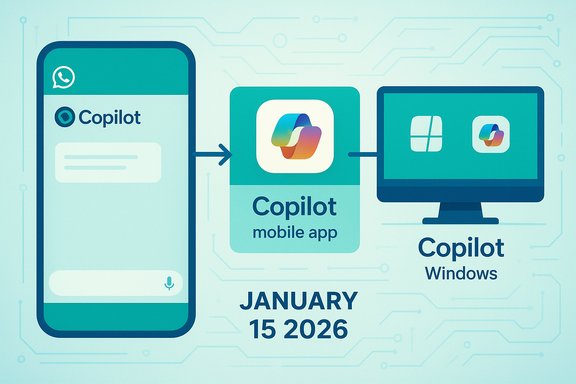
Copilot mobile app integrates with Windows desktop, launching January 15, 2026.Background / Overview​

Since late 2024, several AI providers — including Microsoft and OpenAI — experimented with delivering conversational assistants inside WhatsApp by using the WhatsApp Business Solution (the Business API). Those integrations let people text an AI contact like any other number for quick answers, summaries, lightweight content generation, and basic multimodal replies, all inside the messaging app millions already use daily.
In mid‑October 2025, WhatsApp’s owner, Meta, quietly revised the Business Solution terms to add a new “AI providers” clause that bars providers and developers of LLMs, generative AI platforms, and general‑purpose assistants from using the Business API when such technology is the primary functionality being delivered. The clause is explicit: the new restriction takes effect on January 15, 2026, and was created to refocus the Business API on enterprise messaging and predictable business‑to‑customer flows rather than open‑ended consumer chatbots. Tech reporting captured and republished the policy language when the change was first noticed. Microsoft’s public Copilot blog confirms the practical consequence: Copilot on WhatsApp will remain available through January 15, 2026, after which the WhatsApp contact will stop accepting queries. Microsoft is directing users who want continued access to Copilot to the Copilot mobile apps (iOS and Android), the Copilot web portal at copilot.microsoft.com, and the Copilot experience built into Windows. Microsoft also urges users to export WhatsApp chat history they wish to preserve because the WhatsApp integration used an unauthenticated, contact‑based model and therefore cannot migrate chat histories into account‑backed Copilot surfaces automatically.

What changed in plain English​

The policy shift​

  • WhatsApp’s Business Solution Terms now include a sweeping prohibition aimed at “AI Providers” — a category that expressly covers LLM vendors and general‑purpose AI assistants. That change forbids those providers from using the Business API when their assistant is the primary functionality offered to end users. The effective enforcement date is January 15, 2026.

The practical result​

  • Third‑party assistants that relied on the Business API as a distribution channel — including Microsoft Copilot and OpenAI’s ChatGPT — must cease operating through that interface by the enforcement date. Vendors are being pushed toward first‑party apps, web experiences, and platform integrations where they can authenticate users and control feature sets.

Why the change now​

Public reporting and platform statements point to three overlapping drivers:
  • Platform intent and design: Meta says the Business API was designed for business‑to‑customer messaging (order updates, appointment reminders, support) rather than as a distribution channel for general‑purpose chat assistants. The revised terms realign the API with that intent.
  • Operational strain and abuse surface: Open‑ended LLM conversations generate unpredictable, high‑volume traffic and moderation burdens that differ from transactional business messages. Platforms view that as a risk to stability and moderation resources.
  • Strategic control and monetization: Locking down what can run on WhatsApp’s Business Solution concentrates distribution control and preserves the platform’s commercial model — a factor that has not escaped industry observers and competition watchdogs. The change has already triggered regulatory scrutiny in some jurisdictions.

What Microsoft officially says and what it means for users​

Microsoft’s statement is concise and practical:
  • Cutoff: Copilot on WhatsApp will stop functioning on January 15, 2026.
  • Migration surfaces: Copilot remains available on Microsoft’s owned surfaces: the Copilot mobile apps, copilot.microsoft.com on the web, and the Copilot experience on Windows. These surfaces support authenticated accounts, persistent history, and additional multimodal features.
  • Data portability: Because the WhatsApp integration was unauthenticated, Microsoft cannot import WhatsApp chat histories into Copilot accounts. Users who want to keep transcripts must export chats from WhatsApp before January 15.
Microsoft also emphasizes that native Copilot apps include features absent from the WhatsApp experience — such as Copilot Voice, Copilot Vision, and Mico (a companion presence) — and that many core functions will be preserved on the native surfaces. Some advanced features may require a subscription or be subject to usage limits. Caveat: statements such as “served millions of users” come from vendor messaging (Microsoft’s blog) and should be regarded as company‑reported figures unless independently verified. Microsoft’s post and contemporaneous reporting repeat the claim, but public audits of exact user counts have not been published. Treat that number as Microsoft’s characterization pending independent confirmation.

Fast checklist — immediate actions for users and admins​

  • Export any WhatsApp chats with Copilot you want to keep before January 15, 2026. Exports are the only reliable way to preserve those threads since automatic migration is not supported.
  • Install or update the Copilot mobile app (iOS/Android), bookmark copilot.microsoft.com, or prepare to use Copilot on Windows for continuity.
  • If you depended on Copilot inside business workflows on WhatsApp, evaluate technical alternatives (native app integration, web hooks, authenticated APIs) and get ready to rearchitect flows away from the Business API.
  • For enterprises, document dependencies and plan a migration timeline that allows users and support teams to transition before the deadline.

How to export WhatsApp chat history (practical guide)​

WhatsApp’s own export functionality remains the most straightforward route for most users. The process varies slightly by platform, but the general steps are:
  • Open WhatsApp and go to the chat with Copilot you want to save.
  • Tap the chat name (or three‑dot menu) and choose More → Export chat.
  • Choose whether to Include Media (photos, videos) or export Without Media. Exports with media produce a larger ZIP archive; text‑only exports produce a .txt file.
  • Select where to save or send the exported archive (email, cloud storage, local storage).
  • Verify the saved file is accessible and move it to secure long‑term storage if it contains sensitive content.
Important caveats and tips:
  • Exported chat files are not protected by WhatsApp’s end‑to‑end encryption once exported; keep them in secure storage and consider encryption at rest.
  • WhatsApp has been testing and rolling out features that can restrict chat exports (e.g., Advanced Chat Privacy), which may affect certain group chats or chats where other participants enabled export protections. If you’re unable to export, try alternative backups such as device backups or ask an admin to change privacy settings if appropriate. These privacy controls do not fully stop screenshots or manual copying, so plan accordingly.
  • Very large groups or chats with lots of media can fail to export with media included. If export with media fails, try exporting text only or export smaller segments of the conversation. Community reports and support tools document such limits.
If the chat content is mission‑critical for business purposes, consider creating a formal preservation process now — automated exports, documentation of what was preserved, and secure archival storage — because post‑cutoff recovery will be very difficult.

Enterprise and developer implications​

For businesses using WhatsApp for automation​

WhatsApp’s Business Solution was always intended for structured business workflows: order updates, appointment reminders, customer support triage, ticketing and the like. The new terms preserve those use cases but draw a hard boundary around using the Business API as a primary distribution channel for consumer‑facing LLM assistants. Enterprises that built services around in‑chat assistants will need to:
  • Reassess whether their use of AI is ancillary (allowed) or primary (now disallowed).
  • Redesign customer flows to use verified business messages, in‑app experiences, or authenticated web/mobile SDKs instead of an unauthenticated WhatsApp contact.
  • Consider platform diversity — including messaging apps that remain more permissive — but weigh that against privacy, trust, and compliance concerns.

For consumer AI vendors and startups​

  • The episode underscores the fragility of single‑channel distribution strategies. Relying on a third‑party platform’s private API exposes products to abrupt policy changes. Vendors should prioritize authenticated account relationships, portable histories, and vendor‑owned distribution surfaces to reduce platform risk.

Larger policy, competition, and regulatory consequences​

WhatsApp’s policy revision goes beyond a product tweak; it touches on market structure and platform governance. By restricting third‑party LLM distribution on a major messaging platform, Meta effectively consolidates control over where conversational assistants can interact with WhatsApp’s user base.
  • Regulators are paying attention. European competition authorities and national agencies are assessing whether such policy changes could inhibit competition by favoring Meta’s own assistant or limiting market access for rivals. An example is an expanded antitrust probe into Meta’s use of AI tools in WhatsApp, highlighting the potential for enforcement action where platform rules may distort competition. Stakeholders should expect continued regulatory scrutiny.
  • Portability and interoperability concerns follow. The inability to migrate unauthenticated WhatsApp conversations into vendor accounts reveals a broader hole in user data portability. Users with helpful or valuable conversational histories now confront a manual, export‑and‑archive process rather than a seamless transfer into an authenticated assistant. Policy makers and standards bodies may treat such failures as priorities for future regulation or industry standards.
  • Developers and privacy advocates will debate trade‑offs. Meta frames the change as protecting the Business API’s mission and platform stability, while critics point to the competitive consequences of disallowing third‑party assistants on a dominant messaging surface. The balance between platform safety, operational costs, and open access to distribution channels will remain central to this debate.

Risks and downsides for users​

  • Lost contextual features: Copilot inside WhatsApp was intentionally lightweight and unauthenticated; it lacked deep access to Microsoft account data. But it did provide frictionless access in a space users already lived. Migrating to native apps restores authentication but reduces in‑chat convenience and requires installing or opening a separate app.
  • Data security of exports: Exports are plain text (and ZIPs with media) and are not covered by WhatsApp’s end‑to‑end encryption once exported. Mishandled exports can expose sensitive information; users must protect exported files appropriately.
  • Incomplete preservation: Exports may fail for very large chats or when participants enabled export restrictions. Media‑heavy threads may be truncated or require multiple exports. There is no guaranteed way to import exported WhatsApp transcripts back into Copilot or other assistant accounts in a usable, interactive form.
  • Platform fragmentation: Users who appreciated a single unified experience across messaging and assistant interactions now must juggle multiple apps and interfaces, increasing friction and potential confusion.

What this means for Copilot and Microsoft’s strategy​

Microsoft’s decision to centralize Copilot on its own surfaces is both defensive and logical. Owned apps and web portals let Microsoft:
  • Enforce authentication and tie conversations to user accounts for persistent history and personalized contexts.
  • Offer richer multimodal features (voice, vision, companion presences) without third‑party platform limitations.
  • Control monetization, subscription tiers, usage quotas, and enterprise governance.
That said, the WhatsApp exit reduces Copilot’s ubiquity in a high‑engagement product (messaging), and Microsoft will need to compensate with smoother onboarding flows, clear guidance to users, and utility incentives to move people into the Copilot app or web experiences.

Migration plan — recommended steps (for individual users)​

  • Install Copilot on your phone (iOS or Android) and sign in with your Microsoft account.
  • Bookmark or pin copilot.microsoft.com for quick desktop/web access.
  • Export WhatsApp Copilot chats you want to keep (see instructions above). Store exports in secure, encrypted cloud storage or encrypted local drives.
  • Update any routines or automations that relied on the WhatsApp Copilot contact — for example, replace the contact with the Copilot app shortcut or add Copilot to your device home screen for one‑tap access.
  • If you used Copilot for business work on WhatsApp, notify stakeholders, prepare documentation of what will change, and schedule retraining or communications to reduce friction.

Broader takeaway — what the shift tells us about AI’s next phase​

This episode marks an inflection: conversational AI is moving from opportunistic distribution inside third‑party surfaces to a model where platform governance, authentication, and vendor‑owned experiences dominate. The practical consequences are immediate (users must export history and migrate), but the structural effects are deeper:
  • Platform policy is now a primary design constraint for AI distribution.
  • Vendors will prioritize authenticated, account‑linked experiences and portable, auditable records.
  • Regulators and competition authorities will scrutinize platform rules that restructure market access for AI providers.
For users, the path forward is clear and actionable: export anything you care about from WhatsApp before January 15, 2026, and adopt Copilot’s official apps or web experience to preserve continuity with Microsoft’s assistant. For developers and businesses, the message is blunt: build for portability and authenticated channels — platform rules can change quickly, and dependence on a single third‑party surface is a strategic vulnerability.

Closing analysis — strength, risk, and final recommendations​

Strengths of the change
  • It clarifies the Business API’s intended purpose and reduces unexpected platform load caused by open‑ended chatbots.
  • It pushes AI vendors toward authenticated, accountable surfaces that can provide richer, auditable experiences.
  • It reduces certain moderation and abuse risks for WhatsApp’s business infrastructure.
Risks and trade‑offs
  • The rule concentrates distribution control in platform hands and raises competition concerns, already attracting regulatory attention.
  • Users lose the convenience of in‑chat assistants in WhatsApp and face friction to migrate.
  • Data portability remains clumsy: exported archives are static and cannot be imported back into account‑linked assistants.
Final recommendations
  • Export WhatsApp Copilot chats you need and store them securely immediately. Don’t wait until the last week.
  • Move routine AI workflows to authenticated Copilot surfaces (mobile app, web, Windows) where history, personalization, and enterprise governance are supported.
  • For businesses and developers, design systems to avoid single‑channel dependence and prioritize identity, portability, and resilience to platform policy change.
This is a policy‑driven shift, not the end of Copilot — but it is a clear sign that the era of ubiquitous, platform‑embedded assistants will be shaped as much by platform governance and commercial strategy as by technical capability.
Source: digit.in Microsoft Copilot to leave WhatsApp on Jan 15, 2026: Here’s why
 

Back
Top