

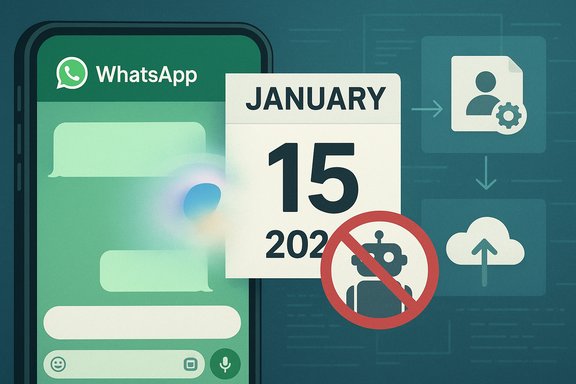
Microsoft confirmed this week that its consumer AI assistant Copilot will stop working inside WhatsApp on January 15, 2026, a direct consequence of WhatsApp’s recently revised Business Solution terms that bar general‑purpose large‑language‑model (LLM) chatbots from operating as a primary service through the Business API.
Microsoft introduced a lightweight Copilot experience inside WhatsApp in late 2024 to reach users inside a familiar messaging surface without forcing them to install a new app or sign in to a Microsoft account. That integration behaved like a contact you could message for quick answers, short-form content help, and basic multimodal requests. Microsoft says the WhatsApp connection “helped millions of people connect with their AI companion,” but it was intentionally limited: it did not provide authenticated access to Microsoft accounts, persistent account‑backed history, nor the full multimodal feature set available on Microsoft’s native Copilot surfaces.
In mid‑October 2025 Meta updated the WhatsApp Business Solution (Business API) terms to add a broad “AI Providers” prohibition. The new language bars “providers and developers of artificial intelligence or machine learning technologies, including but not limited to large language models, generative artificial intelligence platforms, general‑purpose artificial intelligence assistants…from accessing or using the WhatsApp Business Solution…when such technologies are the primary (rather than incidental or ancillary) functionality.” Meta set the effective date for enforcement as January 15, 2026. Tech reporting and Meta’s public comments frame the change as a refocus of the Business API on business‑to‑customer workflows (support, notifications, commerce) rather than as a distribution channel for standalone consumer chatbots.
Practical consequences for users:
But the move also carries clear strategic and commercial consequences:
Microsoft’s withdrawal of Copilot from WhatsApp is emblematic of a broader industry reset: platform governance, product economics and identity architecture now matter at least as much as raw model capability in deciding where and how LLM assistants reach people. Users should export chats they care about and adopt first‑party Copilot surfaces for continuity. Developers must design for authenticated identity, portable data and channel diversity or risk being cut off when platforms change the rules.
Source: NDTV Profit Microsoft’s AI Chatbot Copilot To Exit WhatsApp In January 2026: What's Changing For Users?
 Background
Microsoft introduced a lightweight Copilot experience inside WhatsApp in late 2024 to reach users inside a familiar messaging surface without forcing them to install a new app or sign in to a Microsoft account. That integration behaved like a contact you could message for quick answers, short-form content help, and basic multimodal requests. Microsoft says the WhatsApp connection “helped millions of people connect with their AI companion,” but it was intentionally limited: it did not provide authenticated access to Microsoft accounts, persistent account‑backed history, nor the full multimodal feature set available on Microsoft’s native Copilot surfaces.In mid‑October 2025 Meta updated the WhatsApp Business Solution (Business API) terms to add a broad “AI Providers” prohibition. The new language bars “providers and developers of artificial intelligence or machine learning technologies, including but not limited to large language models, generative artificial intelligence platforms, general‑purpose artificial intelligence assistants…from accessing or using the WhatsApp Business Solution…when such technologies are the primary (rather than incidental or ancillary) functionality.” Meta set the effective date for enforcement as January 15, 2026. Tech reporting and Meta’s public comments frame the change as a refocus of the Business API on business‑to‑customer workflows (support, notifications, commerce) rather than as a distribution channel for standalone consumer chatbots.
What changed in WhatsApp’s policy — the essentials
- New “AI Providers” clause: The Business Solution terms now explicitly call out LLM vendors, generative AI platforms and general‑purpose assistants and deny them access to the Business API when they are the product being provided.
- Carve‑outs remain: Businesses that use AI incidentally inside customer‑facing automations—e.g., flight booking bots, support triage, order status—are still permitted. The prohibition targets general‑purpose assistants delivered as a primary consumer-facing service.
- Effective date: January 15, 2026 — vendors and users have a short migration window.
Microsoft’s announcement and immediate user impact
Microsoft’s Copilot team published guidance confirming the outcome: Copilot on WhatsApp will be discontinued on January 15, 2026. The company told users that Copilot remains available on its first‑party surfaces — the Copilot mobile apps for iOS and Android, Copilot on the web (copilot.microsoft.com), and Copilot built into Windows — and advised users to export any WhatsApp chat history they want to keep because the WhatsApp integration used an unauthenticated contact model and Microsoft cannot automatically migrate those conversations.Practical consequences for users:
- Copilot messages inside WhatsApp will stop responding after the January 15, 2026 cutoff.
- Chats with Copilot inside WhatsApp are not tied to Microsoft accounts and therefore cannot be ported into Copilot’s account‑backed history on Microsoft’s apps or the web. Users must export chat logs manually if they want to preserve them.
- Microsoft recommends moving to Copilot’s native apps or the web, where authentication, synced history, richer multimodal features (for example, Copilot Voice and Copilot Vision) and stronger enterprise controls are available.
Why Meta made the change — stated reasons and plausible incentives
WhatsApp’s public explanation for the policy adjustment focuses on product fit and operational stability: the Business API was built to support businesses serving customers, not to act as a front door for consumer chat assistants that can generate unpredictable, high‑volume conversational traffic. Meta said the rapid adoption of third‑party assistants over the Business API created system strain and a support burden outside the API’s design. That rationale is realistic: general‑purpose assistants can produce sustained, free‑form back‑and‑forth sessions that differ materially from transactional business messages in volume, context and moderation needs. Limiting those workloads removes a class of usage that requires different scaling and moderation policies.But the move also carries clear strategic and commercial consequences:
- Monetization and product fit: WhatsApp’s Business Solution is a revenue channel focused on structured messaging and enterprise features. Removing a class of high‑churn, high‑volume third‑party integrations preserves the Business API’s commercial contours.
- Distribution control: The policy concentrates the channel for general‑purpose assistants inside platforms that choose which assistants to host, notably Meta’s own assistant across WhatsApp, Messenger and Instagram. Observers call this a consolidation of distribution power that narrows user choice and strengthens platform incumbents.
Technical implications: authentication, portability, and features
The way these WhatsApp integrations were implemented matters. Many vendors, including Microsoft, delivered Copilot as a simple, unauthenticated WhatsApp contact. That design minimized friction but had trade‑offs:- No account link → no server‑side history: Without a persistent identity tied to a Microsoft account, there is no automatic path to transfer chat logs or personalization into Microsoft’s native Copilot services. Microsoft explicitly says it cannot migrate WhatsApp chats into Copilot accounts. Users must export chats manually.
- Feature limitations: The WhatsApp version of Copilot lacked authenticated access to Microsoft 365 assets, richer plugin ecosystems, long‑term memory, advanced multimodal inputs and some subscription gated features that the Copilot app and web support. Moving to first‑party surfaces restores those capabilities at the cost of added friction (installing an app, signing in).
- Operational profile differences: Chatbot traffic tends to be conversational and stateful, sometimes requiring more context and compute than short transactional messages — a profile WhatsApp’s Business API wasn’t tuned to handle at scale. That mismatch is the immediate technical justification for the policy.
Cross‑checks and verifiable claims
Key factual claims and where they are verifiable:- Copilot will stop functioning on WhatsApp on January 15, 2026 — Microsoft’s public guidance and multiple independent reports confirm the date.
- WhatsApp’s Business Solution terms were revised in mid‑October 2025 to add the “AI Providers” prohibition — TechCrunch and other outlets reported the policy update and republished the relevant clause.
- The WhatsApp integration was unauthenticated and therefore not migratable to Copilot accounts — this is Microsoft’s explicit statement to users.
- Microsoft and other AI vendors (including OpenAI) are directing users to their native apps and web experiences as alternatives — reported by Business Standard and other outlets.
How to preserve your Copilot conversations and migrate (practical steps)
If you used Copilot via WhatsApp and want to keep conversations or continue similar workflows, act now. The migration window is short.- Export WhatsApp chats with Copilot (before January 15, 2026):
- Open the chat with the Copilot contact in WhatsApp.
- Tap the chat menu → More → Export chat (choose whether to include media).
- Save the exported file to your device or cloud storage.
- Confirm the export file is readable and backed up.
- Move to a first‑party Copilot surface:
- Install the Copilot app on iOS or Android, or visit the Copilot web experience.
- Sign in with your Microsoft account to enable authenticated features, history sync and personalized functionality.
- If you want continuity for ongoing tasks, copy and paste essential prompts or artifacts from exported chats into the Copilot app to rebuild context manually.
- For account linking where vendors support it (example: ChatGPT):
- Some services have explicit linking flows that attach your phone number to an account so past WhatsApp threads surface in the native app. OpenAI documented such a linking process for its 1-800‑ChatGPT contact; check vendor guidance for any similar options. Note that Microsoft has said that, for Copilot, no automatic migration exists.
- For businesses and admins:
- Export important logs and transcripts.
- Notify customers of the change and provide alternate channels (email, web chat, Copilot app) for conversational AI access.
- If your use case relies on the Business API for customer workflows, confirm that your AI is ancillary to core business processes to remain compliant under the new terms.
What this means for developers, startups and the AI ecosystem
- Distribution strategy must include authentication and ownership. Relying on a third‑party messaging API that treats your assistant as a contact is fragile. Design for a persistent identity (account link) and exportable data so users retain control over history.
- Diversify channels. Telegram, native apps, web PWAs, SMS and other messaging platforms remain viable distribution channels. Some vendors are already driving users to alternatives like Telegram.
- Build for portability. Provide built‑in account linking and migration options so users don’t lose context when platforms change policy.
- Expect more platform governance. As LLM services scale, platform owners will increasingly assert control over what runs on their pipes. Companies need to prepare for policy shifts and to argue constructively with platform operators about acceptable use and technical safeguards.
Legal, competition and privacy considerations
This policy change raises broader questions that regulators and commentators are likely to watch:- Competition and gatekeeping: By restricting third‑party assistants while retaining the ability to host its own assistant, Meta’s policy may tilt distribution power toward in‑house services. That dynamic is squarely in the domain of competition scrutiny in some jurisdictions and could trigger questions about unfair platform conduct. Several industry observers flagged this competitive angle after the policy change.
- Data portability and user control: The unauthenticated contact model used by many vendors limited portability. Users who relied on the frictionless WhatsApp experience may now find it difficult to carry conversations forward. The lack of a standard, cross‑platform approach for linking chat threads to authenticated accounts is a structural problem for data portability.
- Privacy and moderation: Meta cited moderation, support burdens and infrastructural strain as part of its rationale. Enforcing a uniform business‑centric policy simplifies moderation scope but concentrates user data inside platforms that also monetize attention and engagement. That concentration has privacy and surveillance economics implications that deserve scrutiny.
Risks, trade‑offs and edge cases
- User friction vs. product capability: Native Copilot surfaces offer richer features but require installs and sign‑ins. For casual users who relied on the zero‑friction WhatsApp contact, the shift imposes tangible friction.
- Small vendors and startups: Companies that used WhatsApp as a primary discovery and distribution channel lose a major growth vector and must invest in retention and app installs or find alternative messaging partners.
- Enforcement ambiguity: Meta’s clause gives it discretion to determine what counts as “primary” functionality. That interpretive leeway introduces uncertainty for developers trying to design compliant use cases; enforcement could be uneven or evolve over time.
- Incomplete migration tooling: Microsoft cannot migrate WhatsApp chats into Copilot accounts in bulk. Unless vendors build export/link flows before enforcement, many conversations will be permanently fragmented.
What to watch next
- Regulatory reactions: Competition authorities in major markets may examine the competitive effects of platform rules that restrict third‑party AI distribution while favoring native assistants.
- Vendor workarounds: Expect more vendors to prebuild account‑linking flows, offer native app incentives and use other messaging platforms that remain permissive (for example, Telegram) to maintain conversational reach.
- Policy refinement: Meta may refine enforcement language or provide clearer compliance paths for narrowly scoped AI use cases that remain business‑centric. Developers should monitor WhatsApp’s policy page and developer communications for clarifications.
- Platform negotiations: Large AI vendors may seek bilateral agreements with Meta to restore limited functionality under contractual constraints; watch for announcements or pilot programs that create controlled access under stricter rate limits and moderation controls.
Recommendations — concrete next steps
- For individual users:
- Export any Copilot‑WhatsApp chats you want to keep before January 15, 2026.
- Install Copilot’s native app or sign into Copilot on the web and link a Microsoft account to enable history and personalization.
- For IT administrators and businesses:
- Audit any internal workflows that relied on consumer‑grade chatbot contacts in WhatsApp.
- Migrate business‑critical automations to authenticated, documented channels that meet WhatsApp’s business‑intent test or to other messaging platforms.
- For developers of conversational AI:
- Build identity and migration tooling up front.
- Diversify distribution and prioritize first‑party apps or authenticated web experiences.
- Design for rate limits and moderation needs that differ between transactional business messaging and open conversational assistants.
Conclusion
WhatsApp’s decision to bar general‑purpose LLM chatbots from the Business API and Meta’s enforcement timeline (January 15, 2026) marks a turning point for how conversational AI is distributed. The policy redraws the map of low‑friction distribution channels and forces a migration toward authenticated, vendor‑controlled surfaces where companies can deliver richer, more accountable AI experiences — at the cost of increased friction for users and narrower distribution for competing assistants.Microsoft’s withdrawal of Copilot from WhatsApp is emblematic of a broader industry reset: platform governance, product economics and identity architecture now matter at least as much as raw model capability in deciding where and how LLM assistants reach people. Users should export chats they care about and adopt first‑party Copilot surfaces for continuity. Developers must design for authenticated identity, portable data and channel diversity or risk being cut off when platforms change the rules.
Source: NDTV Profit Microsoft’s AI Chatbot Copilot To Exit WhatsApp In January 2026: What's Changing For Users?
