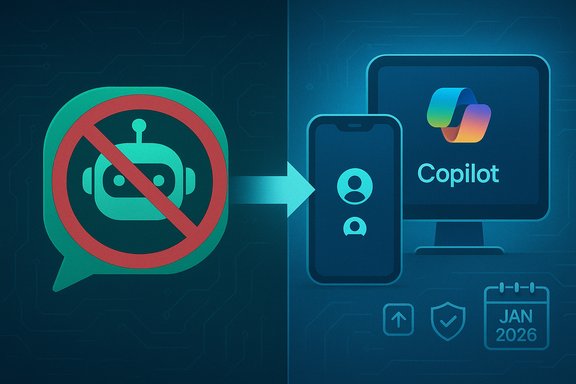
WhatsApp's decision to bar general-purpose AI assistants from its Business API and Microsoft’s confirmation that Copilot will be removed from WhatsApp mark a pivotal moment in how AI assistants are distributed, authenticated, and monetized—and the cutover date is explicitly set for January 15, 2026.
WhatsApp’s owner, Meta, updated the WhatsApp Business Solution terms in October 2025 to add an “AI providers” prohibition that prevents providers of large language models and general-purpose conversational agents from using the Business API when those AI capabilities are the primary functionality being offered. That policy is scheduled to take effect on January 15, 2026, and Meta framed it as a clarification that the Business API is meant for business-to-customer use (support, notifications, commerce flows), not as a distribution channel for consumer chatbots. Microsoft announced that Copilot on WhatsApp will cease functioning on that same date and advised users to migrate to Microsoft’s first‑party Copilot surfaces: the Copilot mobile app (iOS/Android), Copilot on the web, and Copilot on Windows. The company also warned that, because the WhatsApp integration was unauthenticated, chat history cannot be migrated automatically and users who want to preserve conversations must export them before the shutdown. This change is not unique to Microsoft—or limited to a single vendor. OpenAI and other third‑party LLM providers that had built WhatsApp integrations have already signaled similar wind‑downs or migration guidance, because the new WhatsApp policy applies broadly to general‑purpose assistants.
For Windows users and Microsoft customers, the immediate reality is straightforward: export any WhatsApp Copilot conversations you value, then migrate to Copilot’s native apps or the web for a more feature‑complete and authenticated assistant experience. The larger industry effects—on competition, interoperability, and platform power—are still unfolding and worth watching closely.
Source: The Tech Buzz https://www.techbuzz.ai/articles/whatsapp-boots-microsoft-copilot-in-ai-chatbot-crackdown/
 Background / Overview
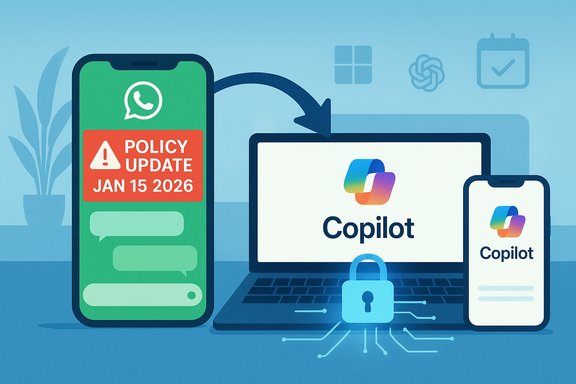
WhatsApp’s owner, Meta, updated the WhatsApp Business Solution terms in October 2025 to add an “AI providers” prohibition that prevents providers of large language models and general-purpose conversational agents from using the Business API when those AI capabilities are the primary functionality being offered. That policy is scheduled to take effect on January 15, 2026, and Meta framed it as a clarification that the Business API is meant for business-to-customer use (support, notifications, commerce flows), not as a distribution channel for consumer chatbots. Microsoft announced that Copilot on WhatsApp will cease functioning on that same date and advised users to migrate to Microsoft’s first‑party Copilot surfaces: the Copilot mobile app (iOS/Android), Copilot on the web, and Copilot on Windows. The company also warned that, because the WhatsApp integration was unauthenticated, chat history cannot be migrated automatically and users who want to preserve conversations must export them before the shutdown. This change is not unique to Microsoft—or limited to a single vendor. OpenAI and other third‑party LLM providers that had built WhatsApp integrations have already signaled similar wind‑downs or migration guidance, because the new WhatsApp policy applies broadly to general‑purpose assistants. Why the policy changed: WhatsApp’s stated rationale versus strategic incentives
Meta’s official explanation: platform intent and operational strain
Meta’s public rationale is pragmatic: the Business API was built to facilitate business messaging—order updates, booking confirmations, customer support—not to host open‑ended conversational assistants. Meta says the unexpected growth of general‑purpose bots imposed atypical message volumes, moderation burdens, and engineering/support overhead, which the Business API was not designed to handle. The policy change formalizes that boundary.Plausible strategic incentives
Independent reporting and industry analysts draw a second, strategic inference: restricting third‑party general‑purpose assistants clears space for Meta to expand its own assistant offerings (Meta AI) inside WhatsApp, Messenger, Instagram, and other properties. The policy’s broad language—giving Meta discretion to define “AI Provider” and “primary functionality”—creates levers that could be applied selectively, benefiting in‑house or tightly controlled integrations. That reading is supported by multiple outlets and by the observable effect that third‑party assistants must now pivot to vendor‑owned apps or other platforms.The mixed reality
Both arguments have force. Operational concerns about unpredictable LLM traffic are real and measurable; at the same time, platform owners routinely make product and policy decisions that align operational constraints with product and monetization priorities. Treating either explanation in isolation would oversimplify the change.What this means for users: immediate impacts and practical steps
Key, verifiable facts
- Copilot on WhatsApp will stop working on January 15, 2026; Microsoft confirmed the cutoff in a public post.
- Because the WhatsApp integration was unauthenticated, Microsoft cannot migrate WhatsApp conversation history into Copilot accounts; users must export chat threads if they want to preserve them.
- OpenAI and multiple other LLM providers will also wind down WhatsApp integrations due to the same policy; OpenAI reported over 50 million ChatGPT users had used WhatsApp and is advising linking or migration steps.
What users should do now (practical checklist)
- Export any WhatsApp conversations you want to keep with Copilot or other assistants using WhatsApp’s Export Chat tool. Include media if needed and store the exported files in a secure location.
- Install and sign in to the Copilot mobile app (iOS/Android), visit copilot.microsoft.com on your preferred browser, or enable Copilot on Windows to continue using Microsoft’s assistant.
- If you used ChatGPT or another assistant on WhatsApp, follow that provider’s link/account‑linking guidance now so history is preserved where supported. OpenAI provides a linking workflow for account association.
- If you relied on WhatsApp for business workflows that now use a general‑purpose assistant, re‑architect your bot to fit WhatsApp’s Business API intent (narrow, business‑specific flows) or move to authenticated, vendor‑owned channels.
Why migration matters beyond convenience
Exporting and migrating isn’t just about keeping records. Moving to authenticated Copilot surfaces unlocks richer, account‑linked features: synced history across devices, deeper Microsoft 365 integrations (when authorized), multimodal capabilities (voice/vision), and more robust enterprise controls. Those are the tradeoffs Microsoft is highlighting to encourage migration.The developer and startup angle: distribution, costs, and fragmentation
WhatsApp was a low‑friction growth channel
For many startups, WhatsApp offered near-zero friction onboarding: phone-number identity, immediate reach inside a user’s primary messaging app, and lower acquisition cost compared with app stores and web signups. Losing that channel is therefore meaningful. The policy raises the cost to acquire and retain users and shifts growth playbooks toward owned apps, web experiences, or other messaging platforms (Telegram, Signal, SMS).Tech and compliance consequences
- Messaging SLA and throughput guarantees previously used by some vendors under the Business API will no longer be available for consumer assistant traffic; vendors must build their own delivery systems or adopt alternative gateways.
- The unauthenticated model that made WhatsApp attractive also prevented providers from offering server‑side continuity—leading to data portability problems now on display. Startups must design authenticated flows if they want persistent history and account linkage.
Short-term pivots and tactical moves
- Push users to native apps and PWAs with smooth onboarding and optional phone‑number linking.
- Maintain presence on more permissive platforms (Telegram/Discord) where permitted.
- Rebuild WhatsApp bots as narrow, business‑incidental agents that comply with the new Business API language.
These steps add cost and complexity, and smaller players may struggle to execute them quickly.
Privacy, security, and data portability: practical risks
Export caveats and encryption
WhatsApp’s export tools let users save chat text and media, but exported files lose WhatsApp’s end‑to‑end encryption protections and are typically saved in plain text or compressed formats. Users should take care to store exported data securely and be aware that exporting does not produce a seamless importable conversation into Copilot or ChatGPT—these are archival records, not live session transfers.Authentication reduces impersonation risk but increases profile linkage
Moving to authenticated Copilot apps reduces risks like session hijacking and impersonation that unauthenticated WhatsApp contacts can invite. However, linking a phone number or other personal identifiers to a central account increases the provider’s ability to profile and correlate activity across services—something privacy‑conscious users and admins should weigh.Regulatory and enterprise compliance consequences
For enterprises that used WhatsApp‑based assistants for internal workflows or customer support, the vendor migration can either simplify compliance (if moving to enterprise‑grade, auditable Copilot accounts) or complicate it (if new architectures store data in differing jurisdictions). Enterprises should perform fresh privacy and security assessments tied to the new service model.Competitive and market consequences: consolidation, gatekeeping, and regulation
Centralization risk
By removing third‑party general‑purpose assistants from WhatsApp’s Business API, Meta effectively narrows in‑messaging AI choices and preserves room for Meta AI inside its ecosystem. That packing of distribution inside first‑party apps accelerates a trend where platform owners control the most convenient in‑app AI experiences. Analysts warn this raises competition and consumer‑choice concerns.Regulatory spotlight likely
Major platform changes that affect competition and interoperability often attract regulatory attention. If providers claim anticompetitive behavior, this could prompt inquiries. Observers will watch whether enforcement is evenhanded or selectively favors in‑house products. The broad wording of the policy—giving Meta discretion—makes this a realistic area for scrutiny.Industry consolidation and survivorship bias
Smaller players that relied on WhatsApp will either shift to new channels and pay higher acquisition costs, consolidate with larger vendors, or exit. The resulting consolidation benefits providers who already own native apps and robust account systems—like Microsoft and OpenAI—because they have the means to convert WhatsApp users into signed‑in customers.Vendor responses and fallback strategies
Microsoft
Microsoft’s public guidance is to migrate users to Copilot’s native experiences and emphasizes the benefits of authenticated accounts, richer multimodal features, and enterprise controls. Microsoft explicitly recommends exporting chats before the January 15, 2026 cutoff.OpenAI
OpenAI provided step‑by‑step guidance for users to link WhatsApp phone numbers to ChatGPT accounts so conversation history can be preserved where supported, and it confirmed ChatGPT will no longer be available on WhatsApp after January 15, 2026.Smaller vendors
Some smaller vendors have already pointed users to alternative channels: Perplexity and others have active Telegram bots or web apps and are advising users to migrate there. This is a rapid, imperfect decentralization rather than a single migration destination.What to watch next: enforcement, substitutes, and standards
- Enforcement patterns: Will Meta block indirect routing and subtly re‑classify narrowly scoped assistants as “general-purpose”? The breadth of the definition gives Meta discretion, so enforcement examples will be informative.
- Meta AI’s expansion: Expect Meta to accelerate integrated assistant features across its family of apps, which will shift more AI interactions into a Meta‑controlled data plane.
- Platform alternatives and standards: Momentum for interoperable assistant protocols or verifiable identity layers could accelerate if developers lobby for cross‑platform agent portability—this would reduce reliance on any single platform. However, meaningful protocol adoption would take years.
Strengths and weaknesses of the policy from a user-centric and industry view
Notable strengths
- Operational clarity: The policy restores a clear design intent for the Business API—business messaging, not consumer‑grade assistants—reducing unpredictable technical burdens on platform infrastructure.
- Encourages authenticated, auditable assistant deployments that are better suited for enterprise and regulated uses, improving safety traceability in some contexts.
Potential risks and tradeoffs
- Reduced consumer choice and increased centralization of AI in platform‑owned assistants. That consolidation can favor incumbents and reduce innovative distribution models for startups.
- Friction and data‑portability pain for users who relied on WhatsApp for lightweight, unauthenticated AI access; exported chat files are archival rather than live continuity.
- Enforcement opacity: The policy’s broad wording gives Meta discretion that could be used unevenly, raising concerns about gatekeeping and competitive fairness.
Technical verification and date correction
Several secondary sources and first‑party confirmations align on the essential timeline and mechanics: Microsoft’s own Copilot blog post confirms the January 15, 2026 cutoff; TechCrunch and multiple independent outlets reported Meta’s October 2025 policy change and the January 15, 2026 effective date; OpenAI posted migration guidance with the same deadline. These independent confirmations make the January 15, 2026 date the verifiable canonical deadline. Any earlier date that appears in some reports (for example, January 15 of a different year) should be treated as a reporting error unless corroborated by primary sources.Practical migration how‑to (step‑by‑step)
- Open the WhatsApp chat with Copilot (or any assistant you used).
- Tap the contact name → Export chat → choose whether to include media. Save the exported file to a secure cloud folder or email it to yourself. Note that exported files are not reimportable to Copilot—this is an archive.
- Install the Copilot mobile app or go to copilot.microsoft.com and sign in with your Microsoft account to enable authenticated continuity going forward. Test a few prompts and sign‑in sync.
- For ChatGPT users on WhatsApp, follow OpenAI’s linking flow before the cutoff to bring any supported WhatsApp history into the ChatGPT account. If you fail to link before January 15, 2026, history retention will be inconsistent.
Conclusion
The WhatsApp policy change and Microsoft’s removal of Copilot from the platform represent a broader turning point in AI distribution: a movement away from unauthenticated, third‑party access inside dominant messaging apps and toward authenticated, vendor‑owned surfaces that deliver continuity, governance, and monetization. That shift will increase friction for end users who enjoyed low‑touch access on WhatsApp and raise distribution costs for startups—but it will also enable richer, auditable experiences for users who accept account linkage.For Windows users and Microsoft customers, the immediate reality is straightforward: export any WhatsApp Copilot conversations you value, then migrate to Copilot’s native apps or the web for a more feature‑complete and authenticated assistant experience. The larger industry effects—on competition, interoperability, and platform power—are still unfolding and worth watching closely.
Source: The Tech Buzz https://www.techbuzz.ai/articles/whatsapp-boots-microsoft-copilot-in-ai-chatbot-crackdown/