

WhatsApp’s latest wave of product changes and policy revisions marks a decisive moment for the platform — one that simultaneously upgrades the everyday experience for billions of users and reshapes the technical and commercial landscape for businesses and AI providers. The company has rolled out a suite of user-facing features that make calling, messaging and media creation richer and faster, while quietly rewriting the rules that govern how third‑party AI can interact with WhatsApp’s Business API. Those two tracks — feature modernization and ecosystem governance — are tightly linked: product changes improve user engagement, while contractual changes control who can ride that engagement to reach end users. The result is a platform that is more powerful for consumers, but more tightly policed for external AI vendors and commercial integrators.
WhatsApp is no longer only a lightweight chat app. Over several product cycles it has expanded into voice, video, payments and multimodal messaging, becoming an essential communications hub in many markets. That scale makes even incremental design changes meaningful for hundreds of millions of people, and it makes any change to platform policy consequential for the businesses and services that rely on WhatsApp as a distribution channel. The recent updates fall into two clear categories: new end‑user experiences (calls, media, on‑chat features) and a targeted revision to the WhatsApp Business Solution terms that restricts how general‑purpose AI assistants may use the Business API.
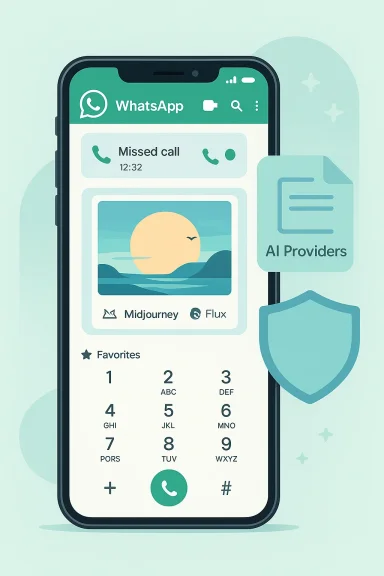
The product improvements are oriented toward immediacy and multimedia: richer in‑chat voicemail alternatives, a consolidated Calls tab, more expressive live reactions in voice chats, and expanded generative-image tools inside the chat flow. The policy change — the new AI Providers restriction — clarifies that the Business API is for enterprise messaging (notifications, customer support, commerce) and not for distributing general‑purpose AI chatbots that provide open‑ended conversation as their primary feature. That contractual pivot has immediate operational implications for popular AI integrations and long‑term implications for competition and data portability.
Practical implications:
Benefits for users include:
WhatsApp applied the rule to both new signups immediately and to existing integrations with an enforcement deadline that was communicated to the ecosystem. The policy language also grants Meta discretionary authority to decide whether an integration’s AI is primary or merely ancillary, giving the platform a wide interpretive scope for enforcement. That discretion is the practical lever that makes the rule powerful: Meta can permit bots that it regards as tightly scoped business automation while denying general‑purpose assistants that behave like independent chat companions.
Practical advice for affected users:
The European Commission has also signalled interest, opening a parallel probe and issuing a Statement of Objections that the change may breach Article 102 of the Treaty on the Functioning of the European Union when a dominant firm abuses market power to exclude rivals. In practice, EU authorities are focused on two core concerns:
This is a defining moment for messaging platforms and conversational AI. It forces a reckoning about the balance between product safety, operational scalability and open competition. The near term will be messy: migrations, exports and legal challenges. The longer term will hinge on whether regulators, industry and platform owners can agree rules that preserve innovation and user choice without sacrificing reliability and safety. In the meantime, consumers should secure important conversations and vendors should rearchitect for authenticated, portable, and standards‑friendly experiences.
Source: Indeksonline. https://indeksonline.net/mg/WhatsApp-dia-mitondra-fanavaozana-lehibe-sy-mampiala-voly/
 Background: why this update matters now
WhatsApp is no longer only a lightweight chat app. Over several product cycles it has expanded into voice, video, payments and multimodal messaging, becoming an essential communications hub in many markets. That scale makes even incremental design changes meaningful for hundreds of millions of people, and it makes any change to platform policy consequential for the businesses and services that rely on WhatsApp as a distribution channel. The recent updates fall into two clear categories: new end‑user experiences (calls, media, on‑chat features) and a targeted revision to the WhatsApp Business Solution terms that restricts how general‑purpose AI assistants may use the Business API.The product improvements are oriented toward immediacy and multimedia: richer in‑chat voicemail alternatives, a consolidated Calls tab, more expressive live reactions in voice chats, and expanded generative-image tools inside the chat flow. The policy change — the new AI Providers restriction — clarifies that the Business API is for enterprise messaging (notifications, customer support, commerce) and not for distributing general‑purpose AI chatbots that provide open‑ended conversation as their primary feature. That contractual pivot has immediate operational implications for popular AI integrations and long‑term implications for competition and data portability.
Overview of the user-facing product changes
Missed‑call messages: a modern voicemail built into chat
WhatsApp has introduced an inline missed‑call message workflow that replaces the friction of carrier voicemail with the immediacy of a voice or video note recorded directly from the missed‑call experience. Instead of digging for microphone controls inside a chat thread, callers can leave a short voice or video message immediately after the call is missed; the message appears inline in the chat and benefits from WhatsApp’s end‑to‑end encryption promise for in‑app content. For users who primarily connect over WhatsApp voice and video, this behaves like a modern voicemail — faster to compose, easier to find, and multimedia by default. The feature repackages existing voice‑note technology into a more discoverable interaction.Practical implications:
- Faster triage of missed conversations — no separate carrier inbox.
- Multimedia replies are natural (voice or short video), improving context over text.
- In regions where carrier voicemail remains default, the two systems will coexist, so carriers and OS voicemail apps are not immediately obsolete.
Calls Tab redesign: a single hub for calling
WhatsApp has rebuilt its Calls Tab into a single purpose-built hub that consolidates dialing, scheduling, favourites, and recent activity. The redesign positions calling as a first‑class experience rather than a historical log, adding call scheduling with invite links, a dialer keypad, quick‑call shortcuts, and a favourites strip for frequent contacts. This consolidates calling workflows and brings parity across phone, desktop and wearables. The redesign is a clear usability push: fewer taps, clearer visibility, and faster access to group calling and scheduled conversations.Live reactions and richer voice‑chat interactions
In group voice calls WhatsApp now supports emoji reactions that can be tied to the current speaker — a small but meaningful change that makes synchronous conversations feel more interactive. Reactions targeted at the active speaker cut through timing awkwardness and reduce interruption. For remote work, community groups and family calls, the change increases communicative bandwidth without forcing everyone to speak at once.Image generation: bringing third‑party models into chats
WhatsApp has expanded its in‑chat image creation capabilities by integrating additional image generation models into the experience. The platform now supports models from partners such as Midjourney and Flux, making on‑demand, AI‑generated imagery available without leaving a conversation. This is part of a broader strategy to embed creative tools into chat flows, enabling richer media exchanges in place of static photos or stickers. For users who already enjoy sharing visual content, the change turns messaging into a quick creative studio.Benefits for users include:
- Rapid generation of bespoke images for planning, storytelling or social sharing.
- Reduced context switching — creation happens in the thread where the content will be shared.
- Multimodal creativity that combines prompts, sketches or references inside chats.
The Business Solution terms rewrite: what changed and why it’s consequential
The new “AI Providers” clause explained
In mid‑October 2025 WhatsApp amended its Business Solution Terms to add a distinct section aimed at AI Providers. The change states, in functional terms, that providers of large language models (LLMs), generative AI platforms, and general‑purpose conversational assistants cannot use the Business Solution if the AI assistant is the primary functionality offered through the integration. The company frames the update as a clarification: the Business API was always intended for authenticated enterprise messaging — notifications, support, commerce — not open‑ended consumer chatbots. The clause effectively draws a boundary between business automation and general‑purpose assistants.WhatsApp applied the rule to both new signups immediately and to existing integrations with an enforcement deadline that was communicated to the ecosystem. The policy language also grants Meta discretionary authority to decide whether an integration’s AI is primary or merely ancillary, giving the platform a wide interpretive scope for enforcement. That discretion is the practical lever that makes the rule powerful: Meta can permit bots that it regards as tightly scoped business automation while denying general‑purpose assistants that behave like independent chat companions.
The immediate operational fallout: Copilot and ChatGPT
Major AI providers that used the WhatsApp Business Solution as a low‑friction distribution channel quickly responded. Microsoft confirmed that Copilot running inside WhatsApp would stop functioning when enforcement took effect, and OpenAI gave similar guidance for ChatGPT‑based integrations. The channel model — where users could message an AI assistant like any other contact, often without formal authentication — provided enormous discovery and onboarding advantages, but it also meant that chat histories and account linkage were limited or impossible to migrate cleanly to the vendors’ native surfaces. The contractual change forces those vendors to guide users toward official apps and web experiences that support authenticated access, persistent memory and richer account integrations.Practical advice for affected users:
- Export any important chat history with AI assistants now.
- Install and sign into the vendor’s native app or web portal and, where available, link your phone number to preserve continuity.
- Store exported archives securely; exported conversations are not protected by WhatsApp’s in‑app end‑to‑end encryption once they leave the app.
Regulatory and competition risks: Europe strikes back
Italian interim measures and EU-level scrutiny
The contractual change did not go unnoticed by regulators. Italy’s antitrust authority (AGCM) rapidly broadened an existing probe into Meta’s embedding of Meta AI into WhatsApp and opened precautionary proceedings. Citing the risk of serious and irreparable harm to competition, the authority adopted interim measures that ordered Meta to suspend the application of those contract terms in Italy while the investigation proceeds. The sequence of product prominence (embedding Meta AI), contract changes and swift regulatory response shows that EU authorities perceive a real risk of platform foreclosure when a dominant messaging app restricts third‑party access while promoting an in‑house assistant.The European Commission has also signalled interest, opening a parallel probe and issuing a Statement of Objections that the change may breach Article 102 of the Treaty on the Functioning of the European Union when a dominant firm abuses market power to exclude rivals. In practice, EU authorities are focused on two core concerns:
- Whether WhatsApp’s policy artificially channels users to Meta’s own assistant rather than letting superior third‑party services compete for attention.
- Whether blocking access to an important discovery and distribution channel for AI assistants harms innovation and consumer choice in the nascent conversational AI market.
Why the legal theory matters for businesses and developers
If regulators find that WhatsApp’s policy amounts to an exclusionary practice, they could order Meta to restore third‑party access or impose remedies that force more open technical interoperability. That outcome would reshape distribution economics for AI providers: an open WhatsApp Business API would remain a low‑friction discovery channel; a closed API could drive vendors toward platform‑controlled surfaces and increase friction for users. For businesses that built workflows on the convenience of unauthenticated contacts, the legal dispute is an urgent reminder to diversify communication channels and adopt authenticated, standards‑based approaches to conversation portability.Technical and security tradeoffs behind WhatsApp’s decision
Engineering realities: scale, moderation and message volume
WhatsApp’s engineering team faces real challenges when enterprise messaging channels are repurposed as distribution pipes for open‑ended AI agents. Systems tuned for templated, enterprise notifications and predictable support flows can be strained by high‑volume, back‑and‑forth LLM sessions that generate massive message traffic and atypical content moderation loads. From an operational standpoint, limiting general‑purpose chatbot use reduces abuse vectors and helps preserve API capacity for transactional business traffic. Meta cited strain and the Business API’s intended purpose as part of its rationale.Data portability and privacy exposures
A key weakness revealed by the unauthenticated channel model was the lack of secure, standardized import/export of conversational history. Users who chatted with AI assistants inside WhatsApp had limited paths to move that history to vendor accounts; exports are unencrypted once outside the app, and improperly stored archives can expose sensitive prompts, personal data, or authentication tokens. The policy change forces vendors to provide authenticated surfaces that can preserve conversation continuity in a more secure and controlled way — but it also raises the cost of discovery and onboarding for independent assistants. Users and businesses must weigh convenience against privacy and long‑term portability.Strategic analysis: winners, losers and the middle ground
Who benefits
- Meta / WhatsApp: The company regains control of a critical distribution surface, reduces operational complexity, and directs users toward integrated, account‑based experiences that it can instrument and monetize. From a product perspective, consolidated calling and media features make the platform stickier and more capable.
- Users who prefer polished, integrated experiences: People who value secure, authenticated assistants with account sync and richer capabilities will see vendors push them toward first‑party apps that offer those features.
- Businesses using authenticated automation: Companies that use narrow, transactional bots (appointments, order updates, triage) remain unaffected by the rule and benefit from a clarified acceptance boundary for the Business API.
Who loses or faces new costs
- Third‑party AI assistants and LLM vendors: Those that relied on WhatsApp as a zero‑install discovery surface lose a powerful growth channel and must invest in app, web, or alternative distribution strategies.
- Casual users who discovered assistants by adding a contact: The frictionless "send a message to an AI number" onboarding is effectively closing, reducing incidental discovery and experimentation.
- Businesses that built dependent user workflows around unauthenticated bots: They face reengineering costs to migrate to authenticated, loggable, and consented interactions.
The middle ground: narrow automation vs. general‑purpose assistants
WhatsApp’s policy leaves room for incidental or ancillary use of AI inside business flows — the carve‑out matters. Tools that use AI to automate order confirmations, shipping notifications, or triage chats are still permitted. The dividing line is practical: if the integration’s main purpose is to deliver a general‑purpose conversational assistant, it is likely to be disallowed; if AI is used to augment a genuine business workflow it will usually be allowed. That nuance will shape how vendors rearchitect: more narrow, purpose‑built bots and stronger authentication will be the default patterns going forward.Recommendations and practical steps
For everyday users
- Export important assistant conversations and media you want to keep. Exports lose WhatsApp’s in‑app encryption, so store them in encrypted, access‑controlled locations.
- Install vendor apps or sign into web portals and link your phone number or account where possible to preserve continuity.
- Treat exported transcripts as sensitive data: sanitize or redact credentials and personal identifiers before storing or sharing.
For businesses and developers
- Audit any WhatsApp workflows that rely on general‑purpose assistant behavior.
- Re‑architect critical flows to use authenticated accounts, OAuth‑style linking and server‑side logging that comply with WhatsApp’s Business API best practices.
- Build fallback channels (email, SMS, mobile app, web chat) to reduce single‑channel dependency risk.
For product and platform strategists
- Expect regulators to continue scrutinizing platform design that bundles first‑party services with access restrictions. Plan for multi‑jurisdictional compliance and consider defensive interoperability strategies.
- Invest in standards or tools for secure conversational portability: encrypted export/import formats, user consent flows, and account‑linking primitives could become differentiators.
Critical perspective: strengths and risks of WhatsApp’s approach
Strengths
- Clearer channel purpose: The Business Solution revision helps restore the Business API to its intended role, reducing misuse and protecting enterprise messaging workloads.
- Better product UX: The Calls Tab, missed‑call messages and expanded generative tools materially improve day‑to‑day communication.
- Operational predictability: Tighter rules make it easier for platform engineers to prioritize capacity and moderation investments around predictable traffic patterns.
Risks and downsides
- Competitive foreclosure concerns: Restricting a high‑value distribution channel while operating an in‑house assistant is a textbook friction that regulators will challenge, and early interventions in Italy and at the EU level illustrate that risk. The legal disputes could result in forced reopenings of the channel or structural remedies.
- Reduced consumer choice and experimentation: Casual discovery of alternative assistants will decline, potentially slowing innovation in conversational AI.
- Data portability headaches: Without robust, secure standards for conversational portability, exports and migrations may remain error‑prone and privacy‑exposing for users who want to switch services.
What to watch next
- Regulatory outcomes: The AGCM interim measures in Italy and the European Commission’s preliminary challenges could set binding precedents about platform governance and exclusive distribution of AI services. The pace and direction of those decisions will determine whether WhatsApp’s contract remains enforceable in the EU and whether similar actions spread across jurisdictions.
- Vendor migration strategies: Watch how Microsoft, OpenAI and other AI vendors rearchitect discovery and user onboarding. Will they invest in deeper OS and Windows integrations, or will they pursue new in‑browser or alternate messaging partnerships?
- Standardization of portability: Expect pressure from privacy advocates, industry groups and regulators for clearer portability and data‑sharing standards for conversational histories. Momentum here would ease migration pain and make lock‑in harder to achieve.
- Product rollout timelines: Keep an eye on incremental feature parity across mobile, desktop and wearable clients as WhatsApp continues to fold calling and media experiences into a single, unified interface.
Conclusion
WhatsApp’s recent updates represent a dual strategy: deliver tangible, user‑facing improvements that make messaging more expressive and immediate, while reasserting platform control over who may build and distribute general‑purpose AI experiences through the Business API. For users the changes are mostly beneficial — improved calls, easier missed‑call replies and convenient on‑chat image generation. For the AI ecosystem and businesses the changes impose a meaningful pivot: low‑friction discovery channels are closing, authenticated and account‑based experiences are the future, and regulatory scrutiny may force further changes to how platforms gate third‑party access.This is a defining moment for messaging platforms and conversational AI. It forces a reckoning about the balance between product safety, operational scalability and open competition. The near term will be messy: migrations, exports and legal challenges. The longer term will hinge on whether regulators, industry and platform owners can agree rules that preserve innovation and user choice without sacrificing reliability and safety. In the meantime, consumers should secure important conversations and vendors should rearchitect for authenticated, portable, and standards‑friendly experiences.
Source: Indeksonline. https://indeksonline.net/mg/WhatsApp-dia-mitondra-fanavaozana-lehibe-sy-mampiala-voly/
