

What CIOs Are Most Looking to Replace with AI Today
The new enterprise software battle is no longer about whether AI will change the stack. It is about which categories CIOs are now willing to rip out, which ones they will merely augment, and which ones still feel too embedded to touch. A March 2026 Redpoint survey of 141 CIOs suggests the pressure is no longer hypothetical: it is concentrated, measurable, and already reshaping budget decisions. The categories under the heaviest threat are the ones built around coordination, visibility, and repetitive workflows — the exact places where AI agents are increasingly good enough to change buying behavior. (saastr.com)
Redpoint’s survey lands at a moment when enterprise software buyers are under unusual pressure from two directions at once. On one side is the mandate to add AI quickly, because boards and executives now expect visible AI progress. On the other is the more mundane but more decisive budget reality: AI spending often comes from existing software spend, not fresh money. That makes every new AI deployment part of a replacement conversation, not just an innovation story. (saastr.com)
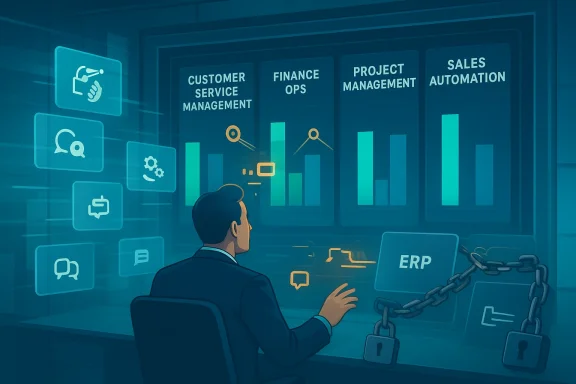
The headline ranking is straightforward. Customer service management tops the list at 26%, followed by finance ops at 21%, project management at 20%, and salesforce automation at 19%. At the other end, general productivity sits at just 2%, with ITSM and procurement at 5% apiece and ERP at 6%. Those gaps matter because they show that CIOs are not treating every software category as equally vulnerable to AI displacement. (saastr.com)
That distribution also maps closely to what broader industry research says about AI adoption pressure. Gartner’s February 2026 customer service survey found 91% of customer service leaders under pressure to implement AI in 2026, and nearly 80% planning to transition at least some frontline agents into new roles. In other words, customer support is not just being “optimized” by AI; it is being structurally rethought.
The deeper significance is that CIOs appear to be making category-level judgments, not feature-level ones. They are deciding which systems will remain the system of record, which will become a thin layer on top of other platforms, and which are interchangeable enough to replace entirely. That is a much more consequential shift than simply adding copilots to existing workflows. (saastr.com)
Project management at 20% is easier to understand. A lot of project tools are essentially coordination systems: who owns what, what is blocked, what changed, and what needs a reminder. AI agents are particularly good at those tasks because they can synthesize status signals, nudge owners, and generate reporting without requiring humans to constantly update cards, tasks, and timelines. (saastr.com)
Cybersecurity at 13% may look lower than expected, but that may reflect trust and risk asymmetry rather than absence of AI opportunity. Buyers may be eager to use AI in security, yet still hesitant to swap out core security platforms until the tools prove they can handle detection, response, governance, and audit requirements at enterprise scale. (saastr.com)
The same logic applies, even more strongly, to ERP. ERP may be a favorite target in theory because it is large and expensive, but in practice it is embedded in the deepest operational processes a company has. Redpoint’s survey makes a subtle but critical distinction here: not every legacy category is equally replaceable, and the ones tied to compliance, financial history, and core system-of-record duties are much harder to uproot. (saastr.com)
The 3% figure matters because it kills a comforting narrative many software companies may still be telling themselves: that buyers will adopt AI as a new layer and keep everything else intact. The survey says the opposite. Most CIOs appear to believe AI will compress the stack, not thicken it. (saastr.com)
The danger for vendors in these categories is that they are often selling a workflow wrapper, not an irreplaceable source of truth. Once the wrapper becomes easy to automate, the product looks less like a platform and more like a temporary interface. That is the sort of repositioning that can compress valuations surprisingly fast. (saastr.com)
The most dangerous position for an incumbent is to have the relationship but not the product economics. If buyers believe the AI layer is overpriced, underdelivered, or too hard to operationalize, then the very consolidation logic that should protect the incumbent can flip and open the door to a challenger. (saastr.com)
This also strengthens the case for category-specific AI rather than broad “AI for everything” pitches. Buyers are more likely to fund a tool that removes a clearly defined pain point than a platform that vaguely promises transformation across the organization. The more specific the replacement case, the easier it is to earn a budget line. (saastr.com)
That makes the enterprise market more predictive of where AI will create durable category winners. The categories that first earn budget by replacing something else will likely define the next generation of enterprise software economics. That is the real significance of the data. (saastr.com)
The categories to watch most closely over the next 12 months are the ones where the line between software and workflow is blurred. Customer service, finance ops, project management, and sales automation all fit that description, and they are where the most credible replacement stories are emerging. The slower-moving categories are not invulnerable; they are simply protected by deeper entrenchment and more complex change management. (saastr.com)
Source: SaaStr What CIOs Are Most Looking to Replace with AI Today
The new enterprise software battle is no longer about whether AI will change the stack. It is about which categories CIOs are now willing to rip out, which ones they will merely augment, and which ones still feel too embedded to touch. A March 2026 Redpoint survey of 141 CIOs suggests the pressure is no longer hypothetical: it is concentrated, measurable, and already reshaping budget decisions. The categories under the heaviest threat are the ones built around coordination, visibility, and repetitive workflows — the exact places where AI agents are increasingly good enough to change buying behavior. (saastr.com)
 Overview
Redpoint’s survey lands at a moment when enterprise software buyers are under unusual pressure from two directions at once. On one side is the mandate to add AI quickly, because boards and executives now expect visible AI progress. On the other is the more mundane but more decisive budget reality: AI spending often comes from existing software spend, not fresh money. That makes every new AI deployment part of a replacement conversation, not just an innovation story. (saastr.com)The headline ranking is straightforward. Customer service management tops the list at 26%, followed by finance ops at 21%, project management at 20%, and salesforce automation at 19%. At the other end, general productivity sits at just 2%, with ITSM and procurement at 5% apiece and ERP at 6%. Those gaps matter because they show that CIOs are not treating every software category as equally vulnerable to AI displacement. (saastr.com)
That distribution also maps closely to what broader industry research says about AI adoption pressure. Gartner’s February 2026 customer service survey found 91% of customer service leaders under pressure to implement AI in 2026, and nearly 80% planning to transition at least some frontline agents into new roles. In other words, customer support is not just being “optimized” by AI; it is being structurally rethought.
The deeper significance is that CIOs appear to be making category-level judgments, not feature-level ones. They are deciding which systems will remain the system of record, which will become a thin layer on top of other platforms, and which are interchangeable enough to replace entirely. That is a much more consequential shift than simply adding copilots to existing workflows. (saastr.com)
The Categories CIOs Say Are Most Exposed
Customer service management is the clearest pressure point in the data. A quarter of CIOs seriously considered replacing their current vendor in that category, and that aligns with the market’s rapid emergence of AI-native support vendors such as Sierra, Decagon, and Intercom’s Fin. The core support use case is especially exposed because AI can take on triage, response drafting, routing, and increasingly end-to-end handling of routine requests. (saastr.com)Why support is moving first
Support workflows are unusually legible to AI because the inputs and outputs are structured enough to automate. Tickets arrive, patterns repeat, answers exist, and performance is measurable in resolution time, deflection rate, and customer satisfaction. That makes the ROI case much easier to explain to finance and operations leaders than in more ambiguous software categories. (saastr.com)- Customer service management: 26%
- Finance ops: 21%
- Project management: 20%
- Salesforce automation: 19%
Project management at 20% is easier to understand. A lot of project tools are essentially coordination systems: who owns what, what is blocked, what changed, and what needs a reminder. AI agents are particularly good at those tasks because they can synthesize status signals, nudge owners, and generate reporting without requiring humans to constantly update cards, tasks, and timelines. (saastr.com)
The sales and workflow layer is also vulnerable
Salesforce automation at 19% is another category where the replacement conversation is becoming real. The issue is not simply that AI can assist reps; it is that many enterprises are now willing to consider self-built or AI-generated alternatives for CRM-like functions if the workflow is narrow enough and the integration cost is manageable. That puts pressure on both incumbents and startups that depend on seat expansion economics. (saastr.com)- HRIS: 17%
- Integration and automation: 17%
- Business intelligence: 14%
- Cybersecurity: 13%
Cybersecurity at 13% may look lower than expected, but that may reflect trust and risk asymmetry rather than absence of AI opportunity. Buyers may be eager to use AI in security, yet still hesitant to swap out core security platforms until the tools prove they can handle detection, response, governance, and audit requirements at enterprise scale. (saastr.com)
Why General Productivity Still Looks Safe
At 2%, general productivity is the most important cautionary data point in the whole ranking. It is the strongest evidence that Microsoft 365 and Google Workspace are not about to be casually displaced by AI-native upstarts, no matter how loud the disruption narrative gets. These suites sit too deep in daily workflows, and the switching costs are not just technical; they are organizational, contractual, and cultural. (saastr.com)The economics of staying put
Even when buyers dislike the status quo, the friction to move productivity systems is enormous. Email, documents, calendars, permissions, mobile management, identity, compliance, and integrations all live in that layer. Once AI features are bundled into the incumbents themselves, the case for changing vendors gets even weaker. (saastr.com)- General productivity: 2%
- Collaboration: 7%
- ERP: 6%
- ITSM: 5%
The same logic applies, even more strongly, to ERP. ERP may be a favorite target in theory because it is large and expensive, but in practice it is embedded in the deepest operational processes a company has. Redpoint’s survey makes a subtle but critical distinction here: not every legacy category is equally replaceable, and the ones tied to compliance, financial history, and core system-of-record duties are much harder to uproot. (saastr.com)
What the low-risk categories have in common
What protects these categories is not lack of AI relevance. It is a combination of high switching costs, broad integration surfaces, and the fact that incumbents already have a defensible AI distribution advantage. The AI debate in these areas is less “replace the suite” and more how much value can the existing vendor add before buyers get restless? (saastr.com)The Bigger Budget Story Behind the Rankings
The category list matters, but the macro numbers tell the real story. Redpoint’s survey says 54% of CIOs are actively pursuing vendor consolidation, 45% of AI budgets are replacing existing software budgets, and only 3% expect AI to lead to more vendors. That is a profound shift in enterprise buying behavior, and it means the market is moving from expansion to subtraction. (saastr.com)Vendor consolidation is the real constraint
Vendor consolidation is important because it changes the default buying posture from “add one more tool” to “which tool gets cut to make room?” That dynamic tends to favor platforms over point solutions, incumbents over specialists, and vendors that can bundle multiple workflows into one purchase. It also means many software companies will not lose because a competitor is better; they will lose because they are redundant. (saastr.com)- 54% of CIOs are actively consolidating vendors.
- 45% of AI budgets are replacing software budgets.
- 3% expect AI to increase the number of vendors.
The 3% figure matters because it kills a comforting narrative many software companies may still be telling themselves: that buyers will adopt AI as a new layer and keep everything else intact. The survey says the opposite. Most CIOs appear to believe AI will compress the stack, not thicken it. (saastr.com)
The market is moving from best-of-breed to enough-breed
That last point deserves emphasis. The best-of-breed era rewarded specialization because enterprises could afford to buy many tools for many workflows. The current environment is more constrained, more cautious, and more consolidation-driven. In that world, software does not need to be best in class; it needs to be sufficiently good, deeply integrated, and hard to justify replacing. (saastr.com)Why Workflow Categories Are Most at Risk
The highest-risk categories in the survey have a shared trait: they are fundamentally coordination problems. Customer service routing, project management, sales workflow updates, integration orchestration, and some forms of finance operations are all about moving information, assigning work, and keeping humans aligned. AI agents are unusually strong at those tasks because they can observe patterns, act on rules, and generate status without constant human intervention. (saastr.com)Coordination is easy to demonstrate, and easy to budget against
The reason this matters is that buyers can quantify the payoff quickly. If an AI tool reduces ticket handling time, automates status reporting, or eliminates manual reconciliation steps, the savings show up in labor, throughput, and cycle time. That makes these categories more exposed than deeper systems whose value is distributed across compliance, finance, or enterprise-wide recordkeeping. (saastr.com)- Fast ROI: measurable productivity gains
- Low switching friction: easier to pilot and replace
- Repeatable patterns: AI handles recurring workflows well
- Clear ownership: one team often controls the spend
The danger for vendors in these categories is that they are often selling a workflow wrapper, not an irreplaceable source of truth. Once the wrapper becomes easy to automate, the product looks less like a platform and more like a temporary interface. That is the sort of repositioning that can compress valuations surprisingly fast. (saastr.com)
Incumbents Still Have an Advantage
One of the most important findings in the survey is that 61% of CIOs prefer investing in AI features from vendors they already use. That is a strong incumbent signal. Buyers still like the idea of getting AI without adding more vendors, more security reviews, or more integration work. (saastr.com)The bundle is still powerful
This is where the market gets tricky. The same CIO who is considering replacement is often also hoping the current vendor can solve the problem first. That creates a window for incumbents to defend themselves by shipping credible AI features fast, packaging them sensibly, and avoiding punitive pricing. If they do that well, the rational consolidation choice is to stay. (saastr.com)- 61% prefer AI from existing vendors.
- Bundled AI reduces procurement friction.
- Existing vendors already have trust and integration.
- Better packaging can delay or prevent churn.
The most dangerous position for an incumbent is to have the relationship but not the product economics. If buyers believe the AI layer is overpriced, underdelivered, or too hard to operationalize, then the very consolidation logic that should protect the incumbent can flip and open the door to a challenger. (saastr.com)
What This Means for AI-Native Startups
For startups, this survey is both encouraging and sobering. Encouraging because the buyer is demonstrably willing to consider change in several categories. Sobering because the customer is also trying to reduce vendor count, which means every startup must now prove it is not just useful but worth adding to a shrinking stack. (saastr.com)Winning is about timing, not just product quality
The companies with the best odds are the ones attacking categories where the pain is immediate, the workflow is obvious, and the AI replacement story is easy to explain. Customer service, finance ops, project management, and sales automation fit that profile better than broad horizontal suites do. But even there, the window is finite; once a buyer commits to a platform strategy, the door can close quickly. (saastr.com)- Best opportunities: support, finance ops, project management, sales automation
- Harder categories: ERP, productivity, collaboration, ITSM
- Winning motion: show immediate value and low-risk deployment
- Risk: being absorbed as a feature, not adopted as a platform
This also strengthens the case for category-specific AI rather than broad “AI for everything” pitches. Buyers are more likely to fund a tool that removes a clearly defined pain point than a platform that vaguely promises transformation across the organization. The more specific the replacement case, the easier it is to earn a budget line. (saastr.com)
Enterprise vs. Consumer Impact
The enterprise impact is immediate and measurable, but the consumer story is different. In consumer software, AI often changes the interface first. In enterprise software, it changes the economics of ownership, because each purchase is judged against labor savings, vendor count, security overhead, and operational complexity. That is why this survey is so relevant to CIOs and so much less directly useful as a general consumer software forecast. (saastr.com)Why enterprises move differently
Enterprises do not just ask whether AI works. They ask whether it can be governed, audited, integrated, and scaled without increasing operational risk. That is why a category like general productivity looks safe: not because AI is irrelevant, but because the enterprise has too much sunk cost and too much policy infrastructure to tear it out lightly. (saastr.com)- Enterprise buyers care about governance and consolidation.
- Consumer users care more about convenience and feature novelty.
- Enterprise displacement is slower, but higher impact.
- Consumer displacement is faster, but often less durable.
That makes the enterprise market more predictive of where AI will create durable category winners. The categories that first earn budget by replacing something else will likely define the next generation of enterprise software economics. That is the real significance of the data. (saastr.com)
Strengths and Opportunities
Redpoint’s survey is valuable because it does not rely on vague sentiment. It asks CIOs where they have seriously considered replacing vendors, which is a far more practical measure of buying intent than generic enthusiasm for AI. The result is a clean look at where AI-native vendors can actually win, and where incumbents still have room to defend. (saastr.com)- Customer support is the clearest near-term disruption market.
- Finance ops now looks more replaceable than many expected.
- Project management is structurally exposed to automation.
- Sales automation is vulnerable to self-built alternatives.
- Vendor consolidation creates a strong opening for platform buyers.
- Incumbents still have a real advantage if they package AI well.
- AI budgets replacing software budgets means buyers are actively reallocating spend.
Risks and Concerns
The biggest risk in reading this data too literally is assuming every category with a low replacement score is safe, or every high score guarantees a wave of churn. In practice, AI adoption depends on governance maturity, integration effort, pricing, and whether the incumbent moves quickly enough to neutralize the threat. The market is fluid, and some of the apparent winners today may be the first casualties of a more mature consolidation cycle. (saastr.com)- Survey intent is not the same as purchase intent.
- High replacement interest can still stall in procurement.
- Incumbents may respond quickly with bundled AI.
- Overhyped AI products can create backlash and skepticism.
- Consolidation may favor larger platforms over better point solutions.
- Budget pressure can delay innovation as often as it accelerates it.
- Regulatory and governance concerns can slow replacement in sensitive categories.
Looking Ahead
The next phase of enterprise AI will likely be defined less by who can demo the flashiest agent and more by who can survive the consolidation wave. CIOs are already signaling that they want fewer vendors, not more, and that means the best-positioned software companies will be the ones that can either become the platform of record or disappear into someone else’s stack. That is a harsher environment than the last decade of SaaS growth, but it is also a clearer one. (saastr.com)The categories to watch most closely over the next 12 months are the ones where the line between software and workflow is blurred. Customer service, finance ops, project management, and sales automation all fit that description, and they are where the most credible replacement stories are emerging. The slower-moving categories are not invulnerable; they are simply protected by deeper entrenchment and more complex change management. (saastr.com)
- Customer service management
- Finance ops
- Project management
- Salesforce automation
- Incumbent AI pricing and bundling
- Enterprise vendor consolidation programs
- Evidence of AI-driven budget substitution
Source: SaaStr What CIOs Are Most Looking to Replace with AI Today