

Microsoft’s security team has disclosed a new side‑channel called Whisper Leak that can reliably infer the topic of a user’s prompts to streaming large‑language models (LLMs) by observing encrypted network metadata — packet sizes and timings — even when TLS is correctly applied. This disclosure is a technical and product wake‑up call: encryption protects content, but not the metadata created by how modern LLMs stream responses, and that metadata can be used by a trained classifier to flag sensitive conversations with startling accuracy.
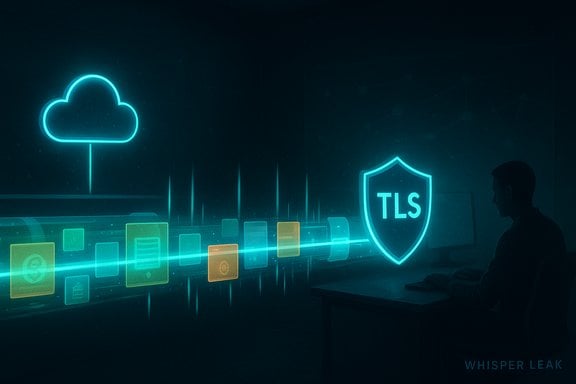
LLMs increasingly operate as remote services that stream responses token‑by‑token or in small chunks to reduce perceived latency. That streaming behavior creates a persistent, structured signal in encrypted traffic: the sequence of TLS record sizes and inter‑arrival times. Whisper Leak exploits that persistent signal by training classifiers on packet‑length and timing sequences to detect whether a given session is about a specific topic (e.g., "money laundering") without ever decrypting the payload. The vulnerability is not a break of TLS — encryption maintains confidentiality — but it demonstrates that metadata is data when adversaries can profile streaming behavior. This is not purely academic. Microsoft coordinated responsible disclosure with multiple vendors and the research team published tooling and data to reproduce experiments, prompting mitigation work across providers. The conversation now shifts from "is the content encrypted?" to "what does the observable metadata reveal?" and how product teams and administrators must adapt threat models and SLAs accordingly.
Source: WebProNews Whisper Leak: Exposing AI Secrets Through Encrypted Shadows
 Background / Overview
LLMs increasingly operate as remote services that stream responses token‑by‑token or in small chunks to reduce perceived latency. That streaming behavior creates a persistent, structured signal in encrypted traffic: the sequence of TLS record sizes and inter‑arrival times. Whisper Leak exploits that persistent signal by training classifiers on packet‑length and timing sequences to detect whether a given session is about a specific topic (e.g., "money laundering") without ever decrypting the payload. The vulnerability is not a break of TLS — encryption maintains confidentiality — but it demonstrates that metadata is data when adversaries can profile streaming behavior. This is not purely academic. Microsoft coordinated responsible disclosure with multiple vendors and the research team published tooling and data to reproduce experiments, prompting mitigation work across providers. The conversation now shifts from "is the content encrypted?" to "what does the observable metadata reveal?" and how product teams and administrators must adapt threat models and SLAs accordingly.Why Whisper Leak matters: metadata as an inference channel
- Streaming patterns are repeatable. Autoregressive generation plus streaming APIs produce predictable chunk sizes and timing characteristics that correlate with semantic content and response complexity. Those correlations can be learned.
- Passive observation is sufficient. An attacker only needs to be in the path of network traffic (ISP, compromised router, shared Wi‑Fi, or a local network tap) to collect the metadata used by classifiers. No TLS keys or active compromise of the LLM service is required.
- Operational impact is immediate. Topic detection is a reconnaissance primitive: it lets an adversary prioritize targets, tailor phishing/social‑engineering, or escalate surveillance of specific users or organizations. The classifier does not reconstruct plaintext but it flags sessions that warrant further monitoring or action.
Technical breakdown: how the attack works
Signal collection
The proof‑of‑concept collects:- Sequences of encrypted TLS record sizes (after overhead).
- Inter‑arrival times between records or packets.
- Session identifiers and directional context (client → server and server → client flows are preserved during capture).
Modeling and classification
The researchers evaluated multiple classifiers and architectures:- Gradient‑boosted trees (LightGBM) for fast, explainable features.
- Recurrent networks (Bi‑LSTM) for sequential modeling of inter‑arrival time and packet sequences.
- Transformer‑style models (DistilBERT adapted for size/time buckets) for richer sequence context.
Scope and limitations
- The attack detects topics, not exact prompt text. Claiming it extracts plaintext would be inaccurate; it flags sessions likely to be about a monitored subject.
- Performance varies by model, provider, and streaming behavior. Some providers that already batch tokens or coalesce responses naturally reduced the signal.
- Controlled lab conditions (balanced data collection, consistent network conditions, repeatable profiling) favor higher detection rates than noisy, heterogeneous real‑world traffic; real‑world performance will depend on attacker resources and environmental variability. The researchers explicitly frame their reported rates as baseline, not immutable field guarantees.
Results and verification: what the numbers say
Microsoft’s disclosure and the accompanying technical report show very strong classifier performance in controlled tests: many model/provider combinations reached AUPRC scores above 98%, and in extreme imbalance simulations (one target conversation mixed into 10,000 benign conversations) classifiers achieved high precision and operationally useful recall for a portion of target conversations. An independent preprint and multiple security outlets corroborate those figures and note that the attack surface spans dozens of popular models and providers. At the same time, vendor summaries and follow‑ups report that mitigations change the arithmetic: token batching and randomized padding significantly reduce classifier performance in many scenarios, while packet injection (sending dummy packets) also helps but increases bandwidth and latency. No mitigation was shown to fully eliminate the signal at the time of disclosure; instead, the results point to a trade‑space between privacy, latency, and operational cost. These trade‑offs are consistently documented across the vendor disclosure and independent reporting. Caveat: some secondary articles and summaries report lower accuracy figures (for example, web summaries citing “around 80%” in some contexts). Those differences reflect varying test setups, evaluation metrics, or choice of models and providers. Where possible, rely on the primary technical report and peer preprints for precise metrics; secondary reporting may simplify or round figures for readership.Comparisons to historical side‑channels
Side‑channel attacks in cryptography historically exploited timing, power consumption, or cache behavior to extract keys. Whisper Leak is analogous in principle but novel in scope: it leverages application‑level streaming semantics unique to LLMs rather than low‑level hardware leaks. The attack joins a growing body of research that shows modern AI serving optimizations (speculative decoding, caching, token batching) have observable manifestations that can leak semantics. Prior token‑length and timing attacks set the stage; Whisper Leak synthesizes these signals into practical topical classifiers.Cloud providers, enterprises, and the threat model
Who can leverage Whisper Leak?
- Nation‑state actors with ISP/transit visibility can perform wide‑area passive surveillance.
- Malicious insiders on corporate networks can profile internal usage.
- Public Wi‑Fi adversaries or compromised network infrastructure can collect local flows.
- Cybercriminals seeking reconnaissance for targeted social engineering.
Industry context: broader risk environment in 2025
Microsoft’s 2025 threat reporting emphasizes AI’s simultaneous role as an accelerator for both offense and defense: adversaries are weaponizing AI to scale reconnaissance and social‑engineering, while defenders are adopting AI for detection and automation. The digital landscape in 2025 saw significant cloud and identity attacks — including a widely reported SharePoint server compromise that initially affected about 100 organizations and later estimates that scaled higher — illustrating the larger set of vectors attackers may chain with metadata reconnaissance. Enterprises must therefore view Whisper Leak as one part of a larger, AI‑augmented threat surface.Mitigation strategies: engineering and operational tradeoffs
No single silver bullet eliminates Whisper Leak without cost. The research and vendor responses converge on a practical set of mitigations:- Token batching (server‑side): group multiple tokens into larger chunks before streaming. This reduces per‑packet granularity and can meaningfully reduce classifier signal while keeping latency acceptable in many workloads.
- Randomized padding: add random or deterministic padding to response chunks so ciphertext sizes no longer map directly to token lengths. Padding reduces leakage but increases bandwidth and slightly increases latency.
- Packet injection / dummy packets: intersperse filler packets to blur timing and size sequences. Effective but multiplies bandwidth (reports indicate up to ~3× bandwidth in some test configurations) and complicates networking and billing.
- Privacy‑first streaming modes: expose an API mode that prioritizes obfuscation over latency; enterprises should be able to opt into higher‑latency, lower‑leakage streams for sensitive workloads.
- On‑premises inference: run LLMs in an internal network or private cloud to eliminate ISP‑level metadata exposure. This shifts cost to compute but removes the transit‑level adversary from the model.
- Use of tunneling and fixed‑record framing: multiplex multiple logical sessions into a single tunnel or use fixed‑record framing to minimize per‑session variability; complex but effective when implemented carefully.
- Inventory which workloads send sensitive prompts to external LLM endpoints.
- Prioritize migration of truly sensitive interactions to on‑prem inference or to providers that enable privacy‑first streaming.
- Engage vendors: ask whether streaming obfuscation is enabled by default and if tenant‑level controls exist.
- Update procurement contracts to require metadata‑leakage mitigations and measurable privacy SLAs.
Performance and UX tradeoffs
All mitigations reduce metadata leakage at the price of latency, bandwidth, or compute complexity. The decision is context dependent:- High‑throughput consumer chat services may accept slight latency to preserve UX.
- Financial, legal, or human‑rights workflows may require the strongest obfuscation, justifying higher latency or on‑prem deployment.
- Regulators and procurement teams must demand transparency: “encrypted” must be qualified by guarantees about metadata protections for high‑sensitivity use cases.
Case studies and hypothetical exploitation scenarios
- A corporate M&A team queries an LLM about due diligence; a passive observer at the ISP level detects topic fingerprints and uses them to prioritize social engineering or market manipulation. The attacker never sees the prompt text but knows a target is researching a merger.
- Human‑rights researchers in an oppressive jurisdiction use cloud LLMs for threat analysis; a state ISP applies Whisper‑style classifiers to identify accounts that are researching protest organizing. This is the precise surveillance use‑case Microsoft warned could endanger dissidents.
Regulation, ethics, and procurement implications
- Regulators: Expect scrutiny on claims of "end‑to‑end privacy" and potential requirements for metadata protections — particularly where AI is used in sensitive domains like healthcare, finance, and public sector procurement. The EU AI Act and similar frameworks already emphasize risk‑based controls and transparency, and procurement policies are likely to demand demonstrable obfuscation for high‑risk workloads.
- Ethics: Users assume encryption hides conversations; Whisper Leak challenges that assumption. Product designers must disclose metadata risks and provide privacy‑first options. Informed consent must cover not just content collection and retention but also the limits of encryption in the face of side channels.
Practical recommendations for WindowsForum readers and IT teams
- Treat LLM metadata leakage as a top‑ten operational risk for any workload that handles confidential data through cloud endpoints.
- For high‑sensitivity tasks, prefer on‑prem inference or enterprise contracts that guarantee privacy modes and explicit metadata obfuscation.
- Ask your cloud/LLM vendors these specific questions:
- Do you offer a privacy streaming mode that batches tokens and adds randomized padding?
- Are those mitigations on by default or tenant‑configurable?
- What is the measurable reduction in classifier performance from the mitigations you deploy?
- Are mitigations available for all models and endpoints (including older model variants)?
- Update incident response and procurement language to require telemetry that demonstrates mitigations, not just assertions of "TLS encryption."
Where the research is headed and unresolved questions
- Can classifiers be hardened against obfuscation by using more training data, cross‑session correlation, or multi‑feature fusion? Early work suggests they can improve with scale; mitigations raise the bar but do not close the problem absolutely.
- Are there transport or protocol changes (framing, fixed‑size records, multiplexed tunnels) that can provide scalable, low‑latency defenses? Research prototypes show promise but operationalizing them at cloud scale is nontrivial.
- Regulatory and procurement levers may be necessary to accelerate adoption of privacy‑first defaults; voluntary measures tend to lag attacker innovation.
Conclusion
Whisper Leak reframes a deceptively simple lesson for AI product design and enterprise security: encryption is necessary but not sufficient. Streaming LLMs create observable metadata that, when profiled and modeled, can reveal sensitive topics even without decrypting content. The research demonstrates high detection capability in controlled tests, vendors have rolled out mitigations, and the debate now centers on a trade‑space of privacy versus latency and cost. For enterprises and product teams, immediate actions include auditing where sensitive prompts traverse external networks, demanding privacy‑first streaming options from vendors, and considering on‑prem inference for high‑risk tasks. The defense is a mix of engineering (batching, padding, tunneling), policy (procurement and SLAs), and operational prudence — and it must accelerate to match the speed at which metadata inference becomes a cheap reconnaissance tool for adversaries.Source: WebProNews Whisper Leak: Exposing AI Secrets Through Encrypted Shadows
