

Microsoft has issued a security advisory for a serious Win32k kernel vulnerability — an ICOMP type‑confusion bug that can be triggered by an authorized local user to escalate to SYSTEM — and organizations should treat this as a high‑priority elevation‑of‑privilege (EoP) risk until every affected host in their estate is patched.
The vulnerability is described as “Access of resource using incompatible type (‘type confusion’) in Windows Win32K – ICOMP,” and is categorized as a local elevation‑of‑privilege issue in the Win32k kernel component. Public vulnerability trackers and vendor advisories list the flaw as high severity (commonly cited CVSS v3 ≈ 7.8) and map it to recent Windows 11 and Windows Server servicing branches. A caution about identifiers: the CVE string you provided (CVE‑2026‑20811) does not resolve cleanly in public feeds at the time of writing; major vulnerability catalogs and the Microsoft Security Update Guide reference this class of Win32k ICOMP type‑confusion under CVE‑2025‑50168. The MSRC advisory pages are the canonical source for KB→SKU mappings but often render through JavaScript; if you open the MSRC entry in an automated fetch you may see a JavaScript placeholder instead of the rendered table. Always confirm the exact KB numbers for your OS build from the MSRC Update Guide or Microsoft Update Catalog in an interactive browser session.
1. Identify and inventory exposed hosts
High‑value telemetry signals to monitor:
Source: MSRC Security Update Guide - Microsoft Security Response Center
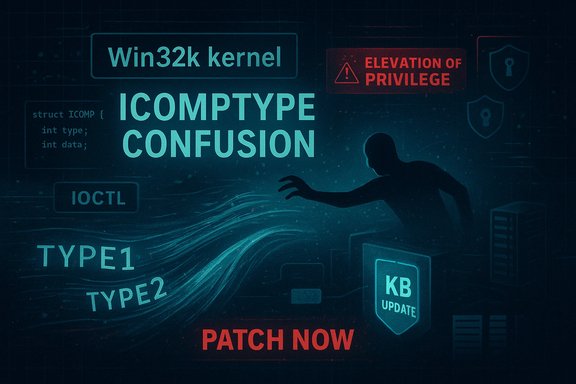 Background / Overview
The vulnerability is described as “Access of resource using incompatible type (‘type confusion’) in Windows Win32K – ICOMP,” and is categorized as a local elevation‑of‑privilege issue in the Win32k kernel component. Public vulnerability trackers and vendor advisories list the flaw as high severity (commonly cited CVSS v3 ≈ 7.8) and map it to recent Windows 11 and Windows Server servicing branches. A caution about identifiers: the CVE string you provided (CVE‑2026‑20811) does not resolve cleanly in public feeds at the time of writing; major vulnerability catalogs and the Microsoft Security Update Guide reference this class of Win32k ICOMP type‑confusion under CVE‑2025‑50168. The MSRC advisory pages are the canonical source for KB→SKU mappings but often render through JavaScript; if you open the MSRC entry in an automated fetch you may see a JavaScript placeholder instead of the rendered table. Always confirm the exact KB numbers for your OS build from the MSRC Update Guide or Microsoft Update Catalog in an interactive browser session. What the flaw is (technical summary)
How type‑confusion in Win32k works
- Type confusion arises when kernel code interprets data using the wrong type assumptions, allowing crafted input to be dereferenced or manipulated in ways the original programmer did not intend. In kernel subsystems this can corrupt kernel memory structures and become a powerful primitive for privilege escalation.
- In this case the vulnerable code path lives in Win32k, specifically the ICOMP surface. Win32k handlers operate in kernel mode and service many user‑facing graphics and windowing operations; that privilege level is why Win32k bugs frequently yield SYSTEM‑level consequences. Public summaries classify the weakness as type confusion and tie it to heap/memory corruption classes (CWE‑843 / CWE‑122).
Practical exploit primitives
- A local attacker who can run code on the machine — even with low privileges — can craft input to the Win32k/ICOMP code path. With a reliable primitive, attackers commonly convert type confusion into address leaks, arbitrary reads/writes, and ultimately token manipulation or a SYSTEM process spawn. Modern mitigations (ASLR, CFG, KCFG, Kernel Control Flow Integrity) complicate exploitation but do not eliminate the risk for skilled exploit authors.
- Public writeups to date have withheld low‑level exploit details; while that reduces short‑term weaponization, defenders must assume the vulnerability is actionable in post‑compromise scenarios.
Affected platforms and builds (what to check)
Public aggregators list the flaw as affecting recent Windows client and server servicing branches — notably Windows 11 servicing branches and recent Windows Server SKUs. Example mappings reported by community trackers include affected build thresholds (hosts with versions before the illustrating build numbers are vulnerable). Administrators must confirm the exact KB(s) that Microsoft published for each SKU and build. Key independent references that list affected products include the NVD, Rapid7 and CVE trackers. Typical affected items reported by community trackers include:- Windows 11 22H2 — builds prior to specified patch build (example: < 10.0.22621.5768 in one public mirror).
- Windows 11 23H2 / 24H2 — similar servicing‑branch thresholds are listed in aggregator pages; confirm per‑build mapping.
- Windows Server 2022 (23H2) and Windows Server 2025 servicing branches.
Current exploitation status and risk assessment
- Severity: High (public trackers generally report CVSS v3 ≈ 7.8 for this Win32k type‑confusion).
- Exploitation observed: at the time vendor advisories and major aggregators published the patch, there was no authoritative public PoC widely available; some vendor intelligence notes the bug surfaced at public security contests, which increases the chances of rapid proof‑of‑concept development. Treat lack of public PoC as temporary uncertainty, not as safety.
- EPSS/Automation: public scoring services show low EPSS/low automatable exploitation probability initially, but weaponization risk is high in targeted post‑compromise scenarios because Win32k primitives are extremely valuable to attackers.
- Discovery context: one tracker indicates the issue was reported during a competitive vulnerability research event (Pwn2Own), which is historically correlated with high research interest and subsequent public PoCs. That raises the urgency for patching, particularly on admin workstations and shared hosts.
What Microsoft recommends (and why the KB→SKU mapping matters)
Microsoft’s Security Update Guide is the authoritative mapping from CVE to the KB package(s) that fix the issue for each Windows SKU. Because updates for kernel components are delivered as cumulative packages and are SKU/build specific, you must confirm the exact KB for each OS image in your estate; an incorrect KB can leave a host apparently patched but still vulnerable. The MSRC entry will show the KB(s) per build — access it in a browser and extract the KB identifier to apply via WSUS, SCCM/Intune or the Update Catalog.Immediate mitigation and deployment playbook (0–72 hours)
Apply the Microsoft update for your exact OS build as top priority. If you cannot apply the patch immediately, implement compensating controls and enhance detection. Below is an operational checklist that security operations and patch teams can use.1. Identify and inventory exposed hosts
- Query your CMDB and inventory tooling for Windows build numbers and map each host to the KB(s) listed in Microsoft’s Update Guide. Do not rely solely on CVE strings in third‑party feeds.
- Deploy the update to a representative pilot ring that includes admin workstations, jump boxes, RDP/VDI hosts and servers that process untrusted content. Validate application compatibility and driver interactions (graphics/kernel updates can sometimes cause display or driver regressions).
- Patch high‑value and high‑exposure hosts first: domain controllers, privileged admin workstations, public upload processors, mail preview servers, RDP/VDI pools, CI/build servers. Expand to the rest of the estate after pilot validation.
- Enforce application allow‑listing (WDAC/AppLocker) on sensitive hosts.
- Remove unnecessary local administrator privileges and implement Just‑In‑Time / Just‑Enough‑Admin controls.
- Disable or restrict automatic thumbnailing and document preview services on high‑exposure servers; quarantine incoming documents pending analysis or patching.
- Kernel patches typically require a reboot. After installing the KB(s), verify build numbers with winver, systeminfo, or Get‑HotFix and confirm the presence of the KB in the update history.
- Ensure endpoint protection and IDS/IPS vendors have applied any rule updates for this vulnerability; apply IPS signatures and EDR rules as directed by your vendors while you patch.
Detection, hunting and indicators
Because public exploit details are often intentionally omitted, defenders should hunt for behavioral indicators and artifacts consistent with local EoP attempts.High‑value telemetry signals to monitor:
- Unexpected elevation of user processes to SYSTEM context (new SYSTEM child processes spawned by user sessions).
- Token manipulation API calls (DuplicateTokenEx, OpenProcessToken, CreateProcessAsUser) originating from userland processes shortly before or after Win32k crashes.
- Kernel crashes (bugchecks) or repeated Win32k‑related minidumps/WER events correlated to user sessions that rendered graphics or previews.
- Unusual DeviceIoControl/IOCTL activity toward graphics or windowing device objects, and anomalous loads of win32k.sys or related modules.
- SIEM rule: Alert if a non‑privileged explorer/office process spawns cmd.exe/powershell.exe with SYSTEM context within 60 seconds of a Win32k crash event.
- EDR rule: Flag token duplication calls when parent process is a user application that normally does not perform impersonation (e.g., Office, Explorer).
- Collect full memory images and WER mini‑dumps before rebooting. Preserve Windows Event logs, driver lists, and recent process trees; these artifacts are critical for reconstructing kernel exploitation and for vendor triage.
Operational risks and likely attack scenarios
- The most likely practical attack model is a post‑compromise escalation where an attacker already has code execution in a low‑privileged context (phishing, malicious installer, compromised tenant app) and uses the Win32k primitive to escalate to SYSTEM. Once SYSTEM is achieved, the attacker can deploy persistent agents, steal credentials, or pivot laterally.
- Server‑side parsing scenarios increase blast radius. Services that automatically parse or thumbnail user‑supplied documents (webmail, document management systems, image‑processing endpoints) can be exploited without human interaction if the vulnerable code path is reachable on the server. This turns a local EoP into a remotely exploitable vector in practice. Harden such services immediately.
- False reassurance risk: relying on third‑party CVE lists or partial KB mappings can leave gaps. The single most common operational error is deploying the wrong KB for an OS build. Always confirm KB→SKU mapping in the MSRC Update Guide or Update Catalog.
Strengths of Microsoft’s response — and cautions
What Microsoft and vendor ecosystems did well:- Microsoft recorded the CVE in the Security Update Guide and shipped fixes in cumulative updates; the Update Guide remains the authoritative KB mapping for automated patch pipelines.
- Security vendors and vulnerability aggregators rapidly mirrored the advisory and produced operational guidance, enabling defenders to act quickly.
- Patch identification errors. Automated patching systems that infer packages from CVE strings (rather than MSRC KB mappings) can install incorrect updates. Verify KB package names per build.
- Rapid PoC risk. When vulnerability details come from competitive research events, public PoCs often follow quickly; unpatched high‑value hosts can become immediate targets.
- Server-side implications. Although the advisory is a local EoP, server components that perform automatic parsing can turn it into a remotely exploitable scenario. Hardening or temporary disabling of preview/thumbnailing is prudent until patching completes.
Recommended timeline and priorities
- Within 24 hours: Inventory hosts that match the affected OS builds and identify the exact KB(s) from MSRC. Start pilot tests for the KB(s).
- Within 72 hours: Deploy patches to high‑value and high‑exposure hosts (domain controllers, admin workstations, RDP/VDI hosts, document‑processing servers). Apply compensating controls to the most exposed systems.
- Within 7–14 days: Complete enterprise wide rollout, verify reboots and KB presence, and run a post‑deployment telemetry sweep looking for exploitation indicators.
If you manage a heterogeneous environment (tips)
- Browsers, Office viewers, or third‑party image libraries that call into Win32k rendering paths may require parallel patching or mitigations. Ensure you coordinate cross‑product updates for components that perform previews or call into Win32k.
- For large fleets where reboots are disruptive, evaluate hotpatching KBs (where Microsoft provides them) or prioritize rolling reboots in maintenance windows for the most critical servers first. Confirm vendor guidance for hotpatch availability.
Final analysis and takeaway
This Win32k ICOMP type‑confusion vulnerability is a classic high‑impact kernel EoP: the bug class is well understood, the privileges gained are severe, and the attack patterns are familiar to attackers and researchers alike. Even in the absence of an immediate public proof‑of‑concept, the combination of a high CVSS rating, disclosure context (research contest reporting), and the ubiquity of Win32k surfaces means defenders must act quickly.- Patch the exact KB(s) Microsoft publishes for each Windows build — do not rely on CVE strings alone.
- Prioritize domain controllers, admin workstations, RDP/VDI hosts, and any server that automatically parses untrusted content.
- Apply stop‑gap hardening (WDAC/AppLocker, remove local admin rights, disable automatic previews) and tune EDR/SIEM hunts for token duplication and unexpected SYSTEM spawns.
Source: MSRC Security Update Guide - Microsoft Security Response Center
